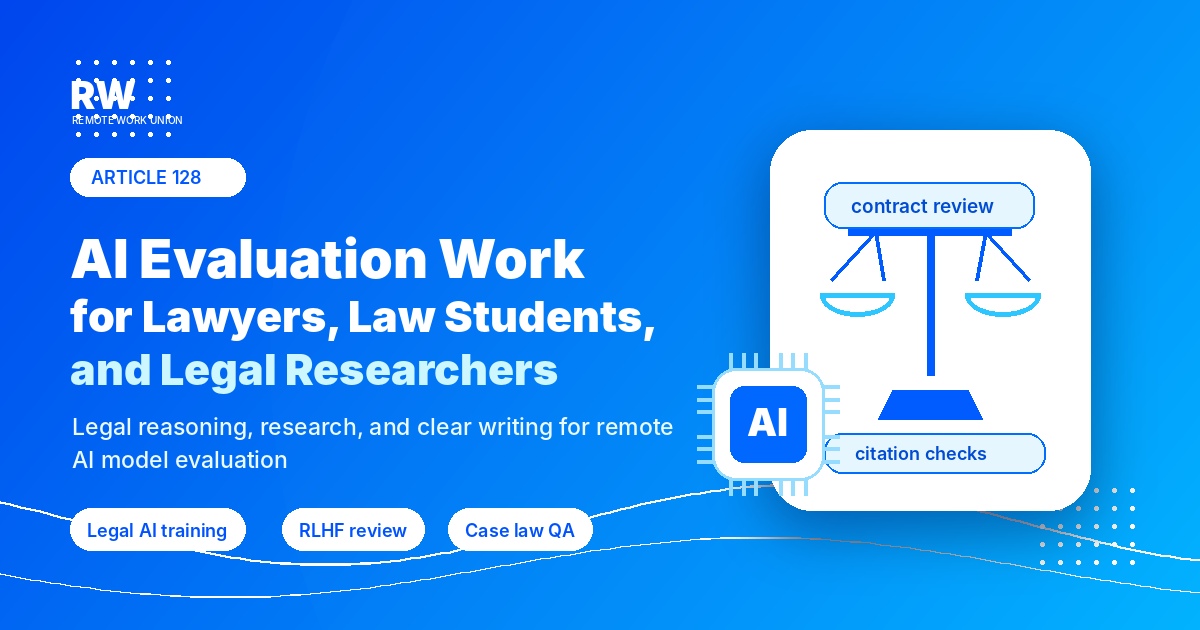
AI evaluation work is one of the more natural remote-work fits for people with legal training because the job often rewards close reading, issue spotting, source awareness, structured reasoning, and the ability to explain why one answer is better than another. Lawyers, law students, legal researchers, paralegals, compliance professionals, and policy specialists may find opportunities in legal AI training, model evaluation, legal data annotation, prompt review, RLHF rating, fact-checking, and answer-quality review.
The work is not the same as practicing law for a client. It is usually about helping AI systems become more accurate, careful, safe, and useful when they respond to legal or law-adjacent prompts.
Why Legal Professionals Are Useful in AI Evaluation
Large AI systems are now asked to answer questions about contracts, employment issues, business formation, intellectual property, privacy, consumer disputes, compliance, litigation concepts, legal research, and everyday legal terminology. Even when a model should not give direct legal advice, it still needs to understand what makes an answer responsible.
A generic reviewer may notice grammar problems. A legally trained reviewer can notice that the answer ignores jurisdiction, overstates certainty, misses an exception, confuses a statute with a regulation, gives procedural advice without context, or fails to tell the user when to consult a licensed attorney. That type of judgment is why legal backgrounds can matter in AI model evaluation work.
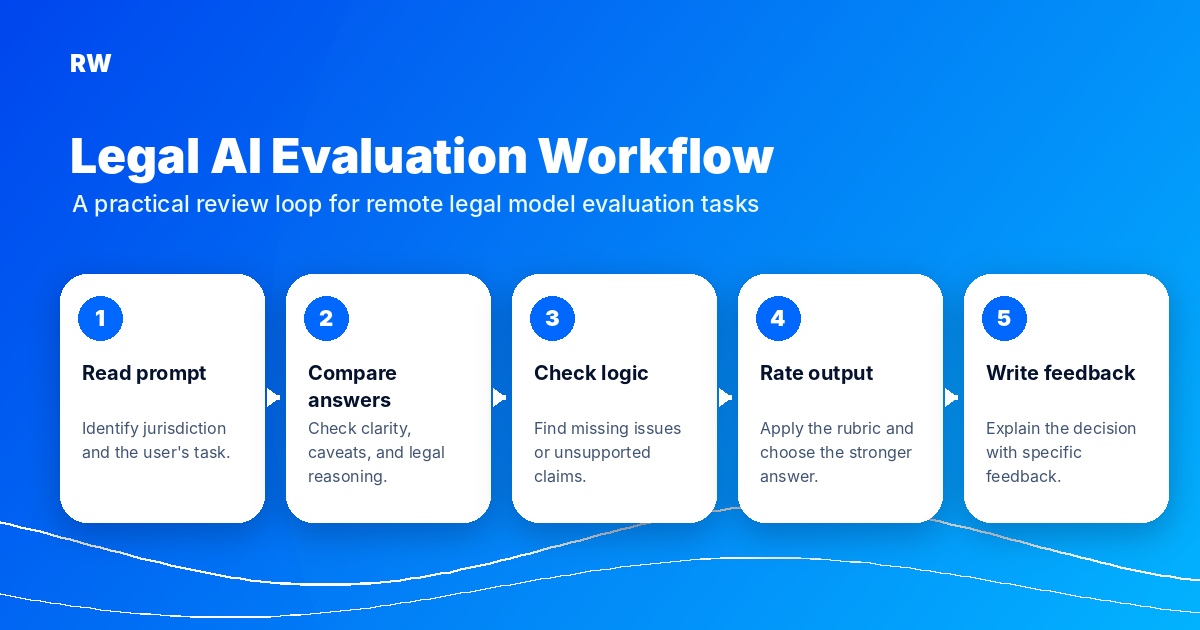
What AI Evaluation Work Means in a Legal Context
AI evaluation work usually means reviewing model outputs and judging quality against a rubric. In a legal project, the prompt may ask the AI to explain a clause, summarize a legal concept, compare two possible answers, draft a neutral informational response, identify risk in a contract passage, or determine whether a response is too confident.
The evaluator may be asked to rank two answers, write feedback, label factual problems, identify hallucinations, check whether the model followed instructions, or rewrite a weak answer into something safer and clearer. The goal is not to replace a lawyer. The goal is to improve how AI systems handle legal information, legal reasoning, and law-adjacent user questions.
Who Should Consider This Type of Remote AI Work
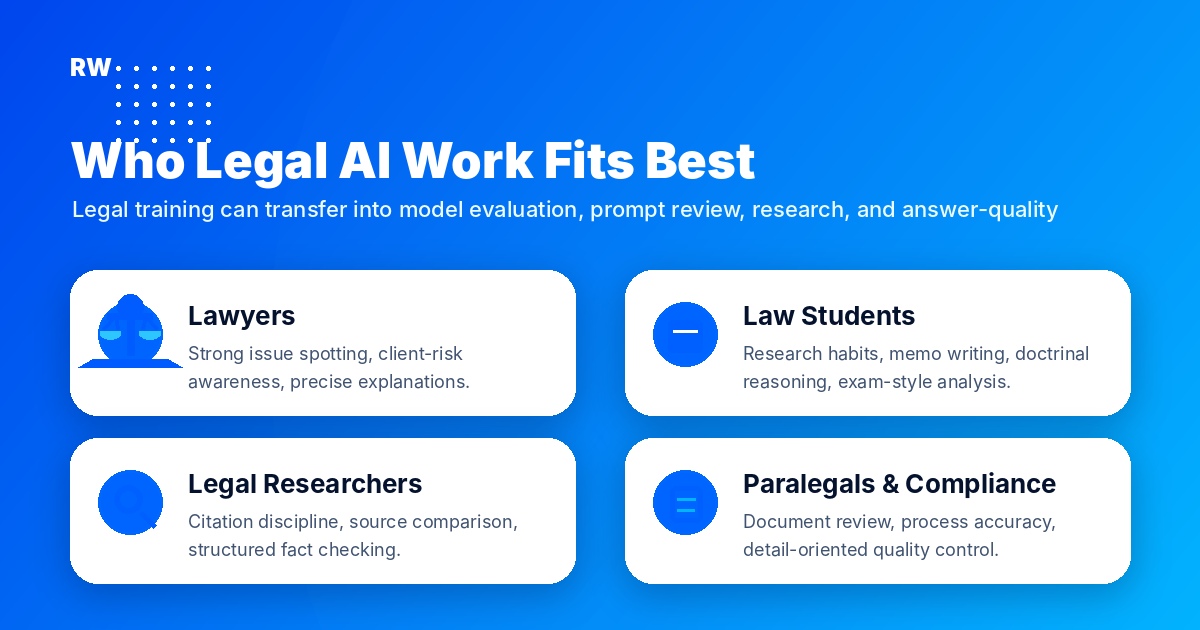
This category can fit several kinds of applicants. Practicing lawyers may be strong candidates for expert evaluation projects, especially if they can explain legal reasoning in plain English. Law students may be useful for research-heavy review, issue spotting, briefing-style analysis, and structured writing. Legal researchers can bring citation discipline and strong source-checking habits. Paralegals and legal operations professionals may fit document review, intake-style classification, compliance labeling, and task-quality work. Policy professionals, contract managers, privacy analysts, and regulatory specialists may also be relevant when a project needs domain knowledge but not necessarily a licensed attorney.
Common Tasks in Legal AI Training Jobs
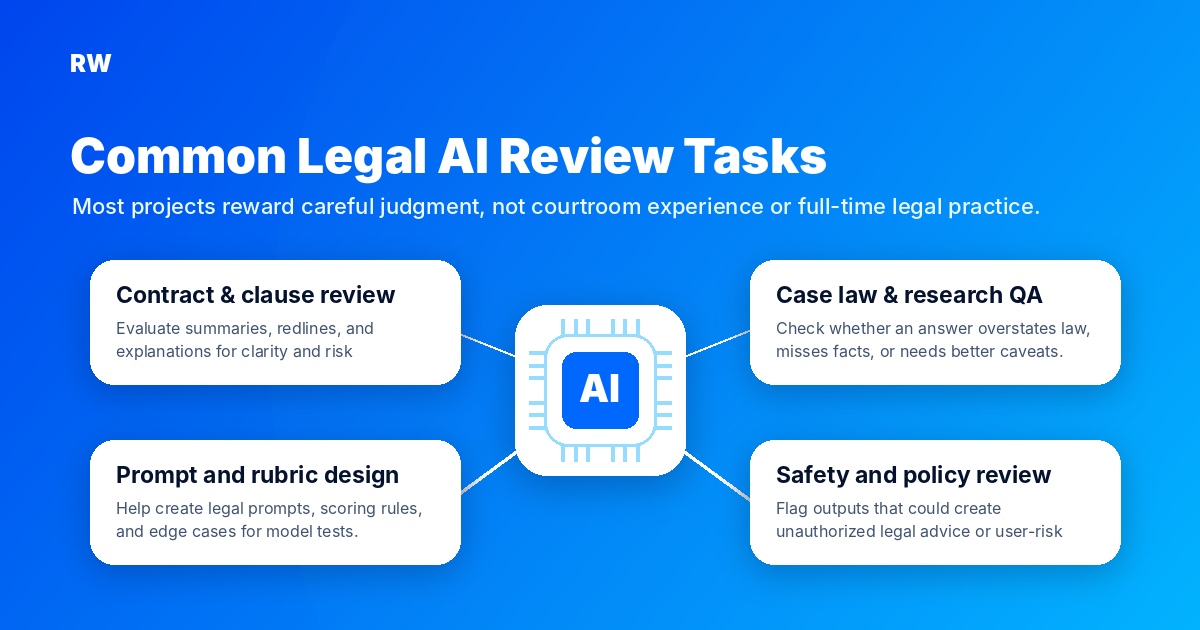
Legal AI evaluation work can appear under many titles: AI evaluator, legal AI trainer, legal model evaluator, AI data annotator, legal data annotation, subject matter expert, legal fact-checker, legal prompt reviewer, RLHF evaluator, LLM evaluator, contract review evaluator, policy evaluator, or AI safety reviewer.
The day-to-day work may include comparing two chatbot answers, checking whether a response contains unsupported legal claims, labeling the type of legal issue in a prompt, creating examples of good legal explanations, reviewing contract summaries, testing a model on edge cases, or writing concise comments about why an answer is incomplete.
Remote Work Union connects you to legitimate remote AI training and evaluation roles. Apply for free and find roles hiring now.
Find Roles Hiring Now →Legal Reasoning Skills That Transfer Especially Well
Close reading helps reviewers catch subtle instruction-following errors. Issue spotting helps them identify what the prompt is really asking. Legal research habits help them notice unsupported or suspicious claims. Writing experience helps them explain decisions in a way a project reviewer can understand. Risk awareness helps them avoid overconfident answers.
How Lawyers Can Position Themselves
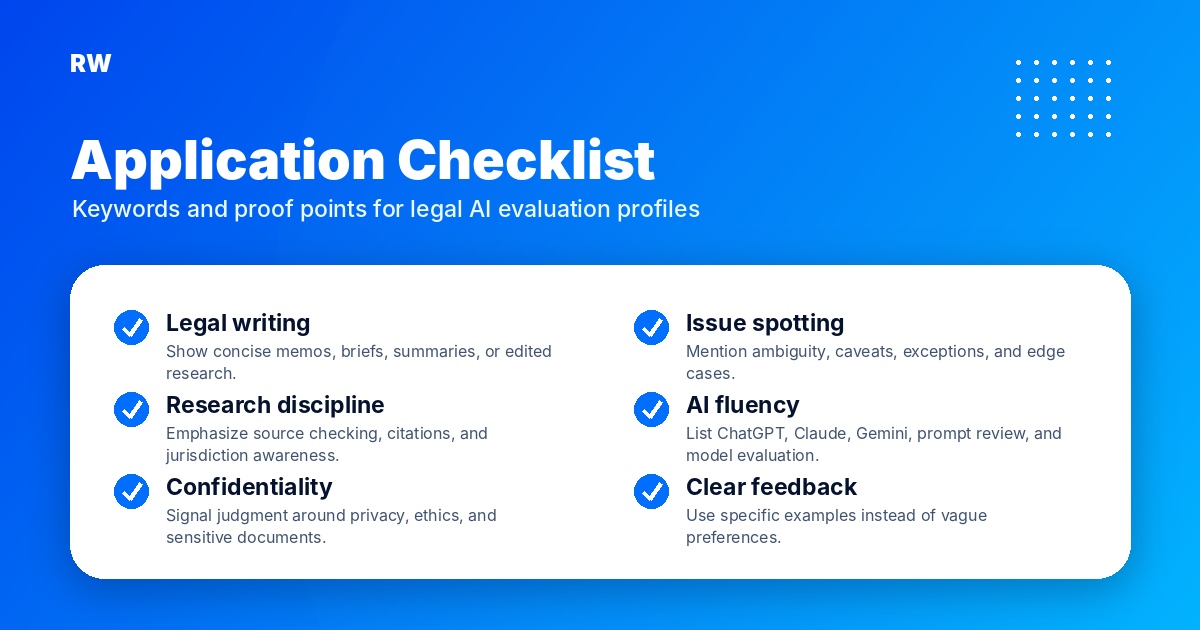
Lawyers should not position themselves only as people who know the law. They should position themselves as people who can evaluate reasoning quality. A strong profile might mention legal analysis, client-risk awareness, contract interpretation, litigation support, privacy, regulatory compliance, legal writing, or advisory experience. It should also mention AI-adjacent terms when accurate: AI model evaluation, LLM evaluation, prompt review, legal research, fact-checking, response ranking, rubric-based review, and clear feedback writing.
How Law Students Can Position Themselves
Law students do not need to pretend they are practicing attorneys. They can lean into the skills that law school builds: reading dense material, briefing cases, spotting issues, writing memos, organizing arguments, comparing authorities, and explaining uncertainty. A law student profile can mention coursework, journal work, moot court, clinic experience, research assistant work, internships, and writing samples.
How Legal Researchers and Paralegals Can Position Themselves
Legal researchers, paralegals, and compliance professionals may have a practical advantage in detail-heavy review work. Many AI evaluation tasks are closer to structured quality control than open-ended legal strategy. Experience with document review, discovery support, contract management, entity research, regulatory tracking, intake notes, citation checking, or compliance procedures can be relevant.
Where to Search for Legal AI Evaluation Opportunities
Useful search terms include legal AI evaluator, legal AI trainer, AI training jobs for lawyers, legal data annotation, legal LLM evaluator, AI model evaluation legal, RLHF legal expert, law student AI jobs, legal research AI jobs, remote AI evaluator, and contract AI reviewer. Major AI companies such as OpenAI, Anthropic, Google, Meta, and Microsoft are useful keywords for understanding the market, but applicants should be careful not to assume every third-party role is directly run by one of those companies.
Ethics and Confidentiality Considerations
Important: Legal professionals should be careful with confidentiality, conflicts, licensing, and unauthorized-practice concerns. Do not upload confidential client materials into outside systems unless you have explicit permission. Do not present yourself as giving legal advice to users if the project is only asking for model evaluation. Do not make claims about being a licensed attorney unless they are true and relevant.
Frequently Asked Questions
Can lawyers get paid for remote AI evaluation work?
Yes. Legal professionals are useful in AI model evaluation because they can identify unsupported legal conclusions, spot jurisdiction issues, notice when an answer misses an important exception, and explain why one response is safer and more useful than another. Many AI training platforms actively recruit lawyers, law students, and legal researchers.
What does legal AI evaluation work actually involve?
Legal AI evaluation work usually involves reviewing model outputs and judging quality against a rubric. Tasks may include ranking two legal AI answers, writing feedback explaining which is stronger, labeling factual problems, checking whether a response ignores jurisdiction, or rewriting a weak answer into something safer and clearer.
Do law students qualify for legal AI training jobs?
Yes. Law students can lean into the skills that law school builds: reading dense material, briefing cases, spotting issues, writing memos, organizing arguments, comparing authorities, and explaining uncertainty. These skills are directly valuable for many legal AI evaluation projects.
What ethical considerations should lawyers keep in mind for AI work?
Legal professionals should be careful with confidentiality, conflicts, licensing, and unauthorized-practice concerns. Do not upload confidential client materials into outside systems without explicit permission. Do not present yourself as giving legal advice to users if the project is only asking for model evaluation. Follow each platform's data rules carefully.