Most people searching for work from home jobs get pushed into the same narrow choices: customer support, sales, data entry, surveys, virtual assistant work, or learning to code from scratch. Those jobs can be real, but they are not the only path. A growing category of remote work rewards clear thinking, strong writing, research ability, judgment, taste, domain knowledge, and the ability to evaluate information carefully.
That matters because many smart people do not want to become software engineers. They may be writers, teachers, marketers, finance professionals, legal assistants, healthcare workers, researchers, students, analysts, creators, operators, or simply sharp generalists. They can read complex instructions, compare two answers, explain which one is better, catch bad reasoning, organize information, and communicate clearly. Those skills are valuable in the remote economy, especially as AI companies, startups, marketplaces, and online teams need humans who can review, improve, and organize digital work.
The best no-code remote jobs are not "easy money." They are better described as judgment jobs. You do not need to write Python, build apps, or understand machine learning architecture. You do need to be accurate, consistent, detail-oriented, and able to explain your thinking.
What makes a no-code remote job worth pursuing?
A good no-code work from home job usually has four traits.
First, it rewards judgment instead of repetitive clicking. If the job only asks you to copy text, fill forms, tag images, or complete tiny tasks at high speed, it usually becomes a race to the bottom. If the job asks you to evaluate quality, make decisions, review answers, summarize research, or apply professional knowledge, your brain becomes the asset.
Second, it can be done asynchronously. The strongest remote jobs from home do not require you to sit on the phone for eight hours. They allow you to complete tasks, submit projects, write reviews, analyze content, or manage workflows on a flexible schedule.
Third, it uses skills you already have. If you have experience in writing, law, medicine, finance, education, marketing, science, software products, customer behavior, operations, or research, you may be closer to a strong remote job than you think.
Fourth, it has a path to better work. A low-level online job that never improves is not a career path. A good remote job helps you build proof: stronger samples, better ratings, domain specialization, client relationships, or access to higher-paying tasks.
1. Remote AI training and AI evaluation jobs
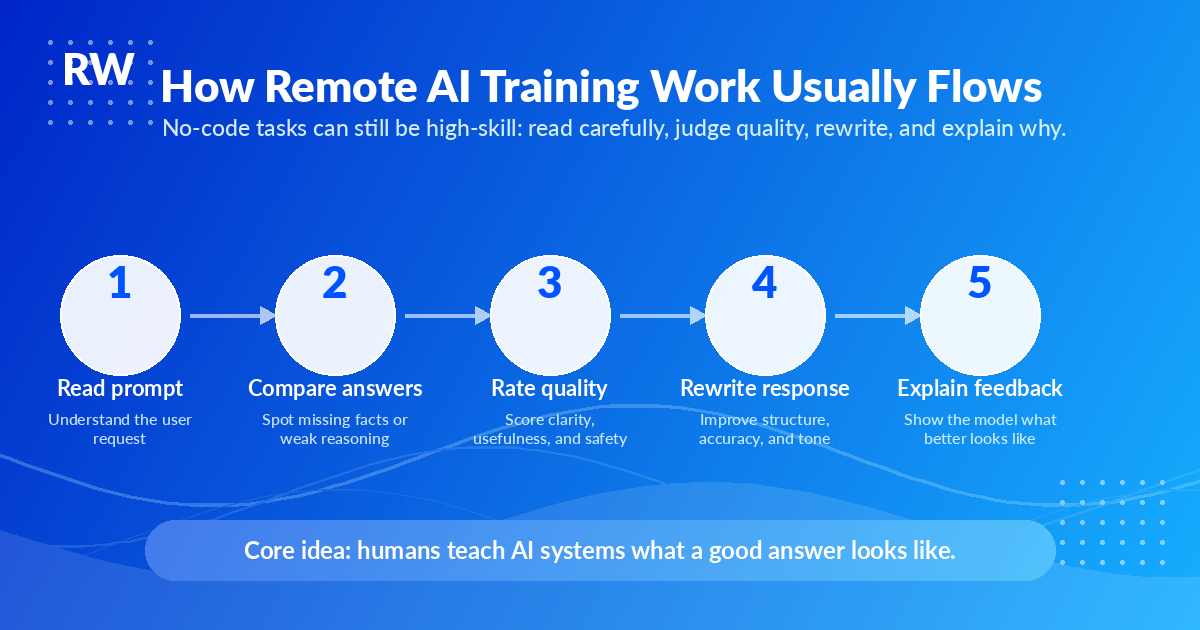
AI training is one of the strongest work from home job categories for smart people with no coding experience. The basic idea is simple: AI systems need human feedback. A model can generate an answer, but humans still help judge whether that answer is useful, accurate, safe, clear, well-structured, and aligned with the user's request.
Remote AI training jobs can include tasks like comparing two AI answers, rating a response, rewriting a weak answer, identifying factual mistakes, improving prompts, labeling examples, or explaining why one answer is better than another. Some projects are general. Others require specialized knowledge in writing, coding, law, finance, medicine, math, science, education, or business.
You do not need to be an engineer to do many of these jobs. You need to understand instructions, read carefully, and apply consistent judgment. If you can look at an AI answer and say, "This is confident but unsupported," "This missed the user's real question," or "This should be structured more clearly," you already understand the core skill.
These roles are especially relevant because people search for ways to get paid to improve ChatGPT, Claude, Gemini, Grok, Llama, and other AI systems. The exact companies and platforms can change, but the underlying need is durable: AI products improve when humans provide better feedback.
2. Research review and fact-checking jobs
Research review is another strong no-code remote work category. These jobs reward people who can find reliable information, compare sources, summarize findings, verify claims, and separate useful evidence from weak evidence.
This work can show up under many job titles: research analyst, fact-checker, research assistant, content researcher, AI research reviewer, source evaluator, internet researcher, editorial researcher, or knowledge operations specialist. The work may involve checking whether an answer cites the right source, finding missing context, verifying company information, summarizing market trends, or reviewing whether a claim is supported.
This is a good fit for smart people because the work is not just searching Google. Anyone can search. Fewer people can decide which source matters, which claim is overstated, which data point is outdated, and which summary is actually useful.
No-code research jobs are especially valuable for remote teams because good research saves time. A founder, editor, recruiter, marketer, analyst, or AI team can move faster when someone else turns messy information into a clean decision-ready brief.
3. Writing, editing, and content quality jobs
Writing is still one of the most useful no-code skills in the remote economy. The difference is that the market has shifted. Basic content mills are harder to rely on, but strong writing judgment is more valuable than ever.
Remote writing and editing jobs now include AI answer editing, content quality review, SEO content improvement, knowledge base writing, newsletter production, product documentation, social media repurposing, scriptwriting, article outlining, ghostwriting, and editorial operations. Many companies do not need someone to write a novel. They need someone who can make messy information clear.
AI tools have changed this category, but they have not eliminated it. In fact, AI has created more demand for people who can edit, evaluate, and improve AI-generated content. A generic AI draft is easy to produce. A useful, accurate, on-brand, readable, well-structured piece still needs human taste.
For smart non-coders, this is a strong lane because writing reveals thinking. If you can take a confusing topic and make it simple, you can work in content, marketing, AI training, research, education, documentation, or communications.
4. Expert review jobs in finance, law, medicine, science, and business
One of the best paths for smart people with no coding experience is expert review. This is where your real-world background becomes the product.
AI companies, research platforms, consulting marketplaces, education companies, and content teams often need people who can review specialized information. A finance professional might evaluate investment explanations. A legal professional might review contract-related reasoning. A nurse or medical professional might judge whether health information is clear and responsibly framed. A scientist might check whether an answer misunderstands a concept. A marketer might review ad strategy or brand positioning.
The key is that expert review does not always require you to create something from scratch. Sometimes the job is to review, compare, verify, annotate, or explain. That makes it a strong remote category for people who have professional knowledge but do not want to code.
This is also where pay can improve. General tasks attract general competition. Specialized review work attracts fewer qualified applicants. If you can prove credible domain knowledge, you are not just another remote applicant. You are a subject matter expert.
5. Search quality and internet evaluation jobs
Search quality work is an older remote job category, but it still matters. The goal is to judge whether search results, recommendations, ads, maps, snippets, or AI-generated answers are relevant and useful.
These jobs can be listed as search evaluator, internet rater, ads quality rater, search quality analyst, content relevance evaluator, or online data analyst. The work is usually no-code, but it requires consistent attention. You may be asked whether a result satisfies a user's query, whether an answer is misleading, whether a page is trustworthy, or whether a recommendation matches the intent.
This can be a useful entry point into remote work because it teaches the habits that higher-value AI evaluation work also uses: following guidelines, judging relevance, explaining decisions, and staying consistent across many tasks.
The downside is that some search evaluation roles can be repetitive or lower-paying than specialized AI or expert review jobs. Treat them as a lane to explore, not the only destination.
6. No-code operations and automation jobs
No-code operations jobs are for people who like systems, organization, and tools. You may not code, but you can build workflows using platforms, templates, automations, spreadsheets, AI tools, forms, databases, and project management systems.
A no-code operations role might involve setting up Airtable, Notion, Zapier, Make, HubSpot, Google Sheets, Slack workflows, CRM processes, AI prompt libraries, SOPs, content calendars, or recruiting pipelines. The job is not programming. It is understanding a process and making it cleaner.
This is one of the most underrated no-code remote job categories because every growing business has operational mess. Leads are scattered. Content ideas are disorganized. Customer notes are not tagged. Applicants are not tracked. Files are not named properly. AI prompts are inconsistent. Someone who can bring order to chaos is valuable.
7. Product testing and QA jobs without coding
Quality assurance does not always mean automated testing or engineering. Many product teams need manual testers who can use an app, follow a script, identify confusing steps, report bugs, and explain what went wrong.
Manual QA roles can be remote and no-code, especially for consumer apps, websites, SaaS products, marketplaces, games, ecommerce flows, and AI tools. A strong tester does not just say, "It broke." They explain what they expected, what happened, how to reproduce it, what device or browser they used, and why the issue matters.
This work is a good fit for people who are observant and patient. It also overlaps with user experience research. If you can explain why a sign-up flow is confusing, why a checkout page causes doubt, or why a feature does not match user expectations, you are doing valuable product work.
8. Talent sourcing and recruiting research jobs
Recruiting is not only sales calls and interviews. A large part of recruiting is research: finding candidates, building lists, reviewing profiles, writing outreach, organizing pipelines, and matching people to roles.
Remote talent sourcing jobs can be a strong fit for smart non-coders because they reward pattern recognition. You need to understand what a company is hiring for, identify people who match, review LinkedIn profiles, search creatively, and communicate clearly.
This category can also connect to AI and tech companies without requiring coding. Many startups need sourcers who can understand product, marketing, design, operations, data, and engineering roles well enough to find the right people.
9. Social media, content repurposing, and creator operations
Social media is a no-code remote job category, but the better version is not just posting random content. The higher-value version is content strategy, repurposing, editing direction, analytics, community understanding, and creator operations.
Businesses, founders, podcasts, newsletters, creators, and agencies need people who can turn long-form content into short posts, write captions, organize clips, build content calendars, identify hooks, study analytics, and maintain a consistent publishing system. AI tools can help, but someone still needs taste and judgment.
This is a strong lane for smart people who understand internet culture. If you can tell why one post feels sharp and another feels generic, you have a marketable skill. If you can combine that taste with reliability, you can become useful to remote teams quickly.
10. Customer insight and user research support jobs
User research support is another no-code role that rewards curiosity and communication. Companies need to understand what customers want, why users leave, what people are confused by, and how products can improve.
Entry-level and support roles can involve reviewing survey responses, summarizing customer interviews, tagging feedback, preparing research notes, creating insight reports, or helping organize user testing sessions. You do not need to be a senior UX researcher to start building these skills.
This category is valuable because many businesses have too much customer feedback and not enough time to interpret it. A smart remote worker can turn messy comments into patterns: common objections, repeated pain points, feature requests, confusion points, and buying signals.
Jobs to be careful with
Not every work from home job is worth your time. Some online jobs are real but low-value. Others are designed to attract desperate applicants with vague promises.
Be careful with survey sites that advertise high earnings but only offer tiny payouts. Be careful with data entry jobs that ask for payment before you start. Be careful with "AI side hustle" offers that require you to buy a course before seeing actual work. Be careful with remote job listings that are vague about the company, the work, the pay, or the hiring process.
A simple rule helps: real remote jobs describe the task clearly. They explain what you will do, what skills matter, how evaluation works, and how payment or employment is structured. Weak opportunities rely on hype.
Remember: Good no-code jobs may still be competitive. They may include assessments. They may start as contract work. What you want to avoid is work that has no skill ladder, no proof value, and no path to better opportunities.
How to position yourself when you have no coding experience
The biggest mistake is saying, "I do not code" as if that is the main point. Instead, position yourself around what you can do.
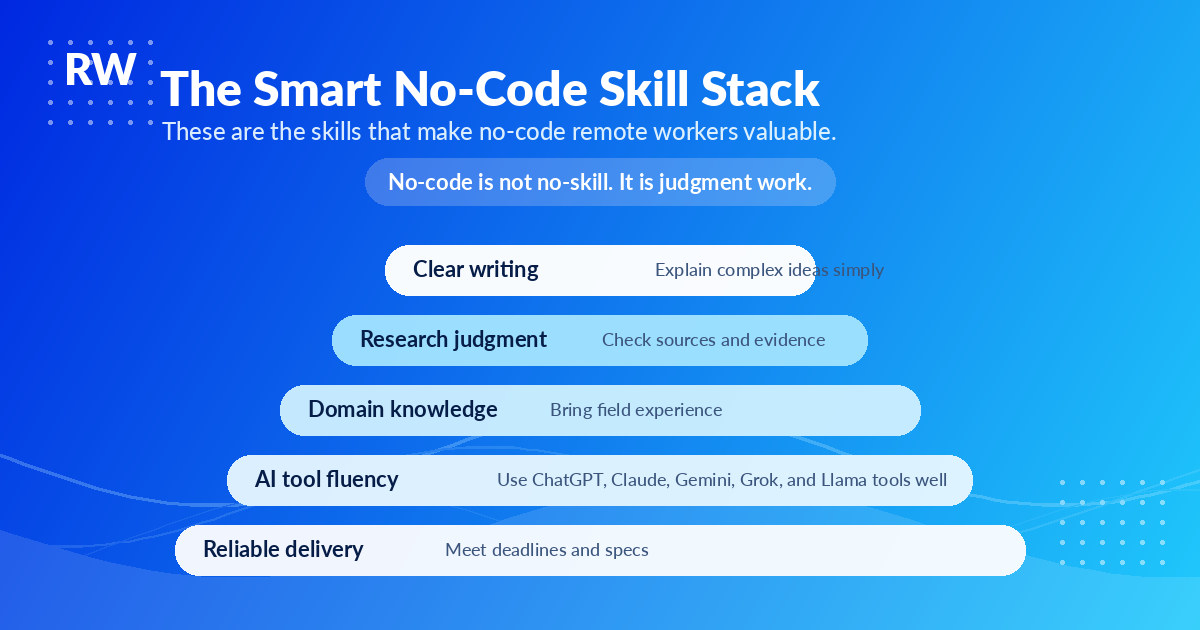
Say that you can evaluate AI answers for clarity, accuracy, and usefulness. Say that you can research topics and summarize findings. Say that you can write and edit clean content. Say that you can review specialized information in your field. Say that you can follow detailed guidelines and explain your decisions. Say that you can use tools like ChatGPT, Claude, Gemini, Grok, Llama-based apps, Google Workspace, Notion, Airtable, Zapier, and spreadsheets to work faster.
Your profile should make it easy for a hiring team or platform to match you to the right work. Instead of sounding like a general remote applicant, pick lanes. Examples:
"AI response evaluator with strong writing and research skills."
"Finance professional available for AI training, expert review, and investment content evaluation."
"Writer and editor focused on AI content quality, SEO editing, and research-backed articles."
"Healthcare background with interest in medical content review and patient-friendly explanation."
"No-code operations generalist skilled in Airtable, Notion, Google Sheets, and AI workflow documentation."
A simple application strategy
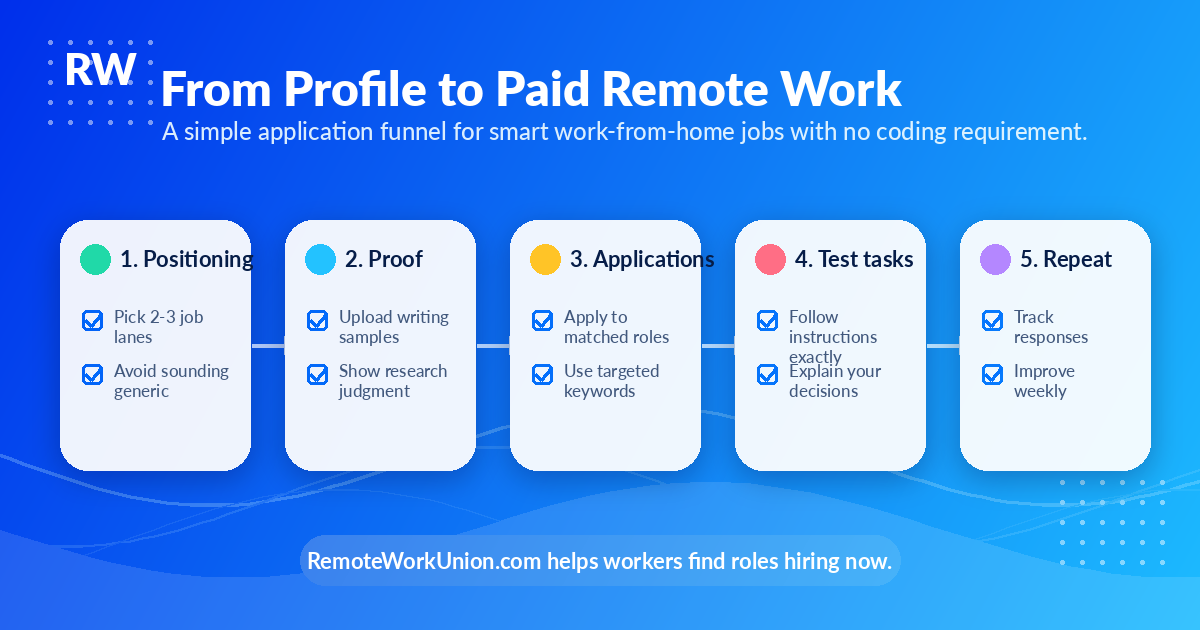
Start with two or three target lanes. Do not apply to every remote job on the internet. For example, choose AI evaluation, research review, and writing/editorial QA. Or choose no-code operations, user research support, and content repurposing. This makes your profile sharper and your applications more believable.
Next, create proof. You do not need a giant portfolio. You need a few clean samples. Write a one-page research brief. Edit a messy AI answer and show the before-and-after. Create a simple content calendar. Build a Notion workflow. Summarize a public report. Review a product onboarding flow. Make it obvious that you can think.
Then apply with the right keywords. Remote job boards and matching platforms often rely on search, tags, and filters. Use phrases like remote AI jobs, AI training, AI evaluator, research analyst, content quality, no-code operations, work from home, online jobs, writing evaluator, expert review, and subject matter expert.
Finally, track everything. Keep a spreadsheet with the company, role, date applied, platform, keywords used, assessment status, response, and follow-up date. Remote work is a volume game, but blind volume is inefficient. Track what gets responses and improve every week.
The best no-code remote jobs are still skill-based
The phrase "no coding experience" can be misleading. It should not mean low-skill. It should mean your value comes from a different skill set.
AI training jobs need evaluators. Research jobs need judgment. Writing jobs need clarity. Expert review jobs need domain knowledge. Operations jobs need systems thinking. QA jobs need patience and precision. User research jobs need empathy and pattern recognition. Social media jobs need taste and consistency.
That is why smart people can do well in remote work without becoming developers. The goal is not to compete for the easiest tasks. The goal is to find work where your thinking matters.
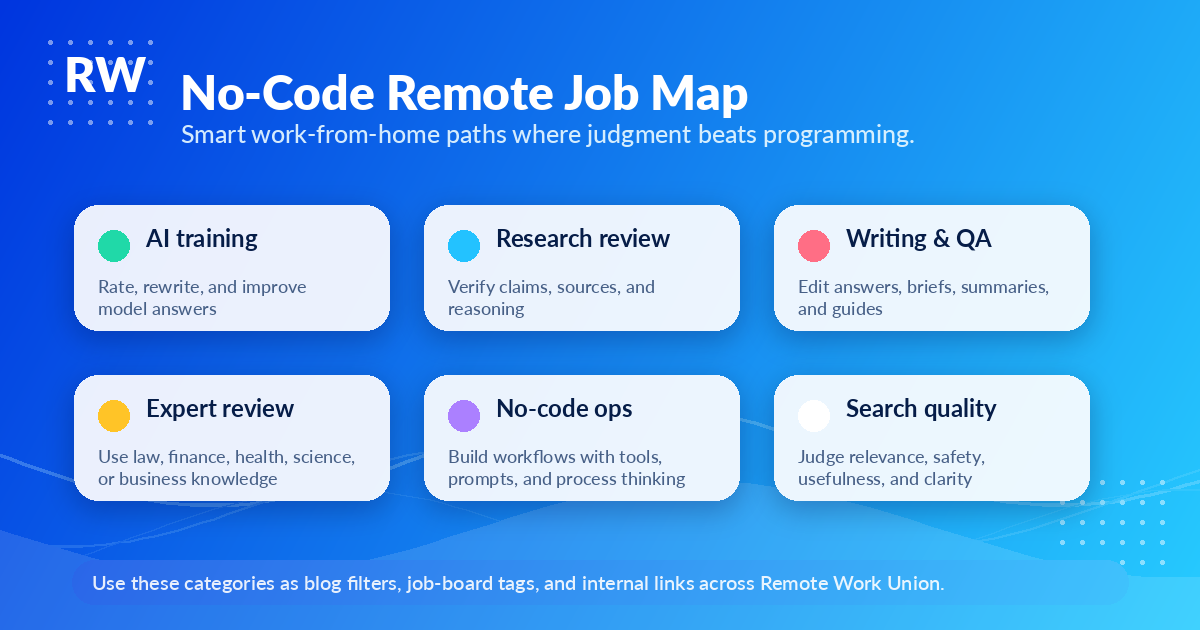
If you are looking for work from home jobs with no coding experience, start with remote roles that reward judgment: AI evaluation, research review, writing and editing, expert review, no-code operations, manual QA, search quality, recruiting research, social media operations, and customer insight work.