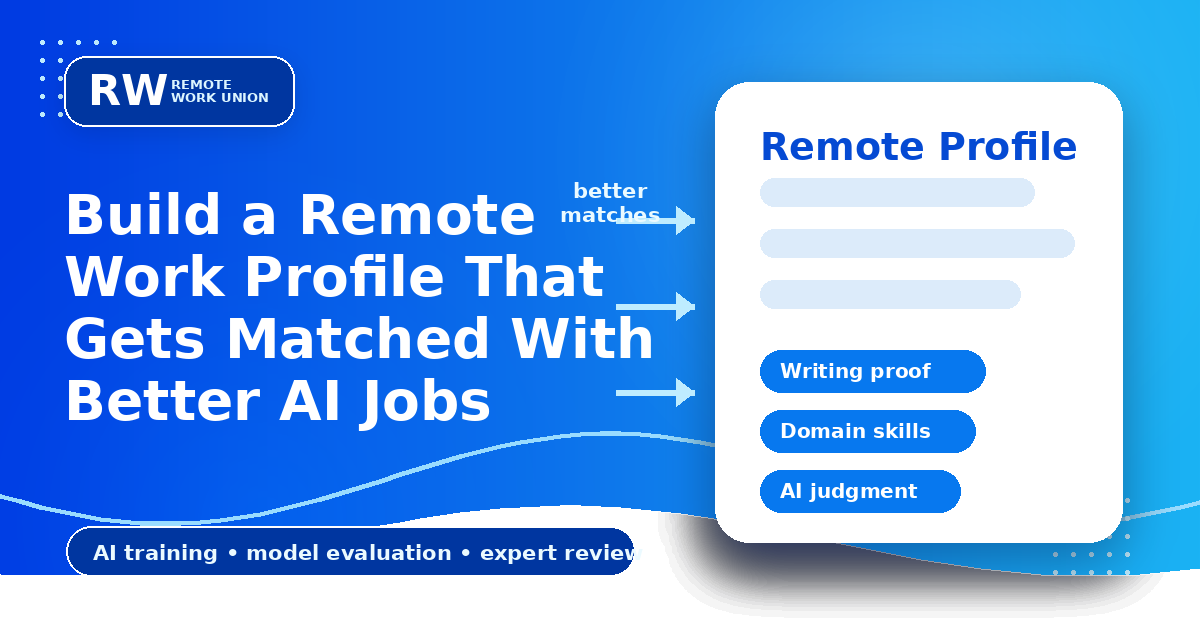
The best remote AI jobs do not always go to the person with the longest resume. They often go to the person whose profile makes the strongest match obvious. When platforms, recruiters, and project managers review candidates for AI training jobs, expert review tasks, prompt evaluation, data annotation, research projects, and model-quality work, they are not only asking, "Is this person smart?" They are asking, "Can this person be trusted with this exact kind of task?"
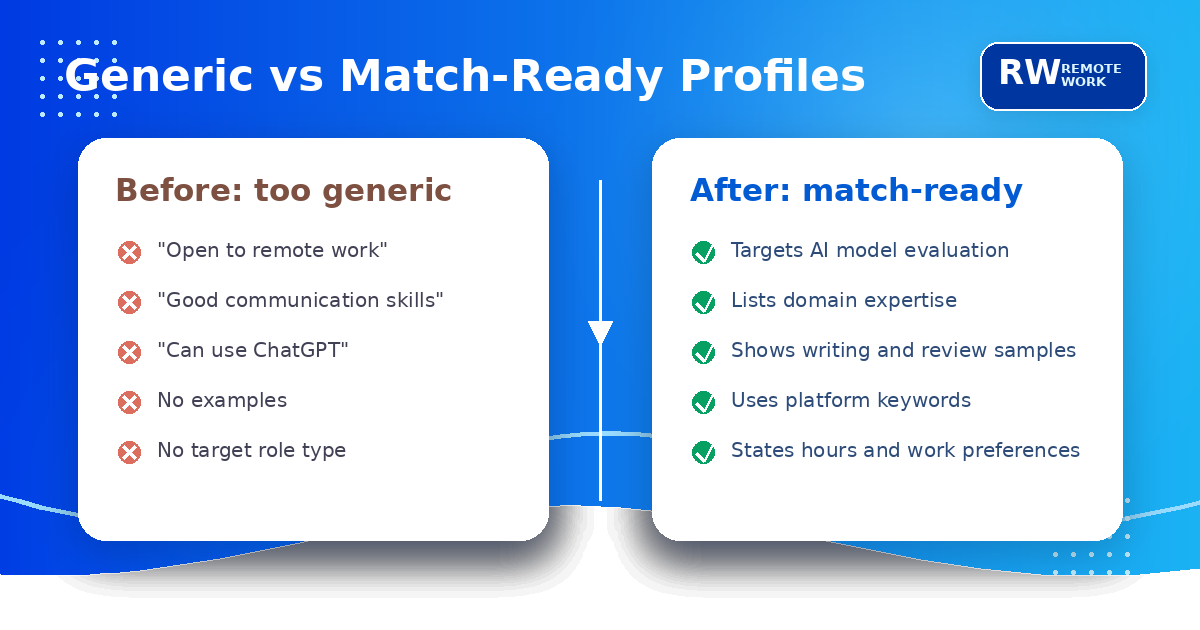
A generic remote work profile says you want to work from home. A strong remote work profile shows what kind of remote AI work you can do, why you are qualified to do it, and what evidence proves you belong in the candidate pool. The difference between a generic profile and a targeted profile can determine whether you are shown low-value online jobs or better-matched AI projects.
Why Better AI Jobs Reward Focused Profiles
Remote AI work is usually task-specific. A company may need someone to compare two AI answers, judge whether a model followed instructions, review a finance explanation, check a legal summary for reasoning problems, evaluate code, or flag unsafe medical advice. Each task has a different ideal candidate.
A broad profile can work against you. "Hardworking remote professional" is not a strong matching signal. "Finance analyst with experience reviewing market commentary, building spreadsheets, checking assumptions, and writing plain-English explanations" is much stronger for finance-focused AI evaluation. The profile should reduce uncertainty — a recruiter should not have to guess your domain, your task fit, or your comfort with detail-oriented review work.
What Matching Systems and Recruiters Are Looking For
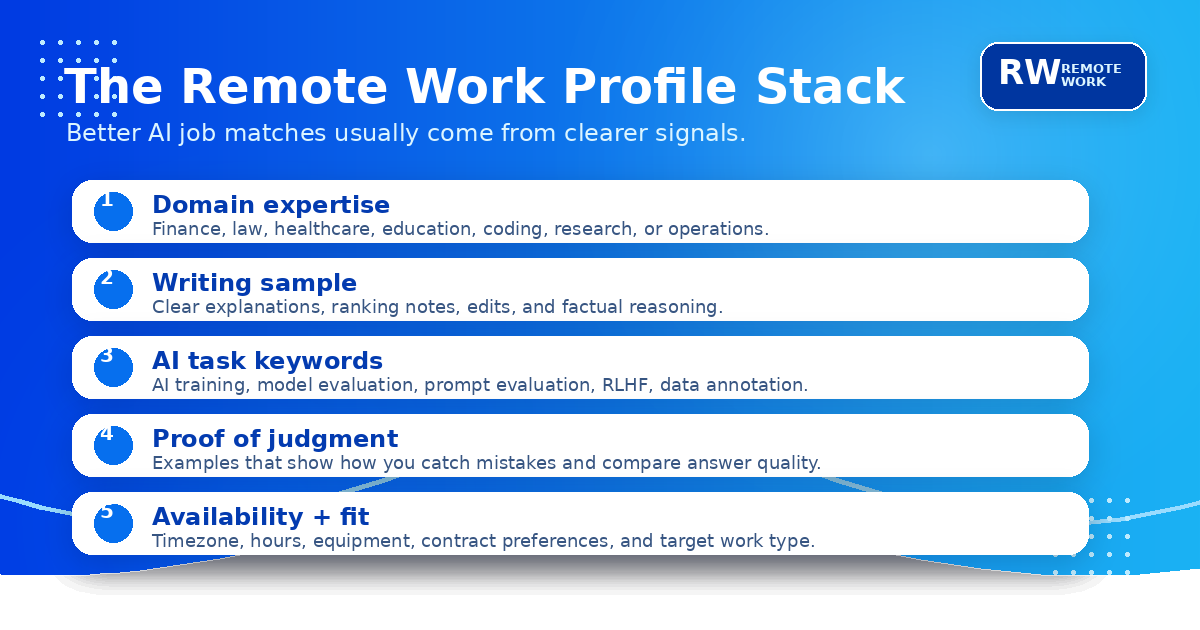
Most remote work platforms use a combination of profile data, work history, skill tags, tests, screening questions, writing samples, and project availability. For remote AI jobs, the most useful profile signals usually fall into seven categories:
- Domain expertise — the subject areas where you can judge quality better than a generalist.
- Communication quality — whether you can write clearly, explain decisions, and follow instructions.
- Evaluation skill — your ability to compare options, apply a rubric, rank answers, identify errors, and give useful feedback.
- Evidence — samples, credentials, portfolio work, projects, licenses, publications, or relevant job experience.
- Tool fluency — comfort using online platforms, spreadsheets, documents, AI tools, search, or code tools.
- Availability — how many hours you can work, when you are online, and whether you can handle flexible deadlines.
- Platform fit — whether your profile language matches the kinds of projects offered by Mercor, Outlier AI, Handshake AI, micro1, and similar marketplaces.
The strongest profiles connect skills to the actual work. Instead of "strong attention to detail," say "experienced reviewing written outputs for factual accuracy, instruction following, tone, consistency, and missing context." Instead of "AI interest," say "comfortable evaluating large language model responses, comparing answer quality, writing justifications, and improving prompts or rubrics."
Remote Work Union helps you find AI training platforms that match your background — skip the searching and go straight to qualified applications.
Find Roles Hiring Now →10 Steps to Build a Stronger AI Profile
Step 1: Choose your primary AI work lane
A remote work profile should not try to be everything at once. Common AI work lanes include writing evaluation, factuality review, legal review, finance review, medical review, coding evaluation, math problem solving, search quality evaluation, instruction-following review, prompt writing, rubric writing, research synthesis, and general data annotation. Choose one primary lane and one or two secondary lanes. A narrow profile can get better matches than a broad one if the narrow profile is clear.
Step 2: Write a headline that sounds like a match, not a slogan
Your headline should include your domain, the task type, and the remote AI job category. Avoid motivational slogans — use searchable, specific language.
- Weak: "Remote worker ready for new opportunities."
- Better: "AI Training Evaluator | Writing, Research, Rubrics, and Response Quality Review."
- Weak: "Finance professional interested in AI."
- Better: "Finance Expert for AI Model Evaluation, Market Research Review, and Financial Explanation QA."
Step 3: Turn your experience into AI task language
Many qualified people fail to get matched because their profile uses the language of their old job, not the language of the new task. Translate experience into task language. A teacher maps to rubric-based AI evaluation. A lawyer maps to legal AI review. A financial analyst maps to financial answer evaluation. A writer maps to model response rewriting and preference ranking. Use phrases like these when accurate:
- Reviewed outputs for factual accuracy, completeness, tone, and instruction following.
- Compared multiple answers and selected the stronger response using defined criteria.
- Wrote clear justifications explaining why one answer was better than another.
- Built or applied rubrics for quality, reasoning, safety, and usefulness.
- Identified hallucinations, unsupported statements, vague reasoning, or missing context.
Step 4: Build a skills section around matching signals
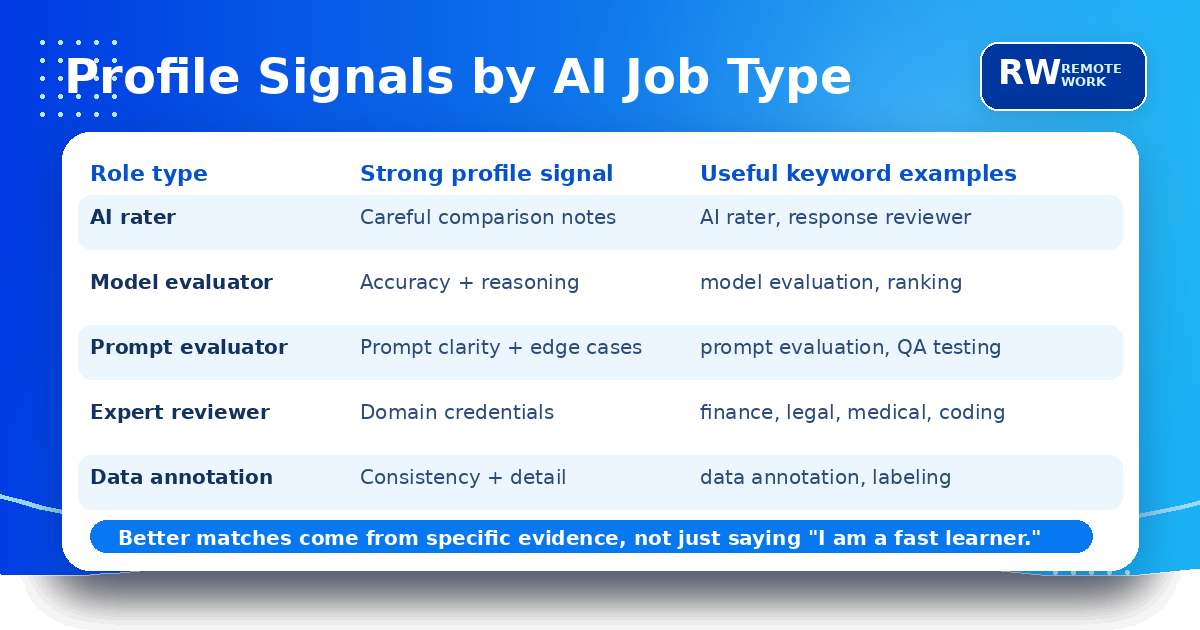
Break skills into categories: AI evaluation skills (response ranking, prompt evaluation, instruction following, rubric application, factuality review, hallucination detection, preference ranking, answer rewriting, safety review), domain skills (writing, finance, legal, medical, coding, research), communication skills (concise writing, structured feedback, plain-English explanation), research skills (source evaluation, citation checking, data validation), and tools.
Step 5: Add proof that reduces risk
Remote AI jobs are trust-based. Useful proof includes portfolios, writing samples, GitHub repositories, published articles, finance models, research summaries, certifications, degrees, or examples of structured feedback. For AI training jobs specifically, consider creating a response comparison sample, a rubric sample, a rewritten answer sample, or a domain review sample showing your judgment clearly.
Step 6: Make your profile easy to scan
A recruiter may spend less than a minute deciding whether to move you forward. Use this order: (1) headline with domain and AI task category, (2) two- or three-sentence summary, (3) skills grouped by category, (4) relevant experience in AI task language, (5) proof links or sample descriptions, (6) availability and time zone, (7) platform-specific notes. The profile should read like a project-matching page, not a traditional resume.
Step 7: Write a summary that sells fit without sounding fake
Sound like someone who can be trusted with detailed review work. A useful template: "I help evaluate and improve AI-generated answers in [domain or task area]. My background includes [specific experience], with strengths in [skills]. I am comfortable comparing responses, applying rubrics, checking facts or assumptions, writing concise justifications, and improving outputs for clarity, accuracy, and usefulness. I am looking for remote AI training, expert review, model evaluation, and research-quality projects that match my experience in [domain]."
Step 8: Customize for different platforms without rewriting everything
Build a core profile with reusable sections, then adjust the first 20 percent for each platform. A profile for Mercor may emphasize expertise and interview performance. A profile for Outlier AI may emphasize AI training tasks, writing quality, and assessment readiness. A profile for Handshake AI may emphasize credentials, research ability, and domain depth. A profile for micro1 may emphasize technical depth and AI-interview performance.
Step 9: Show availability and reliability clearly
Availability is a matching signal. Include a simple line: "Available 10–20 hours per week for asynchronous remote AI training, expert review, and response evaluation projects. Comfortable with deadline-based work, written feedback, and task queues." A strong candidate with unclear availability can lose to a slightly weaker candidate who is easier to schedule.
Step 10: Prepare for screening tests before you apply
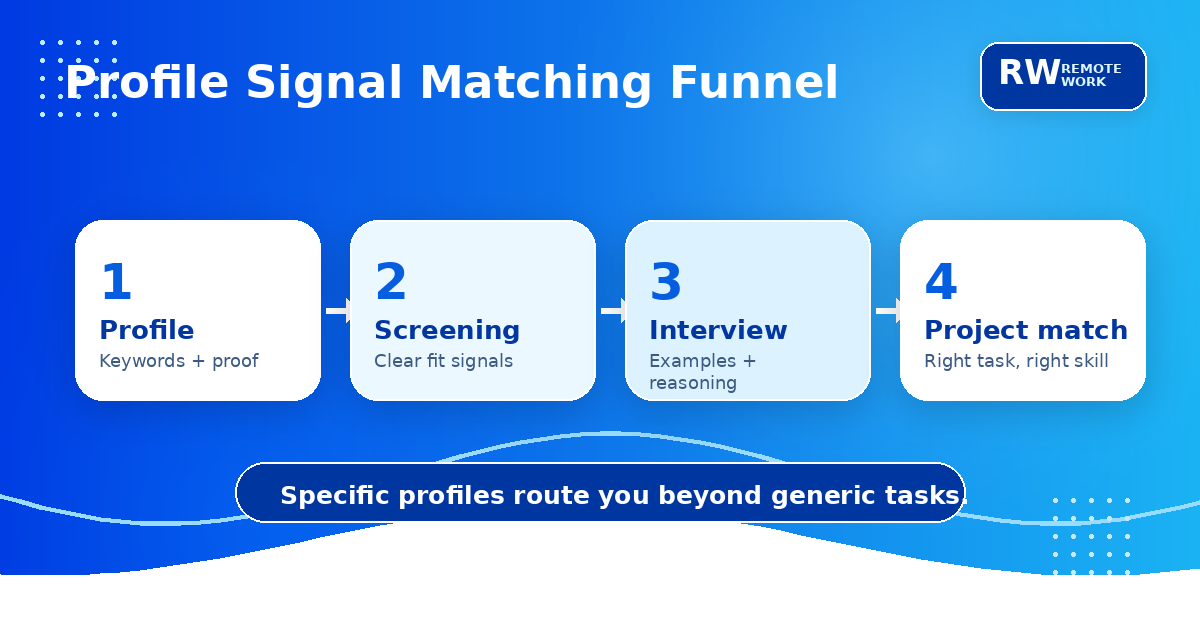
Many remote AI training jobs include screening tests covering writing, domain questions, response comparison, instruction following, or scenario-based judgment. A profile gets you considered — screening quality gets you selected. Before applying, practice comparing two AI answers and explaining which is better, rewriting a flawed answer, identifying unsupported claims, and applying a rubric consistently.
Profile Examples by Background
Writer or editor: Emphasize clarity, tone, structure, factual review, rewriting, preference ranking, and response quality. Target AI writing evaluator, prompt response editor, rubric reviewer, and research summary review roles.
Law or policy professional: Emphasize reasoning, issue spotting, citation awareness, risk language, contract review, and policy interpretation. Target legal AI review, policy evaluation, safety review, and domain expert projects.
Finance professional: Emphasize analytical reasoning, spreadsheet work, market knowledge, valuation, financial education, risk, and clear explanations. Target finance AI evaluator, business content reviewer, investment research QA, and expert review roles.
Medical or health professional: Emphasize terminology, patient-safety awareness, conservative review, citation standards, and domain-specific judgment. Target medical AI review, health content quality, and safety-focused evaluation.
Coder or technical professional: Emphasize debugging, code review, tests, documentation, technical explanation, API reasoning, and quality control. Target code evaluation, AI coding assistant review, and technical documentation review.
Researcher or academic: Emphasize source evaluation, synthesis, methodology, literature review, data reasoning, and structured writing. Target AI research support, source quality review, factuality evaluation, and long-form reasoning projects.
Common Profile Mistakes That Block Better Matches
Using only generic remote work language. "Remote assistant" or "online worker" does not tell platforms what AI projects to match you with.
Hiding your strongest domain. If you have finance, law, medicine, coding, teaching, writing, or research experience, put it near the top.
Listing AI tools without task skill. Saying you use ChatGPT, Claude, Gemini, Grok, or Llama is less valuable than explaining how you evaluate, compare, and improve AI outputs.
Overclaiming expertise. AI platforms often test you. A credible, specific profile beats an inflated one.
No proof. A profile without samples, credentials, or examples makes the reviewer guess.
No availability. Better projects often need people who can start quickly and communicate clearly.
Treating every platform the same. Use a core profile, but tune the headline and skill tags for each marketplace.
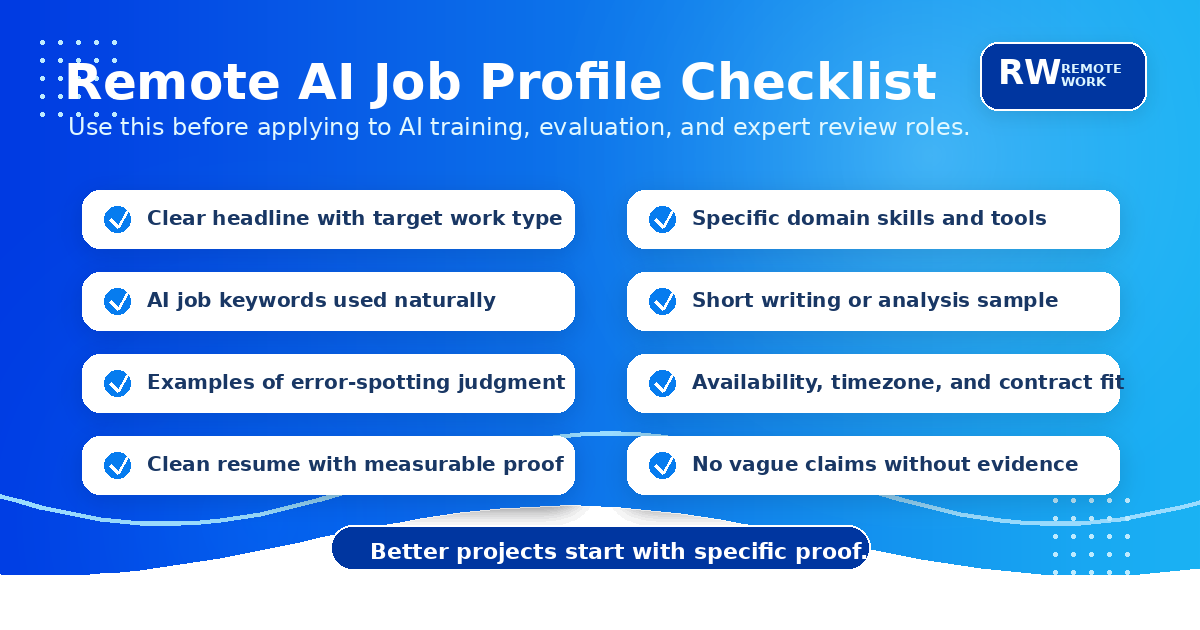
A Remote AI Profile Checklist
- Does the headline include your domain and AI task type?
- Does the first paragraph explain what you evaluate, review, or improve?
- Does the profile include AI training keywords: model evaluation, prompt evaluation, response ranking, rubric writing, data annotation, factuality review, expert review?
- Does it include domain keywords relevant to your background?
- Can a recruiter identify your best-fit project in 15 seconds?
- Do you include proof through samples, links, credentials, or clear project descriptions?
- Is your availability easy to find?
- Are your claims specific enough to be tested?
- Did you remove filler language?
- Did you customize the profile for the platform you are applying to?
A strong profile is not finished once. It should improve after every assessment, interview, completed project, and rejection. Every result gives you information about how platforms understand your skills.
The Long-Term Advantage of a Better Remote Work Profile
Remote AI work is not only about finding one project. The better strategy is to build a profile that compounds. Each completed task, strong assessment, saved sample, positive review, and clearer description improves your future matching. Over time, your profile can move from "person looking for online jobs" to "reliable candidate for AI training, expert review, and model evaluation projects in a specific domain."
Better remote AI jobs are not always found by applying to hundreds of listings. They are often found by positioning yourself so the right projects can recognize you faster. The more clearly your profile communicates expertise, task fit, proof, and availability, the easier it becomes for platforms to route better opportunities your way.
Frequently Asked Questions
What should a remote AI training profile include?
A strong remote AI training profile should include a headline with your domain and AI task type, a short summary explaining what you evaluate and why you are qualified, skills grouped by AI evaluation type and domain expertise, relevant experience rewritten in AI task language, proof links or sample descriptions, and availability information.
Why do AI platforms use profile matching?
AI platforms match candidates to projects based on skill signals: keywords, domain expertise, assessment scores, task history, and evidence of reliability. A generic profile forces recruiters to guess your fit. A specific profile makes the match obvious — which is why targeted profiles consistently get better project invitations.
How do I translate my work experience into AI training language?
Use AI training task language to describe what you already do. A teacher maps to rubric-based AI evaluation. A lawyer maps to legal AI review. A financial analyst maps to finance answer evaluation. Use phrases like: reviewed outputs for factual accuracy, compared multiple answers using defined criteria, wrote justifications explaining why one answer was better, identified hallucinations or unsupported statements.
How do I stand out on platforms like Mercor, Outlier AI, Handshake AI, and micro1?
Tailor the headline and skill tags of your profile to the platform's language. Mercor emphasizes expertise and interview performance. Outlier AI focuses on AI training tasks, writing quality, and assessment readiness. Handshake AI rewards credentials, research ability, and domain depth. micro1 rewards technical depth and AI-interview performance. Build one core profile, then adjust the first 20 percent for each platform.