The most common advice for finding remote work is to apply to more jobs. It is also, usually, the wrong advice. Sending hundreds of weak applications to poorly-matched listings burns time, produces rejection at scale, and teaches you nothing useful. The people who find good remote work consistently tend to do the opposite: they apply to fewer listings, but the ones they apply to are well-matched to their actual skills, and the applications they send are built for the specific role. This guide shows how to build that system.
Why mass-applying to remote jobs fails
Remote job boards are full of listings. Many of them are low-paying. Some are scams. Others are legitimate but poorly matched to any particular person's skills. When a job seeker applies to 500 listings, most of those applications land in categories where the person is underqualified, overqualified, a poor skill match, or applying to a role that pays half of what they actually need.
The result is rejection that feels random but is actually predictable. The solution is not to send 1,000 applications. The solution is to build a filtering system that identifies which listings are worth your time before you spend time on them.
High-paying remote work — AI training, expert review, technical evaluation, research QA, specialized writing — is not found through volume. It is found through matching. The platforms and employers offering the best rates are specifically looking for people who can demonstrate the right skill for the right task. A well-matched applicant with a strong proof of skill routinely beats 50 generic applicants who found the same listing.
What a qualified match actually looks like
A qualified match is a listing that meets four criteria at the same time. Most listings meet one or two. Only apply to the ones that meet all four.
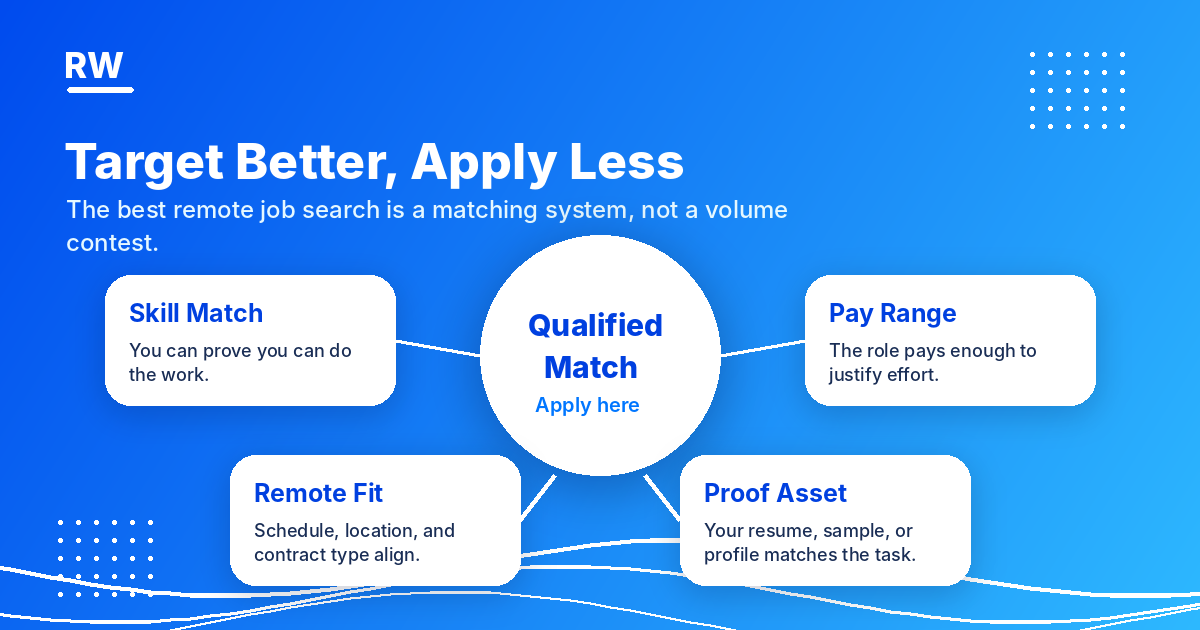
- Skill match — You can prove you can do the work. Not just claim it. Proof means a portfolio sample, a credential, a published piece, a GitHub project, or a track record of similar tasks. If you cannot demonstrate the skill, the application will not convert.
- Pay range — The role pays enough to justify the effort of a quality application. Do not send tailored applications to listings that pay below your threshold. The time cost is the same; the return is not.
- Remote fit — The schedule, location restrictions, and contract type align with your actual situation. A listing that says "remote" but requires specific timezone hours or US residency is not a fit for everyone it reaches.
- Proof asset — Your resume, sample work, or platform profile directly matches what the task needs. A finance review role needs a different proof asset than a coding evaluation role or a general writing position. Sending the same profile everywhere is one of the most common reasons strong candidates get ignored.
The filter test: Before spending more than two minutes on any listing, ask all four questions. If any answer is no — move on. The goal is a small set of listings where all four answers are yes.
The high-value online work categories worth targeting
Not all remote work pays well. The categories that tend to pay well are the ones where judgment, expertise, and proof matter more than mass availability. These are not the easiest categories to enter, but they are the ones worth investing time to target.
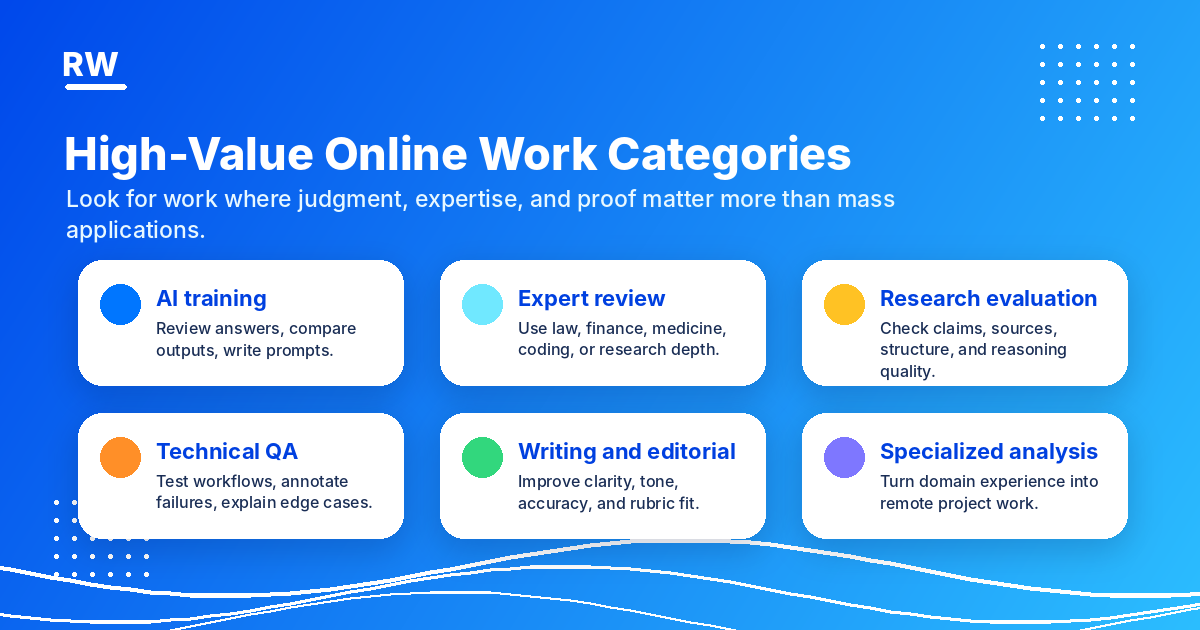
AI training and model evaluation
Reviewing AI answers, comparing model outputs, writing prompts, and evaluating reasoning quality. The pay range is wide — from $20/hr for general tasks to $200+/hr for niche expert review — and determined almost entirely by how specifically you can demonstrate domain expertise. Platforms like Handshake AI, Mercor, micro1, and Outlier AI are the most established starting points.
Expert review
Using professional knowledge in law, finance, medicine, coding, or research to evaluate whether AI output — or other professional content — is accurate, safe, and useful. This category skews toward the highest pay tiers because the required expertise is scarce. Bar admission, medical training, CPA status, engineering credentials, or deep domain experience can all qualify.
Research evaluation
Checking claims, sources, reasoning structure, and factual quality in AI-generated or human-written content. Strong fits include academics, journalists, researchers, librarians, and analysts who have professional habits around verification and sourcing.
Technical QA
Testing AI workflows, annotating model failures, explaining edge cases in code or system behavior. Pays well because the evaluator needs to understand both what the system is supposed to do and why it failed. Software engineers, QA analysts, and technically-oriented researchers often fit here.
Writing and editorial evaluation
Improving clarity, tone, accuracy, and rubric fit in AI-generated or human-produced content. Writers, editors, content strategists, and teachers bring natural skills here. The ceiling is lower than expert review tiers, but the supply of quality applicants is also lower than it looks — most people can write but fewer can evaluate writing against a structured rubric consistently.
Specialized analysis
Turning domain experience from a previous career into remote project work — financial modeling review, regulatory analysis, scientific data interpretation, market research QA, policy evaluation. Often the least visible category, but available through specialized platforms and direct engagement with AI labs or research organizations.
The anti-500-application funnel
The anti-500-application funnel replaces random volume with a smaller number of qualified, tailored applications. It is not about applying less. It is about converting the same effort into better outcomes by moving more listings through a real filter before spending time on them.
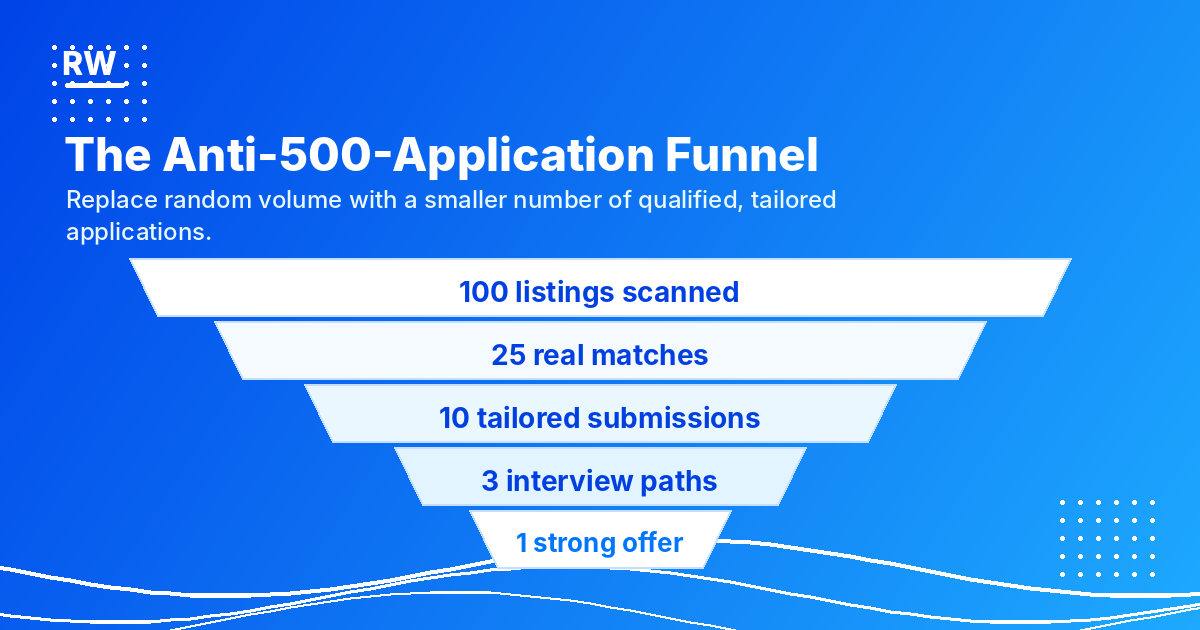
Start by scanning broadly: collect around 100 listings across relevant platforms, job boards, and marketplaces. This is a fast pass — you are not reading full descriptions, you are looking for category fit and pay range. Cut aggressively to the 20–25 listings that pass the qualified match test.
From those 25, spend real time on the 10 that you can build a strong, specific application for — ones where your proof asset is genuinely relevant and where the listing gives you enough information to tailor your submission. These 10 applications should each take 20–30 minutes to prepare well.
From 10 tailored submissions, expect 2–4 interview-stage responses under normal conditions. From there, a realistic expectation for a well-qualified candidate is 1 strong offer per cycle. That rate is better than what most mass-applicants achieve with 500 submissions — and it costs a fraction of the time.
Remote Work Union organizes the best-matched remote opportunities so you skip the 100-listing scan step entirely.
Find Roles Hiring Now →The 5-hour weekly search system
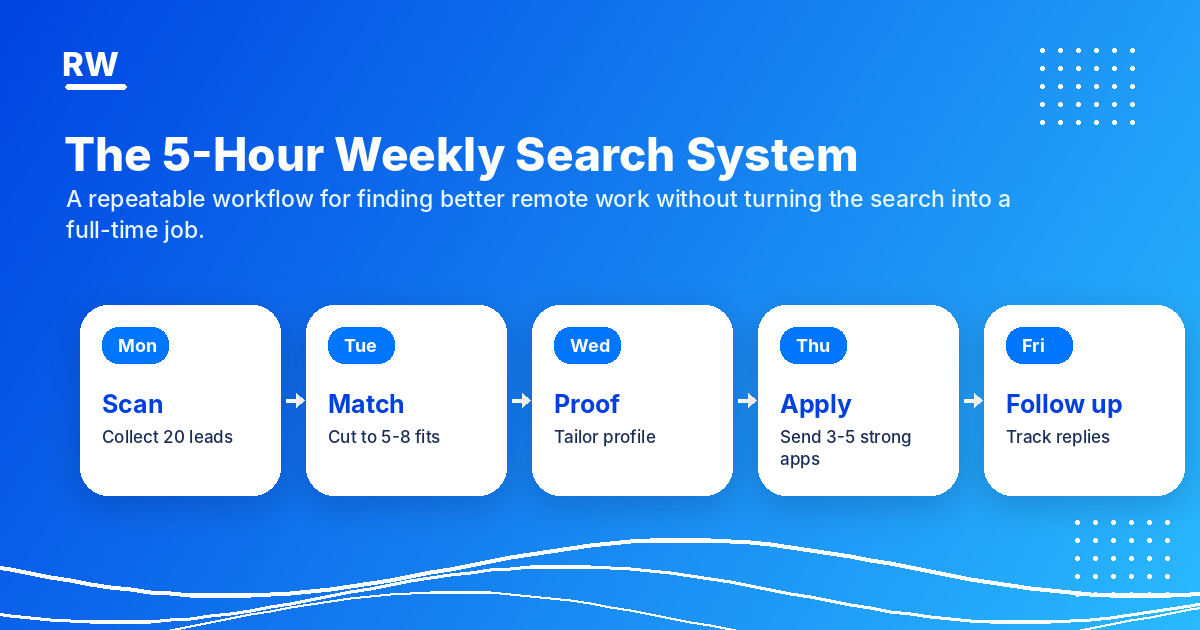
A remote job search runs best as a weekly system rather than a daily panic or an occasional burst. Five focused hours per week, structured by day, produces more results than 20 unfocused hours spent refreshing job boards and sending quick applications.
Monday — Scan (1 hour)
Collect 20 leads from your target platforms and boards. This is a fast pass: you are scanning for category fit and pay range, not reading every listing carefully. Add qualified-looking listings to a simple tracker. This step is about quantity of candidates, not quality review.
Tuesday — Match (1 hour)
Go through your 20 leads and apply the qualified match filter. Cut to the 5–8 listings that pass all four criteria: skill match, pay range, remote fit, and proof asset. Remove the rest from your active list. Do not save maybes — they usually become wasted time later.
Wednesday — Proof (1 hour)
For each of your 5–8 matches, identify which proof asset you will use and tailor your profile, resume summary, or sample accordingly. This is not about writing a new document every time. It is about making sure the specific evidence you are presenting matches what the specific listing is looking for.
Thursday — Apply (1 hour)
Send 3–5 strong, tailored applications. Not 20 fast ones. Each submission should take 15–25 minutes and feel specific enough that the platform or employer would know you actually read what they need. Skip any listing you cannot write a specific application for — it was probably not a real match.
Friday — Follow up (30–60 minutes)
Track replies in your simple tracker. Move stale leads out. Note which platforms responded and which did not. Adjust next week's scan to favor the sources producing better responses. This feedback loop is what makes the system improve over time instead of just repeating the same actions.
The key insight: Five structured hours produces better results than twenty unstructured ones because structure prevents the two biggest time sinks in a job search — reading listings you have no real chance at, and sending applications that are too generic to convert.
Where to find qualified matches
The platforms most likely to surface high-paying, skill-matched remote work include:
- AI training platforms — Mercor, Outlier AI, Handshake AI, DataAnnotation.tech, Alignerr — for evaluation, review, and training tasks across most domain areas
- Technical platforms — Turing (engineering and coding review), Toptal (senior technical freelance), Andela (software and data science) — for coders, engineers, and STEM specialists
- Expert networks — GLG, AlphaSights, Guidepoint — for professionals with verifiable domain credentials who can provide structured expert feedback
- Freelance skill platforms — Upwork, Contra — for writing, research, editorial, and analysis work where a strong portfolio can substitute for credential requirements
- Remote Work Union — Aggregates and filters the best remote AI, expert review, and knowledge-work listings so you spend less time scanning and more time on qualified applications
The most effective approach for most people is to run the 5-hour weekly system across 3–4 sources simultaneously, track which sources produce the best response rates for your specific background, and gradually concentrate effort on the ones that convert. No single platform reaches everyone. The right mix depends on your domain.
Final takeaway
Finding high-paying online jobs without applying to 500 listings is not about applying less effort. It is about directing the same effort toward a smaller set of listings where the match is real, the proof asset is ready, and the application is specific enough to stand out.
The categories that pay well — AI training, expert review, technical QA, research evaluation, specialized writing — all reward demonstrated judgment and domain proof more than volume. Build a weekly system that generates 3–5 strong, qualified applications per week and runs it consistently. That approach will outperform most job searches conducted at ten times the volume.
Remote Work Union helps by organizing the best-matched opportunities in one place, so the scan-and-filter step at the start of the weekly system becomes much faster.
Frequently asked questions
Why doesn't mass-applying to remote jobs work?
Mass-applying produces low returns because most listings are generic, many are low-paying, and sending hundreds of identical applications rarely beats a smaller number of targeted ones. High-paying remote work rewards skill matching and proof over volume. A tailored application to a well-matched role outperforms 50 weak applications to poor fits.
What are the highest-paying online job categories for remote workers?
The highest-paying categories include AI training and model evaluation ($30–$200+/hr), expert review in law, finance, and medicine ($60–$150/hr), technical QA and coding evaluation ($50–$125/hr), research evaluation ($40–$100/hr), and writing and editorial evaluation ($30–$75/hr). These pay more because they require real domain knowledge, not just time.
What is a qualified match in a remote job search?
A qualified match meets four criteria: you can prove you can do the work (skill match), the pay justifies the effort (pay range), the schedule and contract type align with your situation (remote fit), and your profile or sample work matches what the role needs (proof asset). Only apply to listings that meet all four.
How many hours per week should I spend on a remote job search?
Five focused hours per week is often more productive than 20 unfocused hours. The 5-hour weekly system: Monday scan (collect 20 leads), Tuesday match (cut to 5-8 fits), Wednesday proof (tailor your profile), Thursday apply (send 3-5 strong applications), Friday follow up (track replies). This prevents burnout and produces better applications.