The real reason some remote jobs pay $50-$200/hr
Most people search for remote work the wrong way. They type "remote jobs from home," click the first listings they see, and end up in a pile of customer support roles, sales development jobs, low-paid data entry gigs, survey apps, and vague side hustles that never turn into real income.
The higher-paying remote work market is different. Jobs that pay $50-$200/hr usually do not pay that much because they are easy. They pay that much because the worker brings judgment, taste, credentials, speed, technical ability, or industry experience that cannot be replaced by a simple checklist.
This is especially true in AI training jobs, expert review projects, research evaluation, technical writing, model response grading, legal and finance review, medical content evaluation, code review, and other remote AI jobs that depend on human expertise. The best work from home jobs are not always full-time jobs. Many are contract projects, fractional roles, expert marketplaces, or remote side hustles that can become serious online income over time.
The key is to stop searching like a beginner and start positioning yourself like a specialist. This guide explains where the $50-$200/hr remote jobs are, what they usually look like, how to avoid scams, how to build a profile that gets matched with better projects, and how to apply without wasting weeks on low-quality listings.
What kinds of remote jobs can actually reach $50-$200/hr?
A realistic way to think about high-paying remote work is to separate task work from expertise work. Task work pays for completion. Expertise work pays for judgment. The closer a project is to judgment, the higher the potential hourly rate.
Examples of expertise-driven remote jobs include AI model evaluation, AI answer review, prompt writing, fact-checking, research review, legal document analysis, medical content review, finance question evaluation, coding assessment, math problem review, technical editing, product strategy, growth marketing consulting, sales operations, executive assistance for founders, and expert calls.
A general online job might ask: "Can you label this image?" A higher-paying expert job asks: "Can you evaluate whether this AI-generated legal answer is accurate, safe, and useful?" Those are different markets. The first is volume labor. The second is skilled review.
That is why someone with experience in writing, law, medicine, finance, engineering, coding, science, education, sales, marketing, operations, or research may have more remote earning power than they think. The market does not only need coders. It needs people who can tell whether an AI answer, business analysis, research summary, or technical explanation is actually good.
The $50-$200/hr remote job ladder
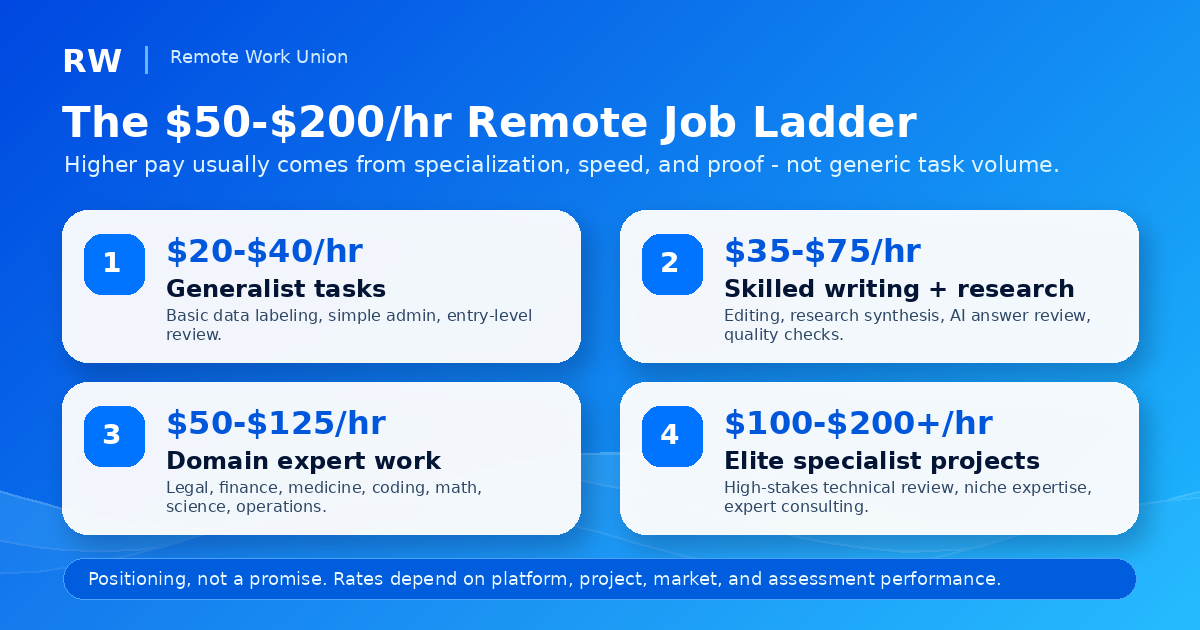
Not every remote job should be expected to pay $50/hr. Most entry-level remote listings do not. The point is to understand the ladder so you can move toward better categories instead of getting trapped in the lowest-paying ones.
At the bottom are generic task jobs: surveys, basic data entry, simple moderation, transcription, basic admin, and microtasks. These can be flexible, but they are usually not the best path if your goal is $50-$200/hr.
The middle range includes skilled writing, editing, customer research, content review, marketing execution, QA testing, AI response evaluation, and research support. Strong writers and analytical thinkers can often move faster here because the work rewards clarity and judgment.
The higher range usually requires a sharper edge: coding, law, finance, medicine, science, advanced math, technical operations, B2B sales knowledge, product strategy, or proven marketing performance. These categories are harder to fake, which is exactly why they can pay more.
The top range is usually project-based or expert-based. Think high-stakes review, niche consulting, advanced coding, technical interviews, expert calls, domain-specific AI model evaluation, and urgent company problems where speed matters. The people who win these jobs are usually not just applying. They are presenting proof that they can solve a specific problem.
Why AI training jobs are creating new remote work opportunities
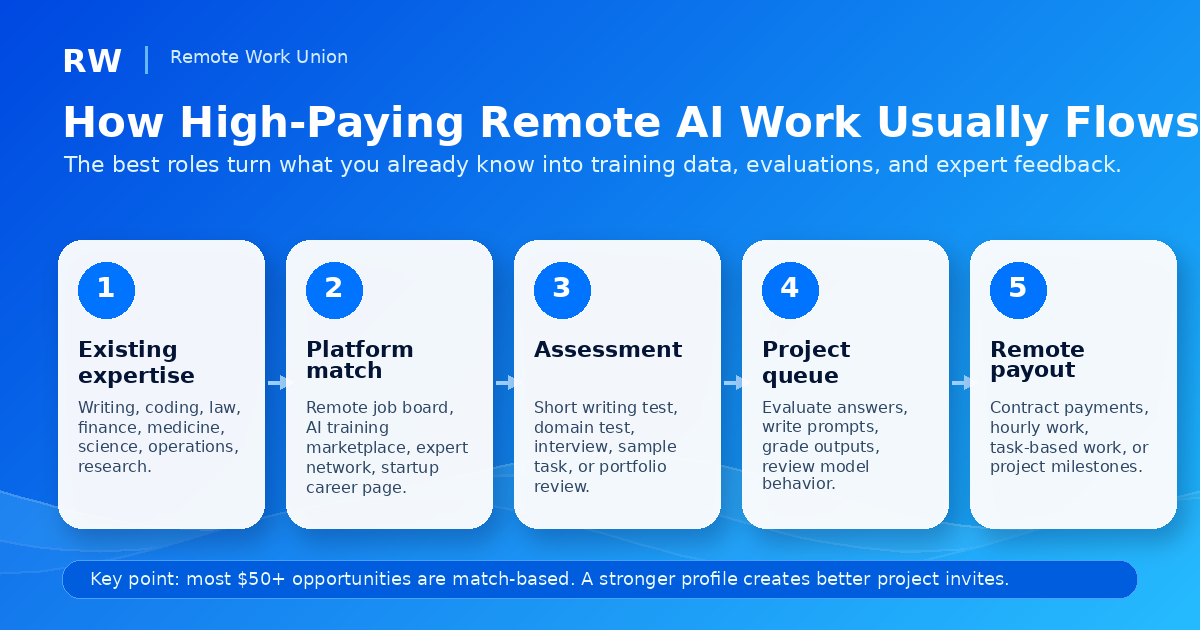
AI companies need human feedback because models do not automatically know what counts as accurate, useful, safe, persuasive, legally sound, medically careful, financially reasonable, or culturally natural. Human reviewers help improve model outputs by writing prompts, comparing answers, rating responses, identifying mistakes, checking facts, rewriting weak answers, and creating examples that teach the model better behavior.
This is why AI training jobs and AI evaluator jobs have become one of the most visible categories of flexible remote work. Some projects are generalist writing and reasoning work. Others require subject matter expertise. A marketer may judge whether messaging is persuasive and on-brand. A salesperson may rate whether an outreach email would actually get a reply. A finance expert may review investing explanations. A customer service lead may flag a reply that would frustrate a real customer. A strong writer may compare model responses for tone, accuracy, and usefulness. A lawyer may evaluate legal reasoning, a clinician may review medical content, and a coder may grade Python or JavaScript answers.
The best part is that many AI training roles are remote, flexible, and project-based. The tradeoff is that they can also be inconsistent. Project availability changes. Assessments can be selective. Rates vary by domain, location, platform, and task type. Treat AI training as a serious remote income channel, not a guaranteed salary.
Key point: RemoteWorkUnion.com is a strong starting point for finding current roles, but the broader strategy is to build a profile that can qualify you for multiple AI training platforms, expert networks, and direct company opportunities at the same time.
The best categories to search first
Start with categories where your existing experience creates an advantage. Do not begin with the broadest remote job board search. Begin with the most valuable skill you can prove.
AI training and AI evaluation: Search for roles like AI trainer, AI evaluator, LLM evaluator, model response reviewer, prompt evaluator, AI answer reviewer, RLHF specialist, search quality rater, data annotation specialist, and subject matter expert AI trainer. These roles can fit writers, researchers, coders, educators, finance professionals, lawyers, medical workers, and technical specialists.
Expert review and research projects: Search for expert reviewer, research analyst, technical reviewer, medical reviewer, legal reviewer, finance reviewer, grant reviewer, policy analyst, market research expert, and expert network consultant. These are often project-based and can pay better because they depend on specialized judgment.
Coding, math, and technical assessment work: Search for coding evaluator, Python reviewer, JavaScript assessment writer, math AI trainer, software engineering expert, technical interviewer, and algorithm reviewer. Coding-related AI training can be one of the stronger remote categories because model builders need precise technical feedback.
Writing, editing, and content quality work: Search for AI writing evaluator, editorial reviewer, technical editor, content quality analyst, SEO content strategist, UX writer, and research writer. General writing is crowded, but writing plus judgment is still valuable.
Marketing, growth, and sales strategy: Search for growth consultant, lifecycle marketing contractor, paid media analyst, content strategist, sales enablement consultant, founder assistant, and fractional marketer. These are not always AI jobs, but they can be strong remote work from home opportunities for people with proof of results.
Teaching, tutoring, and coaching: Search for test prep tutor, admissions essay coach, coding tutor, business coach, language tutor, and online course reviewer. Teaching roles can be flexible and remote, especially when the subject is high-value or credential-based.
Search terms that surface better jobs
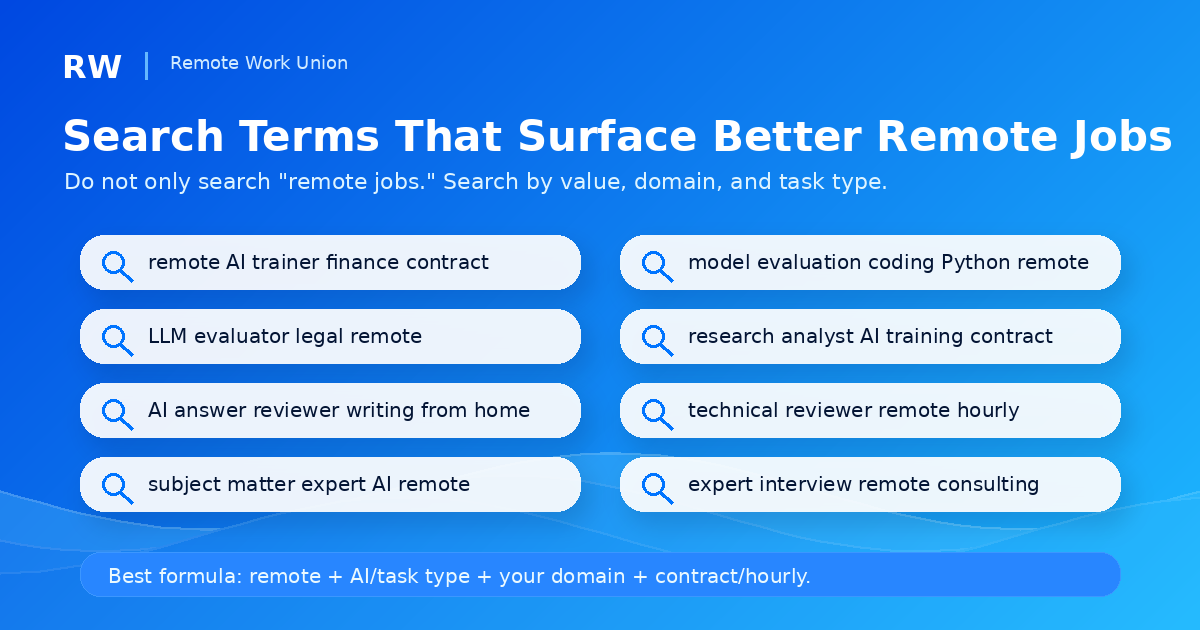
Searching "remote jobs" is too broad. Searching "remote AI trainer finance contract" is much better. The stronger the search phrase, the less time you spend sorting through irrelevant listings.
Use this formula: remote + task type + domain + contract/hourly. For example, "remote AI evaluator law contract," "LLM answer reviewer finance remote," "coding AI trainer Python hourly," "research reviewer remote contract," or "subject matter expert AI healthcare remote."
You can also search by platform category. Try phrases like "AI training jobs," "remote AI jobs," "AI evaluator jobs," "get paid to train AI," "AI answer review jobs," "prompt evaluation jobs," "model response reviewer," "RLHF jobs," "data annotation expert," and "expert review remote jobs."
For non-AI categories, search for "fractional," "contract," "advisor," "consultant," "reviewer," "evaluator," "auditor," "strategist," and "specialist." These words tend to pull up better opportunities than generic entry-level listings.
Where to look for high-paying remote jobs
The best approach is to use several channels at once. One job board is not enough. High-paying remote jobs are scattered across AI training platforms, expert networks, startup job boards, freelance marketplaces, company career pages, LinkedIn posts, and niche communities.
RemoteWorkUnion.com: Use this as your starting point for remote work jobs, work from home jobs, online jobs from home, remote AI jobs, and flexible opportunities hiring now.
AI training platforms: Look at platforms and marketplaces that list AI trainer, AI evaluator, data annotation, RLHF, coding evaluator, expert reviewer, and subject matter expert projects. Examples in the market include Mercor, Outlier, Handshake AI, micro1, DataAnnotation, Turing, and similar platforms. Check each platform directly because project availability and rates change.
Freelance marketplaces: Upwork, Contra, Braintrust, and niche freelance sites can work if your profile is specific. Generic profiles get ignored. Profiles that say "finance AI response reviewer," "B2B SaaS content strategist," or "Python technical assessment writer" are much stronger.
Expert networks: Expert networks and research platforms can pay strong hourly rates for interviews, surveys, and advisory calls, especially for people with industry experience. These are usually not daily jobs, but they can be good high-rate remote side income.
Startup and tech job boards: Wellfound, LinkedIn, company career pages, and founder communities can surface contract work before it becomes a polished job listing. Smaller companies often need remote specialists but do not always use traditional hiring funnels.
How to build a profile that gets matched with better jobs
High-paying remote jobs are often match-based. That means the platform, recruiter, founder, or hiring manager is scanning for a fast reason to believe you can do the work. Your profile should make that reason obvious.
A strong remote work profile has five parts: your domain, your task, your proof, your tools, and your availability. Here are examples you can adapt:
"I review and improve AI-generated answers for clarity, accuracy, usefulness, and tone. My background includes writing, research, content strategy, and editing. I can evaluate model responses, rewrite weak outputs, identify unsupported claims, and create high-quality examples for AI training projects."
"Finance professional available for remote AI training, expert review, and financial content evaluation. I can review AI-generated answers involving accounting, investing, valuation, market research, business analysis, and financial reasoning for accuracy, clarity, and risk."
"Software-focused reviewer available for remote AI training and code evaluation projects. I can write prompts, review model-generated code, identify bugs, compare solutions, grade explanations, and create technical examples in Python, JavaScript, and related tools."
"Legal professional available for remote AI evaluation and legal content review. I can assess legal reasoning, flag unsupported claims, review contract-related explanations, and improve AI-generated responses for clarity, caution, and usefulness."
"Growth and content marketer available for remote strategy, AI evaluation, and content review projects. I can assess marketing copy, review campaign recommendations, improve AI-generated strategy, and create practical examples for brand, content, and social media use cases."
Do not describe yourself only as hardworking, detail-oriented, or passionate. Those words are too generic. Say what you can evaluate, write, review, fix, analyze, or improve.
Build simple proof assets. You do not need a giant portfolio. A one-page writing sample, a before-and-after edit, a sample AI answer evaluation, a case study, a small research memo, a code sample, or a short domain-specific explanation can be enough. The goal is to reduce doubt quickly.
How to apply without wasting time
The worst way to find high-paying remote work is to apply randomly to hundreds of listings. The better approach is to build a targeted pipeline.
First, pick three categories that fit your background. For example: AI writing evaluator, marketing strategist, and research reviewer. Or coding AI trainer, technical interviewer, and Python tutor. Or legal AI evaluator, contract reviewer, and policy researcher.
Second, build one strong profile for each category. You can reuse your background, but the headline and proof should match the role. A general resume is weaker than a targeted profile.
Third, apply in batches. Apply to 10-20 relevant opportunities per week. Track platform, role, rate, assessment status, follow-up date, and result. The goal is not to apply forever. The goal is to identify which categories actually respond to your profile.
Fourth, follow up with better information, not desperate check-ins. Send a short note with a relevant proof sample, a sentence about why the role fits your background, and a direct line about availability. Keep it simple.
Fifth, keep multiple channels open. AI training can be inconsistent. Expert calls can be sporadic. Freelance projects can be lumpy. The best remote workers stack several sources until they find the ones that consistently pay.
How to avoid scams and low-paying traps
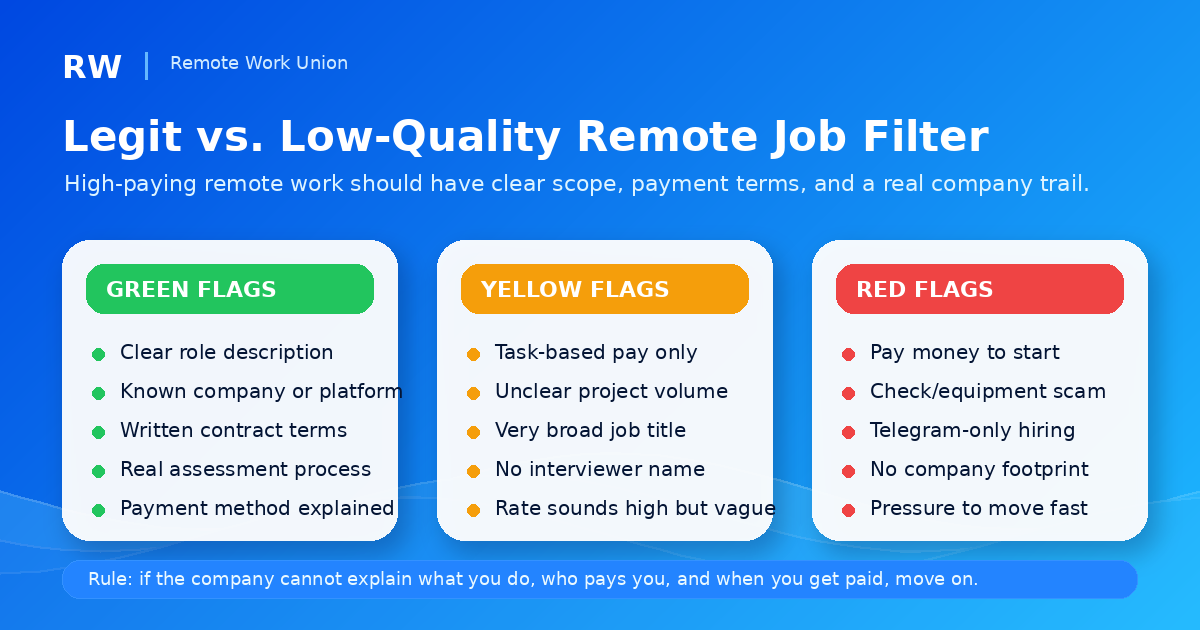
Remote work attracts scams because people want flexible income. A legitimate high-paying remote job should still have clear expectations. You should know what company or platform you are working with, what the task is, how you will be evaluated, how payment works, and what information is required from you.
Green flags include a clear role description, a real company footprint, written payment terms, a normal assessment process, professional communication, and no demand that you pay money to start.
Yellow flags include vague task descriptions, task-based pay with unclear volume, inconsistent project availability, broad promises like "earn $10,000/month from home," or a recruiter who cannot explain the work clearly.
Red flags include paying for training before you can work, being asked to deposit a check for equipment, Telegram-only hiring, pressure to move fast, requests for sensitive personal information too early, fake company domains, crypto-only payment from unknown companies, or any job that avoids written terms.
A good rule: if the company cannot explain what you do, who pays you, and when you get paid, move on. High-paying remote jobs may be competitive, but they should not be mysterious.
How to think about rates without fooling yourself
The phrase "$50-$200/hr remote jobs" should be treated as a target range, not a guarantee. The market can support those rates, but not every person, platform, or project will. Your rate depends on your expertise, speed, proof, availability, location, assessment score, project urgency, and how hard your skill is to replace.
If you are starting with no obvious specialization, aim first for credible paid remote work and build proof. If you have strong writing, research, coding, finance, legal, medical, science, or marketing experience, aim higher from the beginning. Do not price yourself like a beginner if the role needs your actual judgment.
A practical rate strategy is to separate floor rate, target rate, and premium rate. Your floor rate is the lowest rate worth your time. Your target rate is what you expect for normal skilled work. Your premium rate is what you charge for urgent, difficult, technical, or specialized work.
For example, a strong writer might set a floor of $35/hr, a target of $60/hr, and a premium rate of $100/hr for specialized AI evaluation or research-heavy work. A seasoned marketing strategist, sales leader, finance expert, business consultant, senior engineer, lawyer, or medical specialist might set a higher ladder. The exact number matters less than having a clear reason for it.
A simple weekly plan to find better remote work
Day 1: Choose your strongest category. Write a one-sentence positioning statement that explains what you review, write, evaluate, analyze, or improve.
Day 2: Create one proof sample. Keep it short. A one-page sample is better than a giant portfolio no one reads.
Day 3: Build or update profiles on RemoteWorkUnion.com and relevant platforms. Use specific keywords like AI trainer, AI evaluator, research reviewer, finance reviewer, legal evaluator, coding reviewer, technical editor, or growth strategist.
Day 4: Apply to 5-10 targeted roles. Avoid generic listings. Save the best search phrases that worked.
Day 5: Apply to 5-10 more. Track everything in a simple spreadsheet. Note which roles ask for assessments and which profiles get responses.
Day 6: Follow up on high-quality opportunities with a proof sample and availability. Do not send long cover letters. Make the fit obvious.
Day 7: Review the data. Double down on the role type that responded. If nothing responded, tighten the profile, make the proof sample more specific, and improve the search terms.
Final takeaway
The best remote work jobs are not always the most visible ones. Many high-paying opportunities sit behind better search terms, stronger profiles, assessments, expert marketplaces, AI training platforms, and direct outreach.
If you want jobs that can reach $50-$200/hr from home, stop competing for generic remote listings and start positioning yourself around judgment. What can you evaluate? What can you review? What can you improve? What do you understand better than the average applicant?
That is where the money is. Remote work is not just about being at home. It is about making your skill useful from anywhere.
Source notes
Mercor public expert pages describe remote AI project opportunities and state AI trainer hourly rates can vary widely, including rates up to $200+ depending on expertise, platform, specialization, location, and other factors. Outlier public pages describe remote and flexible AI trainer work and state that no AI experience is needed for some opportunities. Handshake AI public pages describe paid, remote AI Fellowship opportunities and advertise some part-time expert projects up to $100/hr. These examples are used as market context only. Rates, availability, and requirements change frequently, so applicants should verify each opportunity directly before applying.