AI companies need people who can judge whether their models produce good answers. That need has created one of the fastest-growing remote work categories: paid AI answer review. The work is flexible, remote, and commonly pays $50–$200/hr for people who bring real judgment — not just fast clicking. This guide explains what AI answer review is, how the work actually flows, what separates quality feedback from weak feedback, how pay is structured, and how to find legitimate opportunities.
What AI answer review is and why companies pay for it
AI models like ChatGPT, Claude, Gemini, and others generate answers by predicting what text should come next based on patterns learned from large datasets. They can be impressively fluent. But fluency is not the same as accuracy, and confidence is not the same as correctness. A model can state something false with complete certainty. It can give an answer that sounds reasonable but misses the actual question. It can use the right words in a technically wrong way.
This is the core problem that human reviewers solve. Automated scoring can catch some errors, but it cannot always judge whether a legal explanation is misleading, whether a coding answer will actually run, whether a medical summary leaves out important safety information, or whether a business recommendation is realistic. These judgments require a human who understands the domain.
AI companies and the platforms they work with pay remote workers to provide exactly that kind of feedback. The feedback is used in training processes — most commonly reinforcement learning from human feedback (RLHF) — to help models learn what better output looks like. The better the human feedback, the more useful the model becomes. That is why review quality matters and why platforms invest in finding reviewers who can explain their reasoning clearly.
The AI answer review workflow, step by step
The exact interface and task format varies by platform, but most AI answer review projects follow a consistent five-step path. Understanding this workflow before you start helps you submit feedback that is actually useful — which is what determines whether you get matched with better projects over time.
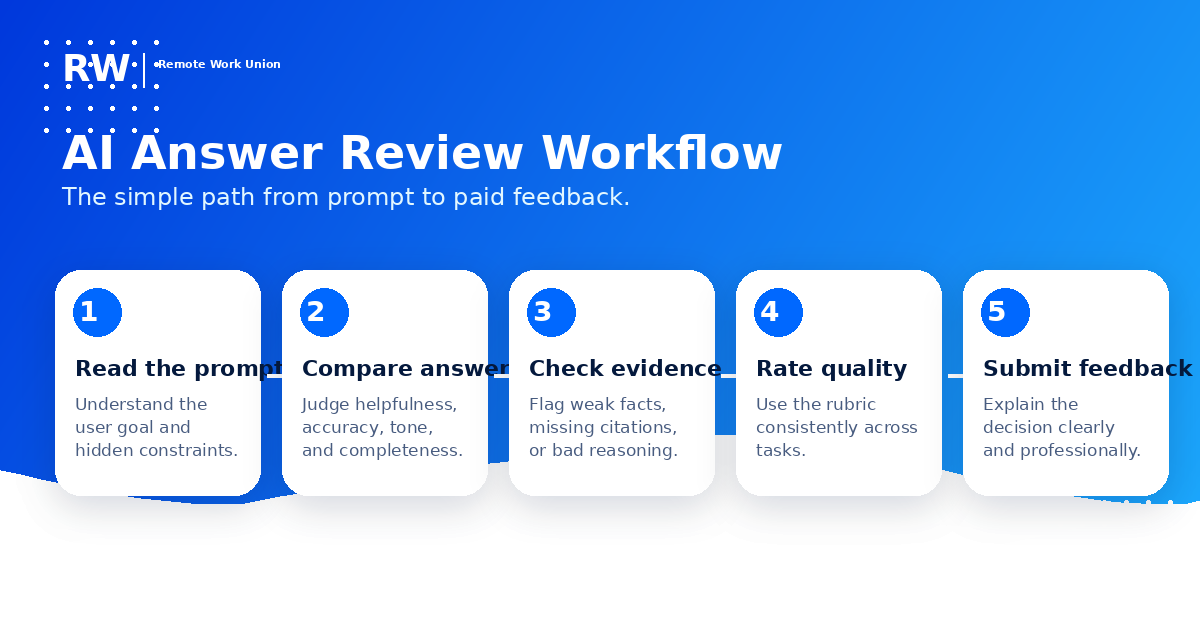
Step 1: Read the prompt
Every review task starts with the user's prompt — the question or instruction that was sent to the AI. Before you look at the answers, read the prompt carefully and identify the real goal. What does the user actually want? Is there a hidden constraint? A tone they implied? A format they expected? The best reviewers do not skip this step. A technically accurate answer can still fail the user if it misses what they were really asking for.
Step 2: Compare the answers
Most AI review tasks show two or more model responses and ask which is better. Evaluate each answer across several dimensions: How helpful is it? Is it accurate? Does the tone match the request? Is it complete, or does it leave out something important? Is it safe? Is it clear and easy to use? Avoid letting length, formatting, or confident-sounding language bias your judgment. A short, correct answer often beats a long, overconfident one.
Step 3: Check the evidence
If an answer makes a specific claim — especially in law, medicine, finance, or science — check whether the claim is supported. This does not mean sourcing every sentence. It means recognizing when a fact looks shaky, when a statistic seems invented, or when a citation is missing from a claim that needed one. Flagging weak evidence is one of the most valuable things a human reviewer can do, and it is something automated scoring often misses.
Step 4: Rate quality using the rubric
Most platforms provide a rubric — a structured set of quality criteria to rate. Follow it. Apply the same standard across every task. Inconsistency is one of the top reasons reviewers lose access to better projects. If you rate an answer highly in the morning and apply a stricter standard by afternoon, the platform's quality systems will notice. Discipline here builds trust and unlocks higher-paying work over time.
Step 5: Submit feedback with an explanation
The rating itself is only part of the submission. The explanation is often where the value is. Write clearly. Name which answer you chose and state the specific reason. Avoid vague phrases like "this one is better" or "the other felt off." The platform may use your explanation to validate your judgment, cross-reference it against other reviewers, or use it as training data itself. Treat the feedback field seriously.
What separates a good review from a weak one
The difference between a good review and a weak one is not effort level — it is specificity. A reviewer who works slowly but gives precise, reasoned feedback is more valuable than one who clicks through tasks quickly with vague justifications. Platforms that use reviewer quality scoring will steer better projects away from reviewers whose feedback does not hold up to scrutiny.
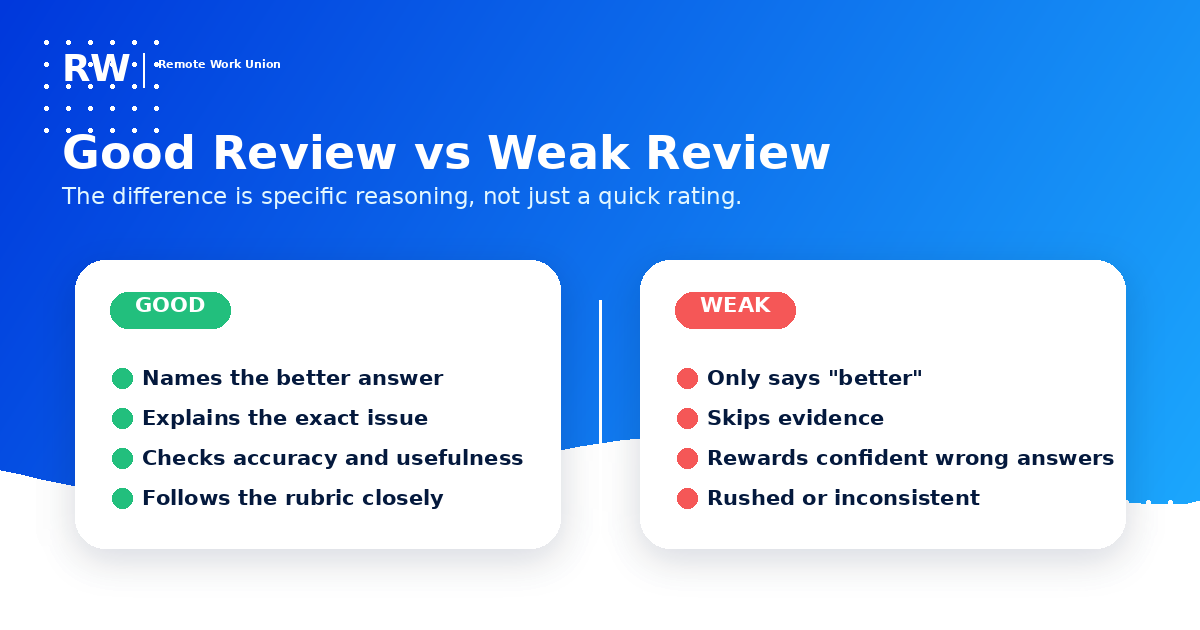
Good Review
- Names the better answer with a clear, direct choice
- Explains the exact issue — what was wrong or missing in the weaker response
- Checks both accuracy and usefulness — not just one dimension
- Follows the rubric closely and applies the same standard every time
Weak Review
- Only says "better" without naming a specific reason
- Skips evidence and lets unsupported claims pass unchallenged
- Rewards confident wrong answers because they sound authoritative
- Rushed or inconsistent — different standards across similar tasks
A common trap for new reviewers is treating confident-sounding output as correct output. AI models can be wrong with complete assurance. If a model states a legal rule incorrectly but does so clearly and in professional language, a weak reviewer might rate it highly. A strong reviewer checks whether the claim is actually true. This is especially important in law, medicine, finance, and science — domains where a confident wrong answer can cause real harm to users.
Key insight: The question is never "which answer sounds better?" It is "which answer is actually better for the person who asked?"
How AI answer review pay is structured
Pay for AI answer review varies significantly by project type, platform, and reviewer background. The general pattern is that specialized expertise unlocks higher rates, and quality feedback leads to better project access over time. Using advertised rates as a filter is useful — platforms that cannot explain what they pay or how rates are set are often not worth the time.
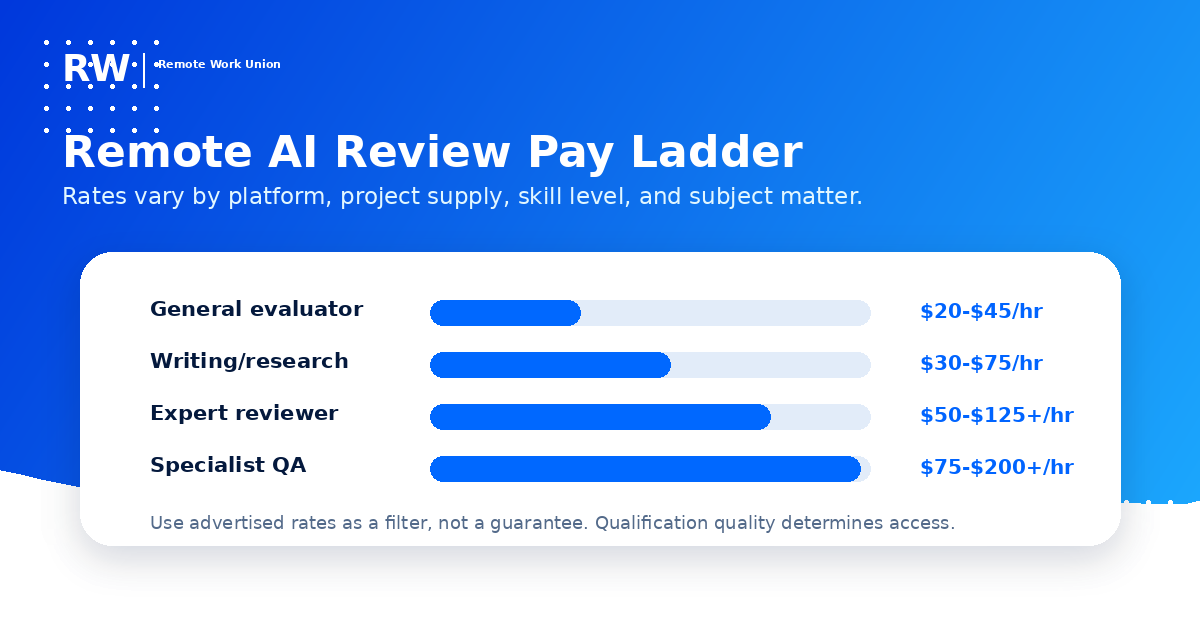
General evaluator ($20–$45/hr): These roles often involve basic response comparison, content classification, or search quality evaluation. The tasks do not require specialized knowledge, which means the applicant pool is larger and pay is lower. Still useful for building a track record on a new platform.
Writing and research ($30–$75/hr): Projects that require strong reading comprehension, editing judgment, fact-checking instincts, and the ability to evaluate clarity and structure. Writers, editors, journalists, researchers, and academics often fit well here. The work rewards people who can recognize the difference between technically acceptable and genuinely useful prose.
Expert reviewer ($50–$125+/hr): Domain-specific review work for people with professional credentials or deep experience in law, finance, medicine, engineering, marketing, or other specialized fields. These projects pay more because finding qualified reviewers is harder and the cost of a bad review is higher. Your professional background directly translates into rate access.
Specialist QA ($75–$200+/hr): The highest-paying tier involves reviewing AI output in domains where accuracy is critical and errors are costly — complex legal reasoning, clinical medical content, advanced code review, financial modeling, scientific research. These roles often require verified credentials and a demonstrated track record of high-quality feedback submissions.
Practical note: Advertised rates set the ceiling, not the floor. Project availability, qualification results, and platform matching all affect what you actually earn in a given week. Treat platforms as part of a remote income portfolio, not as a single steady paycheck.
Skills that help you get better review projects
AI answer review rewards a specific combination of skills. These are not the same as technical credentials. A lawyer who rushes through tasks and submits vague feedback will earn less than a sharp generalist who reads carefully, applies the rubric consistently, and writes clear explanations. That said, domain expertise does open doors to higher-paying work that generalists cannot access.
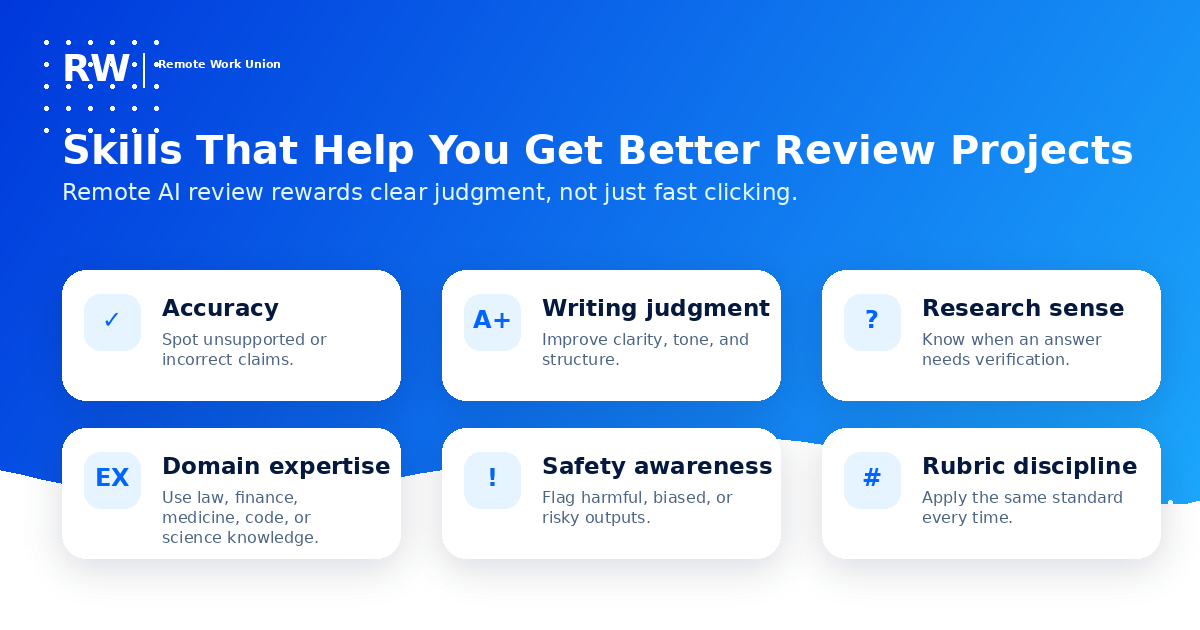
- Accuracy — The ability to spot incorrect or unsupported claims, even when they are stated with confidence. This is the most universally valuable skill in AI review work.
- Writing judgment — Knowing when an answer is clear, when it rambles, when the tone is wrong, or when structure could be improved. Writers, editors, and teachers often have this instinctively.
- Research sense — Recognizing when a claim needs to be verified before it can be trusted, and having the habits to actually check it rather than assuming it is fine.
- Domain expertise — Professional or academic knowledge in law, finance, medicine, coding, science, or another specialized field. Domain expertise unlocks the highest-paying review categories.
- Safety awareness — The ability to flag harmful, biased, manipulative, or risky content. AI safety evaluation is its own specialized track and is valued by all major AI labs.
- Rubric discipline — Consistently applying the same standard across tasks, even when one answer feels intuitively better. Inconsistency is the fastest way to lose access to good projects.
Ready to find AI review and remote work roles that match your skills?
Find Roles Hiring Now →Who AI answer review work fits best
AI answer review is a strong fit for people who like reading, thinking, and writing — and who prefer asynchronous, focused work over meetings, phone calls, or customer-facing interaction. It is not a good fit for people who want high-volume, repetitive tasks they can complete on autopilot.
The work fits writers and editors well because evaluating whether an AI answer is clear and well-structured is essentially editorial judgment. Lawyers and paralegals fit because legal review requires noticing when a rule is stated incorrectly. Finance professionals fit because spotting bad assumptions and missing risk context is exactly what financial analysis involves. Doctors and researchers fit because clinical and scientific accuracy review requires real knowledge to do properly. Engineers and coders fit because code review is already a core professional skill they can apply to model output.
It also fits students and professionals who want flexible supplemental income without a fixed schedule. Most AI review platforms are project-based or hour-flexible. You work when projects are available and when you have time. That makes it a practical option for people who are also job searching, freelancing, teaching, or in graduate programs.
What it is not: a passive income stream, a guaranteed hourly salary, or an easy way to earn maximum rates with no investment in quality. The people who do well in AI review work approach it like a professional skill and improve their feedback over time based on what the platform tells them.
Where to find AI answer review work
AI answer review work is available through platforms that connect remote workers to AI training projects. The most established options include:
- Mercor — Uses an AI-powered interview to match candidates with remote AI training and evaluation projects. Strong for technical and expert-review roles.
- Outlier AI — Offers prompt creation, response ranking, and writing evaluation projects across many subject areas. Good entry point for writers and researchers.
- Handshake AI — Fellowship-style program with referral-based access. Strong for specialized domain experts and academic backgrounds.
- DataAnnotation.tech — Project-based platform with a wide range of AI training and review tasks. Known for accessible entry and consistent project volume.
- Alignerr — Focuses on expert review and model alignment work. Higher credential requirements for specialist tiers.
- Turing — Primarily technical AI roles for coders and engineers, including code review and model evaluation.
- Mindrift — Offers creative writing, story generation, and language-focused AI training tasks.
- RWS TrainAI — Language and localization-focused AI evaluation, with strong demand for multilingual reviewers.
The best approach is to build profiles on several platforms simultaneously and see where your background generates project matches. No single platform guarantees steady volume for everyone. The full breakdown of the best remote AI platforms explains how to match each platform to your specific background.
How to apply and stand out
AI review applications work differently from traditional job applications. Most platforms start with a self-reported profile and move directly to a qualification assessment. The profile matters for initial matching. The assessment is what actually determines access to projects.
Build your profile to show the specific judgment you bring, not just your job title. If you are a writer, specify what kinds of writing you can evaluate: journalism, technical content, legal writing, marketing copy, academic prose. If you are a finance professional, specify the areas you understand well: personal finance, corporate finance, accounting, investment analysis, risk. If you code, list the languages and environments you work in regularly.
When you reach the qualification assessment, slow down. These tasks are testing the same things you will be paid to do. Read each prompt carefully, make a real judgment, and write a specific explanation. Do not describe what the answers contain — explain which one is better and precisely why.
These types of explanations show you understand the task at the level platforms actually need. Generic answers — "Answer A is clearer" — give the platform nothing to validate. Specific answers build a track record you can improve over time.
Once you are active on a platform, consistency matters more than speed. Submit fewer tasks with strong explanations rather than many tasks with weak ones. Your quality score is what unlocks access to better-paying projects. It is a long-term asset, not a number you improve by working faster.
Final takeaway
Getting paid to review AI answers from home is a real opportunity for people who take it seriously. The work rewards reading carefully, checking facts, explaining reasoning, and applying consistent standards. It is not a shortcut to easy income. It is a legitimate remote work category that rewards the same intellectual habits that make someone good at research, editing, analysis, or professional expertise.
The people who earn the most from AI answer review work do not rush. They read the prompt before the answer. They explain their reasoning in specific terms. They apply the rubric the same way every time. And they treat each qualification assessment as a chance to prove that their feedback can be trusted.
If that describes how you already approach careful reading and writing, AI answer review may be one of the better remote opportunities available right now. Remote Work Union helps you find roles that match your background and apply to legitimate platforms without sorting through low-quality listings.
Frequently asked questions
What does it mean to get paid to review AI answers?
AI answer review is a remote job category where workers read AI-generated responses, evaluate their quality, and submit structured feedback. Tasks may include comparing two model answers and choosing the better one, rewriting weak responses, checking facts, rating helpfulness and accuracy, or flagging safety issues. Platforms like Handshake AI, Mercor, micro1, and Outlier AI offer this type of work.
How much does AI answer review pay?
Pay depends on the reviewer's background and the project type. General evaluators typically earn $20–$45/hr. Writing and research reviewers often see $30–$75/hr. Expert reviewers with domain knowledge can reach $50–$125+/hr. Specialist QA roles for hard subject matter can exceed $75–$200/hr. Use advertised rates as a filter rather than a guarantee — qualification quality determines access to higher-paying projects.
What is the difference between a good and a weak AI review?
A good review names which answer is better, explains the exact issue in specific terms, checks both accuracy and usefulness, and follows the rubric consistently. A weak review only says one answer is "better" without explanation, skips evidence, rewards confident-sounding wrong answers, or is rushed and inconsistent across tasks.
Do I need technical experience to review AI answers?
Not for most projects. Many AI answer review roles value writing ability, research skills, domain knowledge (law, finance, medicine), attention to detail, and the ability to explain clear reasoning. Coding experience helps for technical review projects but is not required for writing, research, or general evaluation work.
Where can I find AI answer review jobs?
Legitimate AI answer review projects are available through platforms like Mercor, Outlier AI, Handshake AI, DataAnnotation.tech, Alignerr, Turing, Mindrift, and RWS TrainAI. Remote Work Union organizes these opportunities in one place so you can apply without hunting through dozens of listings.