Most people hear "AI skills" and assume they need to become a software engineer. That is the wrong starting point.
The fastest-growing online work around artificial intelligence is not only coding. A huge amount of AI work depends on people who can judge answers, test prompts, review writing, check facts, compare outputs, organize workflows, and apply real-world expertise. AI companies and AI-powered businesses need human judgment because models do not automatically know whether an answer is useful, safe, accurate, clear, persuasive, legally careful, medically appropriate, financially sound, or actually helpful to a real person.
That creates a practical opportunity: you can make money online with AI skills even if you are not a developer.
This does not mean every AI job is easy. It does not mean every platform pays well. But it does mean that people with writing ability, research ability, professional judgment, subject matter knowledge, communication skills, and tool fluency now have more remote work options than they did a few years ago. Companies are paying people who can make AI outputs better, faster, safer, more useful, and more accurate.
The real AI skill is judgment
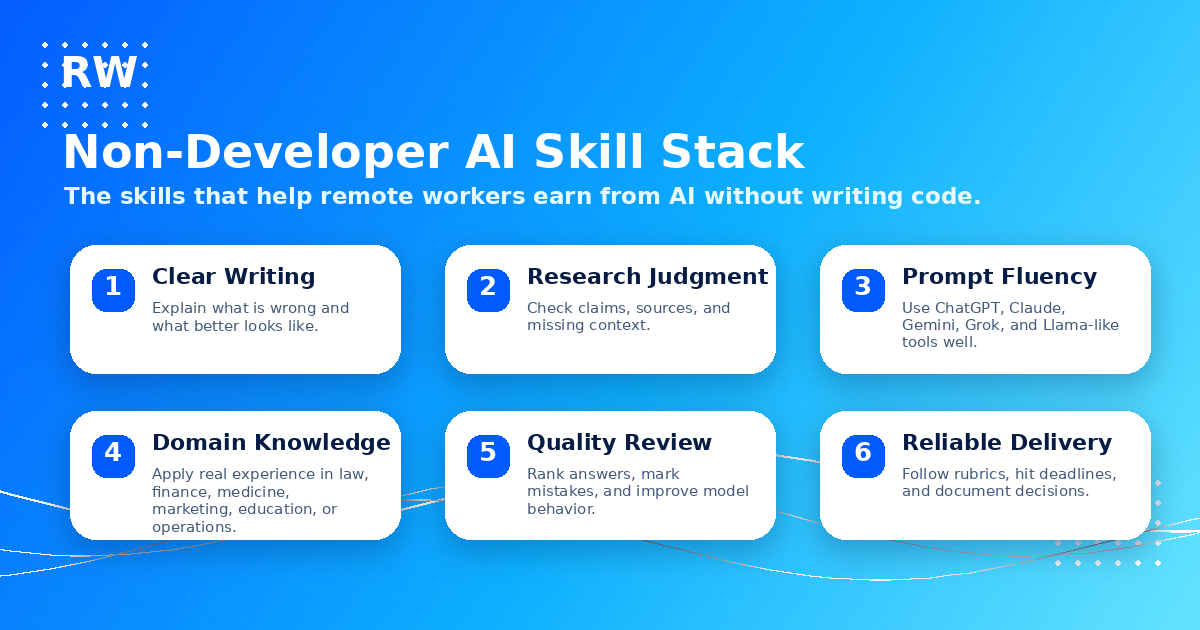
For non-developers, the most valuable AI skill is judgment. Can you look at an AI-generated answer and tell whether it is good? Can you explain what is wrong with it? Can you compare two responses and say which one is more helpful? Can you spot when a model sounds confident but is missing context?
That is the foundation behind many remote AI jobs. AI models are trained and improved through large amounts of feedback, examples, evaluations, rankings, rewritten answers, and human-created instructions. Some of this work is highly technical, but much of it is not. A lawyer may review legal reasoning. A nurse may evaluate medical communication. A finance professional may check whether an answer about budgeting, taxes, or markets is responsible. A teacher may judge educational explanations. A writer may compare tone, structure, and clarity.
The job is not "be the AI." The job is to be the human quality filter.
The main ways to make money online with AI skills
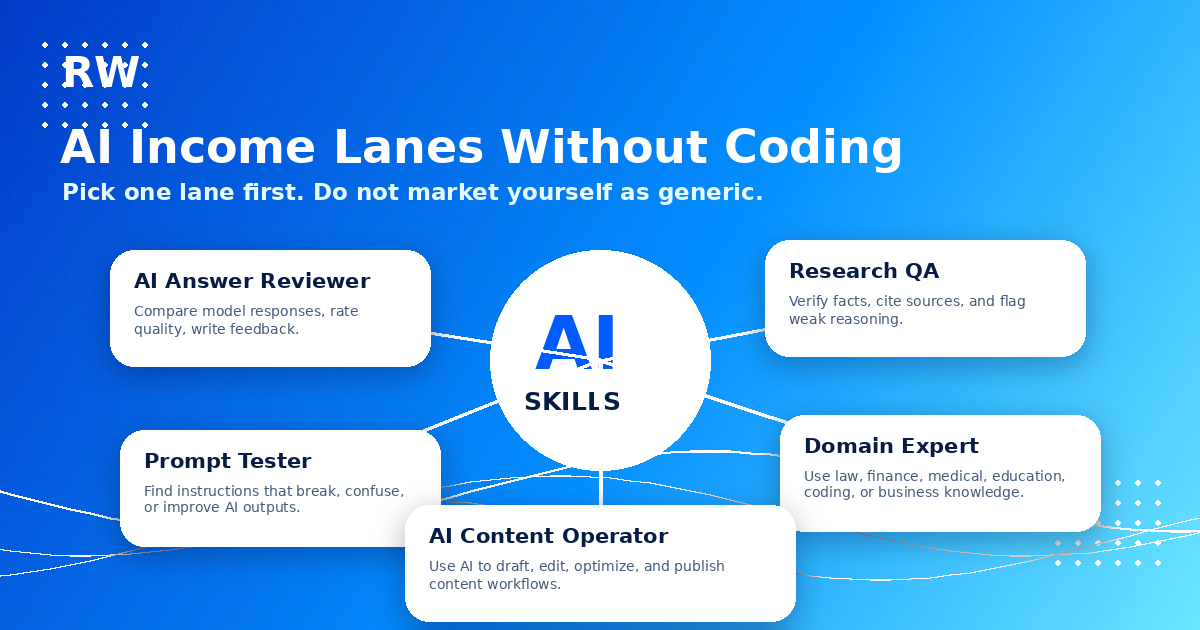
1. AI training and model evaluation jobs
AI training jobs usually involve helping models improve through feedback. Common tasks include ranking two AI answers, writing the ideal answer to a prompt, labeling whether a response followed instructions, identifying factual errors, testing if an answer is harmful or low quality, or giving structured feedback based on a rubric.
These roles appear under titles like AI trainer, AI evaluator, LLM evaluator, AI rater, AI content reviewer, model response evaluator, data annotation specialist, human feedback specialist, or domain expert AI trainer. The best versions test whether you can think clearly, follow guidelines, and explain your decisions. Some projects are general. Others require specific expertise in coding, law, medicine, finance, biology, math, or education.
2. AI answer review from home
A typical task shows you a user question and two AI responses. You decide which response is better and explain why. Another task may ask you to mark whether a response is accurate, complete, concise, safe, or properly sourced. Another may ask you to rewrite a weak answer into a strong one.
This is where writing skill matters. Strong evaluators do not just say "Answer A is better." They say, "Answer A is better because it directly answers the user's question, avoids unsupported claims, gives a clear step-by-step process, and does not introduce irrelevant details." That kind of reasoning is what AI training teams need.
If you want to get paid to improve tools like ChatGPT, Claude, Gemini, Grok, or Llama-based products, this is the skill to practice: compare, critique, and rewrite AI answers with clear explanations.
3. Prompt testing and AI workflow QA
Real prompt testing means trying to get consistent, useful outputs from an AI system — testing whether a prompt works across different examples, whether the model follows all constraints, whether it breaks under edge cases, or whether a workflow produces reliable results.
A non-developer can do this well if they understand the business outcome. A marketing person can test AI prompts for ad copy, landing pages, or email newsletters. A recruiter can test prompts for screening resumes or writing job descriptions. Many businesses do not need a custom AI app — they need someone who can turn AI tools into repeatable work: writing instructions, building simple workflows, testing outputs, and documenting the process.
4. Research, fact-checking, and source evaluation
AI tools can produce unsupported claims, outdated information, fake citations, weak logic, or misleading summaries. Remote AI research jobs may involve checking claims in an AI answer, evaluating source quality, summarizing documents, finding better references, or identifying contradictions.
This is a strong lane for people with backgrounds in journalism, academia, law, finance, science, policy, or consulting. The skill is knowing which source is reliable, what the source actually supports, and how to explain that clearly.
5. Domain expert AI work
Domain expert AI jobs are some of the strongest non-developer opportunities because they are harder to commoditize. A marketing strategist, sales professional, social media manager, accountant or financial analyst, business operator, customer service lead, teacher, attorney, nurse, or scientist can review answers that require specialized knowledge — writing prompts, creating ideal answers, evaluating model reasoning, or flagging subtle errors in their field. The expertise that counts is whatever you do well, not a specific degree.
People with real-world experience should not undersell themselves. You may not know Python, but you may know insurance, mortgages, compliance, medical intake, bookkeeping, real estate, construction, logistics, or education better than most people building AI tools. That experience can become an AI skill when you translate it into evaluations, examples, rubrics, and feedback.
6. AI content operations
Companies need help creating, editing, updating, repurposing, and publishing content across websites, email, LinkedIn, newsletters, YouTube scripts, product pages, and social media. A strong AI content operator uses AI tools to move faster while still adding human taste, accuracy, brand voice, SEO judgment, and final editing.
The difference between low-value and high-value work is whether you can own the final result — not just generate words.
7. AI workflow consulting for small businesses
Many small businesses want to use AI but do not know where to start. A real estate team wants AI-assisted listing copy. A law office wants intake summaries and FAQ drafts. A fitness coach wants content calendars and lead magnets. A recruiting agency wants job descriptions and candidate summaries. A non-developer can serve these clients by understanding operations, communication, and the business problem — delivering prompt sets, workflow guides, Notion systems, or simple automations.
You do not need to code, but you do need proof
Everyone can open an AI tool. The market rewards people who can show a specific use case. Compare these profiles:
If you are starting from scratch, build two or three proof pieces. Create a before-and-after AI answer review. Take a weak AI response, explain what is wrong, then rewrite it. Create a prompt testing sample. Create a research QA sample. These samples separate you from people who only say they are interested in AI.
The best first AI skills to learn
Skill 1: Writing clear evaluations. Practice explaining why one answer is better than another. Be specific — mention instruction following, accuracy, usefulness, tone, structure, missing context, hallucinations, and safety. A good evaluator writes: "Response B is stronger because it answers the user's specific question, gives a practical sequence of steps, and avoids making unsupported claims."
Skill 2: Using multiple AI tools. Get comfortable with the major AI assistants: ChatGPT, Claude, Gemini, Grok, Perplexity, Copilot, and open-model products. The goal is tool fluency — understanding how different tools behave and comparing their outputs.
Skill 3: Prompt structure. A useful prompt includes the role, task, context, constraints, examples, format, and success criteria. Instead of "Write a blog post about remote jobs," use a specific prompt that gives the model a clear job to do.
Skill 4: Research verification. Learn to ask: What claim is being made? What source supports it? Is the source current? Does the answer overstate what the source says? This one skill makes you useful in AI research, content editing, answer review, and fact-checking roles.
Skill 5: Workflow thinking. Businesses pay for repeatable outputs. Learn to think in systems: input → process → output. Connect AI to business results, not just interesting prompts.
Where to find remote AI jobs without being a developer
Search for terms like: AI trainer, AI evaluator, LLM evaluator, AI content reviewer, prompt evaluator, model response reviewer, data annotation specialist, human feedback specialist, AI research assistant, remote AI writer, AI content operations, domain expert AI trainer, work from home AI jobs.
Check AI-focused platforms and marketplaces like Handshake AI, Mercor, micro1, and Outlier AI. Treat these as opportunity sources, not guaranteed income sources — each platform changes its screening, project availability, and pay structure over time.
Also look beyond AI-only platforms. Many businesses list jobs that are not officially called AI jobs but still reward AI fluency: content operations specialist, virtual assistant, research assistant, SEO writer, customer support QA, sales operations, and knowledge operations roles that mention ChatGPT, Claude, Gemini, AI tools, or automation.
A simple 7-day plan to start
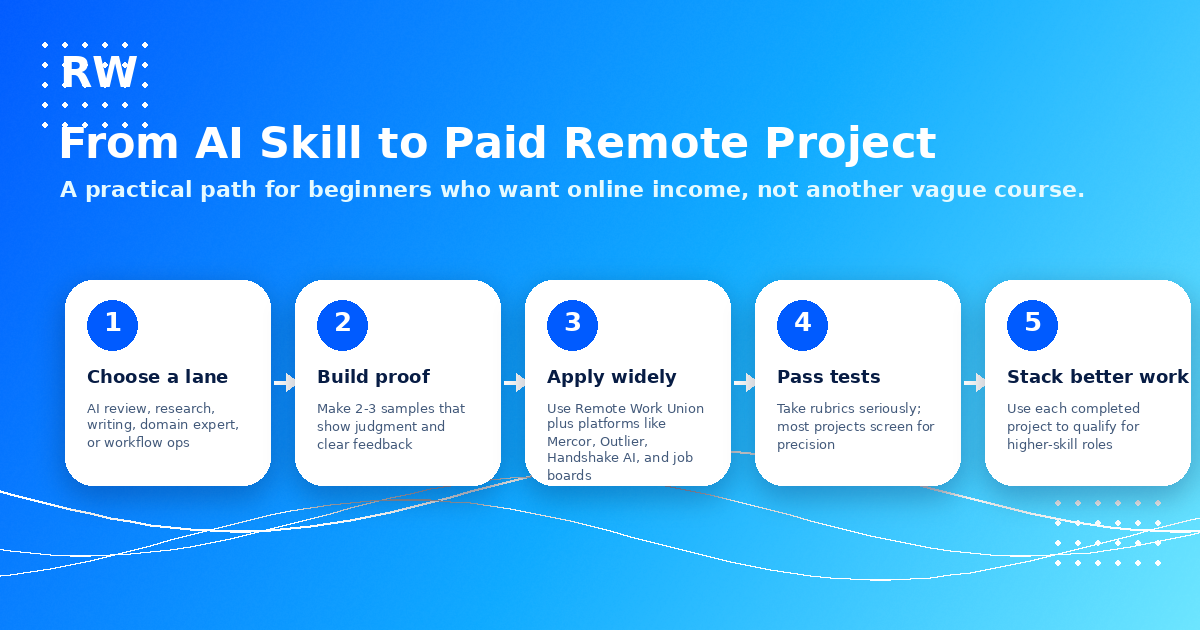
Seven Days to Your First Remote AI Project
Pick your strongest lane. Choose one: AI answer review, AI research QA, prompt testing, AI content operations, domain expert review, or workflow consulting. Pick based on your actual background, not what sounds trendy.
Build one sample. For AI answer review, compare two AI responses and explain which is better. For research QA, verify five claims. For content ops, show how to turn one topic into a blog outline, newsletter, and social post.
Build a second sample in the same lane so your profile looks focused. Do not scatter yourself across ten unrelated AI use cases.
Rewrite your profile. Update your resume, LinkedIn, or portfolio headline with clear keywords: remote AI jobs, AI evaluator, AI training, AI content operations, AI research, prompt testing, model response review, and work from home AI jobs.
Apply to 10 relevant roles that match your sample. If your sample is AI answer review, apply to AI evaluator and LLM review roles. Do not apply randomly.
Take assessments seriously. Many AI training jobs use assessments. Read the rubric carefully. The people who fail often rush. Precision matters. Follow instructions exactly and explain your reasoning.
Improve your proof based on the market. Look at roles that keep appearing. If many ask for research skills, add a research sample. If many ask for domain expertise, make your niche clearer.
How much can you make?
Pay varies widely. Basic online AI tasks are lower-paying and inconsistent. General AI evaluation pays more if you write clearly and follow rubrics well. Domain expert evaluation pays more with specialized knowledge. AI content operations and workflow consulting can pay well if you deliver business results.
The path usually looks like this: basic task work → general AI evaluation → domain expert evaluation → AI content operations → AI workflow consulting. Your goal is to move from generic task-taker to trusted AI operator. Do not build your plan around the highest number you see in a headline. Build your plan around becoming more useful.
Scam and low-quality listing red flags
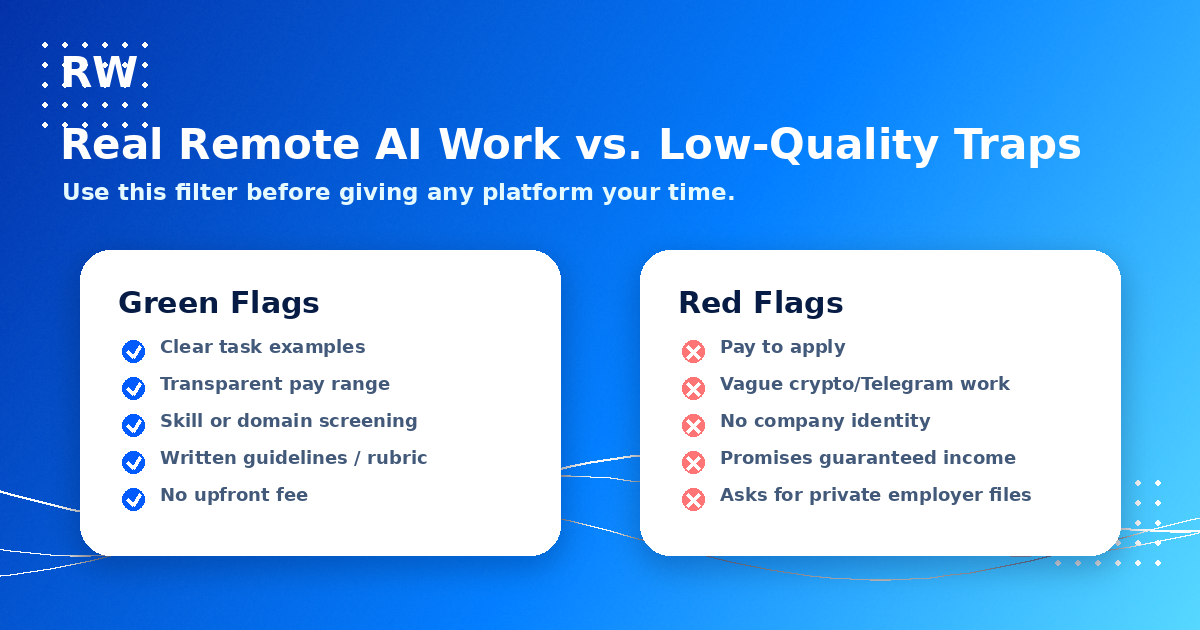
Remote work attracts scams, and AI hype makes it worse. Be skeptical when a listing promises guaranteed income, requires you to pay upfront, refuses to identify the company, moves immediately to Telegram or WhatsApp, asks for sensitive personal information too early, or describes vague work with unrealistic pay.
Be especially careful with any project asking you to upload private documents, employer-owned files, client records, medical records, legal documents, or copyrighted material you do not own. Legitimate opportunities have a clear company identity, written task expectations, some kind of screening or assessment, transparent payment terms, and realistic language about project availability.
The best mindset for making money online with AI
The people who win with AI skills are not always the most technical. They are the ones who learn how to combine AI tools with useful human judgment. Do not sell yourself as someone who merely uses AI. Sell yourself as someone who can improve outputs, evaluate quality, create workflows, and apply real experience.
AI will keep changing. Platforms will change. The names of tools will change. But businesses will keep needing people who can turn messy information into clear work, spot mistakes, improve communication, and make technology useful. That is why non-developers still have a real shot in the AI economy.
Learn the tools. Build proof. Apply to real opportunities. Improve your profile. Repeat.