AI training work is becoming one of the most practical remote job categories because it rewards human judgment, domain knowledge, clear writing, and flexible online work habits. This guide explains what AI training jobs are, why they are growing, who they fit, and how to find better remote AI opportunities without wasting time on low-quality listings.
Introduction: AI training is turning human judgment into remote work
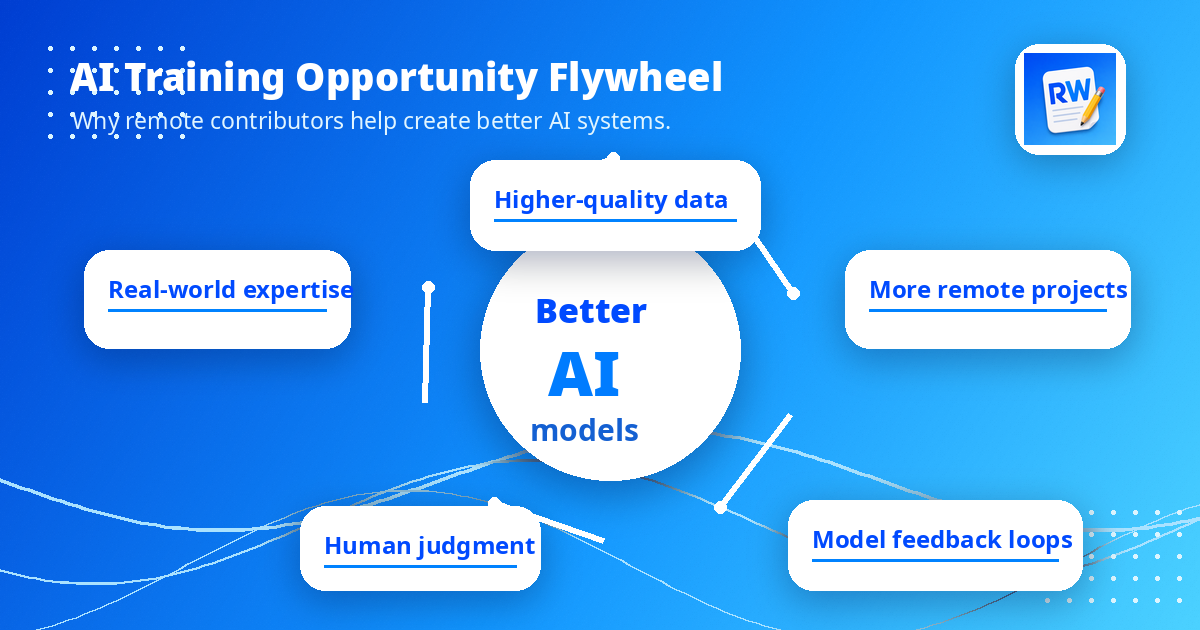
The best remote work opportunities are usually created when a large new industry needs something that cannot be fully automated. AI training fits that pattern. The world now has powerful AI systems that can write, code, research, summarize, analyze documents, reason through problems, and answer complex questions. But those systems still need people to judge whether their answers are accurate, useful, safe, clear, and aligned with what a real user wanted.
That is why AI training jobs, AI evaluator roles, model response review projects, and expert AI feedback work have become such important categories inside the remote work market. These jobs are not the same as old-school data entry. The better opportunities often involve reading AI-generated answers, comparing two responses, writing better examples, checking facts, reviewing code, evaluating reasoning, or using professional expertise to improve model quality.
For Remote Work Union, this is one of the strongest evergreen job categories because it connects several high-intent searches at once: remote work, work from home jobs, online jobs from home, AI training jobs, AI evaluator jobs, flexible remote jobs, and high-paying online opportunities. It also serves people who do not want customer support, cold sales, surveys, delivery apps, or low-value gig work.
What AI training jobs actually are
AI training work is a broad term for tasks that help improve artificial intelligence systems. Some projects are simple. Others require deep expertise. The work may be called AI training, AI evaluation, data annotation, LLM evaluation, prompt evaluation, AI tutoring, model response review, search quality evaluation, coding review, expert review, or reinforcement learning from human feedback.
The exact title matters less than the task. In most cases, the worker is helping a model learn what a better answer looks like. That might mean rating two AI responses, rewriting a weak answer, marking factual mistakes, checking whether a legal explanation makes sense, evaluating a math solution, reviewing code, judging tone, or creating examples that teach the model how to handle a certain kind of prompt.
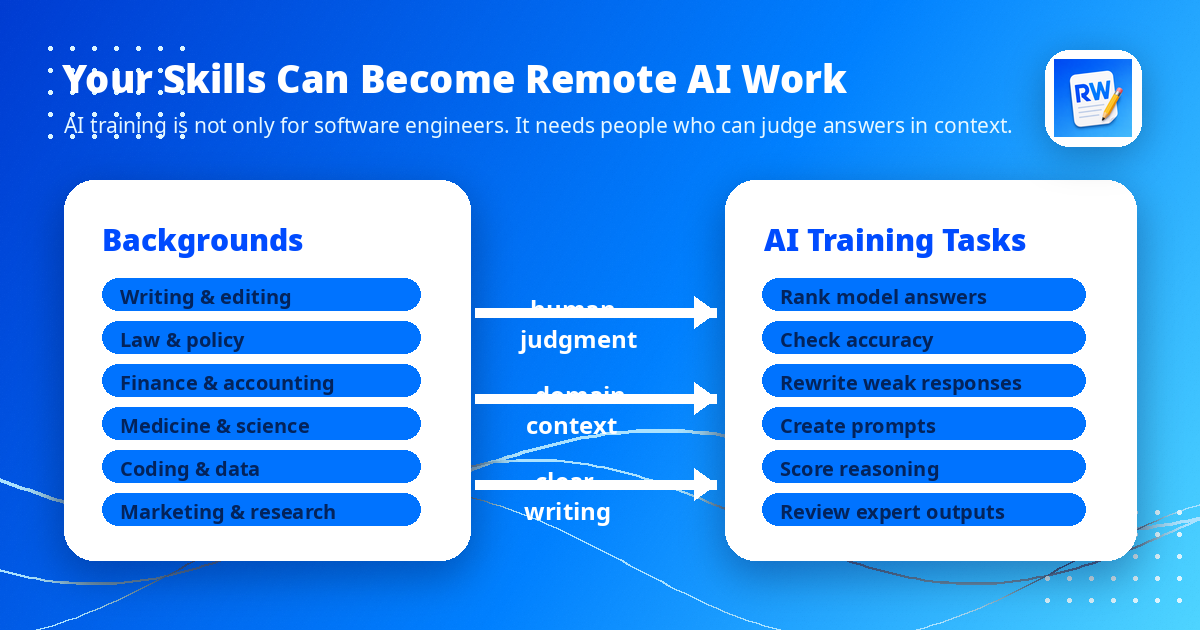
A writer might review whether a ChatGPT-style answer is clear and natural. A lawyer might evaluate a contract explanation. A finance professional might check whether an investment-related answer uses reasonable logic. A doctor or medical researcher might review clinical reasoning. A software engineer might test whether model-generated code actually works. A marketer might judge whether a social media strategy is realistic. A generalist might work on search evaluation, content quality, or basic response comparison tasks.
Key insight: You do not always need to be a developer to do AI training work. You do need to be careful, clear, and able to explain your reasoning.
Why AI training is so remote-friendly
AI training work is naturally remote because the work product is digital. The task usually happens inside a browser-based platform. A worker reads a prompt, reviews AI-generated output, completes a rating form, writes a correction, records a judgment, or submits a structured explanation. There is no physical location requirement for most of the work.
That makes it different from many traditional jobs that were moved online awkwardly. AI evaluation was built for the internet from the start. The work can be distributed across time zones. It can be split into projects. It can be assigned by skill category. It can be reviewed for quality. It can be done from home with a laptop, a stable connection, and the ability to follow instructions carefully.
This is one reason remote AI jobs are expanding across so many categories. The AI ecosystem includes major model companies and research labs associated with tools like ChatGPT, Claude, Gemini, Grok, Llama, and other large language models, plus a wider layer of platforms, vendors, data partners, and specialized AI work marketplaces. People searching for OpenAI jobs, Anthropic jobs, Google AI jobs, Meta AI jobs, xAI jobs, Microsoft AI jobs, Amazon AI jobs, Mistral AI roles, Cohere work, Perplexity-related AI work, Mercor opportunities, Outlier AI jobs, or Handshake AI projects are often looking for the same thing: a way to turn their skill set into remote AI work.
Not every listing is directly with a major AI company. Many remote AI training projects are offered through platforms, staffing partners, expert networks, or project marketplaces. But the underlying demand is connected to the same trend: AI systems need structured human feedback at scale.
Ready to apply for jobs? Go to RemoteWorkUnion.com to find roles hiring now.
Find Roles Hiring Now →Why this category can beat older online jobs
For years, many people searching for work-from-home jobs were pushed toward low-value options: surveys, data entry, microtasks, transcription mills, generic virtual assistant listings, and gig apps. Those categories can be useful for some people, but they often have the same problems. They are crowded, low-margin, repetitive, and hard to turn into meaningful income.
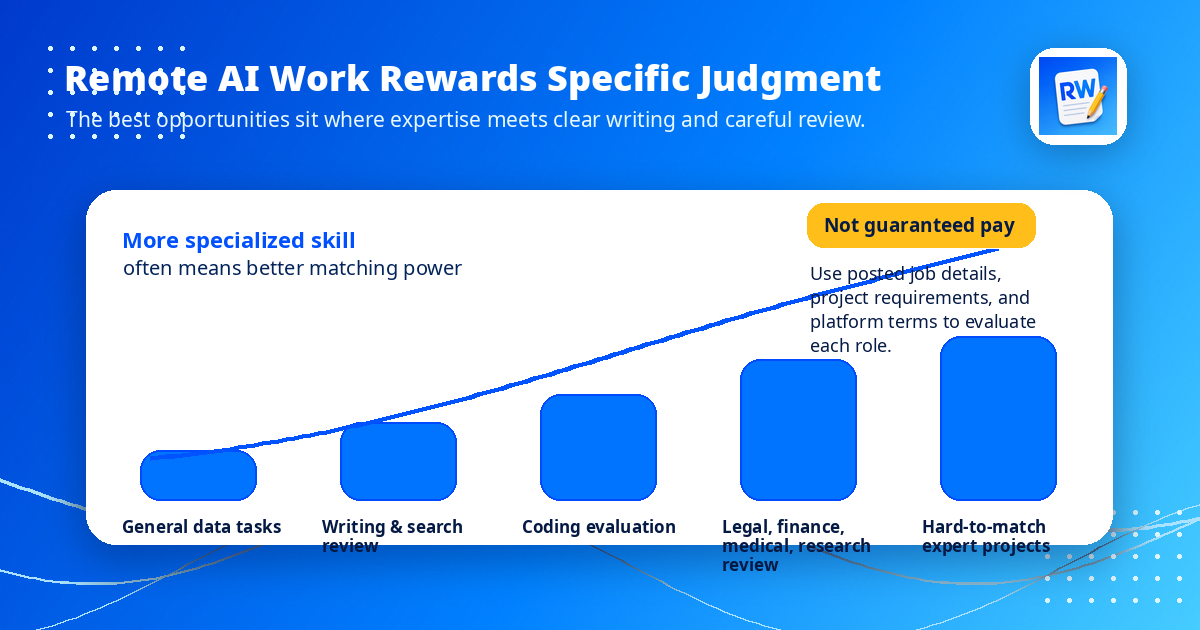
AI training work is different because the better projects are not only paying for time. They are paying for judgment. That matters. Judgment is harder to commoditize than clicking boxes. A person who can explain why one answer is better than another is more valuable than someone who only completes repetitive tasks. A person with domain expertise is even more valuable because the model needs feedback from people who understand the subject.
This does not mean every AI training job pays well. Some projects are basic. Some platforms have inconsistent volume. Some listings are not worth the time. But the category has a stronger ceiling than many old online job categories because specialized knowledge can matter. A remote worker with strong writing ability, legal knowledge, finance experience, medical knowledge, coding skill, research ability, or technical judgment can often compete for better projects than someone applying randomly to thousands of generic remote listings.
The kinds of people AI training work fits best
AI training is especially useful for people who are smart, detail-oriented, and comfortable working independently. It can fit writers, editors, researchers, teachers, lawyers, paralegals, accountants, analysts, finance professionals, medical professionals, engineers, coders, marketers, consultants, students, graduate students, and experienced professionals who want flexible online work.
It also fits people who do not want to spend their day on the phone. Many remote jobs are advertised as work from home but are really customer support, appointment setting, or sales. AI training work is often closer to reading, writing, analysis, and evaluation. That makes it more attractive to people who want remote jobs that are quiet, focused, and flexible.
The strongest candidates usually have three traits. First, they can write clearly. Second, they can follow detailed instructions. Third, they can explain their reasoning. If you can say, "This answer is better because it directly answers the question, avoids unsupported claims, and gives the user a practical next step," you are already thinking in the style these roles often require.
For expert projects, credentials and experience can matter. A law degree, medical background, finance experience, coding portfolio, academic research history, or professional writing background can help a platform match you with better work. For general projects, strong reading comprehension and careful writing may matter more than formal credentials.
Common AI training tasks remote workers may see
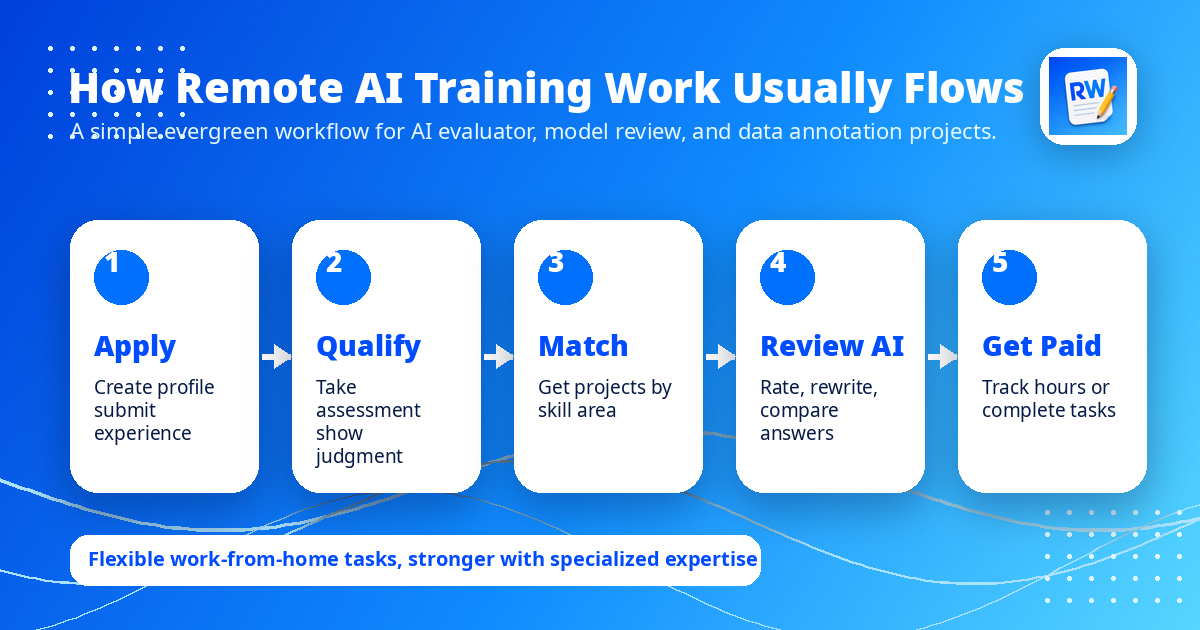
The day-to-day work can vary, but most AI training tasks fall into a few buckets. Response comparison is one of the most common. You may be shown two AI answers and asked which one is better. The best answer might be more accurate, more helpful, more complete, better structured, or safer.
Response rewriting is another common task. In this format, you might take a weak AI answer and improve it. That could mean making it more direct, adding missing context, removing unsupported claims, correcting grammar, or changing the tone to fit the user's request.
Prompt creation asks workers to write prompts that test an AI model. A project might need prompts about legal reasoning, math, coding, creative writing, medical explanations, financial analysis, marketing strategy, history, science, or everyday problem solving. Good prompts help reveal where the model is strong and where it fails.
Expert review is more specialized. A finance expert might check whether an AI answer misstates risk. A lawyer might identify a bad legal assumption. A software engineer might test generated code. A doctor might evaluate whether a medical explanation is too broad, unsafe, or poorly reasoned. A researcher might check citations, logic, or methodology.
Other tasks may include search quality evaluation, content classification, safety evaluation, factuality checking, instruction-following review, tone evaluation, data labeling, and structured annotation. The better you understand the task type, the easier it is to apply for roles that match your strengths.
Why AI companies need people from many backgrounds
AI models are general-purpose systems. Users ask them about everything: resumes, taxes, fitness, parenting, contracts, code, real estate, marketing, medical questions, business ideas, academic research, music, travel, and personal decisions. That range creates a problem for AI companies. A model cannot be evaluated properly by only one kind of worker.
A coding answer needs someone who understands code. A legal explanation needs someone who can recognize bad legal reasoning. A medical answer needs careful review. A finance answer needs someone who understands risk, assumptions, and terminology. A creative writing answer needs someone with taste and language ability. A customer-support simulation needs someone who understands tone and problem solving.
This is why remote AI training jobs can create opportunities for people who do not fit the standard tech hiring mold. You may not be a machine learning engineer, but you might still understand a domain the model needs to handle. You may not build the model, but you can help judge whether the model is useful. That distinction is important.
The AI labor market is not only about building models. It is also about improving them, testing them, correcting them, and teaching them what better output looks like. That creates a wider doorway for remote workers.
Ready to apply for jobs? Go to RemoteWorkUnion.com to find roles hiring now.
Find Roles Hiring Now →How to position yourself for better AI training projects
A strong AI training profile should make your judgment easy to understand. Do not only say you are interested in remote work. Show what you can evaluate. If you are a writer, mention editing, content strategy, grammar, tone, SEO, research, and long-form writing. If you are a lawyer or paralegal, mention legal research, contract review, compliance, policy, or analysis. If you are in finance, mention accounting, markets, modeling, bookkeeping, risk analysis, or business operations. If you code, mention languages, frameworks, debugging, testing, and code review.
The best profiles usually connect experience to task types. For example:
You should also prepare for assessments. Many platforms use qualification tests before matching workers with projects. These tests may check writing quality, instruction following, domain knowledge, attention to detail, or the ability to explain why one answer is better. Rushing these assessments is a mistake. Treat them like paid work before paid work. The platform is testing whether your feedback can be trusted.
Your profile should include relevant keywords without sounding spammy. Useful phrases may include AI training, remote AI jobs, AI evaluator, LLM evaluation, model response review, prompt evaluation, data annotation, content quality, factuality checking, expert review, writing evaluation, code review, legal review, finance review, medical review, research review, and work from home.
How to avoid low-quality AI job listings
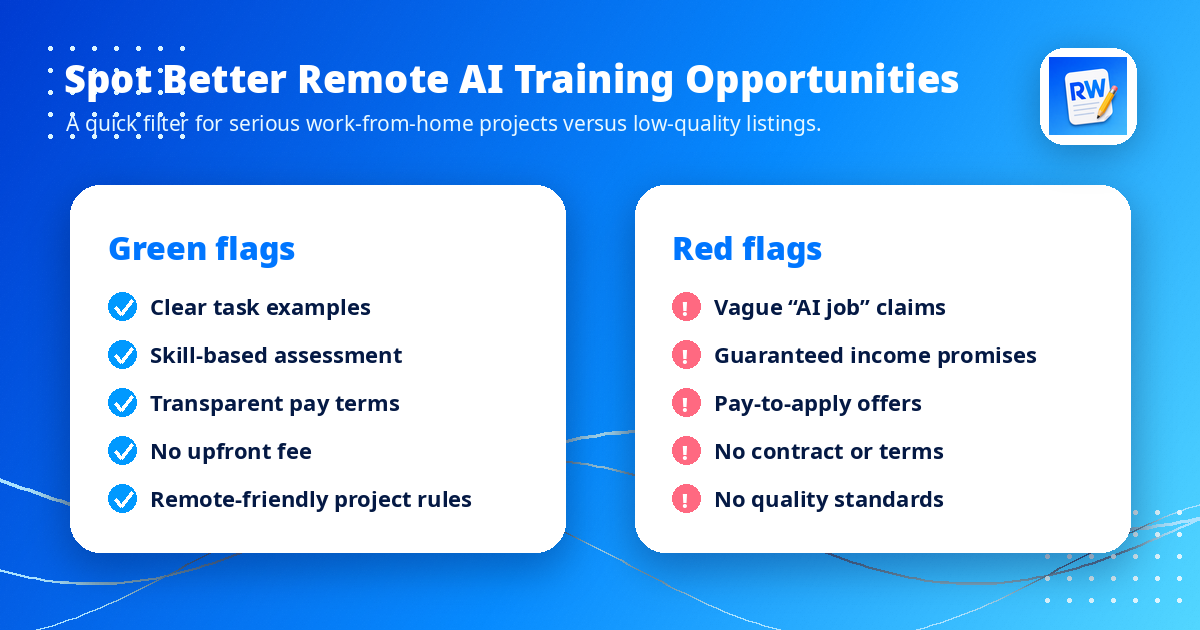
The popularity of AI has also created low-quality listings. Any fast-growing remote work category attracts vague promises, recycled job posts, affiliate traps, and unrealistic income claims. A serious AI training opportunity should explain what kind of work is involved, what skills are needed, how qualification works, how pay is calculated, and what quality standards apply.
Be cautious with listings that promise guaranteed income, ask for upfront fees, avoid explaining the task, use hype instead of requirements, or claim anyone can earn high hourly rates with no skill and no screening. Real AI training work usually has some kind of assessment or quality review. That is not a bad sign. It is often what separates real projects from spam.
Also understand that project volume can change. Some AI evaluator jobs are steady. Others are project-based. Some workers use AI training as a side hustle. Others stack several platforms. Some use it as a bridge while applying for full-time remote roles. The best approach is to think in terms of a remote work portfolio, not one magic website.
Remote Work Union can help by organizing remote jobs, AI training jobs, online jobs from home, and flexible opportunities in one place so applicants spend less time digging through irrelevant listings.
Why AI training is likely to remain a major remote work category
AI systems will keep changing, but the need for human feedback is not going away quickly. As models become more capable, the evaluation problems become more complex. It is easy to rate a simple answer. It is harder to judge whether a model gave a strong legal explanation, wrote secure code, handled a sensitive medical topic responsibly, or reasoned through a messy business problem.
That is why human review remains valuable. The work may evolve from basic labeling to more advanced evaluation, expert testing, synthetic data creation, red-teaming, prompt design, workflow evaluation, and domain-specific model improvement. But the underlying need is the same: AI systems need human judgment to become more useful.
This is also why AI training is such a strong category for remote workers in 2026 and beyond. It sits at the intersection of major trends: AI adoption, remote work, flexible online income, expert marketplaces, and the demand for better digital labor matching. The opportunity is not that every person will earn the highest advertised rate. The opportunity is that more people can turn real skills into remote work without needing to become machine learning engineers.
- For beginners: this can be a starting point.
- For experts: it can be a flexible side income channel.
- For writers and researchers: it can be a better alternative to low-paying content mills.
- For coders: it can be a way to monetize review skills.
- For professionals: it can create access to projects that value experience without requiring a traditional full-time job search.
Final takeaway
AI training is becoming one of the best remote work opportunities because it solves a real problem. AI companies need better model feedback. Workers need flexible online jobs that use their intelligence. The work can be remote, skill-based, and more meaningful than many older online job categories.
The best candidates will not treat AI training like a shortcut. They will treat it like a new remote work lane. They will build a clear profile, apply to relevant projects, take assessments seriously, avoid low-quality listings, and focus on the roles that match their actual strengths.
For anyone searching for remote work from home, online jobs, AI evaluator roles, AI training jobs, or flexible remote AI projects, this category deserves serious attention. It is not the only remote opportunity, but it is one of the most important ones to understand.
Frequently asked questions
What are AI training jobs?
AI training jobs are remote roles where workers help improve artificial intelligence systems by rating responses, rewriting weak answers, creating prompts, checking facts, reviewing code, or evaluating reasoning. The work may be called AI training, AI evaluation, data annotation, LLM evaluation, prompt evaluation, or reinforcement learning from human feedback (RLHF).
Do I need coding experience for AI training jobs?
Not always. Coding is important for technical AI roles, but many AI training jobs use writing, research, legal, finance, healthcare, marketing, education, or general reasoning experience. The key is matching your background to the right task type.
Are AI training jobs full-time or part-time?
Both exist. Some are full-time roles at AI companies or startups. Many are flexible contractor projects, task-based platforms, expert review assignments, or part-time remote opportunities.
How do I avoid low-quality AI job listings?
A serious AI training opportunity should explain what kind of work is involved, what skills are needed, how qualification works, how pay is calculated, and what quality standards apply. Be cautious with listings that promise guaranteed income, ask for upfront fees, avoid explaining the task, use hype instead of requirements, or claim anyone can earn high hourly rates with no skill and no screening.
Which platforms offer AI training and evaluator jobs?
AI training projects are offered through major AI labs and through platforms, staffing partners, expert networks, and project marketplaces. Handshake AI, Mercor, micro1, and Outlier AI are common starting points. The best strategy is to build profiles across multiple legitimate sources and track applications carefully.