AI training work is not only for programmers. Some of the strongest remote AI jobs are built around judgment: reviewing whether a model gives a useful answer, comparing two responses, checking business reasoning, identifying weak assumptions, and explaining which output is better. That is exactly why consultants, MBAs, business analysts, operators, market researchers, finance professionals, and strategy generalists can be a good fit for AI evaluation jobs.
The best applicants in this category usually have a mix of clear writing, structured thinking, research ability, spreadsheet comfort, and professional context. They may not build machine learning systems, but they can tell when an AI answer sounds confident without actually solving the business problem.
Why Business Professionals Fit AI Training Work
AI training jobs, AI evaluator jobs, model evaluation jobs, data annotation projects, prompt review work, and RLHF tasks all depend on human feedback. In many projects, the reviewer is not asked to invent a new product or build a technical system. The reviewer is asked to judge quality.
For business content, that judgment often comes from the same skills used in consulting, MBA coursework, analytics, operations, research, and management work. A consultant may be able to evaluate whether an AI-generated strategy memo actually answers the client question. An MBA may be able to compare two responses about pricing, leadership, marketing, or financial planning. A business analyst may be able to spot unclear requirements, weak process logic, or misleading data interpretation.
What the Work Can Look Like
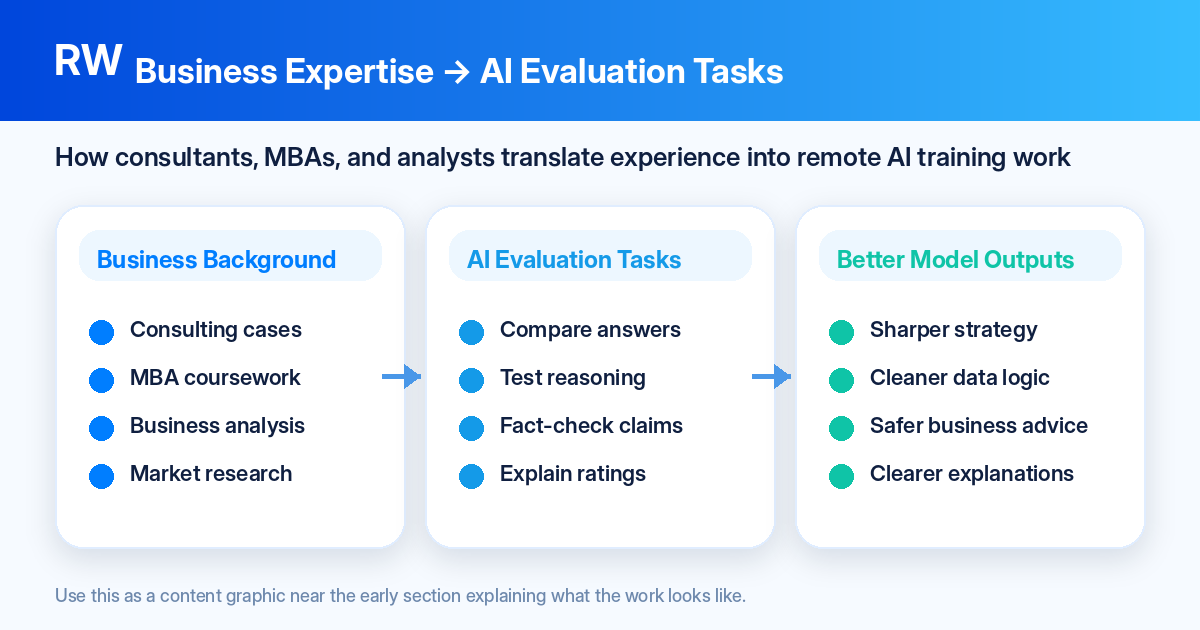
Business-focused AI evaluation work usually falls into a few practical task types. Read a prompt, review one or more AI responses, decide which response is better, identify mistakes, and write a clear explanation. A business prompt might ask for a go-to-market plan, a market sizing approach, a SWOT analysis, a sales email sequence, a financial forecast, a pricing recommendation, or an operations improvement plan.
Some tasks are simple side-by-side comparisons. Others require fact-checking, research, spreadsheet reasoning, or domain-specific judgment. A higher-level task may ask you to evaluate whether a model overstates confidence, misses a key risk, gives advice that would not work in the real world, or presents analysis that sounds structured but lacks substance.
Best-Fit Backgrounds for This Category
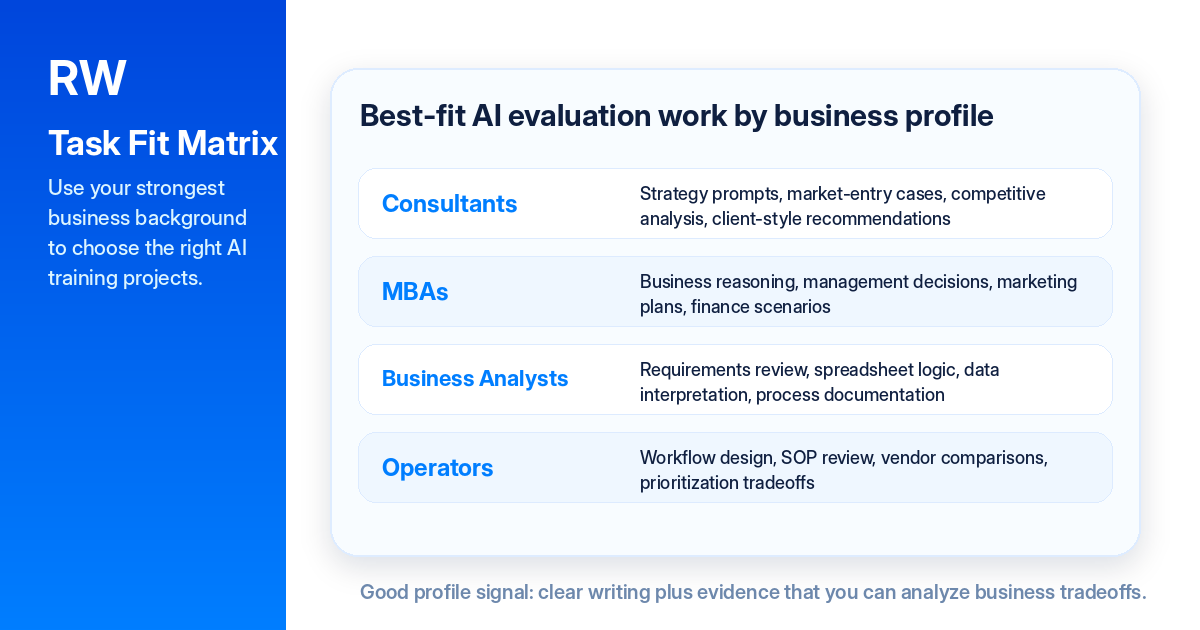
Consultants often fit strategy, market research, business case, competitor analysis, and executive-summary evaluation tasks. Their strongest signal is the ability to structure ambiguous problems and communicate tradeoffs clearly.
MBAs often fit management, finance, marketing, operations, leadership, entrepreneurship, and business reasoning tasks. AI platforms may not care about the credential alone, but they care about whether you can evaluate business answers at a professional level.
Business analysts often fit requirements analysis, process review, data interpretation, dashboard explanation, spreadsheet logic, and operations documentation tasks. Experience with Excel, SQL, financial models, and operational data translates directly.
Operators and startup generalists can also fit. Many AI answers fail because they ignore implementation constraints. A person who understands timelines, vendors, customers, and internal process can see problems that purely academic answers miss.
Skills to Emphasize in Your Profile
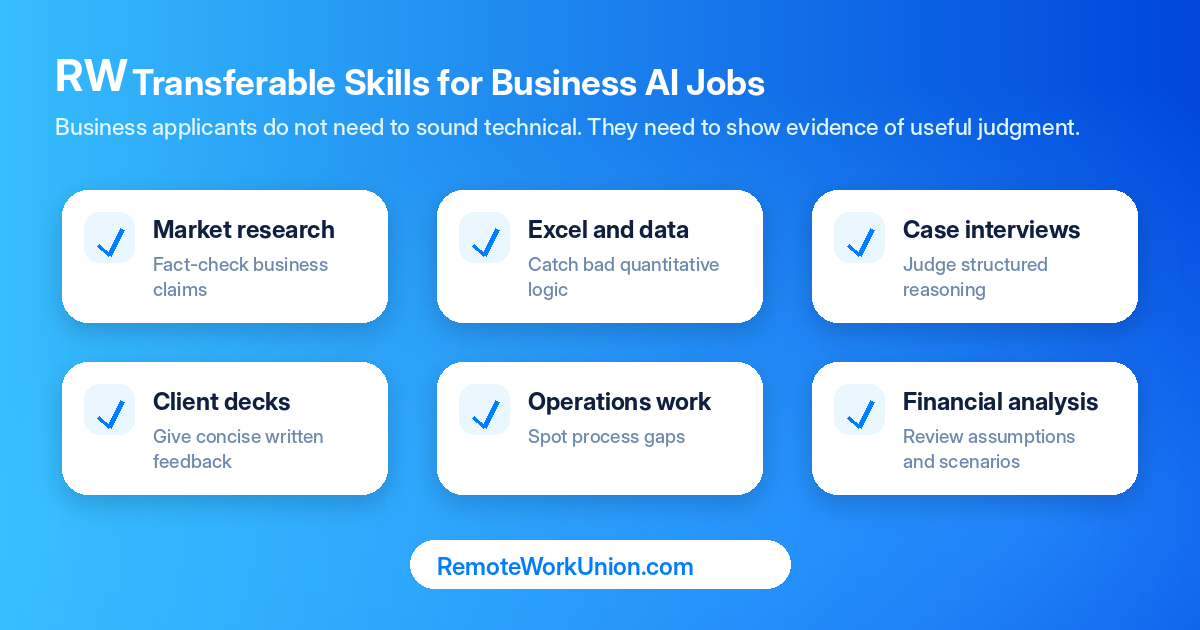
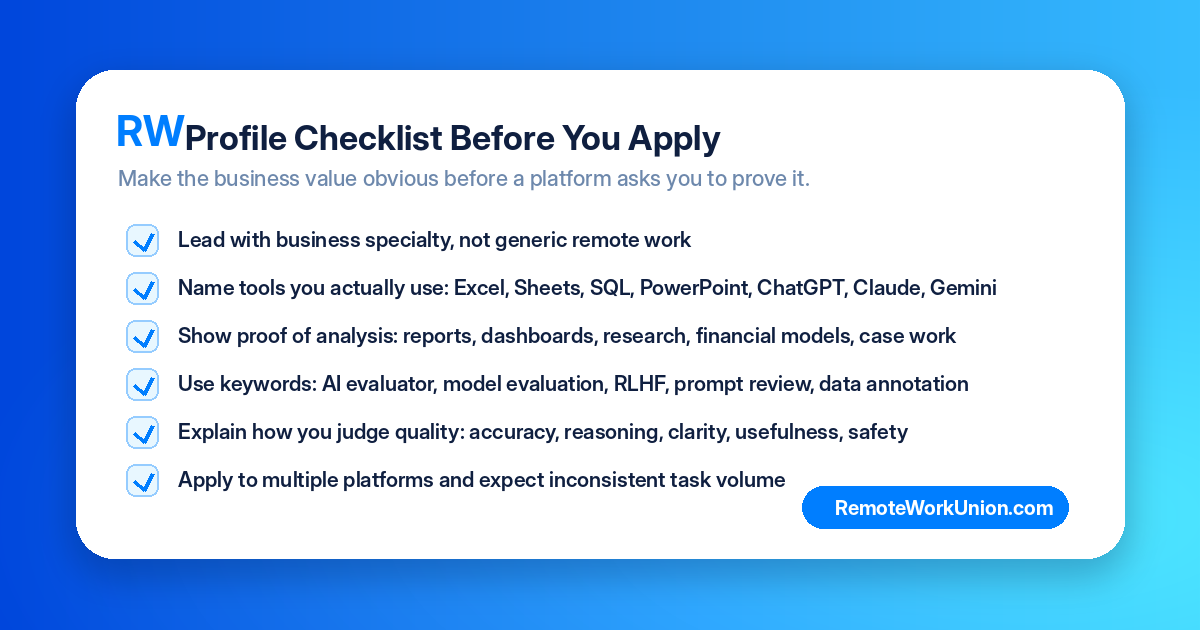
Useful keywords include strategy analysis, market research, financial analysis, business analysis, operations, Excel, Google Sheets, SQL, PowerPoint, executive communication, written feedback, prompt review, AI evaluator, model evaluation, RLHF, data annotation, business reasoning, fact-checking, and AI response quality. Mention tools like ChatGPT, Claude, Gemini, Notion, Airtable, Looker, Tableau, or Salesforce when accurate to your experience.
How to Position Your Background
Consultants should lead with problem structure. AI evaluation projects often reward reviewers who can tell whether an answer frames the problem correctly before jumping into recommendations. Good profile language might focus on structured problem solving, market research, client-ready writing, business cases, synthesis of ambiguous information, and recommendation quality.
MBAs should avoid relying only on the credential. The degree can help, but the stronger signal is the work behind it: cases, models, presentations, finance projects, marketing analysis, operations strategy, or startup work. Connect your coursework to task categories — finance for financial reasoning tasks, marketing for positioning and campaign tasks, operations for process design tasks.
Business analysts should lead with clarity, requirements, and data logic. A strong profile signals requirements gathering, stakeholder communication, process mapping, KPI reporting, dashboard review, Excel modeling, SQL queries, and systems thinking.
Remote Work Union connects you to legitimate remote AI training and evaluation roles. Apply for free and find roles hiring now.
Find Roles Hiring Now →Example Tasks a Business Reviewer Might See
A reviewer might compare two AI-generated answers to a prompt such as: "Create a plan to reduce customer churn for a subscription software company." The better answer may identify leading indicators, segment customers, recommend realistic interventions, and avoid unsupported claims.
Another task might check a financial explanation. If a model says a company can increase profit by cutting price and increasing volume, the reviewer may need to check whether the answer considers margins, fixed costs, variable costs, demand elasticity, and capacity constraints.
Where These Jobs Appear
Business-focused AI training opportunities appear under many labels. Search for AI evaluator, AI trainer, model evaluator, AI data annotation specialist, RLHF evaluator, prompt evaluator, business expert evaluator, business analyst AI, strategy AI evaluator, and remote AI consultant. Some applicants search around major AI companies including OpenAI, Anthropic, Google, Gemini, Meta AI, Microsoft, and Amazon. In practice, many roles appear through contractor platforms, AI training vendors, and specialized evaluation platforms.
Also search LinkedIn, company career pages, AI contractor sites, talent marketplaces, and job boards. The title may not say "consultant" or "MBA" — many good fits are hidden behind labels like AI model evaluator, business reasoning expert, prompt response reviewer, or subject matter expert.
What Makes a Strong Application
A strong application is specific. A weak profile says: "I am an MBA looking for remote AI work." A stronger profile says: "MBA-trained business analyst with experience reviewing market research, building Excel models, summarizing executive reports, and evaluating strategy recommendations. Comfortable comparing AI-generated business answers for reasoning quality, factual accuracy, clarity, and practical usefulness."
Prepare for assessments. Many platforms use writing tests, reasoning tasks, domain tests, or short evaluation trials. The ability to follow a rubric matters as much as the ability to sound smart. If the task asks for a concise justification, write a concise justification. If it asks you to compare two outputs, compare them directly.
Realistic Expectations
AI training income can be strong but is often inconsistent. Some projects pay well and provide steady work for a period of time. Others slow down or disappear with little notice. The safest approach is to apply across multiple credible platforms, keep your profile updated, and avoid depending on one project as your only income source until it proves stable.
Strategy tip: Start by choosing your strongest business lane. A consultant can lead with strategy and market analysis. An MBA can lead with business reasoning and management topics. A business analyst can lead with requirements, data, and process quality. Apply broadly and track which specialties are getting traction.
Frequently Asked Questions
Do consultants and MBAs qualify for remote AI training jobs?
Yes. Many AI training and model evaluation projects specifically need reviewers with business judgment — people who can evaluate whether an AI answer about strategy, market analysis, finance, or operations is accurate, practical, and useful. Consultants, MBAs, business analysts, and operators can qualify for these roles.
What kinds of tasks do business professionals do in AI evaluation work?
Common tasks include comparing two AI-generated business answers and choosing the stronger one, checking whether a business recommendation is realistic and accurate, reviewing market research summaries, evaluating financial reasoning, and writing concise feedback explaining why one response is better than another.
What keywords should a consultant or MBA use when searching for AI training jobs?
Try combinations like AI evaluator, AI trainer, AI model evaluation, business AI evaluator, strategy AI reviewer, RLHF evaluator, prompt evaluator, data annotation specialist, business analyst AI jobs, consultant AI jobs, and MBA remote jobs. Also search by platform names like Mercor, Outlier AI, Handshake AI, and micro1.
Do these roles require coding or machine learning experience?
Most business AI evaluation roles do not require coding. The core skill is judgment — assessing whether an AI answer correctly addresses a business problem, uses sound reasoning, and would be useful to a real professional. Strong writing and structured thinking matter more than technical programming skills.