Consultants are a strong fit for a growing category of remote AI work: reviewing business answers produced by AI models. The task is not simply checking grammar. It is closer to reading a short client memo and deciding whether the reasoning is accurate, practical, well-structured, and safe to rely on.
When a user asks an AI system for help with pricing, market entry, competitive analysis, unit economics, hiring strategy, or a board-ready summary, the model needs more than fluent writing. It needs business judgment. That is where consultants, MBAs, business analysts, operators, financial analysts, and market researchers can stand out.
What Reviewing AI Business Answers Actually Means
Reviewing AI business answers means judging whether a model response would be useful to a business user. The prompt might ask for a go-to-market plan, a market sizing estimate, a pricing recommendation, a customer segmentation framework, a turnaround strategy, or an explanation of why revenue is falling. The AI answer may sound confident, but a consultant-style reviewer has to look underneath the polish.
A reviewer asks practical questions: Does the answer understand the business problem? Are the assumptions realistic? Does the recommendation follow from the evidence? Does the analysis confuse revenue, margin, profit, cash flow, or customer acquisition cost? Does it give generic advice when the prompt asks for a specific decision?
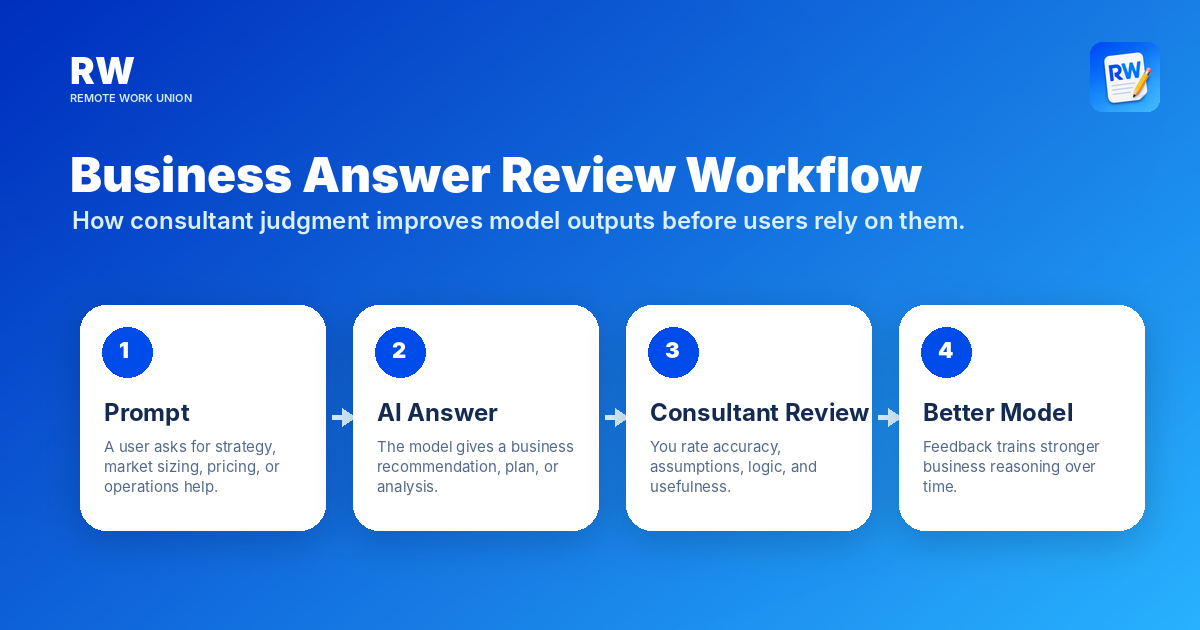
Why Consultants Are Useful to AI Companies
General writing ability matters, but business evaluation requires another layer: structured judgment. Consultants are trained to break vague problems into drivers, compare options, identify constraints, and communicate recommendations clearly. Those habits are valuable when reviewing AI-generated business content.
AI systems are expected to handle increasingly complex business questions. Human reviewers help improve those systems by showing what accurate, useful, and well-reasoned answers look like. A consultant does not need to be a machine learning engineer to contribute. In many expert AI training projects, the most valuable skill is the ability to read a response and say, in plain English, why it is strong, incomplete, misleading, or unhelpful.
The Kinds of Business Tasks Consultants May Review
Business answer review can cover a wide range of prompts. Common examples include reviewing AI answers about market sizing, customer segmentation, pricing models, sales strategy, churn reduction, profitability improvement, supply chain tradeoffs, competitive positioning, product launch plans, KPI dashboards, vendor selection, financial assumptions, unit economics, hiring plans, and board memo summaries.
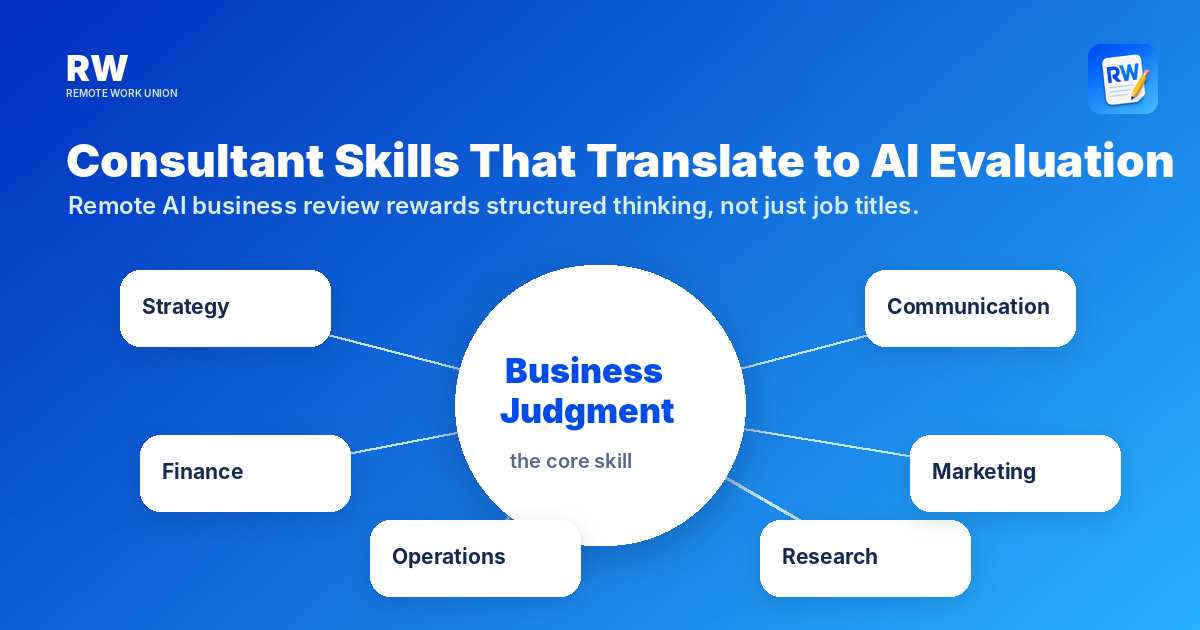
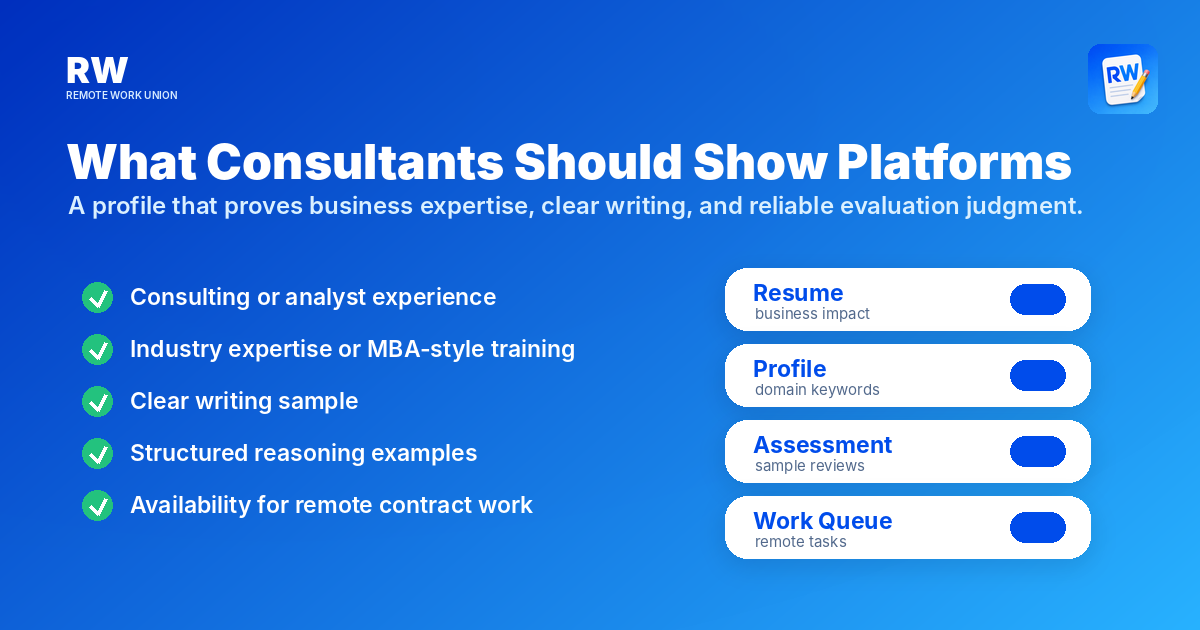
The strongest applicants do not describe themselves only as consultants. They make their expertise searchable. A profile might mention strategy consulting, management consulting, business operations, financial modeling, Excel, market research, competitive analysis, product strategy, or whatever industries they can credibly evaluate.
What Platforms Usually Look For
Every platform has its own process, but consultant-friendly AI evaluation work often rewards the same signals: subject matter expertise, clear writing, reliable reasoning, attention to detail, and the ability to follow a rubric. A degree can help. Consulting experience can help. So can real operating experience, startup experience, analyst work, or domain-specific business knowledge.
Applicants should expect some form of screening: a resume review, profile questions, an AI interview, a writing sample, a timed assessment, or a sample evaluation task. Some platforms focus on broad AI model evaluation. Others recruit experts for specialized projects in business, finance, law, healthcare, coding, marketing, or research. Platforms worth checking include Handshake AI, Mercor, micro1, and Outlier AI.
Remote Work Union connects you to legitimate remote AI training and evaluation roles. Apply for free and find roles hiring now.
Find Roles Hiring Now →How to Position Your Consulting Background
A consultant should position for AI evaluation work by translating client-service experience into concrete review skills. Instead of saying only "strategy consultant," explain the types of business decisions you have evaluated. Instead of saying only "built models," mention financial modeling, unit economics, revenue forecasting, Excel, sensitivity analysis, market sizing, or KPI design when true.
A strong profile makes it easy for a platform to understand what you can review. For example: "I can evaluate AI answers involving market entry, B2B SaaS pricing, sales funnel analysis, financial assumptions, competitive research, and executive memo writing." That is more useful than a vague claim like "I am good at business."
How to Perform Well on Sample AI Evaluation Tasks
The best approach is direct and structured. First, identify the user's actual question. Second, read the AI answer for correctness and relevance. Third, check whether the assumptions are stated and reasonable. Fourth, decide whether the answer would help a business person take the next step. Fifth, write feedback that is specific, concise, and actionable.
When comparing two AI responses, do not reward the longer answer automatically. A shorter answer can be better if it is more accurate, more responsive, and easier to use. Good feedback sounds like a clean consulting note: "Response A is stronger because it directly addresses the pricing tradeoff, identifies the key margin risk, and recommends a testable next step. Response B is more generic and does not account for customer acquisition cost."
A Simple Rubric Consultants Can Use
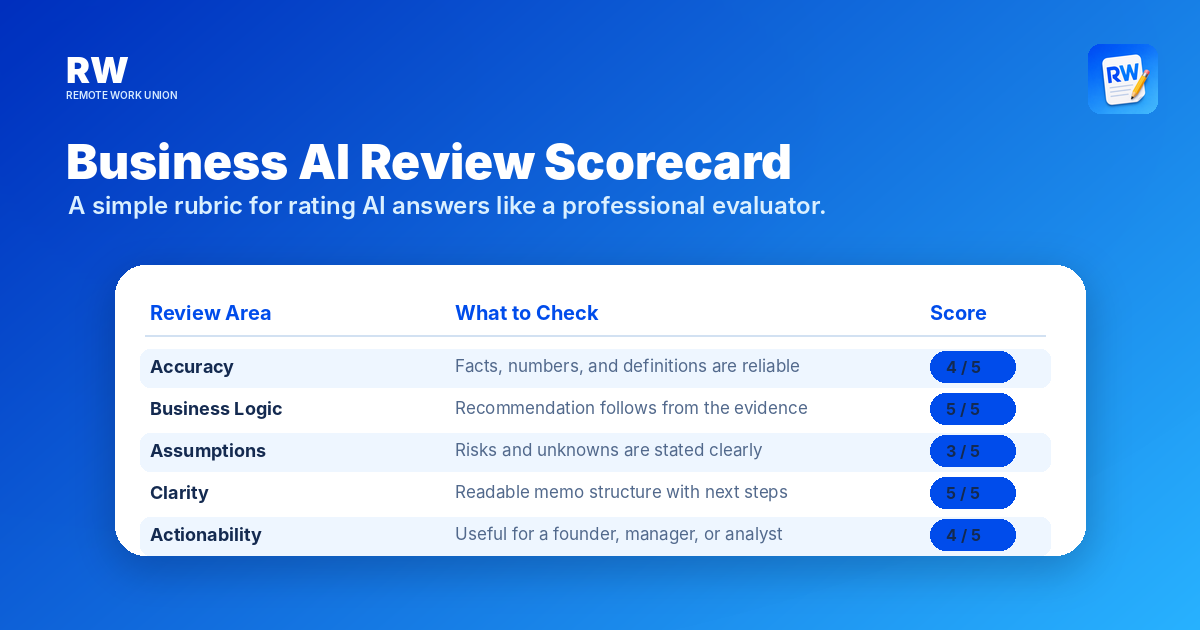
A business AI answer can be reviewed across five basic dimensions:
- Accuracy — are the facts, calculations, definitions, and business concepts correct?
- Business logic — does the conclusion follow from the information given?
- Assumptions — does the answer state what it does not know and avoid pretending uncertain numbers are facts?
- Clarity — is the answer structured, readable, and appropriate for the audience?
- Actionability — could the user reasonably do something with the answer?
This rubric separates style from substance. A model can write beautifully and still fail on assumptions. Consultant reviewers are valuable because they can see those differences.
What This Work Can Look Like Day to Day
Day-to-day AI business evaluation work is usually task-based. A reviewer may log into a platform, receive available tasks, read prompts and model responses, choose ratings, compare answers, edit a response, or write feedback. Some projects are asynchronous and flexible. Others may have qualification tests, deadlines, weekly hour targets, or project-specific guidelines.
Income can vary by platform, project, skill level, country, demand, and task availability. It is better to treat this as remote contract work that can grow into a meaningful income stream than to assume every project will be stable forever. Consultants who apply to multiple legitimate platforms and maintain strong profiles usually have more options.
Mistakes Consultants Should Avoid
Common mistake: Sounding too theoretical. AI evaluation rewards practical judgment. A response that recommends a famous framework but ignores the user's specific constraints may not deserve a high rating. The second mistake is writing feedback that is too long. Platforms often want clear explanations, not a full consulting deck.
The third mistake is ignoring the rubric. Consulting instincts help, but each project has its own rules. If a guideline says to prioritize factual accuracy over tone, follow that rule. The fourth mistake is applying with a generic resume. A consultant who wants AI business evaluation work should make business expertise obvious using plain keywords: strategy, finance, operations, market research, pricing, analytics, Excel, product, go-to-market, and executive writing.
Frequently Asked Questions
What does reviewing AI business answers actually involve?
Reviewing AI business answers means judging whether a model response would be useful to a business user. Reviewers check accuracy, business logic, assumptions, clarity, and actionability. Tasks typically involve comparing two AI responses, rating one response against a rubric, and writing concise feedback explaining the decision.
What makes a consultant a strong AI business evaluator?
Consultants are trained to break vague problems into drivers, compare options, identify constraints, and communicate recommendations clearly. Those habits are valuable when reviewing AI-generated business content — spotting when a pricing strategy ignores margins or when a market entry plan skips regulatory risk.
How should a consultant position their background for AI evaluation roles?
Translate client-service experience into concrete review skills. Instead of saying only "strategy consultant," explain the types of business decisions you have evaluated — market entry, pricing, financial modeling, competitive research, or executive memo writing. The goal is to make your fit obvious, not generic.
What is a simple rubric consultants can use when evaluating AI business answers?
Review across five dimensions: accuracy (are the facts and calculations correct?), business logic (does the conclusion follow from the evidence?), assumptions (does the answer state what it does not know?), clarity (is the answer structured and readable?), and actionability (could the user do something with this answer?).