Advanced degrees can be valuable in remote AI review work, but not because the degree itself does the job. The value comes from the habits that advanced training usually builds: careful reading, precise writing, source evaluation, technical vocabulary, ethical judgment, and the ability to explain why one answer is better than another.
That is exactly what many AI review jobs require. Large language models and AI assistants need human reviewers who can evaluate model answers, rank responses, check facts, identify weak reasoning, improve prompts, and write better examples. For people with a PhD, JD, MBA, MD, nursing background, engineering degree, research experience, or another advanced credential, AI review work can be one of the most natural remote job categories to explore.
What AI Review Jobs Actually Are
AI review jobs are remote or hybrid online roles where humans evaluate the quality of AI-generated answers. The exact title can vary. You may see AI evaluator, AI response reviewer, model evaluator, AI trainer, RLHF reviewer, data annotation specialist, prompt evaluator, search quality rater, expert reviewer, subject matter expert, or AI fact-checker.
The common thread is simple: an AI system produces an output, and a human decides whether that output is useful, accurate, safe, clear, well-reasoned, and appropriate for the task. In some projects, you compare two AI responses and choose the stronger one. In others, you rewrite a weak answer, create an ideal answer, check sources, write a critique, or score the output against a detailed rubric.
Why Advanced Degrees Fit AI Review Work
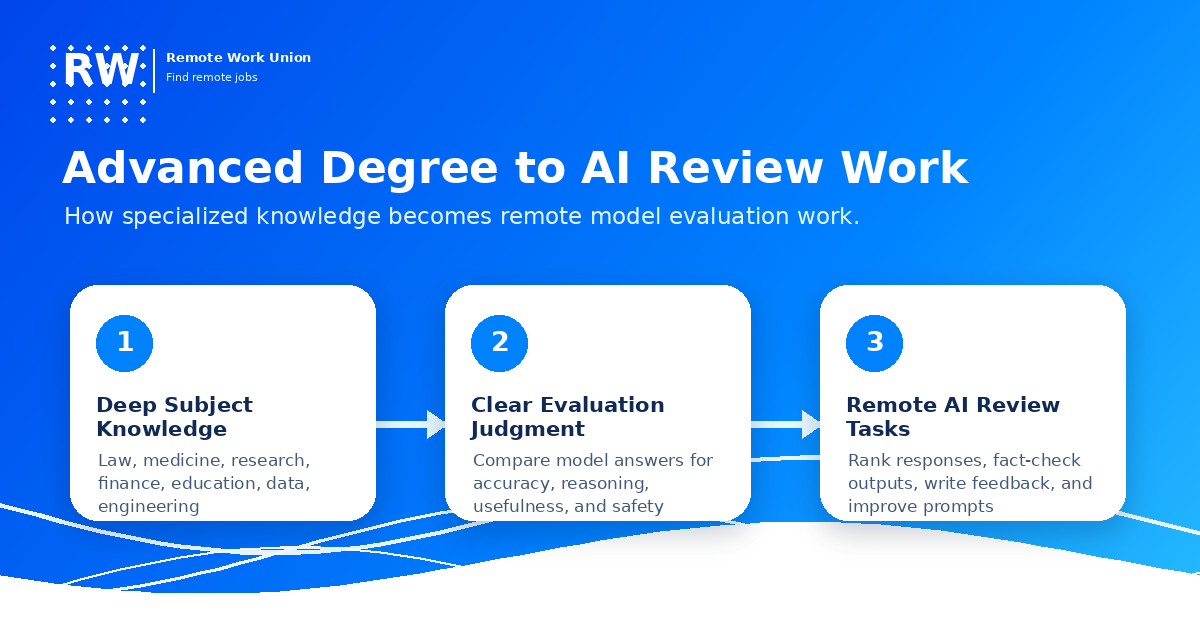
Advanced-degree applicants often have an advantage because AI review work rewards disciplined thinking. A model answer may look polished but still contain a subtle error. A reviewer has to notice the gap between confidence and correctness. That is familiar territory for researchers, lawyers, clinicians, educators, analysts, and technical professionals.
A PhD student may be trained to separate evidence from speculation. A lawyer may be trained to identify unsupported legal conclusions. A clinician may know when a medical answer sounds too certain or skips a safety caveat. An MBA or consultant may recognize a shallow business framework. A software engineer may see that working-looking code has a hidden bug. A teacher may recognize whether an explanation actually helps a learner.
Best AI Review Jobs for Advanced-Degree Holders
1. Expert AI Response Evaluator
Expert AI response evaluators review model answers in a specialized domain. A legal evaluator might compare two explanations of a contract issue. A medical reviewer might assess whether an answer gives safe general health information. A finance reviewer might check whether a model explains valuation, accounting, or risk correctly. This is often the best-fit category for advanced-degree applicants because it connects subject knowledge with practical evaluation.
2. AI Fact-Checking Reviewer
AI fact-checking jobs are built around accuracy. The reviewer looks for hallucinations, unsupported claims, outdated statements, wrong calculations, misread documents, weak citations, and overconfident conclusions. Advanced-degree applicants are often strong here because fact-checking is part of academic, legal, medical, technical, and professional work. Strong fact-checkers do not simply say that an answer feels wrong — they identify the specific claim and explain what should be corrected.
3. Research Synthesis Reviewer
Research synthesis work asks reviewers to evaluate how well an AI system summarizes complex information — scientific research, public policy, market analysis, legal context, or academic material. People with graduate research experience can be strong candidates because they are used to reading dense material and turning it into clear conclusions.
4. Legal, Medical, Finance, and Technical AI Review
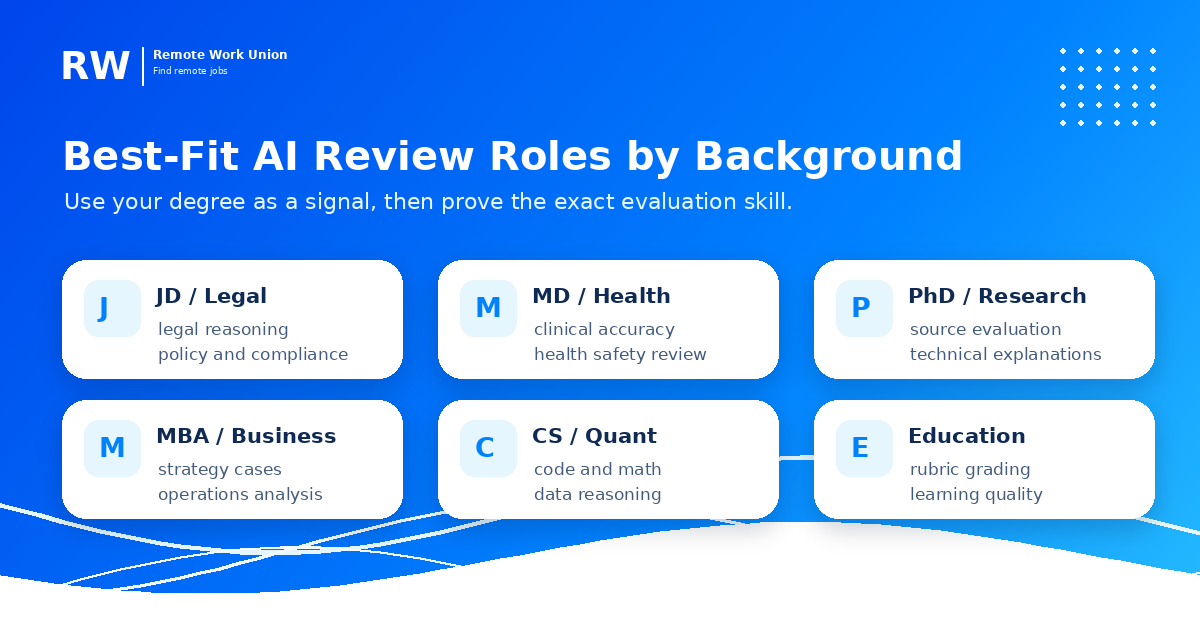
Domain-specific AI review jobs are among the most attractive opportunities for advanced-degree applicants. Legal reviewers may evaluate reasoning, issue spotting, policy interpretation, contract language, and compliance explanations. Medical reviewers may assess patient-facing language, clinical safety, and health information quality. Finance reviewers may examine accounting, investing, and risk explanations. Technical reviewers may evaluate code, math, statistics, and engineering outputs. These jobs require more than casual familiarity — the reviewer must understand what a good answer looks like inside that field.
5. Prompt and Ideal Response Writer
Some AI training projects ask humans to create prompts and write ideal answers. Advanced-degree applicants can do well here when they know how to create challenging but fair prompts. A good prompt tests reasoning, accuracy, nuance, and domain expertise. The strongest prompt writers understand what separates an easy content task from a useful model-training task.
6. AI Safety and Policy Evaluation
AI safety evaluation work involves reviewing whether model answers handle sensitive, risky, or high-stakes topics appropriately — health, law, finance, cybersecurity, privacy, or other areas where a confident but careless answer could cause harm. People with advanced training in law, policy, medicine, ethics, or social science may be especially relevant. The key skill is calibrated judgment: understanding what information is useful and where answers need boundaries.
7. Code, Math, Data, and Quantitative Review
Advanced technical reviewers evaluate whether AI-generated code, formulas, statistics, financial models, database queries, or mathematical explanations are correct. This work fits software engineers, data scientists, quants, statisticians, economists, engineers, and graduate students in technical fields. Technical AI review often pays attention to hidden failure modes — code may run but solve the wrong problem, or an explanation may use the right vocabulary while making an invalid assumption.
8. Education and Learning Quality Review
Teachers, professors, tutors, curriculum designers, and education specialists can evaluate whether AI answers actually help people learn. These jobs may involve grading explanations, improving step-by-step reasoning, spotting misleading simplifications, or checking whether an answer matches the student level. Education-focused AI review is not only about knowing the answer — it is about knowing how a person learns the answer.
Remote Work Union connects you to legitimate remote AI training and evaluation roles. Apply for free and find roles hiring now.
Find Roles Hiring Now →Best Degree Backgrounds for AI Review Jobs
PhD students and researchers can look for AI fact-checking, research review, scientific writing evaluation, citation quality review, and advanced reasoning tasks. Useful search terms: PhD AI jobs, research AI evaluator, scientific AI reviewer, subject matter expert AI jobs, AI model evaluation jobs.
JDs, lawyers, law students, and legal researchers can look for legal AI review, policy analysis, compliance review, legal reasoning evaluation, contract summarization, and document review projects. Useful search terms: legal AI evaluator, law AI training jobs, legal model evaluation, remote legal research AI jobs.
Clinicians, nurses, medical writers, and healthcare experts can look for medical AI review, health information quality, patient education review, clinical safety evaluation, and healthcare content fact-checking. Useful search terms: medical AI reviewer, healthcare AI training jobs, clinical AI evaluator, medical writing AI jobs.
MBAs, consultants, product managers, and business analysts can look for strategy evaluation, business case review, market research synthesis, finance evaluation, and management prompts. Useful search terms: business AI evaluator, MBA AI jobs, AI business analyst, remote AI strategy reviewer.
Engineers, coders, data analysts, and quantitative thinkers can look for code evaluation, math reasoning, spreadsheet tasks, analytics QA, and technical writing review. Useful search terms: AI code evaluator, data annotation, AI math reviewer, coding AI trainer, model evaluation engineer.
Teachers, tutors, professors, and education experts can look for learning-quality review, tutoring answer evaluation, curriculum-aligned prompts, and explanation rewriting. Useful search terms: AI education evaluator, tutoring AI jobs, academic AI reviewer, AI writing evaluator.
What the Work Usually Looks Like
A typical AI review task begins with a prompt. The prompt might ask a model to answer a legal question, debug a spreadsheet formula, summarize an article, explain a medical concept, compare two business strategies, solve a math problem, or write a lesson plan. The reviewer then reads one or more AI responses and decides how well they satisfy the task.
You may be asked to rate helpfulness, accuracy, completeness, safety, relevance, tone, instruction following, source quality, reasoning, formatting, or factual consistency. Many projects require written justification. The explanation does not need to be long, but it must be specific. Good reviewer feedback sounds like: Response A is stronger because it answers the main question, avoids unsupported medical advice, and correctly distinguishes general information from diagnosis. Response B is weaker because it makes a confident claim without evidence and misses the safety caveat requested in the prompt.
What Hiring Teams Look For
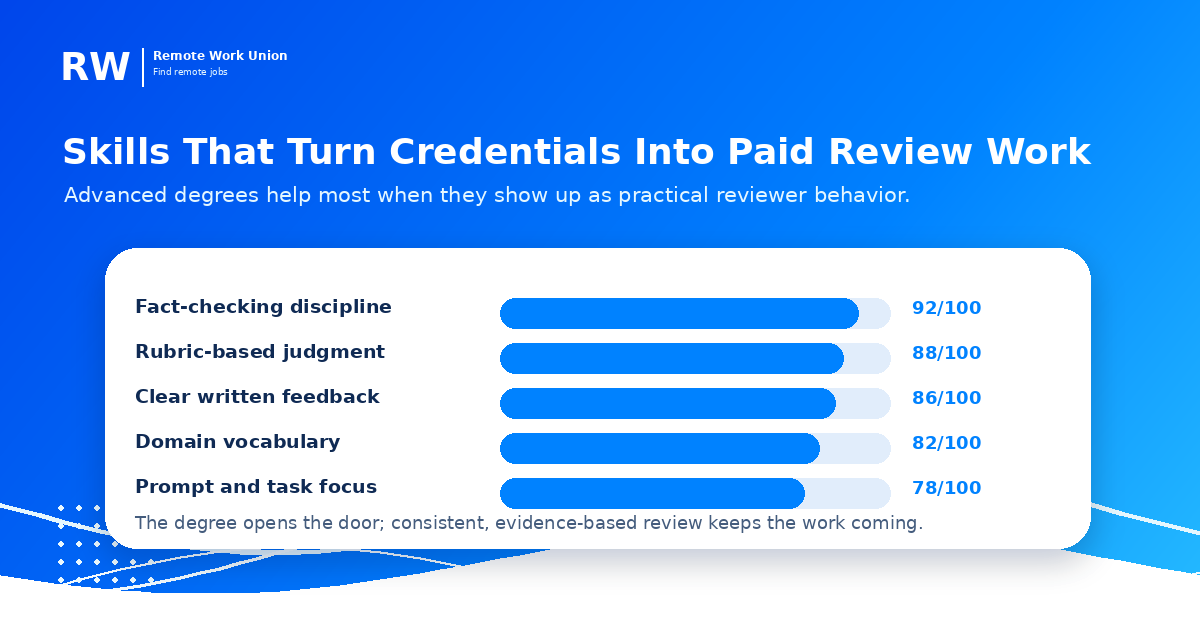
Advanced degrees help, but hiring teams usually care about practical signals. They want to see that you can write clearly, follow instructions, understand your specialty, evaluate without overthinking, and produce reliable work. A strong profile does not simply say PhD candidate or MBA graduate — it says what you can evaluate.
For example: economics PhD candidate with experience reviewing quantitative explanations, statistical reasoning, and research summaries. Or: JD with experience in legal research, issue spotting, policy analysis, and clear written feedback. Or: RN and medical writer with experience translating complex health information into safe patient-facing language. Hiring teams also look at assessment performance — many AI training platforms use tests that matter more than the resume.
How to Search for These Jobs
Search broadly because the same type of work appears under many titles. Useful keywords: AI review jobs, AI model evaluation jobs, remote AI training jobs, AI evaluator, model evaluator, RLHF jobs, AI fact-checking jobs, AI response reviewer, prompt evaluator, data annotation, subject matter expert AI jobs, search quality rater, AI writing evaluator.
You can also search by platform and specialty. Many applicants search for Mercor, Outlier AI, Handshake AI, Surge AI, DataAnnotation, micro1, Stellar AI, and similar platforms combined with their field: legal AI evaluator, healthcare AI reviewer, finance AI training jobs, PhD AI jobs, coding AI evaluator, or education AI evaluator. Major AI company names like OpenAI, Anthropic, Google, Meta, Microsoft, xAI, ChatGPT, Claude, Gemini, Copilot, and Grok are useful search modifiers — but a result mentioning a major AI company does not mean the job is directly at that company.
Resume and Profile Tips for Advanced-Degree Applicants
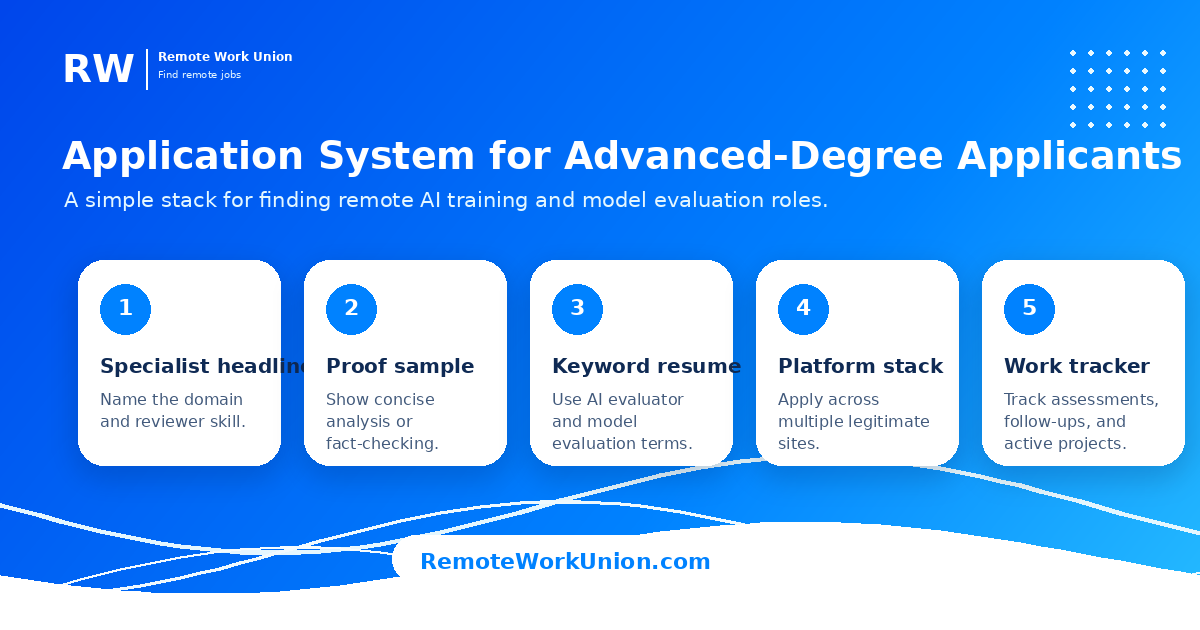
Your resume should translate academic or professional credentials into AI reviewer language. Use a headline that names the relevant domain and the task type. For example: Legal researcher focused on AI response evaluation and policy reasoning. Or: PhD researcher available for remote AI fact-checking, scientific writing review, and model evaluation.
Add a short skills section with keywords that match the work: AI model evaluation, response ranking, RLHF, prompt writing, fact-checking, source review, rubric-based grading, technical writing, domain expertise, data annotation, research synthesis, hallucination detection, and concise written feedback.
Key tip: The biggest mistake is sounding too general. Do not rely on the credential alone. Show the actual work you can do. If you have reviewed manuscripts, graded papers, written technical reports, checked legal citations, performed financial analysis, built spreadsheets, or evaluated research quality — those are relevant signals.
Assessment Tips
Read the instructions before judging the answer. Many applicants fail because they evaluate what they wish the task asked instead of what it actually asks. If the rubric says to prioritize accuracy over style, do that. If it says to penalize unsupported claims, do that. If it asks for a short explanation, keep the explanation short.
Be specific in feedback. A vague note like "Response A is better because it is more detailed" is weak. A stronger note says "Response A is better because it directly addresses all three requested criteria, while Response B ignores the pricing tradeoff and introduces an unsupported claim about market share." Avoid overclaiming — AI review work usually rewards efficient precision, not exhaustive demonstrations of expertise.
Is AI Review Work Worth It for Advanced-Degree Applicants?
AI review work can be worth exploring if you want remote, flexible, knowledge-based income. It can be especially appealing if you are between roles, finishing graduate school, building side income, consulting, freelancing, or looking for a way to monetize specialized expertise without taking a traditional full-time office job.
Be realistic about the nature of the work: many roles are contract-based, task availability can change, and some platforms have waitlists or project pauses. Treat AI review work as a portfolio of opportunities — apply to multiple platforms, keep your profile updated, and continue improving your evaluation skills. For advanced-degree applicants, the upside is clear: this category rewards the type of thinking that many professional and academic paths already build.
Frequently Asked Questions
Do advanced degrees help when applying for AI review jobs?
Advanced degrees can help, but the credential itself is not the deciding factor. What matters more is whether you can apply your training to practical evaluation tasks: reading carefully, explaining your reasoning, following a rubric, and identifying the difference between a polished answer and a correct one.
What kinds of AI review tasks are suited to PhD applicants?
PhD students and researchers can be a strong fit for AI fact-checking, research synthesis review, scientific writing evaluation, citation quality review, technical reasoning tasks, and domain-specific model evaluation in their field.
Can JDs and lawyers do remote AI review work without coding skills?
Yes. Legal AI review work typically involves evaluating legal reasoning, issue spotting, policy interpretation, compliance explanations, and document summaries. Coding is not required. The key skills are legal judgment and clear written feedback.
How should advanced-degree applicants position their resume for AI review jobs?
Lead with the specific domain you can evaluate, not just your degree title. Include keywords like AI model evaluation, response ranking, RLHF, fact-checking, research synthesis, hallucination detection, rubric-based grading, and written feedback. Translate your academic or professional work into AI reviewer language.