Subject matter experts are in a stronger position than many remote job seekers realize. AI companies and AI training platforms do not only need programmers. They also need people who can judge whether an answer is accurate, useful, safe, well-reasoned, and appropriate for a real user in a specialized field.
A marketer can recognize when AI copy is off-brand or unpersuasive. A salesperson can tell when an outreach message would never get a reply. A social media manager can spot the wrong tone for a platform. A finance analyst can tell when a model confuses revenue, margin, valuation, or accounting terms. A customer service lead can spot a reply that would frustrate a real customer. A teacher can evaluate whether an explanation actually helps a student learn. A lawyer can recognize when an AI answer oversimplifies a legal issue, and a software engineer can compare two code answers and explain which one is more correct.
Remote AI work often rewards exactly those skills. The job may be called AI model evaluation, AI training, expert review, data annotation, RLHF, prompt response evaluation, AI answer rating, AI fact-checking, search quality evaluation, or human feedback work. The title changes by platform, but the core idea is the same: human experts help improve AI systems by reviewing model outputs.
What Subject Matter Expert AI Work Actually Looks Like
Most expert AI work is not about building the model from scratch. It is usually about improving how AI systems respond after they have already been trained. Large language models such as ChatGPT, Claude, Gemini, Grok, Meta AI, Copilot, and other assistants need human review to become more reliable. The same is true for models used in enterprise search, coding tools, customer operations, healthcare workflows, legal research, finance analysis, education, and technical documentation.
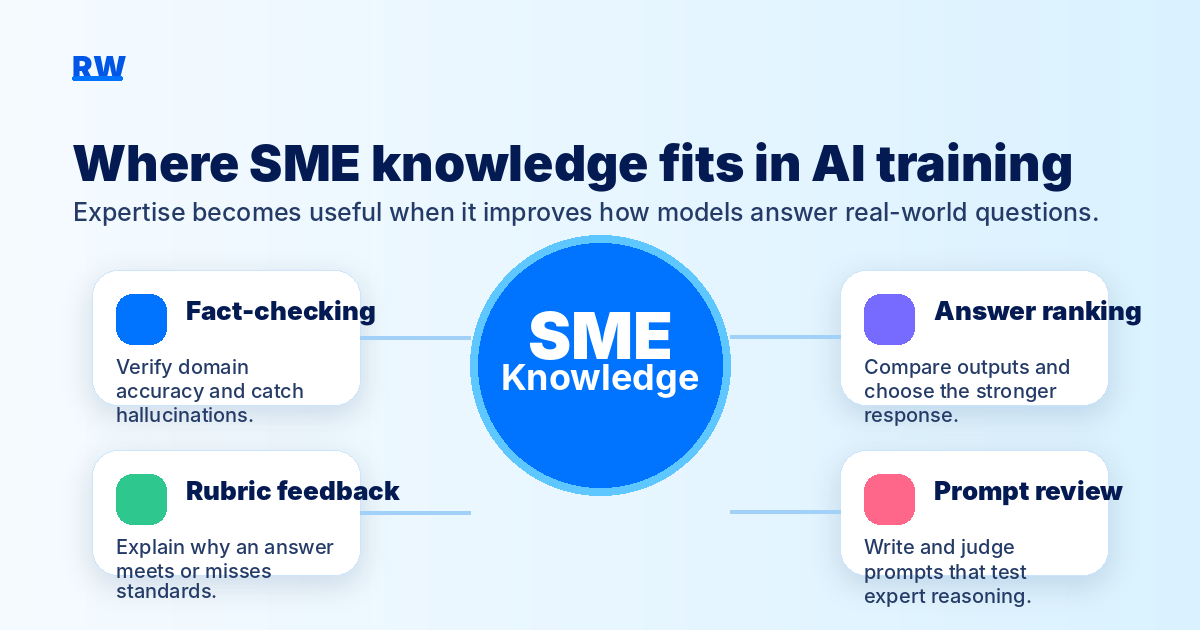
A subject matter expert may be asked to review a prompt and two AI responses. The task might ask which answer is better, whether the response contains factual errors, whether it follows instructions, whether it is too vague, whether it overstates certainty, or whether it misses an important nuance. In some projects, the expert writes an ideal answer. In others, the expert rates outputs against a rubric. In more advanced projects, the expert creates prompts that test whether the AI can reason through difficult domain-specific cases.
Common tasks include: ranking two AI answers and explaining which one is better; checking whether an answer is factually accurate in a specialized field; writing high-quality reference answers for difficult prompts; labeling model outputs for helpfulness, accuracy, completeness, and safety; creating prompts that test expert-level reasoning; reviewing citations, sources, calculations, or code; explaining why a model response is misleading, incomplete, or unsafe; and rewriting weak AI answers into stronger responses.
Why Expertise Matters More Than Generic Remote Work Experience
Many remote jobs are built around customer support, appointment setting, phone sales, scheduling, or repetitive admin work. Those roles can be useful, but they often do not reward deep knowledge. AI evaluation work is different because the value comes from knowing what a good answer should look like.
A general reviewer may be able to say that an answer is clear. A subject matter expert can say whether it is actually correct. AI systems can sound confident even when they are wrong. They can use the right vocabulary while making a flawed assumption. They can give a technically plausible answer that fails in the real world. They can provide advice that is too broad for a regulated field. They can miss constraints that only a practitioner would notice.
The Strongest Fields for Subject Matter Expert AI Work
Legal and compliance: Lawyers, law students, paralegals, legal researchers, compliance specialists, and policy professionals can review AI answers involving legal concepts, document analysis, contract interpretation, regulations, argument structure, and risk-sensitive language.
Healthcare and medicine: Doctors, nurses, pharmacists, therapists, medical writers, public health professionals, and clinical researchers may find projects involving medical explanations, patient-facing language, health education, documentation review, or biomedical fact-checking. These projects require caution because medical AI answers must avoid overconfidence and unsafe advice.
Finance, accounting, and business: Finance analysts, accountants, auditors, consultants, MBAs, investment professionals, tax specialists, and business operators can evaluate answers related to financial modeling, company analysis, spreadsheets, accounting concepts, market explanations, budgeting, valuation, and business strategy.
Marketing, sales, and communications: Marketers, copywriters, brand and content strategists, social media managers, SEO specialists, salespeople, business development reps, customer success and support leads, and PR professionals can judge whether AI-written copy, outreach, messaging, and customer replies are accurate, on-brand, persuasive, and usable in the real world. This is genuine expertise — knowing what actually converts or lands is hard to fake — and it is in constant demand as AI takes on more customer-facing writing.
Coding, data, and technical review: Software engineers, data analysts, Excel experts, technical writers, QA testers, cybersecurity professionals, and quantitative thinkers can review code outputs, SQL queries, debugging steps, technical documentation, data interpretation, and reasoning-heavy problem solving.
Education and tutoring: Teachers, professors, tutors, curriculum designers, academic editors, and test-prep experts can review whether AI explanations are clear, age-appropriate, pedagogically useful, and aligned with learning goals. Good teaching is not only about correctness — it is also about sequencing, tone, examples, and feedback.
Writing, journalism, and research: Writers, editors, journalists, researchers, PhD students, librarians, and analysts can help evaluate AI writing quality, sourcing, factual accuracy, argument structure, originality, tone, and clarity.
Remote Work Union connects subject matter experts to legitimate remote AI training and evaluation roles. Apply for free and find roles hiring now.
Find Roles Hiring Now →How to Turn Expertise Into an AI Work Profile
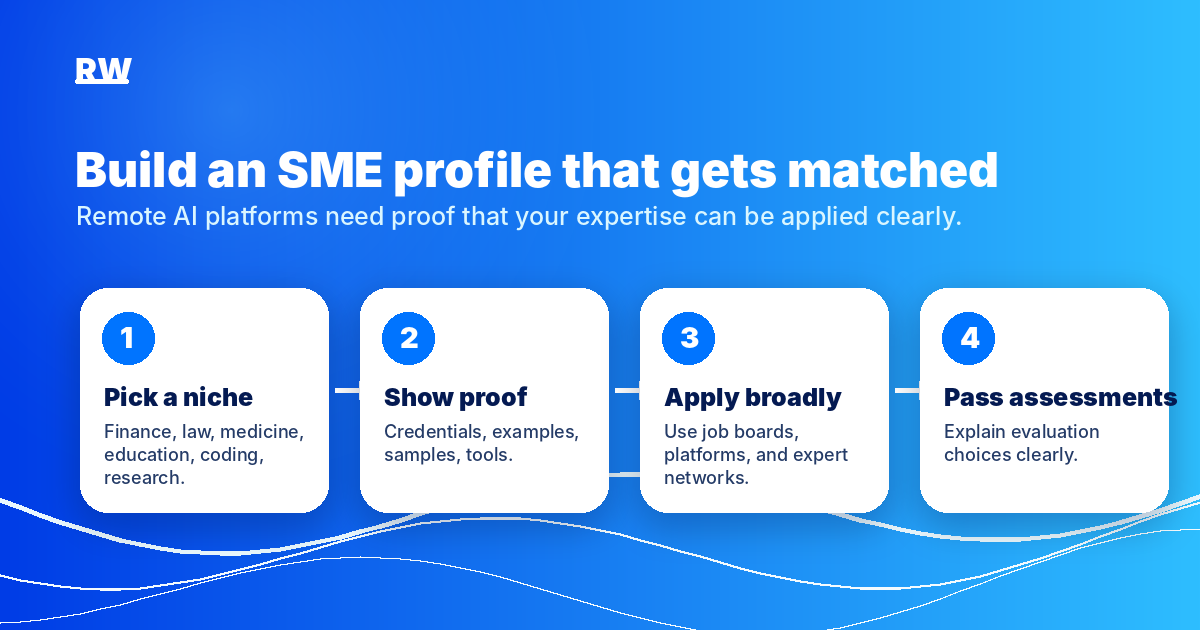
The biggest mistake subject matter experts make is assuming their background will speak for itself. It usually will not. Remote AI platforms match applicants based on what they can quickly understand from a profile, resume, or application form. Your goal is to make your expertise obvious.
Start with a clear specialty. Do not describe yourself only as "experienced" or "detail-oriented." Instead, name the work you can review — for example: legal research, contracts, compliance, and policy analysis; or financial analysis, accounting, spreadsheets, valuation, and business writing; or nursing, patient education, medical documentation, and healthcare writing.
Then connect that specialty to AI evaluation tasks. Platforms do not only want to know what your job title was. They want to know what you can judge. Can you identify factual errors? Can you compare two answers? Can you write clear feedback? Can you explain why an answer is incomplete? Can you follow a rubric? Can you improve a response without changing its intent? A strong profile makes those abilities explicit.
What to Put on Your Resume or Application
For remote AI training jobs, your resume should highlight the skills that matter for model evaluation. Useful sections include a concise summary that names your specialty and remote AI fit; relevant professional experience with domain-specific keywords; writing, research, analysis, editing, or review experience; tools such as Microsoft Excel, Google Sheets, SQL, Python, ChatGPT, Claude, Gemini, research databases, or project management software; certifications, degrees, licenses, publications, or portfolio samples if relevant; and examples of work where you evaluated quality, accuracy, risk, or reasoning.
A finance applicant might highlight financial modeling, variance analysis, accounting review, forecasting, Excel, and business writing. A legal applicant might highlight legal research, contract review, citation checking, regulatory analysis, and issue spotting. A healthcare applicant might highlight clinical documentation, patient education, medical terminology, and safety-sensitive communication. The key is to translate your background into the language of AI evaluation.
How to Perform Well on Expert AI Assessments
Many platforms use assessments before assigning paid work. The assessment may ask you to compare AI responses, rate an answer, write feedback, complete a domain test, or explain your reasoning. Good evaluators do not simply say "Response A is better." They explain why.
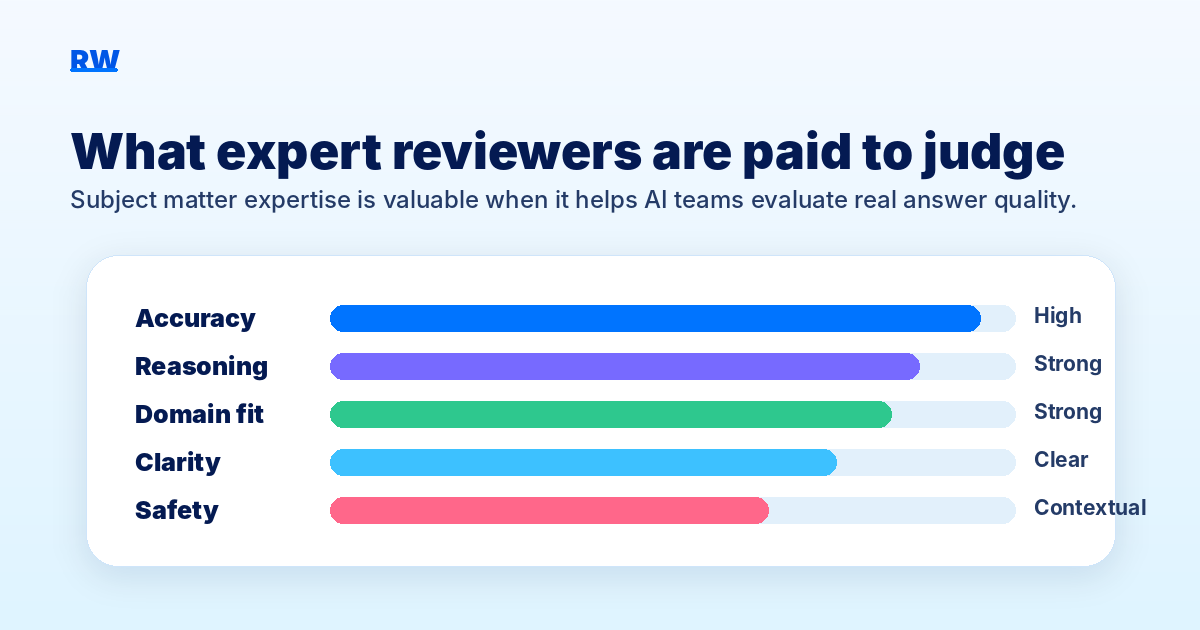
A strong assessment answer usually identifies the main issue, compares the responses directly, uses the rubric, and gives a concise justification. The best reviewers avoid vague feedback and do not overthink every small wording difference. They focus on the factors that matter most: accuracy, instruction following, completeness, reasoning, safety, and usefulness.
Key tip: For expert tasks, the most important skill is often explaining domain-specific nuance in plain English. A model may be partially correct but still misleading. A response may be safe but too generic. A response may be well-written but factually wrong. Your assessment should show that you can catch those differences.
Where Subject Matter Experts Can Find Remote AI Work
Remote AI work appears in several places. Some opportunities are posted by AI training platforms. Others appear through staffing firms, expert networks, research vendors, data annotation companies, job boards, and contract marketplaces. Some roles support companies building applications on top of models from OpenAI, Anthropic, Google, Meta, Microsoft, xAI, Amazon, and other AI organizations.
Search terms that can help include: subject matter expert AI jobs, remote AI trainer, AI model evaluator, expert AI reviewer, AI data annotation jobs, RLHF jobs, prompt evaluator, AI response evaluator, AI fact-checking jobs, legal AI evaluator, healthcare AI reviewer, finance AI evaluator, coding AI reviewer, search quality rater, AI writing evaluator, ChatGPT evaluator, Claude evaluator, and Gemini evaluator.
Do not rely on one platform only. AI training income can be inconsistent because project volume changes. A stronger strategy is to apply to multiple legitimate platforms, keep your profile updated, and stay ready for new projects that match your specialty.
How to Choose the Right Niche
The best niche is not always the broadest field. "Business" is broad. "Financial analysis for startups and operating metrics" is more specific. "Healthcare" is broad. "Nursing documentation and patient education" is more specific. "Law" is broad. "Contract review and regulatory compliance" is more specific.
A clear niche helps platforms understand where to place you. A good niche usually has three traits: it matches your actual background; it creates tasks where AI answers need expert review; and it can be described clearly in a resume, profile, or application. You can apply across related categories, but for your main profile, clarity usually beats vagueness.
What Separates Strong Applicants From Weak Applicants
Strong applicants do three things well. First, they explain their expertise in specific terms — not just job titles, but descriptions of the kinds of questions, documents, decisions, or outputs they can evaluate. Second, they show writing ability. AI evaluation work requires clear written feedback, and even if your domain is technical, your explanation must be readable. Third, they understand the task. The goal is not to show off everything you know. The goal is to help improve an AI answer by following instructions, applying the rubric, and giving useful feedback.
Weak applicants often write too generally. They say they are interested in AI but do not explain what they can review. They mention ChatGPT or AI tools without connecting those tools to real expertise. They apply to every role with the same generic resume. They treat assessments like opinion questions instead of quality-review tasks.
A Simple Action Plan for Subject Matter Experts
Start by choosing one primary AI work angle — for example: finance AI evaluation, legal AI review, healthcare AI training, education content evaluation, coding response review, research fact-checking, or business strategy model evaluation.
Next, update your resume and profile around that angle. Use plain, searchable keywords. Mention your field, your review skills, your writing skills, and the types of AI tasks you can perform. Prepare a few proof points — writing samples, portfolio examples, publications, code samples, spreadsheets, teaching materials, or research summaries. You do not always need a public portfolio, but having examples helps you think clearly about your own positioning.
After that, apply to multiple remote AI platforms and job boards. Use different search terms. Save roles that match your field. Track where you applied, what assessment you took, what rate was offered, and whether the project is active. Finally, keep improving your evaluation skill — practice comparing AI responses, writing short justifications, and identifying hallucinations, missing constraints, bad assumptions, weak sources, and unsafe overconfidence. Those skills compound.
Frequently Asked Questions
What types of professionals qualify as subject matter experts for AI work?
Almost any professional with domain knowledge can qualify, including marketers, salespeople, social media managers, finance analysts, accountants, business operators, customer service leads, teachers, writers, consultants, software engineers, lawyers, and nurses. The key is having expertise that lets you judge whether an AI answer is accurate, useful, and appropriate in a specialized field.
Do subject matter experts need coding skills for remote AI training jobs?
Not usually. Most expert AI review roles require domain knowledge and clear written feedback, not programming. Technical roles that involve code evaluation are the exception, and they typically specify that requirement.
How do subject matter experts get matched with relevant AI projects?
AI training platforms typically match reviewers based on profile information, resume keywords, domain specialties, and assessment performance. The clearer your specialty and reviewer skills are in your profile, the more likely you are to be routed toward projects that match your background.
What separates a strong SME applicant from a weak one?
Strong applicants explain their expertise in specific terms, demonstrate clear writing ability, and understand that the goal is to help improve AI answers rather than to display everything they know. Weak applicants write too generally, apply with the same resume to every role, and treat assessments like opinion questions instead of quality-review tasks.