AI training platforms are becoming one of the most practical entry points into remote AI work. They are not all the same. Some are built for generalists who can read carefully, compare answers, and explain which response is better. Some are built for specialists who bring legal, finance, healthcare, coding, science, education, or writing expertise. Others are a better fit for students and recent graduates who want flexible online work that rewards research, consistency, and clear communication.
The mistake many applicants make is searching for one broad phrase like AI jobs or data annotation jobs and applying everywhere with the same resume. A better approach is to match your background to the kind of AI training platform that actually needs your proof. The right platform for a strong writer may be different from the right platform for a nurse, accountant, law student, software engineer, bilingual worker, or college student.
This guide breaks down the best AI training platform categories for generalists, specialists, and students, plus the keywords, application signals, and role types to look for when searching for remote AI training jobs.
What an AI Training Platform Actually Does
An AI training platform connects human reviewers with tasks that help improve AI systems. The work can include rating chatbot answers, comparing two model responses, checking factual accuracy, labeling data, writing examples, reviewing prompts, flagging unsafe outputs, or judging whether an answer follows a rubric.
Common role names include AI trainer, AI evaluator, AI rater, AI response reviewer, prompt evaluator, data annotator, search quality rater, LLM evaluator, RLHF reviewer, and human feedback specialist.
The exact task depends on the project. A generalist project might ask you to compare two answers about travel planning or explain which response is more helpful. A specialist project might ask a lawyer to evaluate legal reasoning, a finance analyst to check spreadsheet logic, a nurse to review medical communication, or a coder to test whether an AI-generated function actually works.
The best platforms are not simply looking for people who like AI. They are looking for people who can make careful judgments, follow instructions, and produce useful feedback at scale.
The Best Platform Depends on Your Applicant Lane
Before comparing platforms, decide which lane fits you best.
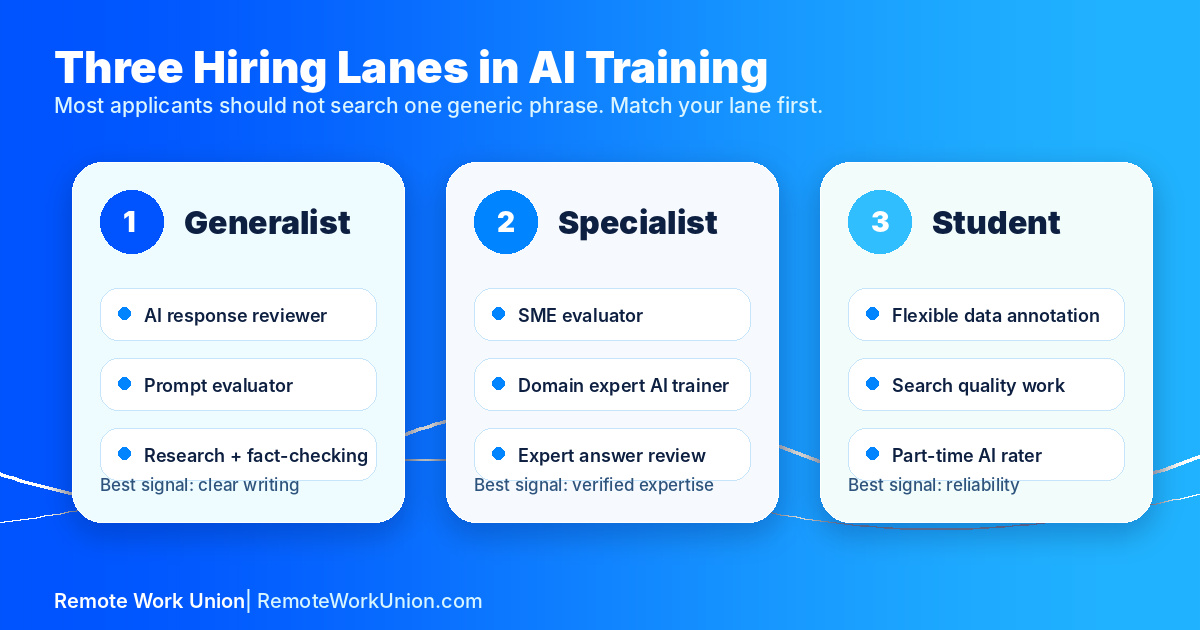
1. Generalists
Generalists are usually strong readers, writers, researchers, editors, teachers, support professionals, content creators, analysts, or detail-oriented remote workers. You do not need to be a programmer to qualify for many AI evaluation jobs. You do need to show that you can compare information, write clearly, and follow a rubric.
Good search terms for this lane include:
- AI response reviewer jobs
- prompt evaluation jobs
- AI rater jobs
- AI model evaluation jobs
- data annotation jobs from home
- human feedback jobs
- work from home AI jobs no phone
- chatbot evaluator jobs
Generalists should look for platforms that offer broad AI response evaluation, writing quality review, fact-checking, search relevance, policy review, and prompt-response comparison. These tasks reward clarity, patience, and sound judgment more than a technical degree.
2. Specialists
Specialists have proof in a field that AI companies care about. That proof can be a degree, license, work history, portfolio, publication record, teaching experience, analyst experience, or deep professional background. Specialist platforms and projects often pay more attention to resumes, credentials, work samples, and assessment quality.
Common specialist lanes include:
- Legal and compliance review
- Finance, accounting, and business analysis
- Healthcare, nursing, medical writing, and life sciences
- Coding, software QA, and technical documentation
- Education, tutoring, curriculum, and test prep
- Science, engineering, math, and data analysis
- Bilingual and language evaluation
- Creative writing, editing, and content strategy
Good search terms include domain expert AI trainer, SME AI evaluator, expert AI review jobs, AI training jobs for lawyers, remote AI jobs for nurses, AI coding evaluator jobs, finance AI evaluator jobs, and bilingual AI evaluator jobs.
3. Students and Recent Graduates
Students usually need flexible work, but they still need to compete with proof. The best proof may be coursework, writing samples, research projects, tutoring experience, internships, GitHub projects, language ability, or strong test performance. Student-friendly AI training work is often part-time, project-based, or assessment-based.
Good search terms include:
- remote AI jobs for college students
- part-time AI evaluator jobs
- data annotation jobs for students
- AI rater jobs part time
- online research jobs from home
- flexible AI training jobs
- prompt evaluator jobs entry level
Students should avoid treating AI training as instant money. Platforms usually test for accuracy, consistency, and instruction-following. The better strategy is to build a small proof package: a clean resume, a writing sample, a research sample, a spreadsheet or coding sample if relevant, and a simple tracker for applications.
Platform Categories to Compare
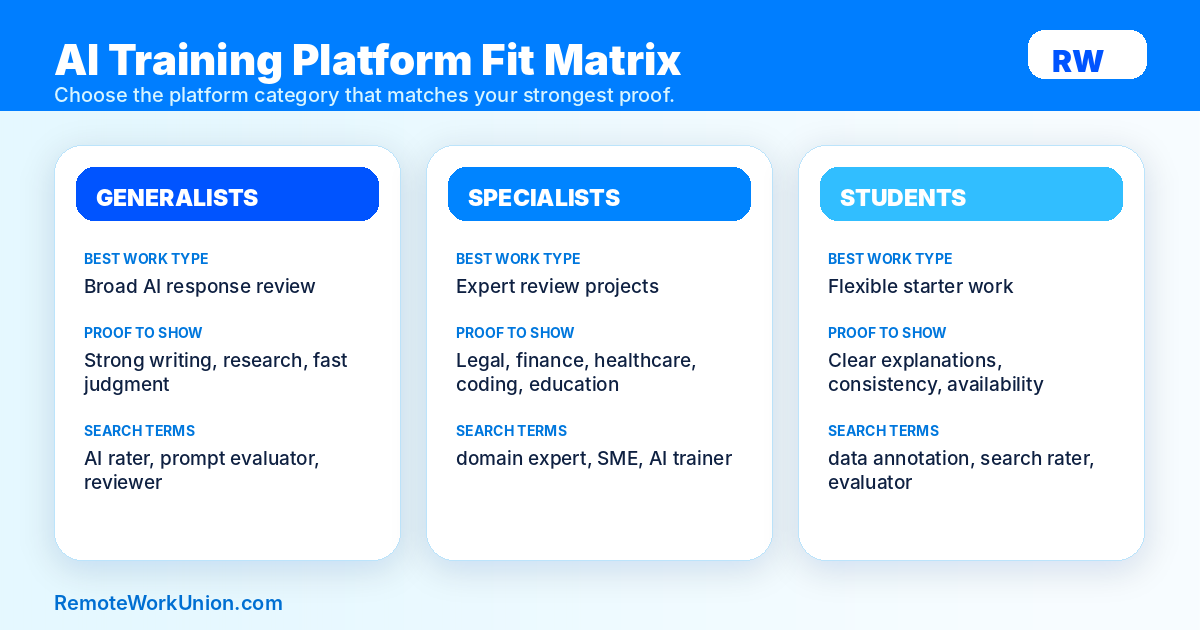
Instead of asking, "What is the single best AI training platform?" ask, "Which platform category fits my proof?" The following categories are more timeless than any one company list.
General AI Training Marketplaces
These platforms usually offer a mix of AI evaluation, annotation, ranking, prompt review, and model response tasks. They can be a fit for applicants who have broad writing and research ability. The work may vary by project, so read each posting carefully.
Best fit: generalists, students, writers, researchers, detail-oriented remote workers.
Common keywords: AI evaluator, AI trainer, AI rater, prompt evaluator, AI response reviewer, RLHF reviewer.
What to show: writing samples, research examples, editing experience, strong resume bullets, and careful assessment answers.
Expert AI Evaluation Networks
Expert networks focus on projects where domain knowledge matters. These are often the best fit for professionals who can review complex answers, create high-quality examples, or evaluate reasoning in a specialized field.
Best fit: lawyers, accountants, finance analysts, healthcare workers, teachers, coders, scientists, engineers, bilingual experts.
Common keywords: domain expert, SME evaluator, expert AI trainer, AI model evaluation, technical reviewer.
What to show: credentials, work history, portfolio, publications, certifications, case examples, or projects.
Coding-Focused AI Training Platforms
Coding platforms usually test whether you can solve programming problems, review generated code, debug mistakes, or explain why one solution is better than another. These can be attractive for coders who do not want a full-time software engineering job but still want technical remote work.
Best fit: software engineers, bootcamp graduates, computer science students, QA testers, technical writers.
Common keywords: AI coding evaluator, code reviewer, coding AI trainer, Python evaluator, JavaScript evaluator, software QA AI jobs.
What to show: GitHub, code samples, technical writing, debugging examples, and language-specific competence.
Data Annotation and Labeling Platforms
Data annotation platforms may include labeling images, categorizing text, reviewing search results, tagging entities, checking whether content follows instructions, or preparing examples that help train models. Some tasks are simple; others require judgment and consistency.
Best fit: beginners, students, careful reviewers, people who want flexible online work.
Common keywords: data annotation jobs, data labeling jobs, AI data annotation, image annotation, text annotation, search relevance rater.
What to show: accuracy, consistency, availability, and willingness to follow detailed guidelines.
Search and Answer-Quality Programs
Search quality work often overlaps with AI evaluation because modern search products increasingly use AI answers, summaries, and assistant-style responses. These jobs can involve checking relevance, usefulness, factuality, local intent, and query satisfaction.
Best fit: researchers, local search reviewers, bilingual workers, generalists, students.
Common keywords: search quality rater, search evaluator, AI answer quality, online rater, web analyst.
What to show: research habits, familiarity with search, attention to detail, and clear written explanations.
Remote Job Boards and Talent Marketplaces
Some AI training roles appear through broader job boards, contractor networks, and freelance marketplaces. These can be useful, but they require filtering. Search terms matter because many postings use different language for similar work.
Best fit: all lanes, especially applicants who want multiple sources of remote AI leads.
Common keywords: remote AI jobs, AI contractor, AI quality analyst, AI content evaluator, LLM evaluator, model evaluation.
What to show: a tailored profile, searchable keywords, clear availability, and proof that matches the exact project.
How to Compare AI Training Platforms
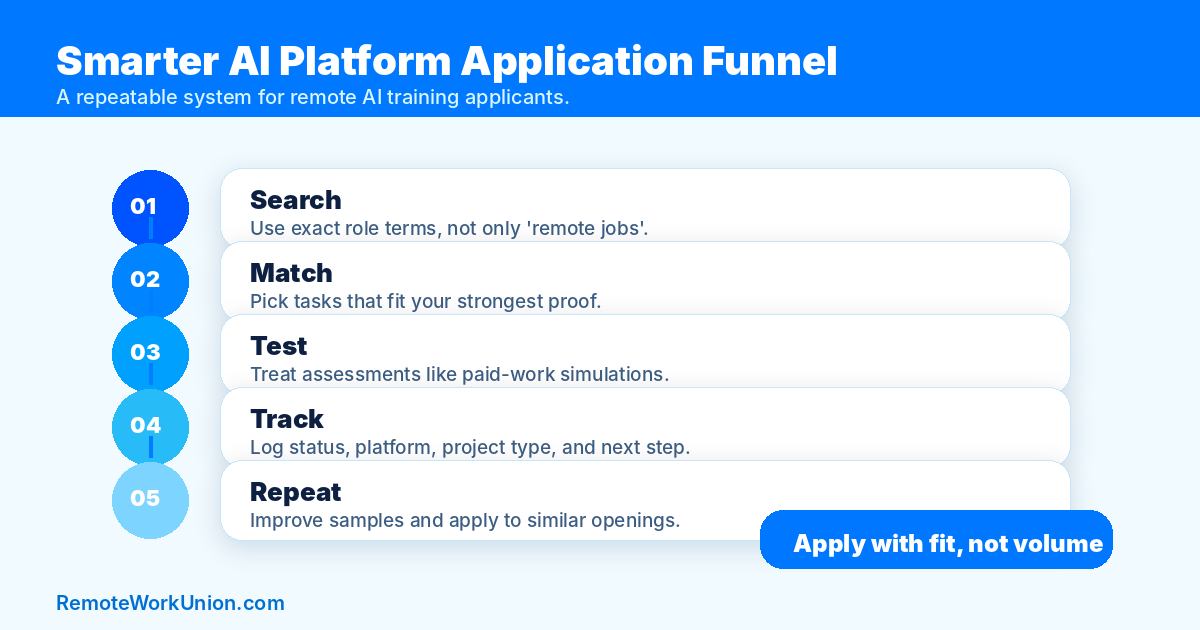
A platform can look attractive from the outside and still be a poor match for your situation. Use a comparison system before applying.
1. Task Type
Do not stop at the job title. Read what the work actually requires. "AI evaluator" can mean writing explanations, ranking answers, labeling data, checking code, reviewing policies, or judging factual accuracy. Apply where the tasks match your strengths.
2. Proof Required
Some platforms care most about a timed assessment. Others care about credentials, resume history, portfolio samples, or domain expertise. If a role asks for legal, medical, finance, coding, or education knowledge, generic remote-work language will not be enough.
3. Flexibility
Remote AI training work may be full-time, part-time, project-based, contract-based, or task-based. Flexible does not always mean unlimited work. Check whether the platform explains project availability, deadlines, expected hours, location eligibility, and communication expectations.
4. Pay Structure
Avoid focusing only on the highest advertised number. Compare hourly pay, task pay, unpaid assessment time, project consistency, payment schedule, platform fees, tax classification, and whether work is guaranteed. A lower rate with steady work may beat a higher rate with rare projects.
5. Assessment Quality
Most strong platforms use assessments. Treat them seriously. The assessment is often a sample of the actual job: reading a prompt, comparing answers, spotting errors, writing a concise justification, or solving a domain-specific problem.
6. Feedback and Support
Good platforms give clear instructions, examples, rubrics, and quality standards. Poor fits often leave applicants confused about why work was rejected. Look for clarity before you commit a lot of time.
7. Portfolio Value
Some AI training work builds useful career language for your resume: rubric-based evaluation, annotation, A/B comparison, model response review, quality assurance, fact-checking, and prompt analysis. Track your skills even if the work is contract-based.
Skills That Transfer Across Platforms
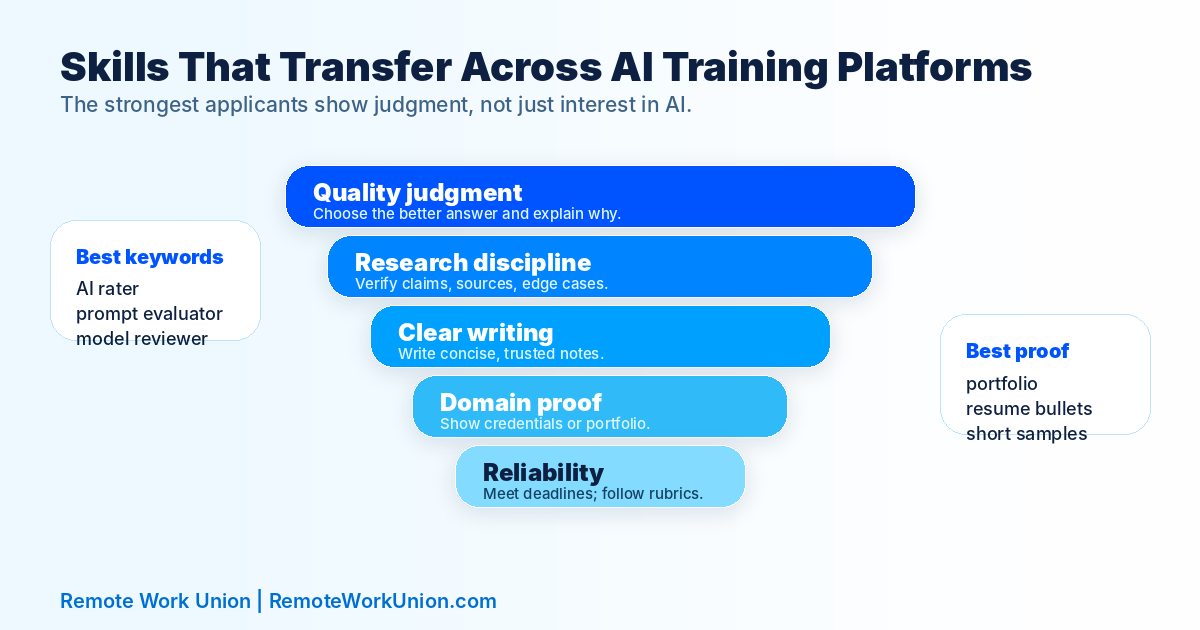
The strongest AI training applicants do not rely on vague enthusiasm. They show transferable skills that map to the work.
Quality Judgment
AI training platforms need people who can decide which answer is better and explain why. This means weighing accuracy, clarity, helpfulness, safety, completeness, tone, and instruction-following.
Research Discipline
Many tasks require checking claims. A good reviewer knows when to verify a fact, how to compare sources, and how to avoid overconfident feedback.
Clear Writing
Short, specific explanations are valuable. Do not write vague comments like "Response A is better." Write why it is better: more accurate, more complete, follows the prompt, avoids unsupported claims, or uses clearer steps.
Domain Proof
If you are a specialist, your resume should make the domain obvious. Use specific language: contract review, financial modeling, patient education, curriculum design, Python debugging, bilingual translation, academic research, technical documentation, or policy analysis.
Reliability
Remote AI training platforms often reward consistency. Follow instructions, meet deadlines, avoid rushing, and keep your quality stable across repetitive tasks.
Remote Work Union connects you to legitimate remote AI training and evaluation roles across multiple platforms. Apply for free.
Find Roles Hiring Now →Best AI Training Platforms for Generalists
Generalists should prioritize platforms with broad AI evaluation tasks. These roles often involve comparing two answers, checking whether a model followed a prompt, rating helpfulness, reviewing tone, and writing short justifications. Handshake AI and Outlier AI are strong generalist starting points, since both run broad evaluation projects that are open to capable non-specialists.
A good generalist profile should include:
- Writing, editing, support, teaching, research, analysis, or content experience
- A short writing sample that shows clear reasoning
- Resume bullets using terms like evaluation, quality review, annotation, rubric, fact-checking, and A/B comparison
- Familiarity with major AI tools such as ChatGPT, Claude, Gemini, Copilot, Meta AI, and Grok as user-facing products
- A willingness to read detailed instructions and apply them consistently
Generalists should avoid applying as if every AI platform wants the same thing. A prompt evaluator role is different from a search quality role. A data labeling task is different from expert answer review. Tailor your resume and assessment approach to the task.
Best AI Training Platforms for Specialists
Specialists should look for platforms and projects that explicitly ask for their field. The best opportunities usually appear when AI systems need higher-quality expert judgment in complex subjects. Mercor and micro1 lean toward this expert tier, matching domain professionals to higher-paying projects that can reach up to $50–$200/hr.
Examples:
- Lawyers and paralegals can evaluate reasoning, issue spotting, document summaries, and legal research quality.
- Finance and accounting professionals can review numerical reasoning, spreadsheet logic, business analysis, and market explanations.
- Healthcare workers and medical writers can review patient-friendly communication, health content structure, and medical writing quality where permitted by the platform guidelines.
- Teachers and tutors can evaluate explanations, lesson quality, test-prep answers, and curriculum content.
- Coders can review code correctness, debugging steps, edge cases, and technical explanations.
- Bilingual workers can evaluate translation quality, cultural nuance, grammar, and language-specific prompts.
Specialists should use specific keywords in their profiles. "Remote AI worker" is weaker than "finance AI evaluator," "legal AI response reviewer," "Python coding evaluator," or "bilingual Spanish AI rater."
Best AI Training Platforms for Students
Students should focus on flexible projects that value clear thinking and availability. Handshake AI is often the easiest entry point for students, while Mercor and micro1 reward strong coursework, writing samples, and language skills. The strongest student applications usually connect coursework to platform needs.
Good student proof can include:
- Research papers or writing samples
- Tutoring, teaching assistant, lab, or club leadership experience
- Data analysis, spreadsheet, or coding projects
- Language fluency
- Debate, journalism, editing, or peer-review experience
- Consistent availability and careful communication
Students should not hide the fact that they are early-career. They should translate school experience into work signals: research, editing, grading, annotation, logic, testing, review, and communication.
Search Keywords to Use
Use multiple searches because AI training platforms do not all use the same titles.
Core searches:
- AI training platforms
- Handshake AI jobs
- Mercor AI jobs
- micro1 AI jobs
- Outlier AI jobs
- remote AI training jobs
- AI evaluator jobs
- AI rater jobs
- AI model evaluation jobs
- prompt evaluation jobs
- AI response reviewer jobs
- RLHF jobs
- human feedback jobs
- data annotation jobs from home
- search quality rater jobs
Specialist searches:
- legal AI evaluator jobs
- finance AI trainer jobs
- healthcare AI reviewer jobs
- coding AI evaluator jobs
- education AI trainer jobs
- bilingual AI rater jobs
- domain expert AI training jobs
- SME AI evaluator jobs
Company and ecosystem keywords can also help with research. Applicants often search around major AI products and companies such as ChatGPT and OpenAI, Claude and Anthropic, Gemini and Google, Microsoft Copilot, Meta AI, and Grok or xAI. Use these as search context, but do not assume that every role is directly employed by the company behind the product.
Application Tips That Improve Your Odds
Build One Resume for Each Lane
Create a generalist resume, a specialist resume, or a student resume depending on your background. Do not use one generic remote-work resume for every AI platform.
Use Proof-Based Bullets
Strong bullets sound like actual evaluation work:
- Reviewed AI-generated responses for accuracy, clarity, completeness, and instruction-following.
- Compared answer quality using rubrics and wrote concise justifications for model improvement.
- Conducted web research to verify claims and flag unsupported statements.
- Evaluated prompt-response pairs for usefulness, safety, and relevance.
- Annotated text data according to detailed project guidelines.
Practice Short Explanations
Many assessments ask you to explain your choice. Practice writing two to four sentences that are specific, calm, and evidence-based. Do not ramble. Do not guess. Show the evaluator that you understand the rubric.
Track Every Application
Use a simple spreadsheet with platform, role title, lane, date applied, assessment status, pay model, location rules, project type, and follow-up date. This keeps you from repeating mistakes and helps you spot which keywords are working.
Keep Your Expectations Realistic
AI training work can be real remote work, but it is often project-based. Do not assume one platform will provide stable full-time income forever. Apply across several good-fit platforms and keep improving your proof.
Common Mistakes to Avoid
The biggest mistake is applying broadly without matching the task. A student with no coding background should not waste time on advanced coding assessments. A lawyer should not bury legal experience under generic remote-work language. A strong writer should not apply with a resume that only says "AI enthusiast."
Other mistakes include ignoring eligibility rules, rushing assessments, using unsupported claims in explanations, failing to track applications, and choosing platforms only by advertised pay.
The best applicants are precise. They know their lane, use the right keywords, show proof, and treat assessments like real work.
Quick Platform Comparison Checklist
Before applying, ask:
- What kind of AI training task does this platform offer?
- Is it built for generalists, specialists, students, coders, or bilingual workers?
- What proof does the application require?
- Is the work remote, hybrid, location-restricted, or time-zone restricted?
- Is pay hourly, per task, project-based, or unclear?
- Are assessments paid or unpaid?
- Are guidelines clear enough to produce consistent work?
- Can the experience strengthen my resume?
- Does this platform fit my current schedule?
- What similar platforms or roles should I apply to next?
Tip: Apply to the best-fit category first, not the highest-paying listing. A platform that matches your proof and task type is more likely to actually pay you than a high-rate project you cannot qualify for.
Final Takeaway
The best AI training platform is not the one with the flashiest job title. It is the one that matches your proof, your schedule, your skill level, and your preferred type of work. Generalists should look for broad AI response review and prompt evaluation. Specialists should look for expert review projects. Students should look for flexible roles where coursework, writing, research, or language skills create a real advantage.
Ready to apply for jobs? Go to RemoteWorkUnion.com to find roles hiring now.
Frequently Asked Questions
Are AI training platforms good for beginners?
Some are. Beginners usually fit best with generalist evaluation, data annotation, search quality, and entry-level AI rater roles. However, beginner-friendly does not mean easy. You still need to follow instructions, write clearly, and pass assessments.
Do I need to know how to code?
No, not for every AI training platform. Coding helps for technical projects, but many AI evaluation jobs are focused on writing, research, language, reasoning, fact-checking, or domain expertise.
Are AI training jobs the same as data entry jobs?
No. Data entry usually means transferring information from one place to another. AI training work usually involves judgment: rating, comparing, labeling, reviewing, or explaining why an answer is good or bad.
What is the best platform for students?
The best platform for a student is one that matches their strongest proof: writing, research, language skills, coding, tutoring, or coursework. Students should search for part-time AI evaluator jobs, data annotation jobs, AI rater jobs, and flexible remote AI training projects.
What is the best platform for specialists?
Specialists should look for domain-specific AI evaluation projects. A marketer, salesperson, finance analyst, business operator, customer service lead, teacher, lawyer, nurse, coder, or bilingual professional should search with field-specific keywords instead of only using broad terms like "AI jobs."