Remote AI training jobs are not won by the applicant who sends the most resumes. They are usually won by the applicant who makes it easiest for a platform, recruiter, or matching system to understand three things: what you know, how clearly you think, and whether you can deliver reliable work from home.
That matters because many AI training jobs are not traditional jobs. They may be contract projects, expert review assignments, writing evaluations, coding evaluations, legal or finance tasks, medical reasoning reviews, data annotation work, research tasks, AI response ranking, or rubric-based quality checks. A platform may need thousands of people, but it still needs the right people for the right project.
This guide explains how to get accepted for remote AI training jobs faster by building a sharper profile, preparing better samples, applying through multiple channels, and avoiding the mistakes that slow down strong candidates.
The Short Version: Acceptance Speed Comes From Clear Signals
The fastest applicants usually do five things well:
- They choose a clear expertise lane before applying.
- They rewrite their experience in AI-training language.
- They prepare a small portfolio packet before a platform asks for it.
- They treat screening tasks like paid client work.
- They apply across multiple platforms without losing track of details.
Remote AI training platforms are trying to answer a simple question: can this person improve model quality? Your job is to make the answer obvious. If your profile says only "hard worker" or "experienced professional," it is weak. If it says "finance analyst who can evaluate investment explanations, spreadsheet logic, accounting assumptions, and factual accuracy," it is much stronger. The difference is not hype — it is specificity.
What "Getting Accepted" Usually Means
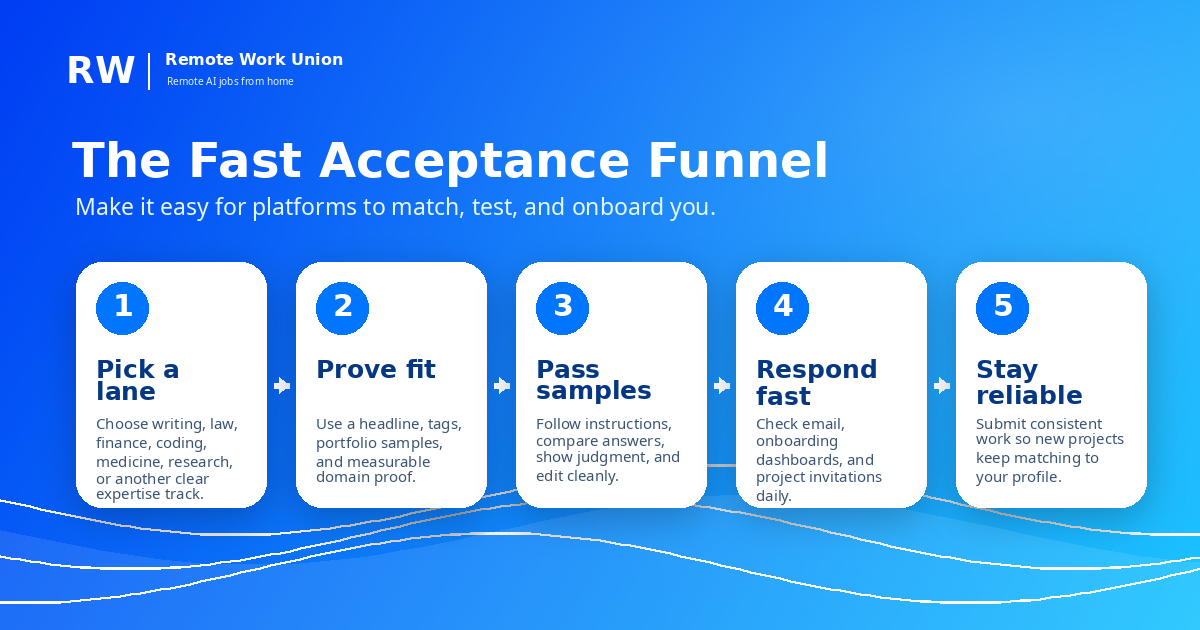
Remote AI training jobs can use different onboarding processes, but most follow a similar path. First, you create a profile. The platform collects your domain skills, work history, education, location, language ability, availability, and sometimes tax or contractor details. Second, the platform matches you to a potential project. Third, you complete a screening task, qualification test, interview, writing sample, coding assessment, or expert review exercise. Fourth, you are onboarded into a paid project, waitlisted for future work, or asked to qualify for another task type.
For some applicants, the process feels random because they apply once and wait. Strong applicants treat the process as a conversion funnel. They improve every step: profile clarity, project fit, sample quality, response speed, and follow-through. Faster acceptance does not mean skipping steps — it means giving the system fewer reasons to hesitate.
Step 1: Choose a Lane Before You Apply
The biggest mistake is applying as a general remote worker. AI training platforms do need generalists for some tasks, but higher-quality projects usually need people who can evaluate something specific. Choose one primary lane and one secondary lane. Your primary lane should be the expertise you can defend under pressure. Your secondary lane should be a useful adjacent skill.
Examples of strong expertise lanes:
- Writing + editing: AI response evaluation, creative writing review, factual improvement, tone ranking, instruction-following checks.
- Finance + business: Spreadsheet reasoning, accounting explanations, market research review, investment education, data interpretation.
- Law + policy: Legal reasoning review, contract explanation, regulatory summaries, citation checking, risk analysis.
- Medicine + health: Clinical reasoning review, patient education quality, medical fact checking, safety-sensitive response evaluation.
- Coding + math: Code review, debugging, algorithm explanations, test case generation, mathematical reasoning evaluation.
- Research + analysis: Source review, claim verification, technical summaries, prompt evaluation, structured annotations.
- Languages + localization: Translation quality, cultural nuance, bilingual evaluation, multilingual data annotation.
A focused lane helps with every downstream step. It gives you better keywords for your profile, better samples for your portfolio, better answers in interviews, and better choices when a platform asks which projects you want.
Step 2: Rewrite Your Profile for AI Training Work
A normal resume is built around job titles. A remote AI training profile should be built around evaluation ability. Do not describe only what you have done — describe what you can judge. AI training work often involves reading two answers, comparing their quality, checking whether instructions were followed, identifying factual errors, scoring a response against a rubric, or explaining which answer is better and why.
Useful profile language includes:
- AI evaluation, AI training, response ranking, rubric-based review
- annotation, preference selection, factual accuracy, reasoning quality
- instruction following, domain review, expert review, research validation
- prompt evaluation, model output review, safety and policy review
- technical writing, editorial judgment
Use this language naturally. Do not stuff keywords into a profile that reads like spam. The best version is direct: "I evaluate AI-generated finance explanations for factual accuracy, reasoning quality, and clarity for non-expert readers." That sentence is more useful than five vague paragraphs about being detail oriented.
Step 3: Build a One-Page Profile Packet
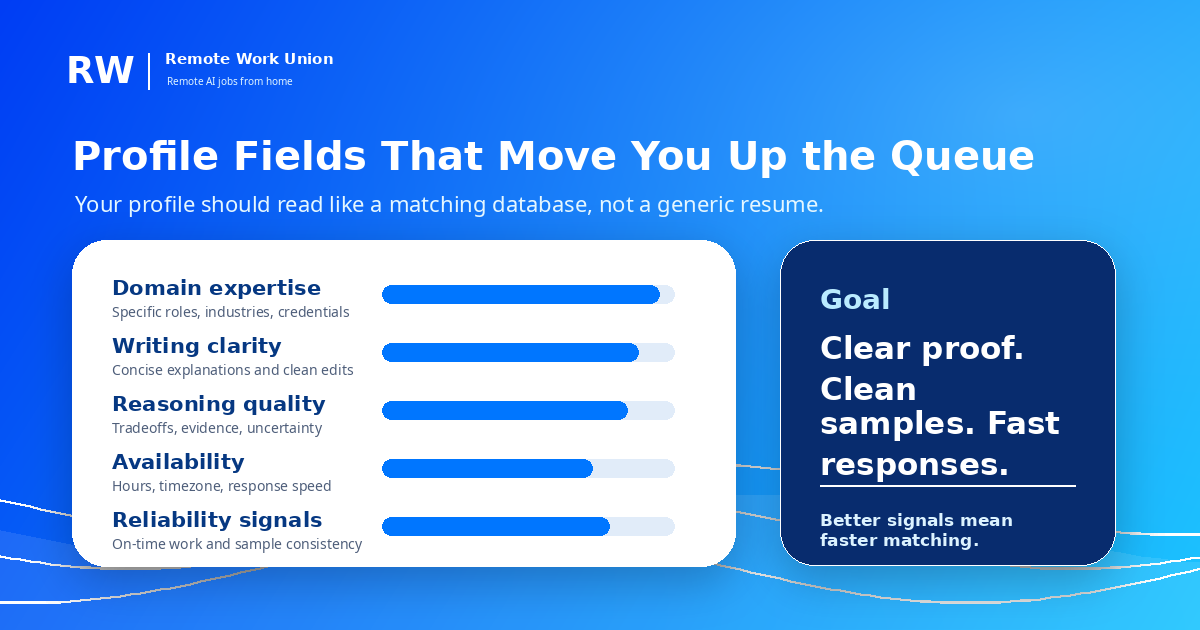
Before applying, create a profile packet you can reuse across platforms like Handshake AI, Mercor, micro1, Outlier, expert networks, AI research projects, and remote job boards. Your packet should include:
- A one-sentence headline: Who you are and what AI work you are qualified to review.
- A short bio: Three to five sentences explaining your domain, writing ability, and remote-work reliability.
- Your top skills: Five to eight tags that match AI training work.
- A mini portfolio: Two or three samples that show clear thinking.
- Your availability: Hours per week, timezone, start date, and preferred task types.
- Proof: Degrees, licenses, work history, publications, shipped projects, client work, or measurable experience.
The packet does not need to be fancy. It needs to be fast to read. A recruiter should be able to skim it in 30 seconds and know where to place you. For example, a finance applicant might use the headline: "Finance and business analyst for AI response evaluation, spreadsheet reasoning, and investment education review." A writer might use: "AI writing evaluator for instruction following, tone, factuality, and editorial quality."
Step 4: Prepare Samples Before the Screening Test
Many applicants wait until they receive a screening test to practice. That is too late. Screening tests are not impossible, but they often expose weak habits: rushing, overexplaining, ignoring instructions, missing factual errors, or giving a preference without a reason.
Prepare samples in your lane before applying. Strong sample formats include:
- A before-and-after edit of a weak AI answer.
- A comparison of two answers with a clear winner and explanation.
- A short research verification note that separates verified facts from uncertain claims.
- A rubric-style review of an answer using categories like helpfulness, accuracy, reasoning, safety, and clarity.
- A domain-specific explanation rewritten for a beginner.
- A coding sample that identifies a bug, explains the fix, and gives a test case.
The best samples are short. One page is enough. The goal is not to prove everything you know — it is to show that you can read carefully, judge accurately, and explain your judgment in a way another person can trust.
Remote Work Union connects you to legitimate remote AI training and evaluation roles across multiple platforms. Apply for free.
Find Roles Hiring Now →Step 5: Treat Screening Tasks Like Paid Work
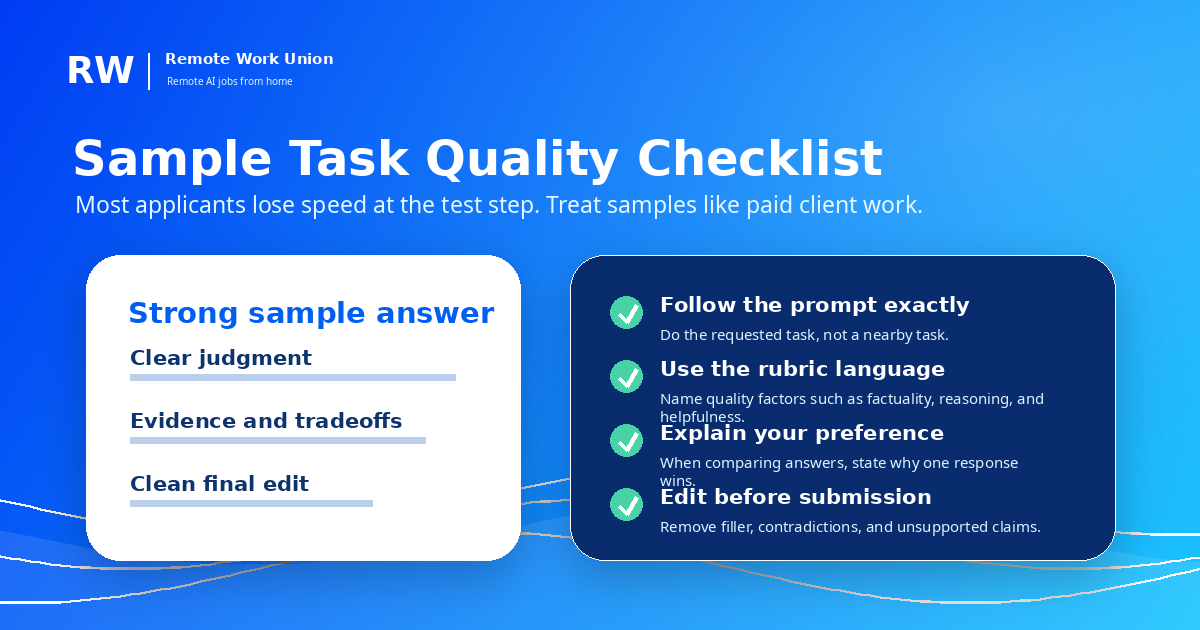
A screening task is not a formality. It is the platform's clearest view of how you will behave on paid work. For each screening task, slow down at the beginning and speed up at the end. Read the instructions twice. Identify the exact task type. Look for hidden constraints such as word count, citation expectations, rating scale definitions, safety rules, or required format. Then complete the work and leave time for a final edit.
Use this simple screening workflow:
- Restate the objective in your own words before answering.
- Identify the rubric or decision criteria.
- Complete the task using the required format.
- Check for unsupported claims, contradictions, and missed instructions.
- Make the final answer shorter, clearer, and more direct.
Good AI trainers do not just know things — they make consistent judgments. If a task asks which response is better, do not say only "Response A is better." Say why. Mention the deciding factors: accuracy, completeness, instruction following, reasoning, tone, safety, or usefulness.
Step 6: Show Expert Judgment Without Overstating Expertise
Remote AI training jobs reward domain knowledge, but they also punish exaggeration. If you claim expertise you cannot defend, you may get matched to a project where your weakness becomes obvious. Be precise. "Experienced with personal finance writing" is different from "licensed financial advisor." "Worked in healthcare operations" is different from "medical doctor." There is room for many backgrounds, but the platform needs an accurate signal.
Accurate positioning can still be strong. Instead of overstating, use clear boundaries:
- "I can evaluate consumer finance explanations, budgeting guidance, and basic investment education."
- "I can review legal information for clarity and issue spotting, but I do not present myself as a practicing attorney."
- "I can evaluate medical writing for patient-friendly clarity and obvious safety issues, but I am not a clinician."
- "I can review Python scripts, debugging explanations, and beginner-to-intermediate coding outputs."
Clear boundaries make you more trustworthy. Trust is a major acceptance signal.
Step 7: Make Your Resume Readable by a Matching System
AI training platforms may use recruiters, internal matching systems, keyword filters, qualification tests, or project managers. Write for all of them. Your resume should include a compact skills section that maps to remote AI work. Add experience bullets that use evaluation terms:
- Evaluated written outputs for factual accuracy, clarity, tone, and instruction following.
- Created rubric-based feedback for model responses across finance and business topics.
- Reviewed research summaries for source quality, claim support, and reader usefulness.
- Compared multiple answer options and selected the strongest response with written rationale.
- Edited technical explanations for completeness, correctness, and concise structure.
This is not about inventing experience. It is about translating relevant experience into the language of the work. A teacher, editor, analyst, lawyer, medical professional, software engineer, researcher, musician, marketer, or operations manager may already have evaluation skills. The profile has to make those skills visible.
Step 8: Apply Through Multiple Platforms, But Track Everything
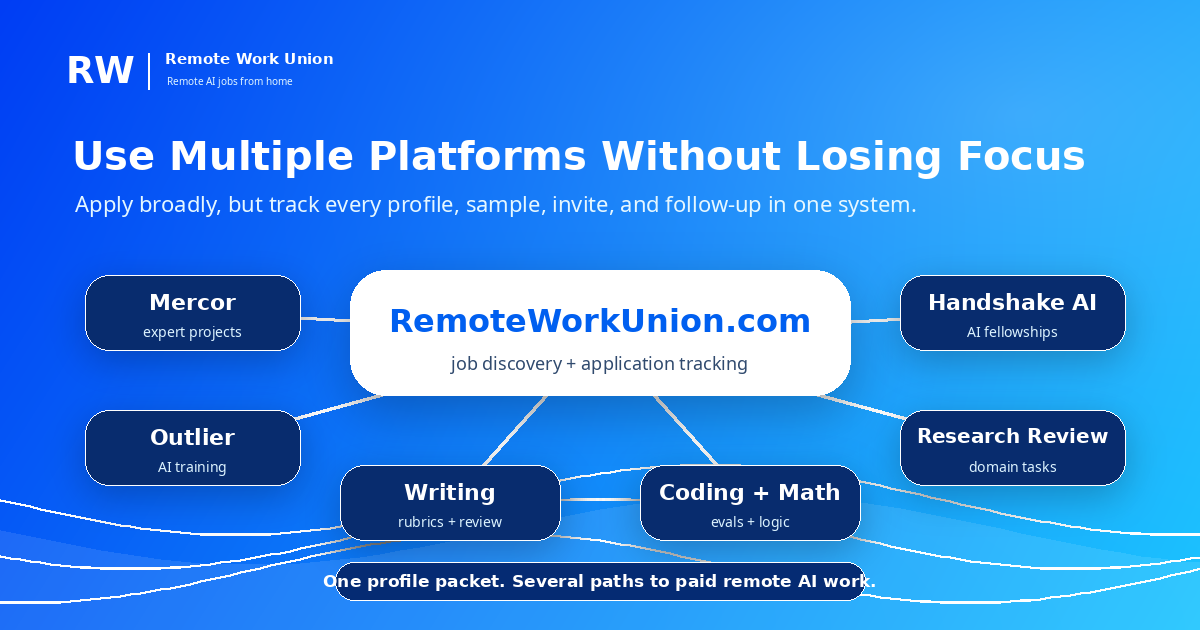
Do not depend on one application. Remote AI training work can be project-based, and availability changes. A platform may have no work for your profile this week and a perfect project next week. Another platform may need your skills immediately. Use a multi-platform strategy: apply to RemoteWorkUnion.com listings, Mercor-style expert projects, Outlier-style AI training work, Handshake AI opportunities, remote research projects, and relevant expert review contracts.
But do not apply randomly. Track every application in a simple sheet with columns for: platform, role or project title, expertise lane, application date, profile used, sample submitted, screening status, follow-up date, pay range, and notes. This prevents duplicate work and helps you see what is converting. If writing projects respond but finance projects do not, adjust the profile. If no platform responds, your profile may be too broad or too vague.
Step 9: Respond Quickly After Every Invite
Speed matters after a platform shows interest. Many remote AI projects have limited seats, fast onboarding windows, or short qualification periods. A slow reply can move you behind applicants who are equally qualified but easier to onboard.
Create a response system: check email and platform dashboards at set times each day. Keep your profile packet, resume, and samples in one folder. Save a short professional reply template. Keep your calendar updated with realistic availability. Complete tax, identity, or contractor setup quickly when requested. A fast response should not be sloppy — the best pattern is fast, calm, and complete.
Step 10: Avoid the Mistakes That Delay Strong Applicants
Strong applicants often slow themselves down with preventable mistakes. The most common ones are:
- Applying to every role with the same generic profile.
- Using AI-generated cover letters that sound vague and inflated.
- Listing too many unrelated skills instead of a clear expertise lane.
- Submitting samples with spelling errors, filler, or unsupported claims.
- Ignoring the rubric in a screening test.
- Overstating credentials or claiming professional authority they do not have.
- Missing onboarding emails or responding days late.
- Failing to track which profile was used for which platform.
- Treating contract work like passive income instead of client work.
A Seven-Day Plan to Get Accepted Faster
Day 1: Choose your primary and secondary expertise lanes. Remove unrelated claims from your profile.
Day 2: Rewrite your resume and profile headline using AI training keywords naturally.
Day 3: Create a one-page profile packet with your bio, skills, proof, samples, and availability.
Day 4: Build two short portfolio samples: one comparison task and one domain-specific review.
Day 5: Apply to a focused set of remote AI training jobs, AI evaluator jobs, expert review projects, and work from home AI roles.
Day 6: Practice one sample task in your lane and edit it down for clarity.
Day 7: Review your tracker, follow up where appropriate, improve weak fields, and apply to another targeted batch.
Tip: This plan is simple because the process should be repeatable. Every week, your profile should get more specific, your samples should get cleaner, and your application data should get more useful.
Final Takeaway
Getting accepted for remote AI training jobs faster is mostly a positioning problem. You need a clearer lane, a sharper profile, stronger samples, faster response habits, and a simple system for applying across platforms.
The market rewards people who can help improve AI systems such as ChatGPT, Claude, Gemini, Grok, Llama, and the next generation of model products. But it does not reward vague profiles — it rewards useful judgment. Choose the work you are actually qualified to review. Build proof around that lane. Practice the task formats before you are tested. Apply consistently. Track everything. Improve the parts of the funnel that are not converting.
Frequently Asked Questions
How long does it take to get accepted for an AI training job?
Acceptance timelines vary by platform, but most applicants who complete their profile, prepare samples, and respond quickly to test invitations can expect a decision within one to three weeks. Platforms like Handshake AI, Mercor, micro1, and Outlier AI have different onboarding processes — some are faster, some require multiple rounds of qualification. Applying to several platforms simultaneously reduces the time to your first paid work.
Do I need a computer science degree for AI training jobs?
No. Many remote AI training jobs value writing, domain expertise, research, legal knowledge, medical understanding, or financial analysis far more than a computer science background. The task is usually to evaluate, compare, or improve AI-generated content — not to build AI systems. Coding experience helps for coding evaluation roles, but it is not required for most AI training categories.
What do AI training platforms look for in applicants?
Platforms look for clear domain expertise, evaluation ability, instruction-following, and reliability. They want applicants who can read carefully, compare responses, identify errors, follow rubrics, explain their judgments, and deliver work consistently. A focused profile with relevant keywords, clear samples, and accurate credentials makes it easier for a platform to match you to projects.
How do I prepare for an AI training screening test?
Read the instructions at least twice before starting. Identify the exact task type — comparison, annotation, rubric-based review, answer writing, or fact-checking. Look for hidden constraints like word counts, format requirements, or safety rules. Complete the task, then review it for unsupported claims, missed instructions, and clarity before submitting. Strong screening test performance is often the deciding factor in acceptance.
Can I work for multiple AI training platforms at the same time?
Yes, and it is recommended. Project availability on any single platform can fluctuate. Applying to and qualifying for multiple platforms — Handshake AI, Mercor, micro1, Outlier AI, and others — creates stability. Track each application, profile, and screening test separately so you know what is working and can respond quickly to invitations.
What is the best way to describe AI training experience on a resume?
Translate your experience into evaluation terms. Instead of "I worked on AI projects," write "Evaluated AI-generated responses for factual accuracy, reasoning quality, and instruction following." Add domain-specific terms: "Reviewed finance AI outputs for spreadsheet logic and valuation clarity," or "Assessed medical AI content for patient-friendly accuracy and safety." Use the language of the actual work, not generic descriptions.