Data entry is one of the first search terms many people use when they want to work from home. It sounds simple: type information, organize records, update spreadsheets, and avoid phone calls. The problem is that remote data entry is also one of the most crowded corners of the online job market. A lot of listings are low-value, repetitive, vague, or built around the same promise: easy work that thousands of other applicants can do.
That does not mean detail-oriented remote workers are out of options. It means the better strategy is to search for jobs that use the same strengths as data entry but pay for more than typing. Accuracy, patience, written communication, source checking, judgment, and the ability to follow detailed instructions are valuable in many modern remote roles.
The best alternatives to data entry jobs include AI data annotation, AI response evaluation, search quality rating, fact-checking, transcript cleanup, spreadsheet QA, content quality review, and research support. These roles are often better aligned with how remote work is changing because they require human review instead of pure keystrokes. They also match the needs behind major AI ecosystems, including tools and platforms connected to OpenAI, Anthropic, Google, Microsoft, Meta, Amazon, and other companies building search, assistants, chatbots, and AI workflows.
This guide is for remote workers who want practical work-from-home options without becoming software engineers, sales reps, or phone support agents. If you were searching for remote data entry jobs, these are the adjacent roles worth learning first.
Why Data Entry Jobs Are So Competitive
Traditional data entry is attractive because the barrier to entry looks low. You usually do not need a complex portfolio. You may not need to talk to customers. You can often work with spreadsheets, forms, records, or internal tools. That simplicity is exactly why the market becomes crowded.
A role that only requires typing and basic computer skills can attract applicants from every background. Employers can also automate parts of the work with optical character recognition, form parsing, spreadsheet formulas, AI extraction tools, and database integrations. The more a task depends only on copying information from one place to another, the easier it is to compress the pay, automate the workflow, or outsource the task at scale.
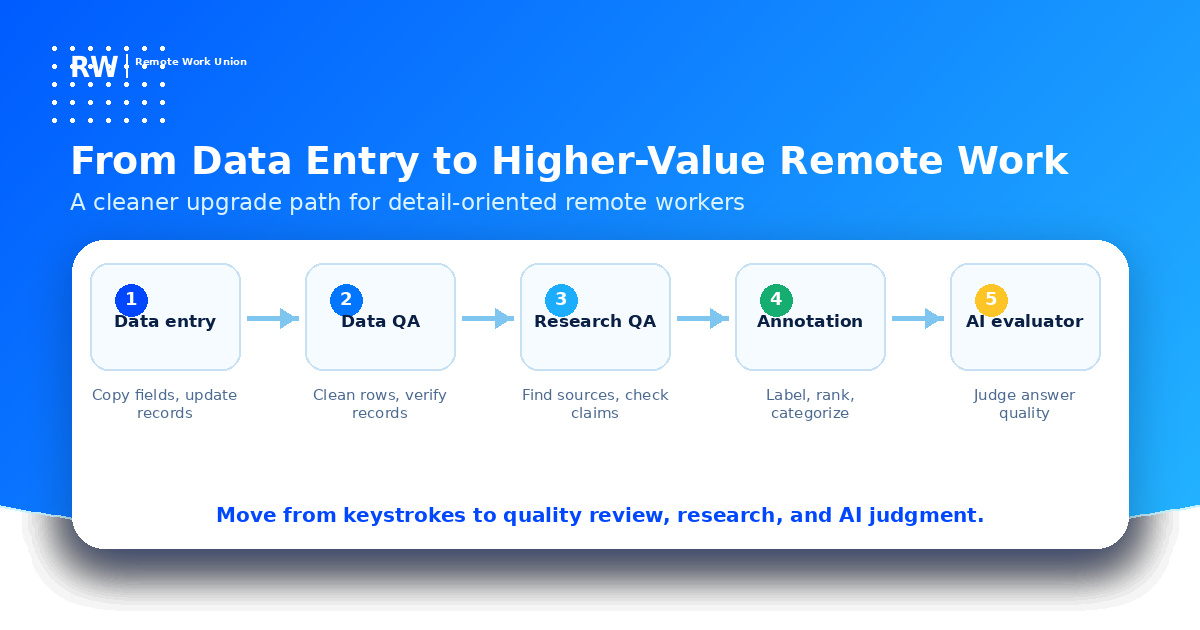
The better path is not to abandon your data entry strengths. It is to reposition them. Instead of saying, "I want data entry," look for roles where accuracy matters but judgment matters too. That shift moves you from basic input work toward quality review work.
A data entry worker enters what is written. A quality reviewer asks whether it is correct. A research assistant finds the source. An AI evaluator compares two answers and explains which one is better. A search quality rater judges whether a result actually satisfies the query. These are still detail-oriented remote jobs, but they are harder to replace with simple automation because they require context.
The Best Alternatives to Data Entry Jobs
The strongest alternatives usually share four traits: they can be done remotely, they reward attention to detail, they do not require constant phone calls, and they can be learned by people who are willing to follow instructions carefully. Some are beginner-friendly. Others require writing ability, subject expertise, a degree, or experience in a field such as finance, law, healthcare, education, coding, marketing, or science.
Below are the best categories to search instead of typing the same generic phrase into job boards.
1. AI Data Annotation Jobs
AI data annotation is one of the clearest upgrades from data entry. Instead of entering rows of information, you label, categorize, compare, or organize data so AI systems can learn from it. The work can include labeling text, identifying whether an answer follows instructions, tagging categories, checking relevance, classifying sentiment, or reviewing examples for quality.
For a remote worker who likes structured tasks, data annotation can feel familiar. You still follow a guide. You still work carefully. You still need consistency. The difference is that you are usually helping build or improve datasets rather than simply moving information from one box to another.
Search terms to use include AI data annotation jobs, data annotation from home, remote annotation jobs, AI training jobs, chatbot training jobs, human feedback jobs, and RLHF jobs. If you have a specific background, combine it with the search. Examples: legal AI annotation, healthcare AI annotation, finance data annotation, coding annotation, language annotation, or education AI training.
2. AI Evaluator and AI Rater Jobs
AI evaluator jobs are a strong fit for people who can read two answers and decide which one is more accurate, helpful, safe, complete, or well-written. These roles may appear under titles such as AI model evaluator, AI response reviewer, AI rater, LLM evaluator, chatbot evaluator, model response reviewer, AI quality analyst, or prompt evaluator.
This work is more judgment-based than data entry. You may compare responses from a chatbot, score them using a rubric, identify mistakes, check whether the answer followed the prompt, or explain why one response is better than another. Strong writing helps because many projects require short justifications.
The best candidates are not necessarily coders. Many projects need people who can evaluate English writing, research facts, review reasoning, test prompts, or bring domain expertise. A teacher may review educational answers. A finance worker may review business analysis. A nurse or medical writer may evaluate health-related content. A lawyer or paralegal may review legal reasoning. A bilingual worker may review translations or cultural accuracy.
This is one of the best data entry alternatives because it uses the same patience and attention to detail while adding higher-value judgment.
3. Prompt Evaluation and AI Workflow Testing
Prompt evaluation jobs sit close to AI evaluator work, but the focus is often on testing how an AI system responds to specific instructions. You may be asked to write prompts, compare outputs, identify failure patterns, flag hallucinations, or document whether the tool completed the task correctly.
This type of work is useful for people who already use tools such as ChatGPT, Claude, Gemini, Copilot, Perplexity, Grok, or other AI assistants. The skill is not just typing a prompt. The skill is noticing whether the answer is useful, whether it misses a constraint, whether it invents facts, whether it follows formatting instructions, and whether it would actually help a user.
Search terms include prompt evaluation jobs, prompt testing jobs, AI workflow tester, chatbot tester, AI response reviewer, AI quality reviewer, LLM evaluation, and remote AI testing. These searches are often better than "remote data entry" because they describe the actual value you provide: structured review of AI behavior.
4. Search Quality Rater Jobs
Search quality rating is another classic remote job category for detail-oriented people. A search quality rater reviews search results, ads, maps results, or web pages and judges whether they satisfy a query. The work can involve relevance, usefulness, page quality, local intent, language quality, or whether a result matches what a user was probably looking for.
This is not the same as data entry. You are not just entering information. You are making a relevance judgment. That makes it a better fit for people who like research, browsing, comparing sources, and thinking about user intent.
Useful search terms include search quality evaluator, search engine evaluator, web search evaluator, ad quality rater, internet rater, map quality analyst, online rater, and search relevance evaluator. For remote workers who want no-phone work, this category is worth testing because many tasks are asynchronous and instruction-based.
5. Remote Research Assistant Jobs
Remote research jobs are a strong alternative if you are good at finding information, reading carefully, organizing notes, and summarizing what matters. Research assistant work can exist in business, recruiting, marketing, academic support, legal support, finance, real estate, healthcare, and AI training.
A remote research assistant may build lead lists, verify company details, compare products, summarize articles, find sources, check facts, organize spreadsheets, prepare briefs, or gather evidence for a larger project. The work can still involve spreadsheets, but the value comes from finding the right information and making it usable.
Search terms include remote research assistant, online research jobs, internet research jobs, research analyst remote, fact-checking assistant, lead research assistant, market research assistant, and AI research evaluator. If you have a degree or professional background, combine the role with your field: legal research assistant remote, finance research analyst remote, education research assistant, healthcare research support, or technical research reviewer.
6. Fact-Checking and Source Verification Jobs
Fact-checking is one of the most important upgrades from basic data entry because it turns accuracy into a paid skill. Instead of copying information, you verify whether information is true, current, sourced, and represented correctly.
This type of work can appear in publishing, media, SEO content, education, AI evaluation, marketing, and research operations. Tasks may include checking names, dates, claims, citations, quotes, product details, company descriptions, medical wording, financial statements, or legal references.
Search terms include fact-checking jobs from home, remote fact checker, source verification jobs, research QA, content QA analyst, citation checker, AI fact-checking jobs, and AI response fact checker. Workers who are good at spotting small mistakes can often transition from data entry into fact-checking because the underlying strength is the same: accuracy. The difference is that fact-checking asks why the information is correct, not just where it should be placed.
7. Transcript Cleanup and QA Jobs
Transcription is sometimes grouped with data entry because it involves turning audio into text. The better opportunity is not always raw transcription. It is transcript cleanup and quality assurance. AI transcription tools are common, but they still make mistakes with names, accents, punctuation, context, technical terms, timestamps, and speaker labels.
A transcript QA worker may review automated transcripts, correct errors, format speaker turns, clean punctuation, and make the output usable. This can be a good fit for workers who are fast readers, strong listeners, and careful editors.
Search terms include transcription QA jobs, transcript editor remote, caption QA, subtitle editor, audio transcription editor, medical transcription editor, legal transcription proofreader, and AI transcript review. Some specialized roles require domain knowledge, but general transcript cleanup can be a practical entry point for people moving beyond basic data entry.
8. Spreadsheet Cleanup, CRM Data QA, and Operations Support
Not every data-related job should be ignored. Some spreadsheet and operations support roles are much better than generic data entry because they involve cleanup, organization, quality checks, and judgment.
Look for roles that include deduplication, record verification, CRM cleanup, list building, lead enrichment, data QA, spreadsheet formatting, database hygiene, or operations support. These tasks still use Excel, Google Sheets, Airtable, Notion, HubSpot, Salesforce, or internal tools, but the role is more valuable because you are improving the quality of a system rather than simply typing into it.
Search terms include remote data QA, CRM data specialist remote, spreadsheet cleanup jobs, data quality analyst entry level, operations assistant remote, data operations assistant, lead enrichment jobs, and database cleanup remote. This path is especially practical for people who already like spreadsheets and want a familiar bridge away from low-paying data entry listings.
Remote Work Union connects you to legitimate remote work roles across AI evaluation, research, annotation, and more. Apply for free.
Find Roles Hiring Now →9. Content Quality Review and Moderation QA
Content quality review is another strong alternative for people who want structured remote work without phone calls. The work may involve reviewing text, images, product descriptions, listings, ads, user-generated content, or AI-generated content against a policy or rubric.
Some moderation roles can be emotionally difficult, so read job descriptions carefully. Focus on content quality, policy review, listing QA, product catalog QA, ad review, AI content review, or trust and safety QA when you want roles built around standards and accuracy rather than live customer interaction.
Search terms include content reviewer remote, content quality analyst, policy reviewer remote, trust and safety QA, ad quality reviewer, marketplace listing QA, product content QA, and AI content reviewer. This is a logical step up from data entry because it still involves structured review, but the work asks you to judge quality and compliance.
10. Ticket-Based Support With No Phone Calls
Some remote workers avoid customer support because they do not want a phone job. That is reasonable. But not all support roles are phone-based. Ticket-based support, email support, chat support, and back-office support can be better alternatives to data entry if you are a clear writer and can solve simple problems from written instructions.
These jobs may involve responding to customer requests, categorizing tickets, escalating issues, updating help desk records, or using templates carefully. The work is not as quiet as pure data review, but it can still be remote, written, and structured.
Search terms include remote email support, chat support no phone, ticket support specialist, customer support no phone, back-office support remote, support operations assistant, and help desk ticket coordinator. This path is best for workers who are comfortable writing to people but do not want calls.
How to Choose the Right Alternative
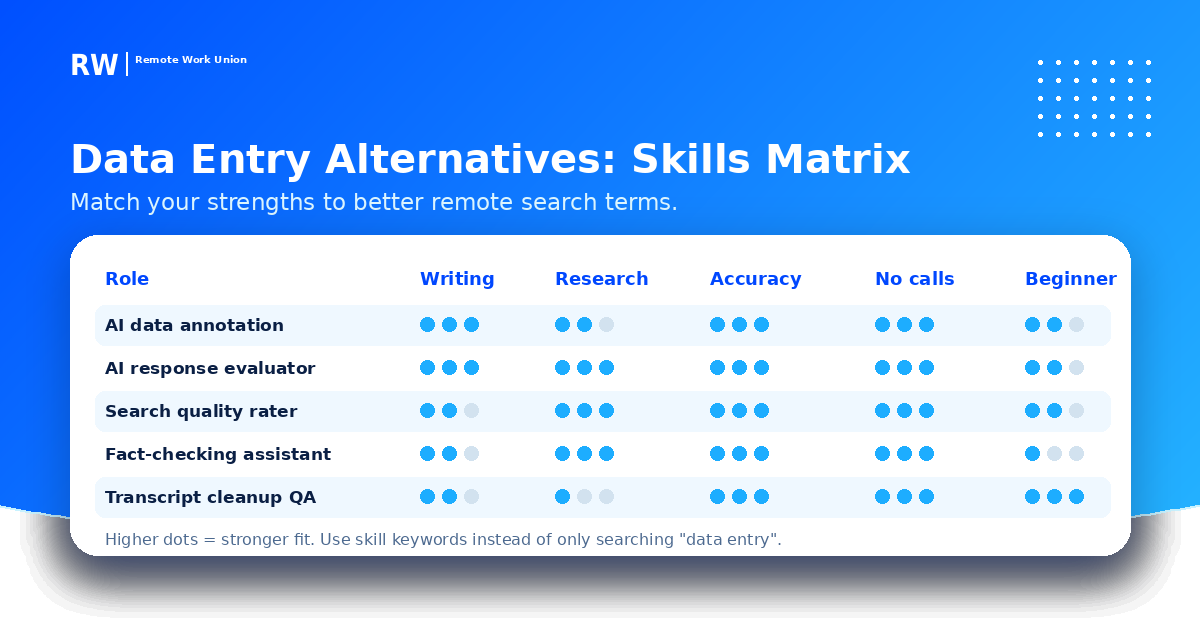
The best data entry alternative depends on what you are actually good at. Do not choose based only on what sounds easy. Choose based on your strongest repeatable skill.
If you like clean structure, try AI data annotation, spreadsheet QA, CRM cleanup, and transcript QA. If you like reading and comparing options, try AI evaluator jobs, search quality rating, prompt evaluation, and content QA. If you like digging for answers, try remote research, fact-checking, citation checking, and source verification. If you write clearly, try AI response reviewing, email support, content QA, and summarization work. If you have a degree or professional background, search for expert review roles in your domain.
Resume Positioning for Data Entry Alternatives
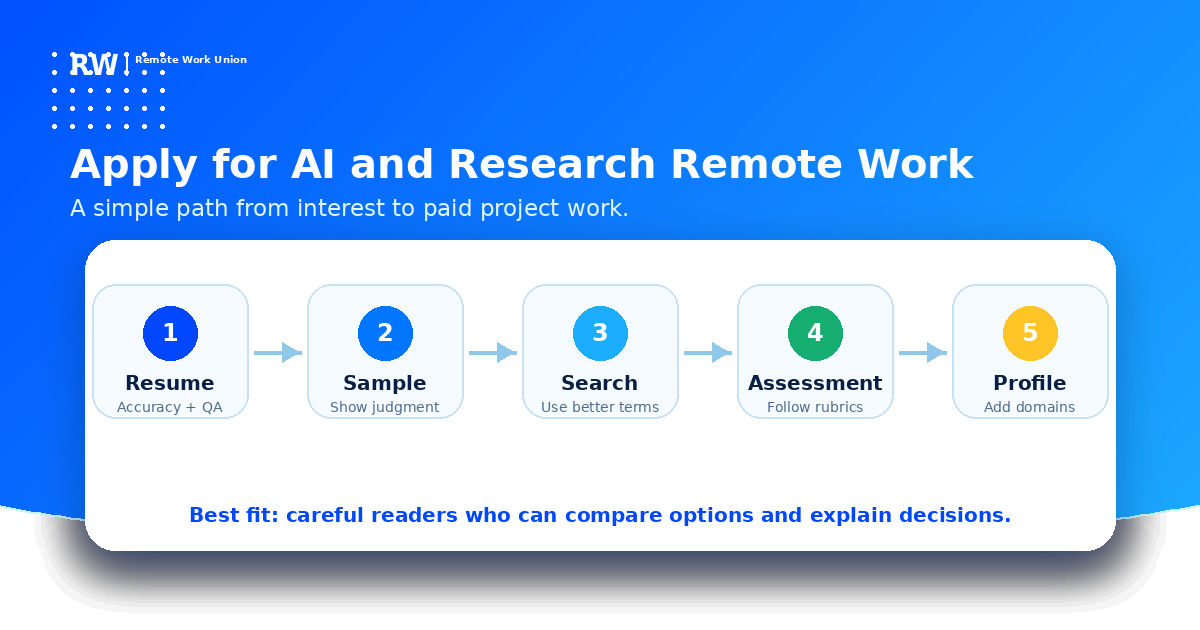
Your resume should not make you look like someone who only types. It should show that you can follow instructions, work accurately, review information, and communicate decisions.
Useful resume phrases include: data quality review, spreadsheet QA, record verification, source checking, written analysis, rubric-based evaluation, content review, annotation, categorization, research support, fact-checking, CRM cleanup, and workflow documentation.
If you have used AI tools, mention them carefully. Do not claim to be an AI engineer if you are not. Instead, describe practical usage: evaluated AI-generated responses for accuracy, compared model outputs using rubrics, tested prompts for instruction-following, reviewed chatbot answers for clarity, or used AI tools to organize research drafts under human review.
For AI evaluation jobs, short writing samples can help. A good sample does not need to be fancy. It can show a prompt, two possible answers, your rating, and a brief explanation of which answer is better and why. That proves the exact skill many projects need: clear judgment.
Application Tips That Actually Help
Apply with precision. Generic applications are easy to ignore because these remote roles attract a lot of interest. Use the job description to mirror the correct language. If the role says annotation, use annotation. If it says response evaluation, use response evaluation. If it says search quality, use search relevance and user intent.
Take assessments seriously. Many AI evaluator and data annotation platforms use qualification tests. The goal is usually not to be clever. The goal is to follow the rubric exactly, avoid assumptions, cite evidence when asked, and stay consistent. Read the instructions more than once before starting.
Build a small proof file. Keep a one-page document with examples of tasks you can do: a short fact-check, a cleaned spreadsheet sample, a response comparison, or a research summary. Do not include confidential work. Use public or fictional examples. The point is to show that you can do more than type.
Search broadly but apply narrowly. Job boards may not always use the same title. One company may say AI rater, another may say model evaluator, another may say data annotation specialist, and another may say content quality analyst. Keep a keyword list and rotate through it. Then tailor each application to the actual role.
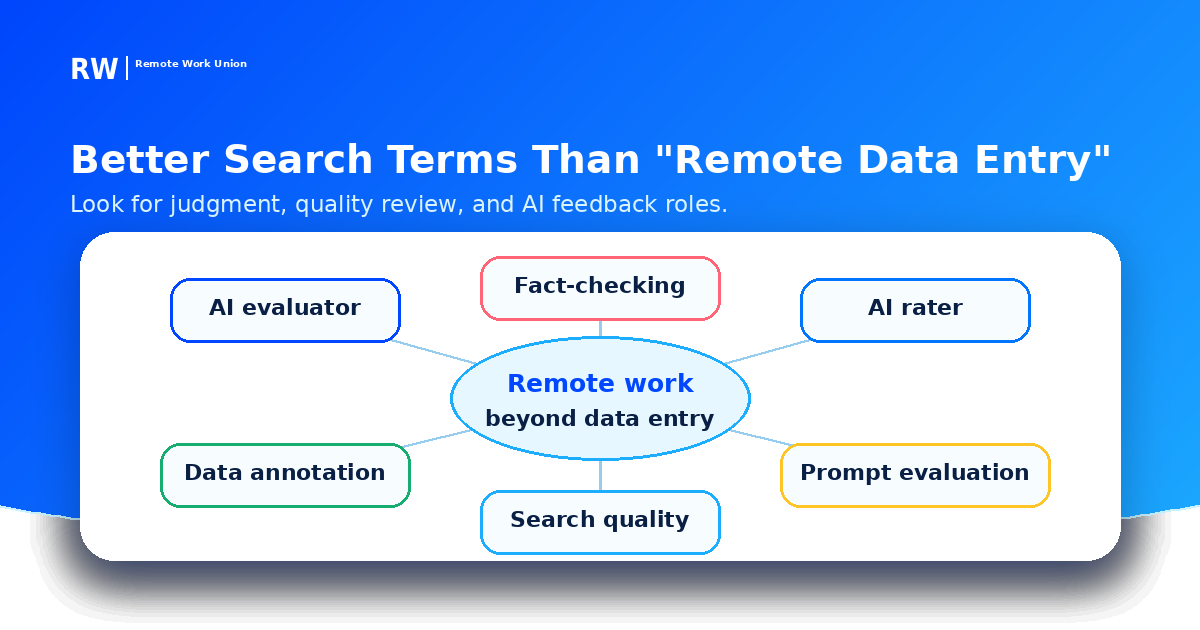
Search Terms to Use Instead of Remote Data Entry
Instead of relying only on remote data entry jobs, use a wider keyword set:
AI data annotation jobs, remote data annotation, AI evaluator jobs, AI rater jobs, AI model evaluation jobs, prompt evaluation jobs, chatbot evaluator jobs, AI response reviewer jobs, RLHF jobs, human feedback jobs, search quality evaluator jobs, internet rater jobs, fact-checking jobs from home, source verification jobs, remote research assistant, content quality analyst remote, transcript QA jobs, spreadsheet QA jobs, CRM data cleanup remote, data quality analyst entry level, online proofreading jobs, remote email support no phone, and work from home jobs with no phone calls.
Tip: The point is not to memorize every phrase. The point is to stop searching like a basic applicant and start searching like someone who understands where the work is moving.
Final Takeaway
Data entry is not a bad starting point, but it should not be the only remote work category you search. The better opportunities usually sit one step above it. They still reward accuracy, patience, and structure, but they add judgment, research, writing, or AI evaluation.
For remote workers, the best alternatives to data entry jobs are not random side hustles. They are roles built around quality: AI data annotation, AI model evaluation, prompt testing, search quality rating, fact-checking, transcript QA, spreadsheet cleanup, content review, and remote research support.
If you can read carefully, follow detailed instructions, compare information, and explain your reasoning, you are not limited to typing jobs. You can position yourself for remote work that is more relevant to the future of online hiring.
Ready to apply for jobs? Go to RemoteWorkUnion.com to find roles hiring now.
Frequently Asked Questions
Is data entry still worth applying for?
Data entry is not a bad starting point, but the market is very crowded and many listings are low-value or easily automated. The better strategy for detail-oriented remote workers is to apply for adjacent roles like AI data annotation, AI evaluation, search quality rating, fact-checking, and spreadsheet QA — jobs that use the same strengths but reward judgment, not just keystrokes.
What is the easiest alternative to data entry?
AI data annotation and spreadsheet QA are among the most beginner-friendly alternatives. Both are structured, instruction-based, and familiar to anyone who has done data entry. The difference is that you are labeling, categorizing, or improving data quality rather than only copying information from one place to another.
Do I need coding skills for AI evaluator jobs?
No. Most AI evaluator roles focus on writing clarity, judgment, research, and instruction-following rather than coding. Coding background helps for technical evaluation projects, but a large portion of AI evaluation work involves language, reasoning, fact-checking, and rubric-based review that does not require programming knowledge.
How do I reposition my data entry resume for AI roles?
Replace data entry language with evaluation and quality language. Use phrases like data quality review, record verification, annotation, content review, rubric-based evaluation, research support, fact-checking, and spreadsheet QA. If you have used AI tools, describe the work in outcome terms: evaluated AI-generated responses for accuracy, compared model outputs using rubrics, or reviewed chatbot answers for clarity. Short writing samples or response comparison examples can also strengthen your application.
Can I do multiple remote roles at once?
Yes. Many of these alternatives are project-based or contract-based, which means you can apply to and qualify for several platforms at the same time. Applying across AI annotation, AI evaluation, research, and content QA categories creates more stability than depending on a single platform or project.