Some people are built for careful work. They read a claim and immediately wonder, "Where did that come from?" They notice when an answer sounds confident but skips evidence. They compare sources, check dates, scan for contradictions, and prefer being right over being fast.
That instinct is useful in a growing group of remote jobs. Fact-checking, online research, AI response evaluation, search quality rating, data annotation, and content quality review all reward the same basic habit: do not accept the first answer at face value.
This guide breaks down the best remote jobs for people who like fact-checking and research, especially workers interested in AI evaluator jobs, AI rater jobs, prompt evaluation jobs, search quality rater jobs, AI response reviewer jobs, data annotation jobs from home, and other work from home research jobs that usually do not require phone calls.
The main idea is simple. If you are good at verifying information, reading carefully, and explaining mistakes clearly, you may be a strong fit for remote AI and research review work.
What Fact-Checking and Research Jobs Have in Common
Remote research jobs can look different from one listing to another, but the strongest roles usually share a few traits.
You are given a question, claim, search result, AI answer, webpage, dataset, or piece of content. Your job is to evaluate whether it is accurate, useful, complete, and well-supported. Sometimes you rate the answer using a rubric. Sometimes you label examples. Sometimes you compare two responses and choose the better one. Sometimes you find sources and write a short explanation about what is wrong.
This is why many roles use different titles for similar work. A company may call the role an AI evaluator, AI trainer, AI response reviewer, search quality rater, research analyst, content quality analyst, data annotation specialist, AI fact checker, or human feedback reviewer. The exact title matters less than the task underneath it.
The best fit is usually someone who can slow down just enough to ask better questions:
- Is this claim actually supported by the source?
- Is the source reliable enough for the topic?
- Is the answer current, or could it be outdated?
- Did the model misunderstand the prompt?
- Are two sources saying different things?
- Is the response useful for a real person trying to make a decision?
That is the core of remote fact-checking work. It is not just browsing the internet. It is structured judgment.
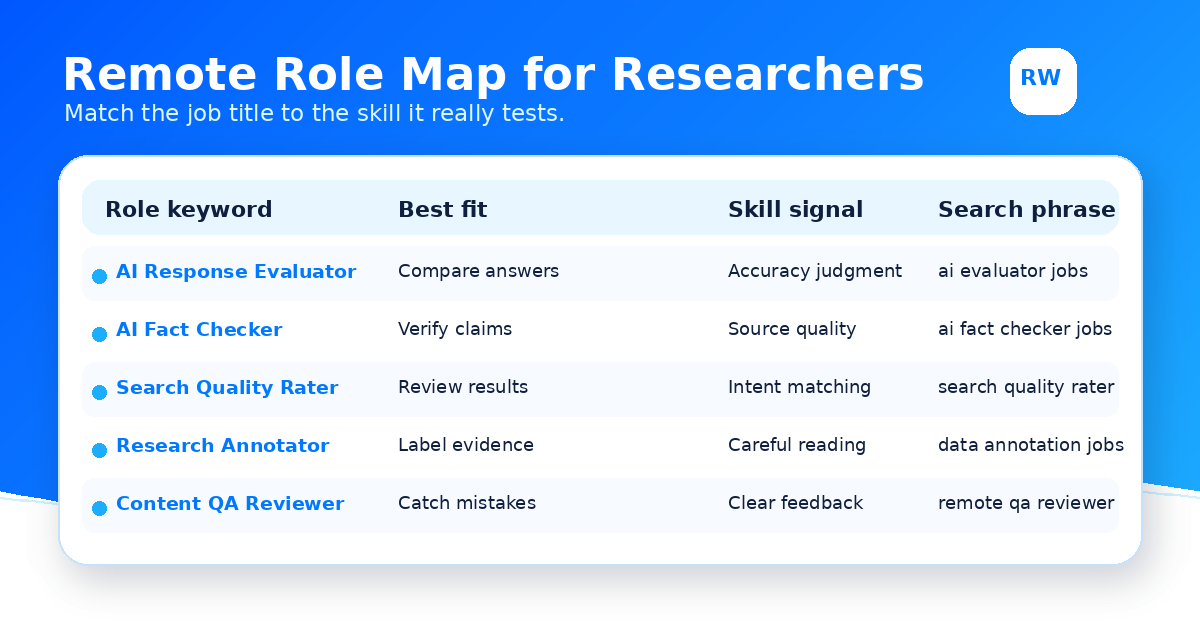
1. AI Response Evaluator Jobs
AI response evaluator jobs are one of the strongest matches for people who like fact-checking and research. In these roles, you review answers produced by AI systems and judge whether they are accurate, helpful, safe, complete, and aligned with the user's request.
The work often involves comparing two model responses. You may decide which answer is better, identify factual errors, explain why one response is stronger, or apply a rubric to rate clarity, instruction following, reasoning quality, and source support.
This kind of job is especially good for people who enjoy research because AI answers often sound polished even when they contain subtle mistakes. A good evaluator checks the substance, not just the style. That means verifying names, dates, definitions, claims, product details, legal or medical caveats, and whether the answer actually responds to the prompt.
Search terms to use:
- AI evaluator jobs
- AI response evaluator
- AI response reviewer jobs
- AI model evaluation jobs
- human feedback jobs
- RLHF jobs
- prompt evaluation jobs
These roles can appear on AI training platforms, data annotation companies, research vendors, and contractor marketplaces. Some projects are generalist-friendly, while others need domain expertise in areas like law, finance, medicine, coding, education, writing, or science.
2. AI Fact Checker Jobs
AI fact checker jobs focus more directly on claims. You may be asked to review an AI-generated answer, identify factual statements, verify each claim against reliable sources, and mark whether the statement is supported, unsupported, misleading, outdated, or false.
This is a good fit for people who already fact-check news, historical claims, product claims, health claims, business claims, or academic-sounding statements in everyday life. The best workers are not just skeptical. They are organized. They know how to separate a vague opinion from a checkable fact.
For example, an AI answer may say that a company was founded in a certain year, that a software feature is available, that a medical guideline recommends a certain action, or that a law works a certain way. A fact checker has to determine whether that claim is correct and whether the source used is strong enough.
Strong AI fact checkers are careful with topics that can change. Company leadership, pricing, job listings, legal rules, product features, tax rules, healthcare guidance, and school policies can all become outdated. A good reviewer does not rely on memory when the answer needs current evidence.
Search terms to use:
- AI fact checker jobs
- fact checking jobs remote
- remote fact checking jobs
- AI content reviewer
- AI verification jobs
- research reviewer jobs
The best applications for these roles show that you can be precise without overcomplicating the work. Companies want people who can find the issue, support the correction, and explain it clearly.
3. Search Quality Rater Jobs
Search quality rater jobs are built for people who like online research. Instead of reviewing only one answer, you may evaluate whether a search result, webpage, map result, video result, or AI search response satisfies a user's intent.
The key skill is understanding what the user was actually trying to find. A search for "best remote jobs for researchers" is different from a search for "remote research assistant jobs no phone" or "AI rater jobs work from home." Search quality work rewards people who can identify intent, compare result usefulness, and judge whether a page is trustworthy.
This work may include evaluating relevance, page quality, source authority, freshness, language quality, and whether the result would genuinely help the user. It is a strong fit for people who already know how to search creatively and avoid low-quality websites.
Search terms to use:
- search quality rater
- search engine evaluator
- internet rater jobs
- online rater jobs
- AI search evaluator
- search evaluation jobs remote
These jobs are often part-time, contract-based, and remote. They may involve detailed guidelines, so patience matters. The role can feel repetitive, but it is a good entry point for people who like structured research work.
4. Data Annotation Jobs for Research-Minded Workers
Data annotation jobs from home are often described too broadly. Some annotation work is simple labeling, but better projects can involve research, classification, evidence review, response comparison, and quality judgment.
Research-minded workers should look for annotation projects that involve text, reasoning, search, citations, summarization, document review, policy review, or domain-specific content. These tasks are usually a better fit than basic image tagging or repetitive data entry.
In AI data annotation, your work may help train or evaluate models. You might label whether an answer follows instructions, whether a summary is faithful to a document, whether a response contains unsupported claims, or whether a model's answer is better than another answer.
Search terms to use:
- data annotation jobs from home
- AI data annotation jobs
- research annotation jobs
- text annotation jobs
- data labeling jobs remote
- AI training jobs remote
The best way to stand out is to show that you can follow guidelines exactly. These projects often use rubrics. If you ignore the rubric and rely only on your opinion, your work quality will suffer.
5. Prompt Evaluation Jobs
Prompt evaluation jobs involve testing how AI systems respond to instructions. You may write prompts, compare responses, identify failure cases, or judge whether a model followed the user's request.
This is a strong role for people who like both research and language. You need to understand the task, evaluate the response, and explain what went wrong. Sometimes the issue is factual accuracy. Sometimes it is completeness. Sometimes it is instruction following. Sometimes the answer is technically correct but not useful.
Prompt evaluation work can involve major AI ecosystems and keywords such as ChatGPT, Claude, Gemini, Copilot, Perplexity, Grok, OpenAI, Anthropic, Google, Microsoft, Meta, Amazon, Apple Intelligence, NVIDIA, and other AI companies. Those terms are useful in search because many job seekers use them when looking for AI model evaluation work. However, applicants should always read the actual job description instead of assuming that a listing is connected to a specific company.
Search terms to use:
- prompt evaluation jobs
- prompt evaluator remote
- AI prompt reviewer
- AI model trainer jobs
- AI trainer remote
- LLM evaluator jobs
The strongest candidates can explain their reasoning in a direct way. A good note might say: "Response B is better because it answers the user's exact question, includes the relevant limitation, and avoids the unsupported claim in Response A." That is more useful than a long paragraph full of vague praise.
6. Content Quality Analyst Jobs
Content quality analyst roles are not always branded as AI jobs, but many use the same skills. You may review articles, help center pages, product content, marketplace listings, educational content, or user-generated content for accuracy and usefulness.
This is a good option for people who like research but want work that feels closer to editing, quality assurance, or operations. Instead of writing full articles from scratch, you may audit content, flag issues, update outdated information, check style guidelines, or verify that a page answers the user's question.
Search terms to use:
- content quality analyst remote
- content QA reviewer
- content reviewer jobs remote
- editorial quality analyst
- quality assurance writer
- knowledge base reviewer
These roles can be especially good for people with writing, editing, customer support, education, legal, healthcare, or finance backgrounds. The core skill is the same: check the content against the standard and explain what needs to change.
7. Remote Research Assistant Jobs
Remote research assistant jobs are broader than AI evaluation. They may involve gathering information, summarizing sources, building lists, reviewing documents, monitoring topics, preparing briefs, or supporting a team with background research.
This can be a good fit if you enjoy open-ended research. Compared with AI rating jobs, research assistant work may require more independence. You may need to decide where to search, which sources to trust, how to organize findings, and how to communicate uncertainty.
Search terms to use:
- remote research assistant
- online research jobs
- work from home research jobs
- internet researcher jobs
- research analyst remote
- desk research jobs
The challenge is that many generic "online research" listings are low quality. Strong listings usually describe the specific research area, the deliverable, the tools, and the kind of judgment required. Weak listings often promise easy money without explaining the actual work.
8. Expert Review Jobs for Domain Specialists
People with specialized backgrounds can often find better-paying remote review work than generalist applicants. Expert review jobs may involve law, medicine, nursing, finance, accounting, education, coding, science, engineering, insurance, real estate, or academic subjects.
These roles may be called expert AI trainer, domain expert evaluator, subject matter expert reviewer, legal AI evaluator, medical content reviewer, financial AI evaluator, coding evaluator, or education content reviewer.
The work is still rooted in fact-checking and research, but the standard is higher. A generalist can spot obvious mistakes. A subject matter expert can spot subtle errors, missing caveats, wrong terminology, and answers that would mislead a professional user.
Search terms to use:
- expert review jobs from home
- subject matter expert AI jobs
- legal AI evaluator
- medical AI reviewer
- finance AI evaluator
- coding AI evaluator
- education AI trainer
If you have domain expertise, make it visible. Your resume should not only say "research." It should show the field, the type of documents you can review, and the standard you can apply.
Skills That Make Applicants Stand Out
Remote fact-checking and research jobs are not only about being smart. They reward specific work habits. The people who do well tend to be consistent, careful, and comfortable explaining their decisions.
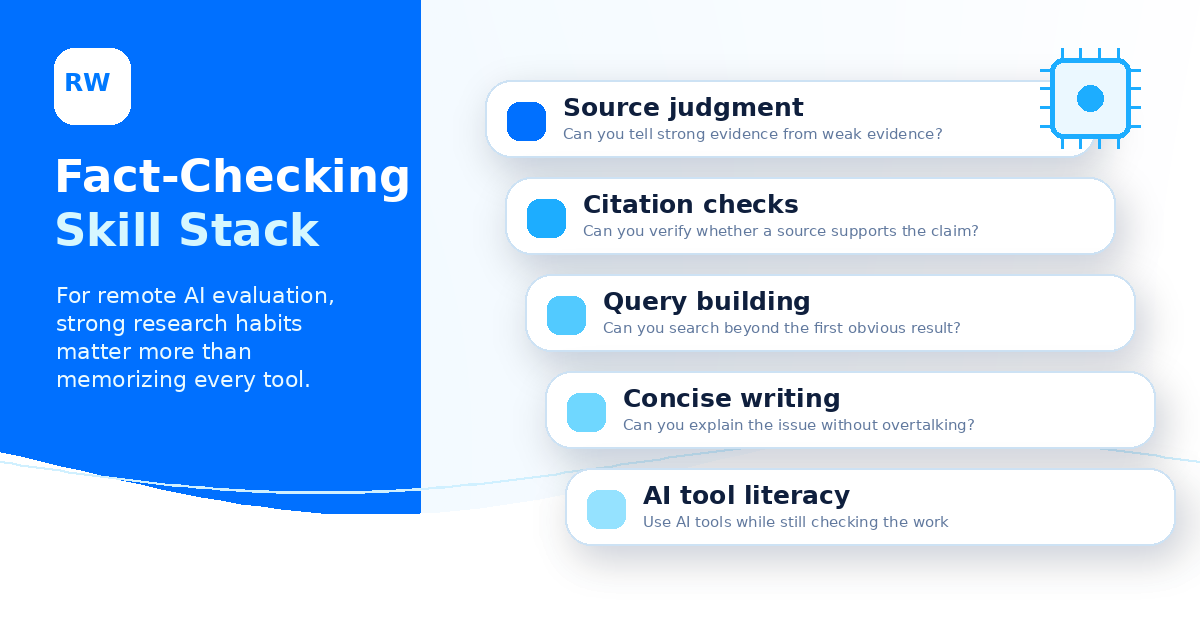
Source Judgment
You need to know the difference between a strong source and a weak source. Official documentation, primary sources, reputable publications, academic sources, and direct company pages usually carry more weight than random blogs, scraped summaries, outdated forums, or AI-generated pages.
The standard changes by topic. A personal opinion can be supported by a review or firsthand account. A legal, medical, or financial claim needs a much stronger source. A product feature may require current official documentation. A breaking-news claim may require multiple reliable outlets.
Citation Checking
A common AI failure is citing something that does not actually support the claim. A source may mention the topic but not prove the statement. Good reviewers check the connection between the claim and the evidence.
Ask: Does the source directly support this? Is the page current? Is the source independent? Is the claim more specific than the evidence? Did the answer exaggerate what the source says?
Query Building
Good researchers do not type one search and stop. They try synonyms, official terms, exact phrases, date filters, company names, document titles, and negative keywords. They know how to search for the same idea from several angles.
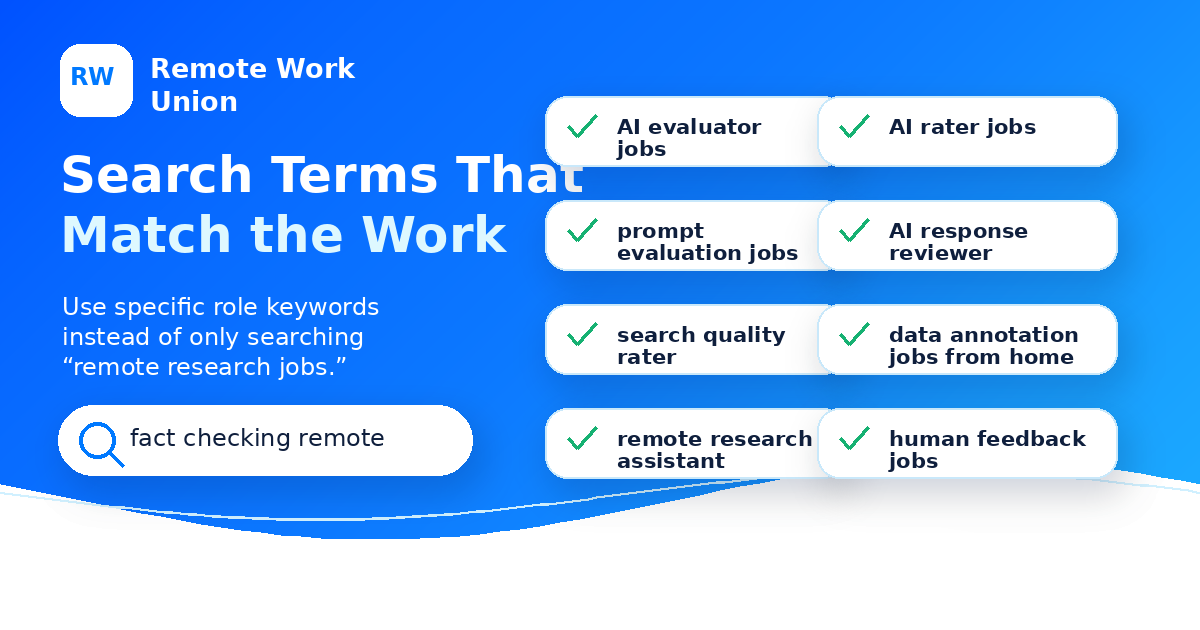
For job seekers, query building also helps with applications. Instead of searching only "remote jobs," use specific terms such as "AI evaluator jobs," "AI rater jobs," "remote research assistant," "search quality rater," "prompt evaluation jobs," and "AI response reviewer jobs."
Concise Written Judgment
Many remote AI and research jobs require short explanations. The goal is not to write a long essay. The goal is to identify the issue and explain it clearly.
A strong explanation is specific: "The answer claims the policy applies nationwide, but the source only discusses one state." A weak explanation is vague: "This answer seems bad and needs more detail."
Rubric Discipline
AI evaluation work often uses rubrics. A rubric may define accuracy, helpfulness, completeness, safety, writing quality, or instruction following. The best workers do not freestyle. They apply the standard consistently.
That matters because these roles usually measure quality. If your ratings are random, too generous, too harsh, or poorly explained, you will not last on serious projects.
AI Tool Literacy
You do not need to be a software engineer for many AI evaluator or AI rater jobs. However, you should understand how AI tools can make mistakes. Large language models can hallucinate, overgeneralize, misunderstand prompts, cite weak sources, miss edge cases, or produce answers that sound correct but are not.
Knowing how to use ChatGPT, Claude, Gemini, Copilot, Perplexity, Grok, and other AI tools can help you understand the work. But the important skill is not blindly trusting AI. It is knowing when to verify.
What a Typical Remote Research Task Can Look Like
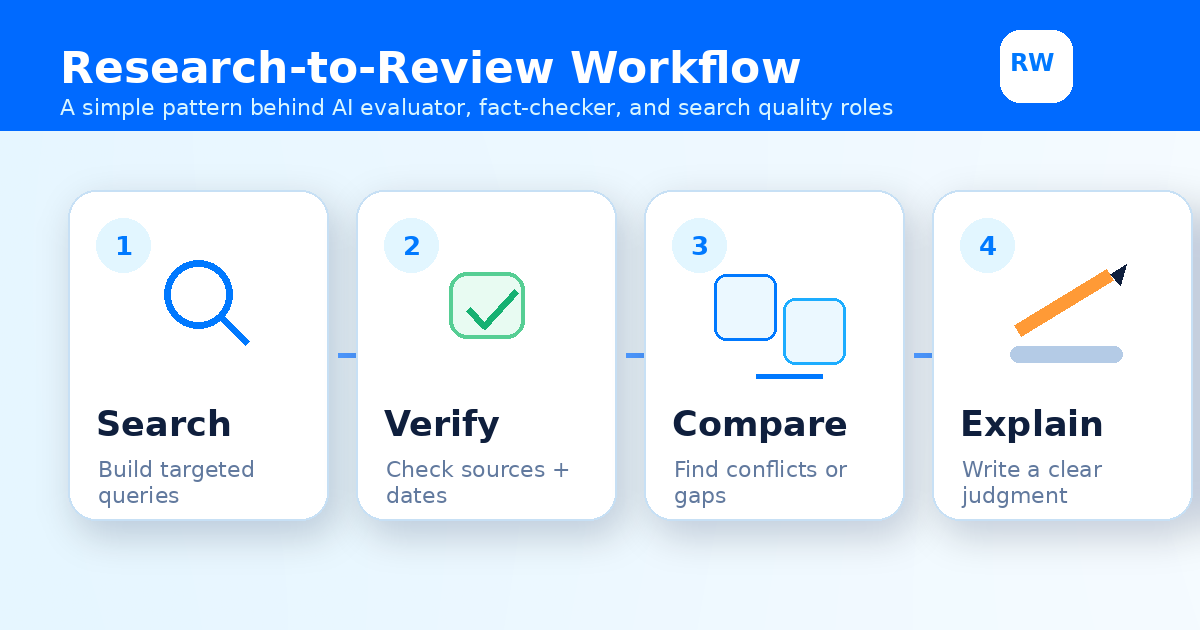
A typical AI evaluation or fact-checking task may look like this:
- Read the user's prompt.
- Read one or two AI-generated responses.
- Identify the main claims.
- Check whether the answer followed the instructions.
- Research any factual claims that matter.
- Compare the response against the rubric.
- Choose the better answer or assign a rating.
- Write a brief explanation.
For example, a user might ask for the best remote jobs with no phone calls. One AI answer might list data entry, transcription, AI evaluation, content moderation, and online tutoring. Another might list sales development, customer support, and appointment setting. A good evaluator would notice that the second answer includes phone-heavy roles and may not satisfy the user's request.
In another task, a model may summarize a webpage. Your job might be to check whether the summary added facts that were not in the source. This is called faithfulness or groundedness in many AI workflows. It is one of the most important skills in AI response review.
Remote Work Union connects you to legitimate remote AI training and evaluation roles across multiple platforms. Apply for free.
Find Roles Hiring Now →How to Build a Resume for These Jobs
A resume for remote fact-checking and research jobs should not sound like a generic office resume. It should show the skills these projects actually need.
Useful resume phrases include:
- Evaluated AI-generated responses for factual accuracy, helpfulness, and instruction following
- Reviewed written content against detailed rubrics and quality guidelines
- Verified claims using reliable sources and documented support clearly
- Compared response options and selected the stronger answer based on evidence
- Conducted online research, source review, and structured data annotation
- Identified unsupported claims, outdated information, and misleading wording
- Wrote concise rationales explaining quality issues and recommended corrections
For skills, include terms such as research, fact-checking, AI evaluation, data annotation, response review, rubric-based grading, source verification, search quality, content QA, prompt evaluation, and written analysis.
If you have domain expertise, include it clearly. A finance background, teaching background, legal research experience, healthcare writing experience, coding experience, academic research, journalism, editing, or technical writing can all make you more competitive for specialized projects.
How to Apply Without Wasting Time
The biggest mistake is applying to every remote listing with the same generic resume. These jobs are keyword-sensitive and task-sensitive. A better approach is to build a simple application system.
Start with three resume versions:
- An AI evaluator resume focused on response review, rubrics, comparison, and written rationales
- A research resume focused on source verification, online research, summaries, and reports
- A content QA resume focused on editing, accuracy, guidelines, and content improvement
Then match your resume to the listing. If the job says "AI model evaluator," emphasize AI evaluation. If it says "search quality rater," emphasize intent matching and result quality. If it says "content quality analyst," emphasize content QA and fact-checking.
Your application should make the hiring team believe you can do the task on day one. That means fewer vague claims and more concrete examples.
Good: "Reviewed AI responses for accuracy, instruction following, and unsupported claims using a rubric."
Weak: "Hard-working remote professional with strong communication skills." The first line matches the work. The second line could apply to almost any job.
Search Terms to Use When Applying
Many strong jobs never use the phrase "fact checker." They may be categorized under AI training, search evaluation, data annotation, content quality, or research operations. Use a wider keyword list.
Try searches like:
- AI evaluator jobs remote
- AI rater jobs work from home
- AI response reviewer jobs
- prompt evaluation jobs
- AI model trainer jobs
- RLHF jobs remote
- human feedback jobs
- search quality rater jobs
- search engine evaluator remote
- data annotation jobs from home
- AI data annotation jobs
- remote research assistant jobs
- online research jobs
- content quality analyst remote
- content QA reviewer jobs
- expert review jobs from home
Also search by domain if you have a specialty:
- legal AI evaluator
- medical AI reviewer
- finance AI evaluator
- coding AI evaluator
- education AI trainer
- science AI reviewer
- accounting AI evaluator
Do not rely only on one job board. These roles can appear on AI training platforms, company career pages, contractor marketplaces, LinkedIn, specialized communities, and remote work boards. Search broadly, but screen carefully.
Red Flags to Avoid
Research-related remote jobs attract low-quality listings because many people want flexible work from home. Be selective.
Avoid listings that promise easy money without explaining the task. Be careful with any company that asks you to pay for access to jobs, buy a training kit before seeing the role, or submit unpaid work that looks like real client work. Also be cautious when a listing uses popular AI keywords but gives no detail about the work, pay structure, evaluation process, or platform.
A real role should be able to explain at least some of the following:
- What you will review
- How your work will be evaluated
- Whether the role is employee or contractor
- Whether the schedule is flexible or fixed
- What skills are required
- What tools or guidelines are used
- Whether domain expertise is required
This does not mean every short listing is fake. Some legitimate projects keep details limited until onboarding. But the more vague the listing is, the more carefully you should screen it.
Who These Jobs Are Best For
Remote fact-checking and research jobs are a strong fit for people who enjoy quiet, focused work. They are especially good for workers who prefer written tasks over phone calls, independent review over meetings, and structured judgment over sales.
They can fit writers, editors, researchers, students, teachers, paralegals, analysts, coders, nurses, medical writers, finance professionals, librarians, journalists, content marketers, and detail-oriented generalists.
They are not ideal for people who hate guidelines, dislike repetitive tasks, or want every assignment to be creative. Many projects require patience. Some tasks are dry. The upside is that the work can be remote, flexible, and built around skills that many thoughtful people already have.
The Best Long-Term Path
The strongest long-term path is to move from generic remote research work into higher-skill evaluation. Basic data entry and simple labeling can become crowded. More advanced AI evaluation, fact-checking, domain review, and search quality work require better judgment.
Build toward tasks where accuracy matters. Learn how to explain factual issues. Practice comparing two answers. Get comfortable with rubrics. Track the domains where you have stronger knowledge. Over time, that can help you qualify for better AI training jobs, expert review jobs, and research-heavy remote projects.
The future of remote research work is not just finding facts. It is knowing which facts matter, which sources deserve trust, and how to turn that judgment into useful feedback.
Final Takeaway
If you like fact-checking and research, do not limit your job search to the phrase "remote research jobs." Look for the work underneath the title: AI response evaluation, AI fact checking, search quality rating, prompt evaluation, data annotation, content QA, human feedback, and expert review.
These jobs are built for people who notice mistakes, verify claims, compare sources, and explain their reasoning clearly. That skill set is valuable because AI systems need human judgment to improve.
Frequently Asked Questions
Do I need to be a journalist to get fact-checking remote jobs?
No. Skills that transfer include research, source evaluation, clear writing, and rubric discipline. Many applicants come from writing, editing, teaching, legal, finance, healthcare, or academic research backgrounds. The core skill is structured judgment — not journalism credentials.
What is the difference between AI fact-checking and content moderation?
Fact-checking verifies specific claims against reliable sources — checking whether an AI answer is accurate, current, and well-supported. Content moderation reviews content against platform policies — checking whether something violates rules around safety, legality, or community standards. Both are remote roles, but they require different skills and judgment frameworks.
Can beginners apply for AI response evaluator jobs?
Yes. Generalist AI evaluation roles value careful judgment, clear writing, and instruction-following more than credentials. Beginners can qualify for entry-level evaluation projects. However, specialists with domain expertise in law, finance, medicine, coding, or other fields often qualify for higher-paying and more selective roles.
What search terms work best for remote research jobs?
Use specific terms rather than broad phrases. Strong search terms from the article include: AI evaluator jobs remote, AI rater jobs work from home, AI response reviewer jobs, prompt evaluation jobs, RLHF jobs remote, human feedback jobs, search quality rater jobs, data annotation jobs from home, remote research assistant jobs, content quality analyst remote, and expert review jobs from home.
How do I avoid scam remote research job listings?
Look for listings that explain what you will review, how your work will be evaluated, the pay structure, whether the role is employee or contractor, and what tools or guidelines are used. Avoid listings that promise easy money without task details, ask you to pay for access or training kits before seeing the role, or require unpaid work that looks like real client deliverables.