Journalists, editors, copy editors, fact-checkers, and content strategists are unusually well matched for remote AI writing review work. The job is not just typing words into a chatbot. It is judging whether AI-generated writing is accurate, clear, complete, appropriately sourced, and useful for the person who asked the question.
As AI tools become part of search, customer support, education, legal research, health information, and everyday writing, companies need humans who can review the output. A model can produce fluent paragraphs quickly, but fluency is not the same as truth, judgment, or editorial quality. That gap creates paid work for people who already know how to read carefully, question claims, improve structure, and explain why one piece of writing is stronger than another.
What AI Writing Review Work Actually Is
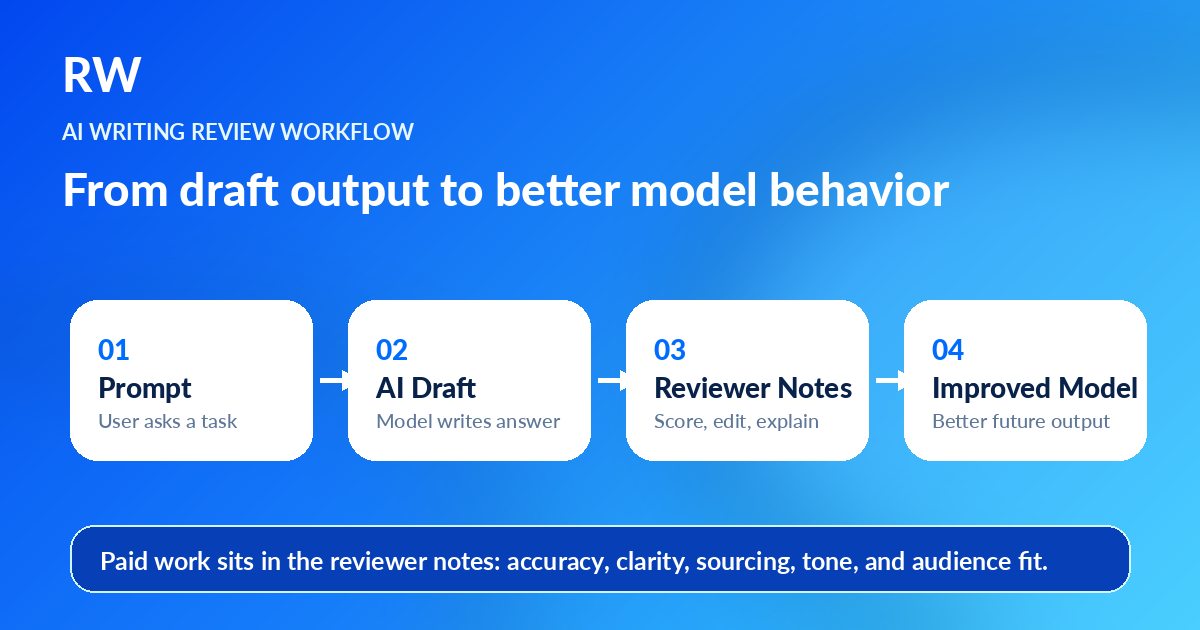
AI writing review work usually means helping a model produce better written answers. A reviewer may compare two AI responses and choose the better one, rewrite a weak answer, flag unsupported claims, grade tone and helpfulness, check whether the response followed instructions, or explain what made an answer fail. Some tasks feel like editing. Some feel like fact-checking. Some feel like grading. The common thread is human judgment.
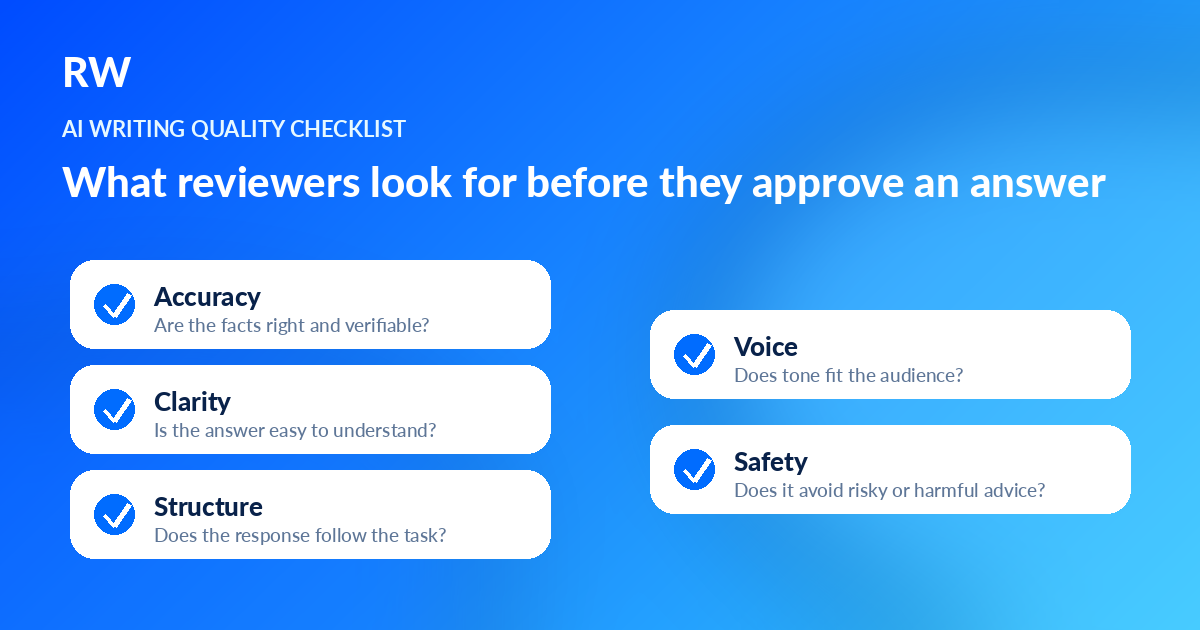
A typical task might show a prompt such as: "Explain this news event to a general audience." The AI model may provide two different responses. Your job could be to decide which answer is more accurate, which one is clearer, whether either response invents facts, and what a better answer would include. The best reviewers do not simply say "Response A is better." They explain why — pointing to accuracy, sourcing, structure, completeness, safety, audience fit, tone, and formatting.
Why Journalists and Editors Are Strong Candidates
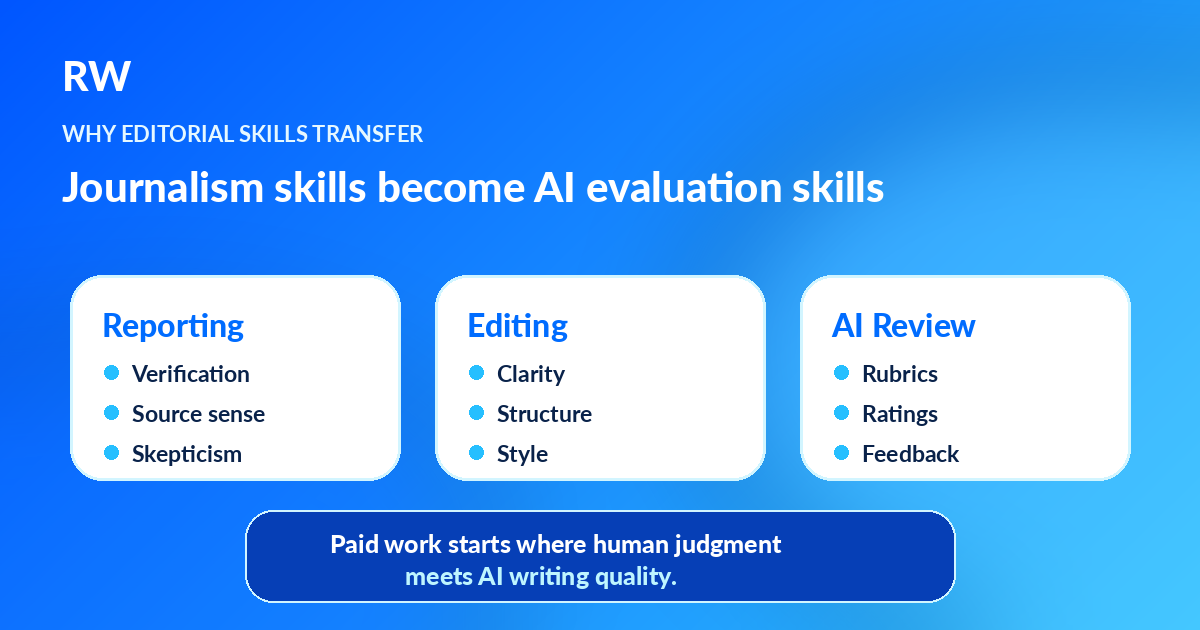
Journalists are trained to be skeptical of claims that sound confident but lack support. Editors are trained to improve structure, remove ambiguity, preserve meaning, and adapt writing to an audience. Those skills map directly to AI model evaluation.
AI systems often produce writing that is plausible before it is correct. They may summarize a topic too confidently, skip the strongest caveat, overstate a conclusion, use a weak source, or bury the answer under generic language. Editorial professionals also understand the difference between a technically grammatical answer and a useful answer — a response can be polished and still be incomplete; it can be concise and still miss the user intent.
Common Remote AI Roles for Editorial Professionals
AI writing evaluator: Reviews AI-generated answers for clarity, accuracy, tone, relevance, and completeness.
AI response reviewer: Compares two or more model outputs and chooses the strongest answer based on a rubric.
AI content editor: Rewrites or improves AI-generated text so it is more useful, concise, natural, and accurate.
Fact-checking evaluator: Tests whether AI answers contain unsupported claims, hallucinations, outdated statements, or incorrect citations.
RLHF writing reviewer: Provides preference ratings and explanations that help train models through human feedback.
Search quality rater or AI search reviewer: Reviews whether AI-generated search answers or summaries satisfy the query.
AI safety writing reviewer: Flags content that is misleading, harmful, policy-sensitive, or inappropriate for a general audience.
Remote Work Union connects editorial professionals to legitimate remote AI evaluation roles. Apply for free and find roles hiring now.
Find Roles Hiring Now →What the Tasks Can Look Like
Compare two AI answers. Rank Response A versus Response B based on accuracy, helpfulness, relevance, formatting, and user intent.
Rewrite a weak answer. Some projects ask reviewers to create an ideal response — where strong writers can stand out by producing a clean, direct, and complete model answer.
Identify hallucinations. A hallucination is not just a bizarre falsehood — it can be a subtle invented statistic, a fake citation, a wrong date, a misattributed quote, or an overconfident claim.
Edit for tone. AI writing can sound generic, overpolished, evasive, or too casual. Reviewers may adjust tone for a professional, academic, consumer, or expert audience.
Grade instruction following. If the prompt asks for three bullets, no jargon, a neutral tone, or a specific format, the evaluator checks whether the response obeyed those constraints.
Explain the rating. The explanation is often as important as the score — platforms want reviewers who can write concise, defensible feedback rather than vague reactions.
Where to Search for These Jobs
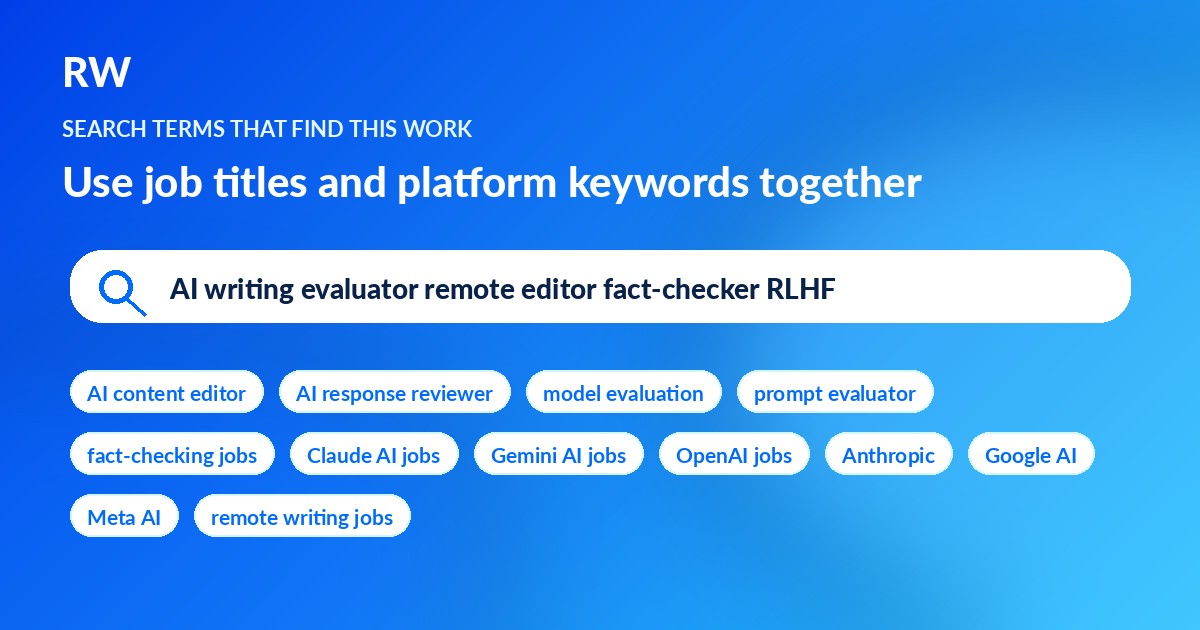
Editorial AI work can appear on general job boards, AI training platforms, freelance marketplaces, and company career pages. Useful searches include: AI writing evaluator, AI content editor, AI response reviewer, LLM evaluator, model evaluation writing, RLHF writer, prompt evaluator, AI fact-checking jobs, AI hallucination reviewer, search quality rater, data annotation writing, AI training contractor, remote editing AI, and work from home AI writer.
Major AI company names are useful search modifiers even when the role is posted through a contractor or partner. Job seekers commonly search around OpenAI, Anthropic, Google, Gemini, Meta, Microsoft, Claude, ChatGPT, Perplexity, Scale AI, Outlier, Mercor, Handshake AI, DataAnnotation, Telus, RWS, Appen, micro1, and Surge AI.
How to Position Your Journalism or Editing Background
Your resume should translate editorial experience into AI evaluation language. Strong positioning phrases include: evaluated written content for accuracy and clarity; edited complex material for a general audience; fact-checked claims across multiple sources; applied style guidelines consistently; reviewed drafts for structure, tone, and audience fit; identified unsupported statements and corrected misleading language; produced concise editorial feedback under deadline; used AI tools to draft, edit, research, compare, or improve written output.
How to Pass AI Writing Evaluator Assessments
Most AI evaluator tests reward careful reading more than speed. Read the prompt first. Identify every constraint. Then read the answers. Do not get distracted by confident language or fancy formatting. A response with a strong opening can still fail the task.
Look for common failure points: unsupported claims, wrong dates, missing caveats, made-up citations, generic advice, refusal when the task is safe, overanswering, underanswering, tone mismatch, and failure to follow formatting instructions. When writing explanations, be specific: "Response A directly answers the user question, includes the required caveat, and avoids the unsupported claim in Response B."
Red Flags to Avoid
Legitimate AI training and model evaluation work should not require you to pay an upfront fee to unlock jobs. Be careful with listings that promise guaranteed income, ask you to move immediately to encrypted chat, request sensitive identity information too early, offer unusually high pay with no assessment, or ask you to process payments for someone else.
Application plan: Start with one resume version for editorial AI work. Create job alerts for five searches: AI writing evaluator, AI content editor, AI response reviewer, LLM evaluator, and AI fact-checking jobs. Apply to several roles at once instead of waiting on one platform.
Frequently Asked Questions
Do journalists need coding skills for AI writing evaluator jobs?
Usually no. Some technical roles require coding, but many writing review roles are built around reading, editing, research, fact-checking, and clear feedback. Strong editorial judgment matters more than technical programming skills for most AI writing evaluation positions.
Can copy editors apply for AI model evaluation work?
Yes. Copy editors often have valuable skills for these projects because they understand grammar, clarity, consistency, style guides, and how small wording changes affect meaning — all of which are directly useful in AI writing review.
Is AI writing review the same as freelance writing?
Not exactly. Freelance writing is usually about creating finished content for a client. AI writing review is more about rating, editing, comparing, and improving model outputs based on a rubric. The audience is the AI training team, not a content publisher.
What should editors put on their resume for AI jobs?
Use phrases like AI writing evaluation, content quality review, fact-checking, prompt response review, editorial feedback, model output review, accuracy assessment, and style guideline application where they honestly match your experience.