Strong writers have more online job options than most people realize. The obvious paths are content writing, copywriting, editing, and proofreading. The less obvious paths include AI response review, prompt evaluation, fact-checking, UX writing, grant writing, research support, and documentation work for technical teams. If you can explain ideas clearly, notice mistakes, follow instructions, and adapt your tone to a specific audience, you already have a useful remote-work skill set.
The best work-from-home writing jobs do not always have the word "writer" in the title. Search for terms like content specialist, editorial reviewer, AI evaluator, model response reviewer, research analyst, documentation specialist, copy editor, quality analyst, and prompt evaluator. These roles often reward the same core strengths: clarity, judgment, research discipline, accuracy, and the ability to turn messy information into clean communication.
Why Writing Is Still One of the Strongest Work-From-Home Skill Sets
Writing is not just putting words on a page. In remote work, writing is how teams brief projects, explain products, document processes, improve search visibility, test AI systems, support customers, and turn information into action. That makes writing valuable across marketing, education, software, finance, legal services, healthcare, recruiting, ecommerce, and artificial intelligence.
A strong writer can often move between job categories because the underlying skill is portable. A content writer can learn SEO. An editor can become a quality reviewer. A researcher can move into AI evaluation. A technical writer can support product, support, and developer teams. The key is to describe your skill in the language employers use: research, editing, documentation, quality review, content strategy, fact-checking, rubric-based evaluation, and audience-specific communication.
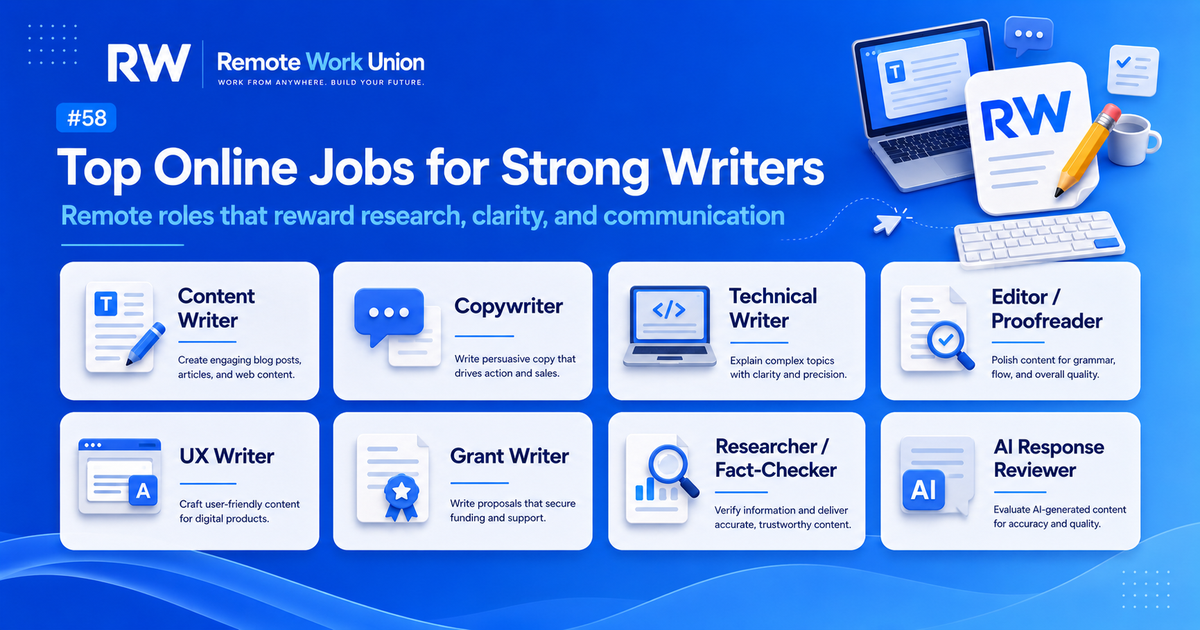
10 Online Writing Job Paths
1. Content Writer
Content writing is the most familiar online writing job. Content writers create blog posts, guides, landing pages, newsletters, knowledge-base articles, case studies, and educational resources. The strongest content writers do more than produce words. They understand search intent, structure information, answer the reader quickly, and make complex topics easier to understand.
This is a good fit if you enjoy explaining things, organizing research, and writing in a brand voice. Employers usually want samples, so create two or three clean examples in a niche: remote work, SaaS, personal finance, fitness, real estate, legal services, healthcare, education, or AI tools. A focused portfolio is stronger than a random collection of general articles.
Useful search terms: remote content writer, SEO content writer, blog writer, content specialist, web content writer, freelance content writer, AI content editor, and content marketing writer.
2. Copywriter
Copywriting is writing designed to drive action — clicking a button, joining an email list, booking a demo, buying a product, or reading the next page. Remote copywriters write ads, landing pages, emails, product pages, website headlines, sales pages, social posts, and campaign copy.
Copywriting is a strong path for writers who think strategically. You need to understand the customer, the offer, the pain point, and the reason someone would act now. Good copy is clear and specific. It does not rely on hype. If you are new, build sample projects: rewrite a weak landing page, draft a five-email welcome sequence for a fictional product, or create before-and-after examples that show your ability to improve clarity.
3. Editor or Proofreader
Editing and proofreading jobs are ideal for people who notice mistakes fast. Proofreaders focus on grammar, punctuation, spelling, formatting, and consistency. Editors go deeper: structure, flow, tone, logic, audience fit, factual gaps, and whether the piece accomplishes its goal.
Remote editing work can appear under several titles: copy editor, proofreader, content editor, quality editor, editorial reviewer, managing editor, line editor, and content quality analyst. The best way to stand out is to show your process — a small portfolio with a messy paragraph, your edited version, and a short explanation of why you made the changes is more persuasive than a long resume.
4. AI Response Reviewer or AI Evaluator
AI response review is one of the fastest-growing paths for writers who want online work that uses judgment. These roles may involve comparing two AI answers, checking whether an answer follows instructions, identifying hallucinations, evaluating tone, ranking responses, rewriting weak outputs, or creating better examples for model training.
This type of work may appear under titles like AI trainer, AI evaluator, AI response reviewer, prompt evaluator, model evaluator, human feedback specialist, RLHF reviewer, content quality rater, or data annotation specialist. Many projects value writers because writers are trained to spot unclear reasoning, weak structure, unsupported claims, awkward tone, and missed instructions.
Useful keyword clusters include ChatGPT, Claude, Gemini, Copilot, Grok, OpenAI, Anthropic, Google AI, Microsoft AI, model evaluation, AI training, human feedback, prompt evaluation, and data annotation. Treat these names as ecosystem keywords that can help you find relevant evaluation and quality-review projects.
5. Technical Writer
Technical writers turn complex processes into clear documentation. They write help articles, setup guides, API documentation, product manuals, onboarding materials, release notes, internal SOPs, and troubleshooting guides. This does not always require coding, but it does require patience, precision, and the ability to explain step-by-step instructions without ambiguity.
A simple portfolio project can be enough to get started: choose a tool you already know, write a setup guide, create a troubleshooting page, and include screenshots or diagrams. Employers want to see clarity, structure, and accuracy.
Looking for remote writing or AI evaluation work? RemoteWorkUnion.com lists roles hiring now.
Find Roles Hiring Now →6. UX Writer or Product Content Writer
UX writers create the words inside digital products — button labels, empty states, onboarding flows, error messages, tooltips, navigation labels, and product instructions. It is a writing job, but it also requires product sense. The goal is to help users understand what to do next.
To build samples, redesign the wording of an app flow. Show the original screen, the problem, your revised copy, and the reason behind the change. This creates a mini case study that proves you can think beyond grammar.
7. Researcher or Fact-Checker
Research and fact-checking jobs are excellent for writers who care about accuracy. These roles may involve verifying claims, summarizing sources, checking citations, reviewing AI-generated content, researching competitors, preparing briefs, or turning scattered information into a clean report.
This work fits people who are skeptical in a useful way — willing to ask: Where did this claim come from? Is the source reliable? Is there missing context? Does the evidence support the conclusion? Search for research assistant, remote researcher, fact-checker, editorial researcher, content quality analyst, AI fact-checker, research analyst, and source verification jobs.
8. Grant Writer
Grant writing is a specialized writing path focused on funding proposals. Grant writers help nonprofits, educational organizations, research groups, and community programs explain their mission, document need, outline budgets, and make a strong case for support.
Grant writing rewards organized writers who can follow instructions. Applications often have strict requirements — you need to answer the exact prompt, meet deadlines, gather supporting details, and write persuasively without vague language. Even a few focused samples can help: create a mock proposal summary, a needs statement, and a project description.
9. Resume Writer or LinkedIn Profile Writer
Resume writing is a practical remote job for writers who understand career positioning. Resume writers help job seekers turn experience into clear, credible, keyword-rich documents. LinkedIn profile writers do similar work by improving headlines, summaries, role descriptions, and skill sections.
A strong sample can be a before-and-after resume section. Show how you turned a generic bullet into a specific achievement. The transformation is the product.
10. Online Course Writer or Curriculum Writer
Course writers turn knowledge into teachable material. They write lesson scripts, modules, worksheets, quiz questions, learning objectives, facilitator guides, and training content. You do not need to be a classroom teacher, but you need instructional thinking. Good course writing starts with the learner: What should they know, do, or understand by the end?
Search for curriculum writer, learning content developer, instructional writer, course writer, elearning writer, training content writer, and assessment writer.
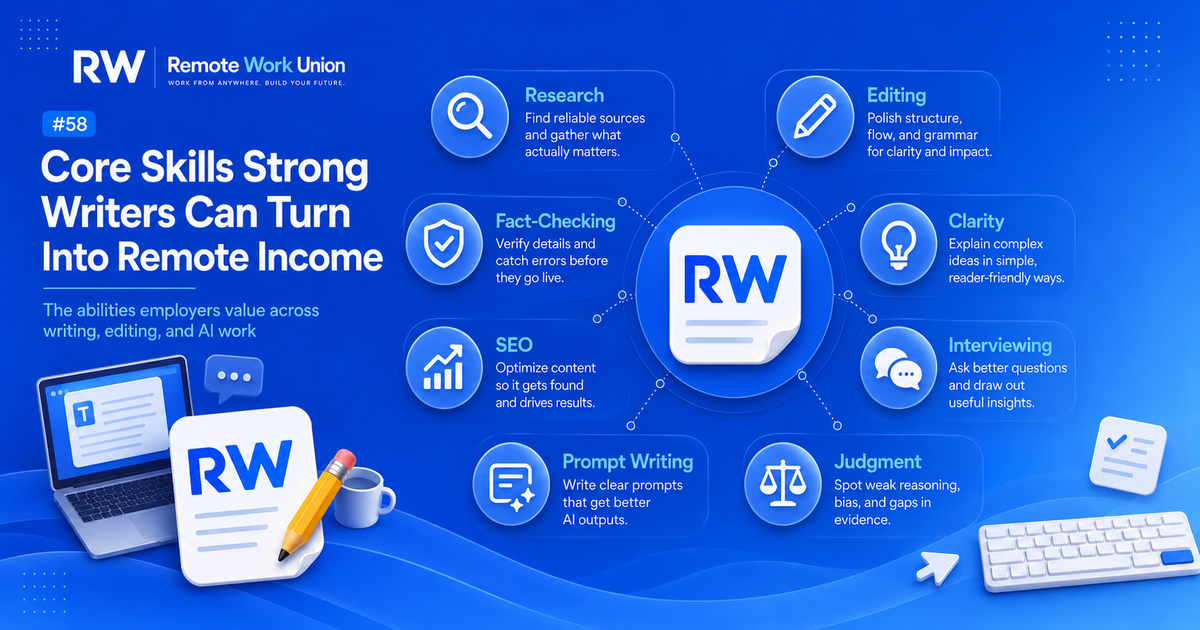
How to Choose the Right Writing Job Path
Do not apply to every writing job with the same resume. Pick the path that matches your strongest proof. If you have blog samples, start with content writing. If you are persuasive and concise, try copywriting. If you notice errors quickly, try editing and proofreading. If you like testing answers and judging quality, try AI evaluation. If you enjoy explaining systems, try technical writing.
The fastest path is usually the one where you can create proof this week. A strong writing sample beats a vague claim. A useful before-and-after edit beats saying "detail-oriented." A clear AI evaluation sample beats saying "I use ChatGPT." Remote employers want evidence that you can deliver without hand-holding.
What to Put in Your Portfolio
A good remote writing portfolio does not need to be large — it needs to be relevant. Include three to five pieces that map to the jobs you want. For each sample, include a short note explaining the assignment, audience, goal, and result. If the sample is fictional, label it clearly as a sample project.
Useful portfolio pieces include a 1,200-word blog guide, a landing page rewrite, a before-and-after edit, a product help article, a UX microcopy case study, a fact-checking brief, an AI response comparison, a research summary, and a newsletter sample. Keep the design clean. The writing should be easy to read, not hidden inside a complicated website.
How to Search for Real Work-From-Home Writing Jobs
Use specific search terms. "Writing jobs" is too broad. Search for remote content writer, AI response reviewer, remote proofreader, technical writer remote, editorial quality analyst, prompt evaluator, AI model evaluator, documentation specialist, SEO content writer, research writer, UX writer, and freelance copywriter.
Also search by skill and task. Many good jobs do not include the word writer. Try remote editing, rubric evaluation, response ranking, fact-checking, content quality review, source verification, documentation, knowledge base, and model training. These terms can surface roles that fit strong writers but are not advertised as traditional writing jobs.
When reading a job post, look for signs of legitimacy: clear scope, clear pay structure, reasonable test requirements, professional communication, defined expectations, and a real application process. Be cautious with vague posts that promise instant income, require upfront payment, or avoid explaining the work.
How AI Changes Writing Jobs Without Replacing Strong Writers
AI tools changed the writing market, but they did not remove the need for strong human judgment. In many workflows, AI creates drafts, outlines, summaries, or alternative phrasing. The human writer still decides what is accurate, useful, persuasive, on-brand, and worth publishing.
Writers who learn to work with AI can become more valuable. The best skill is not typing prompts — it is knowing what good output looks like. That means checking facts, improving structure, removing fluff, tightening language, identifying weak logic, and making the final piece useful to a real reader.
For AI-related roles, describe your skills in terms employers understand: prompt writing, response evaluation, rubric-based review, content quality, accuracy checking, hallucination detection, instruction following, tone evaluation, and comparative ranking.
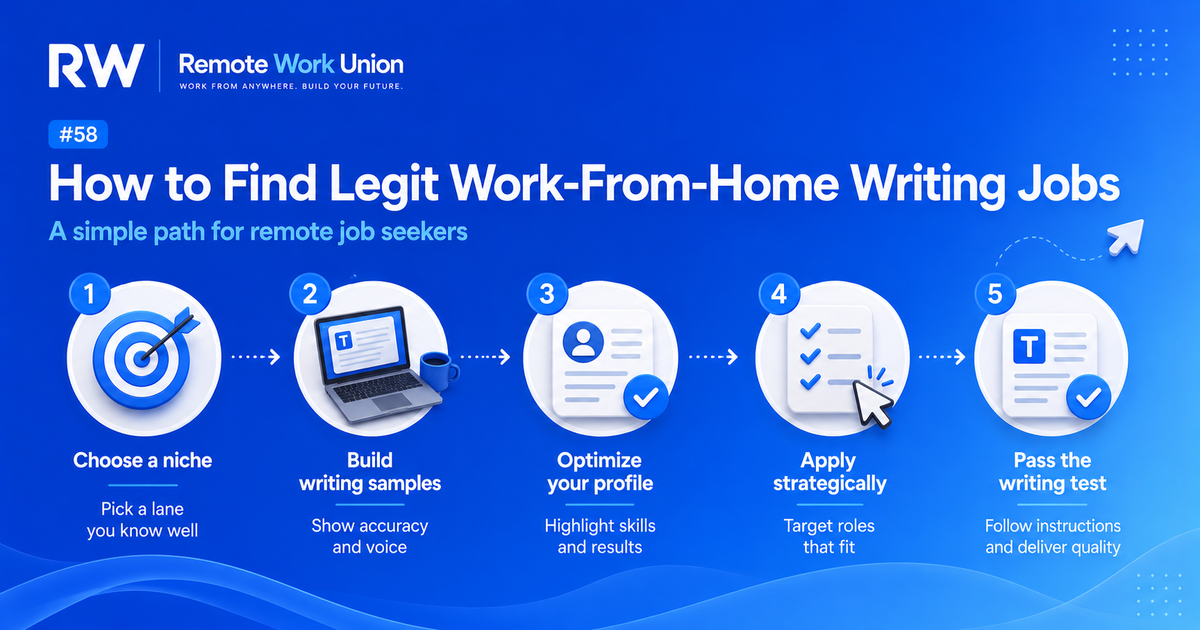
Application Tips for Strong Writers
Lead with proof. Your resume should mention writing, editing, research, SEO, fact-checking, AI evaluation, documentation, content quality, and project-specific keywords only when they are true. Then link to samples that prove those skills.
Follow instructions exactly. Many writing and AI evaluation applications include a small test. If the instructions ask for 300 words, do not send 700. If they ask for plain text, do not send a PDF. If they ask for a specific format, match it.
Customize the first paragraph of your application. You do not need a long cover letter. A few direct lines explaining why your samples match the role can separate you from generic applicants. Strong writing is often visible before anyone opens your portfolio.
A Simple Weekly Plan to Land Remote Writing Work
Day one: choose one lane and collect five job posts that match it. Day two: create or update one sample that matches those posts. Day three: rewrite your resume and profile headline around the exact role. Day four: apply to five targeted jobs and track the results. Day five: create a second sample based on what employers keep asking for. Repeat weekly.
The goal is not to apply blindly — it is to build evidence. Every week should make your application stronger: better samples, sharper keywords, cleaner profile, more targeted searches, and more realistic understanding of which roles fit your strengths.
Best fit summary: Long-form explanation → content or technical writing. Concise persuasion → copywriting. Noticing mistakes → editing or proofreading. Accuracy and evidence → research or fact-checking. Testing AI answers → AI response review. Product clarity → UX writing. Mission-driven work → grant writing.