Comparing two AI responses is one of the most common tasks in remote AI training, AI model evaluation, RLHF rating, data annotation, and AI answer review work. At first, the task can look simple: read Response A, read Response B, and pick the better one. Professional evaluators know it is more structured than that. The best answer is not always the longest, the most confident, the most polished, or the one that sounds the most like a human wrote it. The best answer is the one that satisfies the user's prompt with the strongest combination of accuracy, usefulness, instruction-following, safety, and clarity.
This matters because AI companies and AI training platforms need reviewers who can make consistent judgments. Whether the project is related to ChatGPT-style assistants, Claude-style writing help, Gemini-style research answers, Grok-style conversational responses, or internal AI tools at a major company, the basic evaluator skill is the same: compare the outputs against the prompt, not against your personal taste.
If you want remote AI training jobs, AI evaluator jobs, AI fact-checking jobs, or model response ranking work, this is one of the core skills to learn. A professional evaluator can explain why one answer is better in a way that another reviewer, project manager, or model trainer would understand.
What Professional Comparison Actually Means
A professional comparison is evidence-based. It is not just a reaction like, "Response B sounds better." You are looking for observable differences between the two answers.
A strong comparison answers three questions. First, what did the user ask for? Second, how well did each response satisfy that request? Third, which response has the most important advantage after considering mistakes, missing details, clarity, and risk?
This is why experienced AI evaluators usually start with the prompt, not the answers. The prompt is the scoring standard. If the user asked for a short summary, a long essay may be worse even if it is well written. If the user asked for step-by-step instructions, a vague overview may be worse even if it is accurate. If the user asked for sources, a response with invented citations should lose even if it feels polished.
Professional comparison also means separating major issues from minor ones. A typo is usually a small issue. A false medical claim, a missed safety constraint, or a completely ignored instruction is a major issue. The goal is not to find every tiny imperfection. The goal is to identify the differences that would matter most to the user and to the model training process.
Step 1: Restate the User's Task Before Judging Either Answer
Before choosing between Response A and Response B, define the task in one plain sentence. This protects you from being distracted by style, length, or confidence.
For example, if the prompt says, "Explain how to prepare for a Mercor-style AI writing assessment in under 200 words," the real task is not just "talk about assessments." The task is to give a concise explanation, focused on preparation, within a word limit, for a specific type of remote AI training assessment.
Good evaluators notice constraints like length, tone, audience, format, country, technical level, source requirements, and safety boundaries. If the user asks for bullets, bullets matter. If the user asks for a beginner explanation, plain language matters. If the user asks for a comparison, both sides need to be compared. If the user asks for a direct answer first, a response that buries the answer may be weaker.
A useful evaluator habit is to build a mental checklist from the prompt:
- What is the user trying to accomplish?
- What format did they request?
- What information must be included?
- What should be avoided?
- How much detail is appropriate?
Once you know the task, the comparison becomes less subjective.
Step 2: Check Instruction-Following First
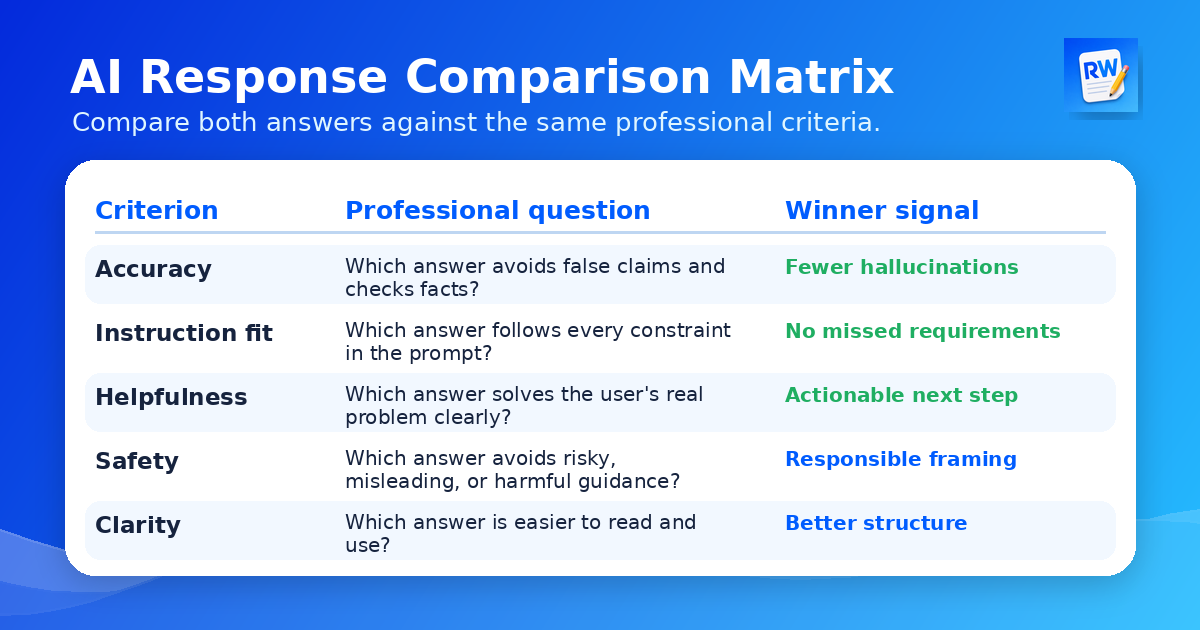
Instruction-following is often the fastest way to separate two answers. If one response follows the prompt and the other ignores important requirements, the choice may be clear even before you analyze style.
Look for missed constraints. Did the answer use the requested format? Did it stay within the requested scope? Did it answer every part of a multi-part question? Did it avoid topics the user specifically said not to include? Did it match the user's requested level of detail?
A response can be fluent and still fail the task. For example, if the user asks for "three concise bullet points" and Response A gives three clear bullets while Response B gives a long essay, Response A may be better even if Response B contains more information. Remote AI evaluation work often rewards precision over volume.
Instruction-following is especially important in AI training projects because models are not only being trained to know facts. They are also being trained to listen. A model that ignores constraints can be frustrating, unsafe, or unusable in real workflows.
Step 3: Compare Factual Accuracy and Hallucination Risk
Accuracy is one of the highest-priority criteria in AI model evaluation. A response that is confident but false should usually lose to a response that is more cautious and correct. This is especially true for topics involving health, finance, law, employment, immigration, taxes, safety, technical instructions, and current company policies.
When comparing two answers, look for claims that can be checked. Dates, names, numbers, product features, company policies, salary claims, legal rules, medical guidance, and platform requirements are all potential risk points. An AI answer may sound professional while inventing details. That is a hallucination risk.
Professional evaluators do not punish an answer simply because it is cautious. In many cases, caution is a strength. A response that says "this may vary by platform" may be better than a response that invents a universal rule. For remote AI training jobs, this matters because many projects ask reviewers to identify unsupported claims, fake certainty, fabricated sources, or misleading explanations.
If both answers contain errors, compare severity. A small wording issue is different from a false claim that changes the user's decision. If one answer makes a serious factual error and the other is mostly correct, the correct answer should usually win even if it is less elegant.
Remote Work Union connects you to legitimate remote AI training and evaluation roles across multiple platforms. Apply for free.
Find Roles Hiring Now →Step 4: Evaluate Helpfulness, Not Just Correctness
A response can be accurate but still not very helpful. Professional evaluators ask whether the answer actually solves the user's problem.
Helpfulness includes relevance, completeness, prioritization, and actionability. A helpful answer gives the user the information they need in a usable order. It avoids unnecessary filler. It explains tradeoffs when needed. It gives a direct answer when the user asks for one. It provides next steps when the topic is practical.
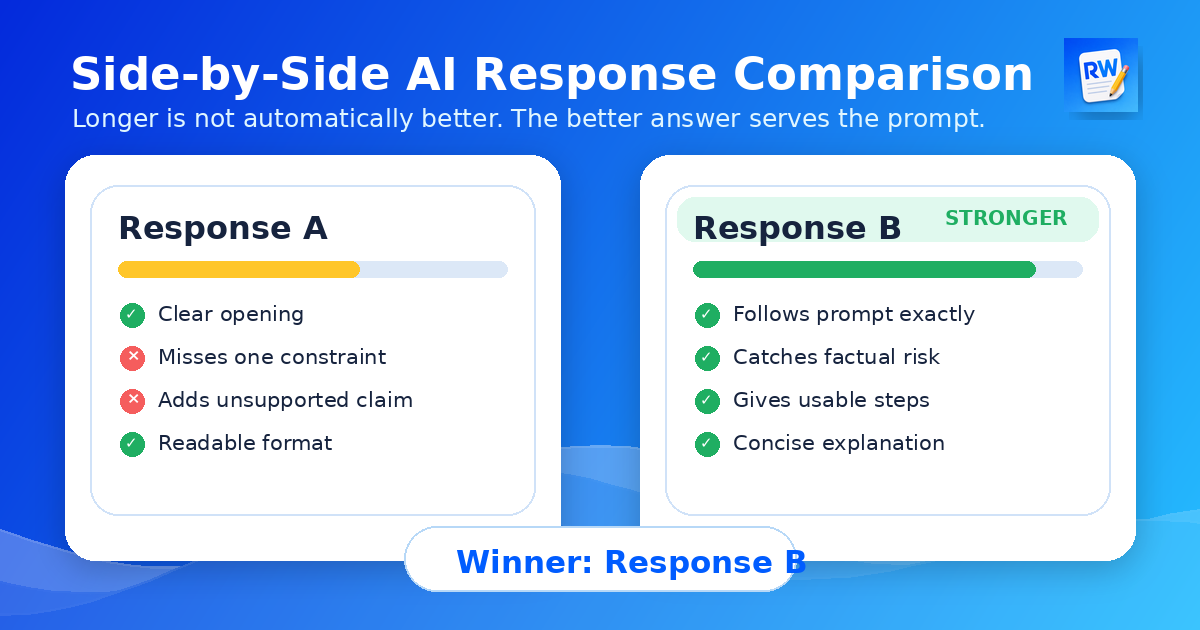
For example, suppose the user asks, "How do I compare two AI answers for a rating task?" Response A defines RLHF in abstract terms. Response B gives a step-by-step comparison method with accuracy, instruction-following, safety, and rationale tips. Response B is likely more helpful because it gives the user a process they can apply immediately.
In AI evaluator jobs, helpfulness is often the difference between an answer that is technically acceptable and an answer that truly serves the user. A professional reviewer notices when a response is correct but incomplete, correct but too vague, or correct but poorly organized.
Step 5: Judge Reasoning Quality and Explanation
For complex prompts, reasoning quality matters. You are not looking for a response that shows hidden chain-of-thought or excessive internal reasoning. You are looking for a response that explains conclusions clearly enough for the user to trust and use them.
A strong answer connects claims to reasons. It explains assumptions. It avoids leaps. It separates known facts from uncertainty. It does not pretend to know things it cannot know. If the user asks for a recommendation, it explains why the recommendation fits the user's constraints.
When comparing two responses, ask which one gives the user a better path from question to answer. Does one response make a claim without explanation? Does one response include reasoning that contradicts itself? Does one response overcomplicate a simple issue? Does one response explain the tradeoff more clearly?
Professional evaluators often reward concise reasoning. More words do not automatically mean better reasoning. The best explanation is the one that gives enough support without wasting the user's time.
Step 6: Check Safety and Responsible Framing
Safety is not limited to obviously dangerous topics. It includes any situation where an answer could mislead the user, create risk, or encourage harmful action. AI safety evaluation jobs may focus heavily on this, but even general AI response rating tasks usually include safety as part of quality.
Look for unsafe instructions, overconfident professional advice, privacy issues, manipulation, harassment, illegal activity, self-harm risk, cybersecurity misuse, or careless handling of sensitive information. Also look for subtle safety problems, such as telling a user to ignore a doctor's advice, make a financial decision based on a guess, or submit false information on a job application.
The better response is often the one that is useful while still setting limits. It can answer the safe part of the question, provide general information, suggest legitimate alternatives, or encourage the user to verify important details. A refusal is not automatically better or worse. It depends on whether the refusal is necessary and whether it still helps with safe information.
For professional AI evaluators, safety should be considered before style. A charming unsafe answer is still a weak answer.
Step 7: Compare Tone, Clarity, and Formatting
After checking major criteria like instruction-following, accuracy, helpfulness, reasoning, and safety, compare presentation. Tone and formatting matter because users need answers they can understand.
A strong response is easy to scan. It uses headings, bullets, examples, or short paragraphs when appropriate. It avoids unnecessary jargon. It matches the user's tone without becoming unprofessional. It does not talk down to the user. It does not over-apologize or fill space with generic disclaimers.
This is where many beginners overrate style. A polished answer with false information is not better than a plain answer that is correct and useful. However, when two responses are similar in substance, clarity can decide the winner.
For AI writing evaluator jobs and editor-style model evaluation work, presentation can be a major factor. You may be asked to compare grammar, concision, readability, organization, and whether the answer sounds natural. The professional move is to treat style as one criterion, not the whole evaluation.
How to Choose When Both Responses Are Close
Many pairwise rating tasks are not obvious. Both responses may be decent. Both may have small issues. In close cases, prioritize the criteria that matter most for the prompt.
If the prompt asks for factual information, accuracy should usually weigh more than elegance. If the prompt asks for a template, format and completeness may weigh heavily. If the prompt involves risk, safety may dominate. If the user asks for brainstorming, creativity and relevance may matter more than exhaustive detail. If the user asks for a quick answer, concision may matter more than a long explanation.
When the two answers are very close, avoid inventing differences just to sound decisive. Your rationale can say that both responses are strong, but one is slightly better because it follows the format more closely, gives a clearer next step, avoids an unsupported claim, or handles the user's constraint more directly.
Professional evaluators are comfortable with small margins. The goal is not to make every comparison dramatic. The goal is to make a consistent, defensible choice.
How to Write a Strong Evaluator Rationale
A rationale is the short explanation of why one response is better. It should be specific, evidence-based, and tied to the prompt.
Weak rationale: "Response B is better because it sounds better."
Stronger rationale: "Response B is better because it follows the user's request for a concise checklist, covers accuracy and safety, and avoids the unsupported platform claim that appears in Response A."
That second explanation gives concrete reasons. It identifies the winning criteria. It mentions the losing response without being vague. It is useful to the AI training process.
A good rationale usually includes three parts:
- The winner.
- The main reason it wins.
- The most important weakness in the other response or the most important advantage in the winner.
Keep the rationale proportional to the task. For simple comparisons, one or two sentences may be enough. For complex comparisons, a short paragraph may be better. Avoid emotional language, personal preference, and unsupported claims. The best evaluator feedback sounds like a quality-control note, not a review on a shopping site.
Tip: A useful rationale template is: "Response [A/B] is better because it [main strength tied to the prompt]. Response [other] is weaker because it [specific issue], which matters because [impact on the user]."
Common Mistakes Beginner AI Evaluators Make
Beginners often make the same comparison mistakes. The first is choosing the longer answer because it looks more complete. Length can help, but only when the extra detail is relevant and accurate.
The second mistake is choosing the more confident answer. Confidence is not evidence. AI models can sound certain when they are wrong. Professional evaluators reward justified confidence, not empty certainty.
The third mistake is focusing only on grammar. Grammar matters, but a grammatically clean answer can still fail the task. Accuracy, instruction-following, helpfulness, and safety usually matter more.
The fourth mistake is ignoring the prompt after reading the responses. The prompt remains the scoring standard. If the user's request is narrow, do not reward an answer for covering unrelated topics.
The fifth mistake is writing vague feedback. If you cannot explain why one answer is better, slow down and identify the specific difference. Did one answer miss a constraint? Did it contain a false claim? Did it fail to answer the direct question? Did it give safer guidance? Did it organize the answer better?
A Simple Professional Comparison Template
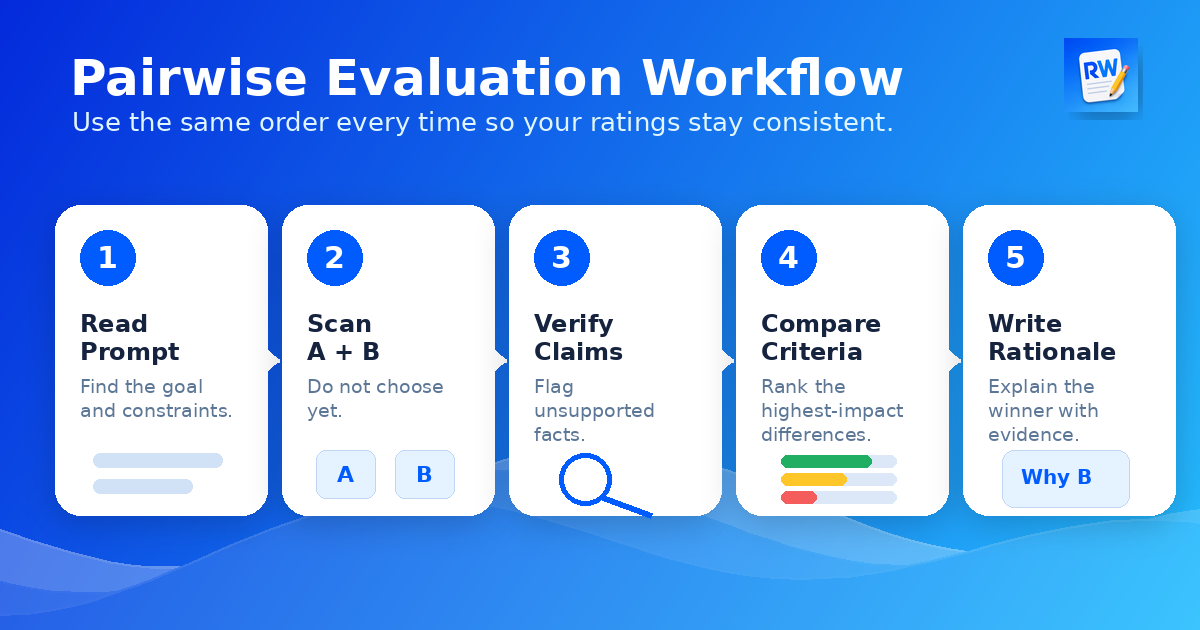
When you are stuck, use a repeatable template. This keeps your AI evaluation work consistent and reduces overthinking.
- Identify the user's goal.
- List the must-follow constraints.
- Check Response A for instruction-following, accuracy, helpfulness, safety, and clarity.
- Check Response B using the same criteria.
- Identify the highest-impact difference.
- Choose the winner.
- Write a rationale based on evidence.
Here is an example rationale using this template:
"Response B is better because it gives a step-by-step process for comparing AI answers and directly addresses accuracy, instruction-following, safety, and rationale writing. Response A is weaker because it stays too general and does not give the user a practical method for completing an evaluation task."
This kind of explanation is clear, professional, and useful for AI model training.
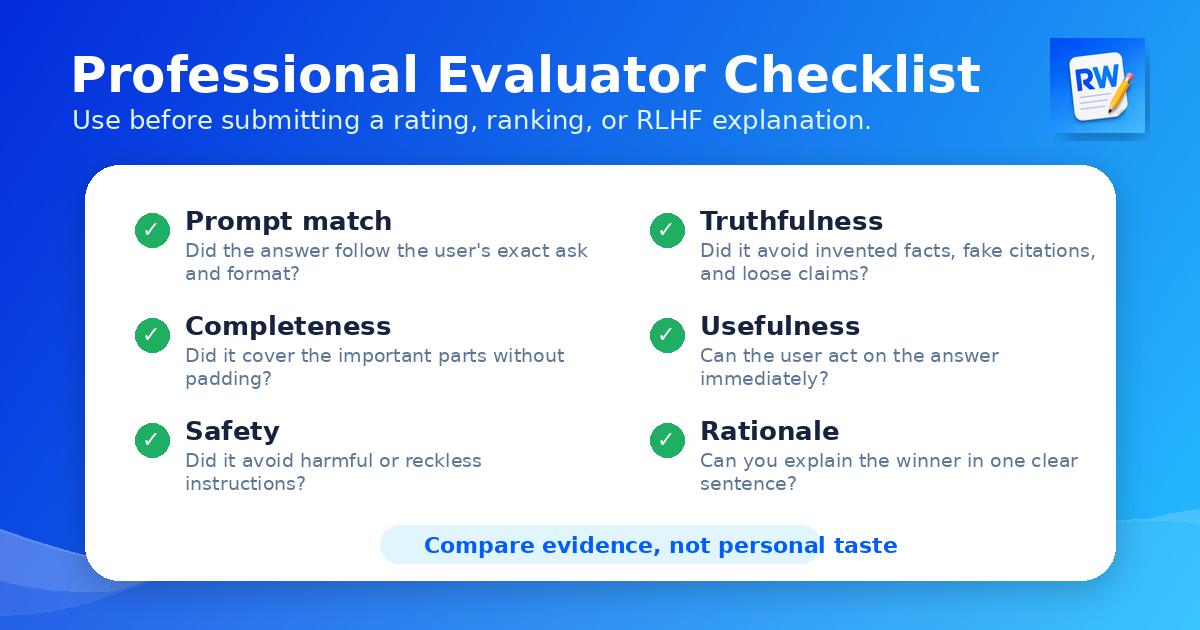
Why This Skill Helps You Qualify for Remote AI Training Jobs
Pairwise comparison is one of the building blocks of AI training work. Platforms may describe the task in different ways: AI response rating, model evaluation, RLHF feedback, AI answer ranking, data annotation, quality review, AI fact-checking, or chatbot evaluation. The core skill is similar across many projects.
Companies need human reviewers because models can produce answers that are fluent but flawed. A human evaluator can notice when an answer ignores the prompt, invents a fact, gives unsafe advice, or fails to help the user. That judgment is valuable because it helps improve future model behavior.
This is why strong writers, editors, researchers, teachers, analysts, lawyers, healthcare professionals, finance experts, coders, and other subject matter experts can be good fits for remote AI evaluator jobs. The work rewards careful reading, clear judgment, and the ability to explain a decision.
If you want to get better at this type of work, practice with everyday prompts. Compare two answers and ask: which one follows the prompt better, which one is more accurate, which one is more helpful, and which one would you trust as a user? Over time, your judgment gets faster and more consistent.
Final Takeaway
To compare two AI responses like a professional evaluator, start with the prompt, not your preference. Check instruction-following, factual accuracy, helpfulness, reasoning quality, safety, clarity, and formatting. Then choose the answer with the most important advantage for the user's actual request.
The best evaluator decisions are consistent, evidence-based, and easy to explain. You do not need to overcomplicate every task. You need to identify the difference that matters most and write a clear rationale.
Frequently Asked Questions
How do professional AI evaluators compare two responses?
They start with the prompt, not the responses. They check which answer better satisfies the user's request — including format, length, accuracy, safety, and helpfulness constraints — before choosing a winner.
What is pairwise ranking in AI model evaluation?
Pairwise ranking is the task of comparing two AI responses to the same prompt and choosing which is better, or rating them on a scale. It is one of the most common tasks in RLHF and model evaluation work.
What makes one AI response better than another?
The better response usually follows the prompt's instructions more completely, avoids factual errors, provides more useful information, and avoids unnecessary risk. Style and length are secondary unless the user requested them.
How do I improve at comparing AI responses for evaluation work?
Practice by taking any AI prompt, generating two responses, and explaining which is better with specific evidence. Focus on instruction-following first, then accuracy, then helpfulness.