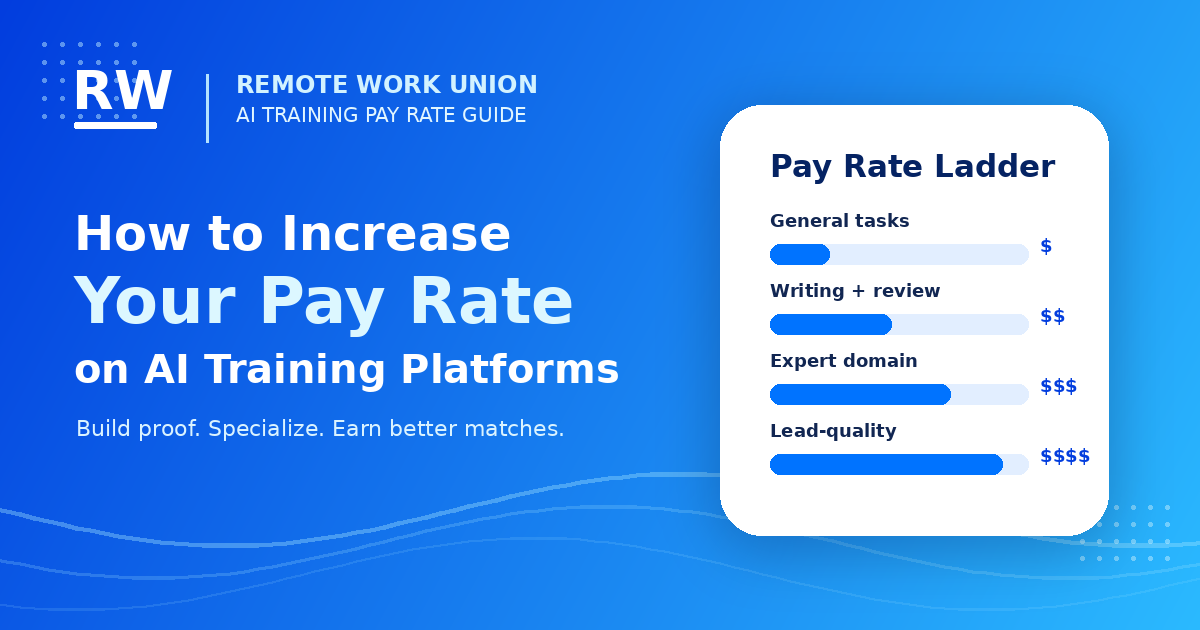
AI training platforms do not usually pay every worker the same rate forever. The rate you see depends on the type of work available, the platform's current demand, your background, your assessment results, your task quality, and how clearly your profile matches higher-value projects.
That matters because many people enter remote AI work through general tasks: rating responses, labeling data, comparing chatbot answers, checking whether an answer follows instructions, or rewriting short pieces of text. Those tasks can be useful starting points. But the higher-paying opportunities often come from work that requires judgment: expert review, domain-specific model evaluation, prompt writing, coding review, legal analysis, finance reasoning, medical-adjacent review where allowed, math problem solving, multilingual evaluation, safety review, and research-heavy annotation.
In simple terms, your pay rate usually rises when the platform has more confidence that you can handle harder work with less supervision.
This guide explains how to increase your pay rate on AI training platforms such as micro1, Mercor, Handshake AI, and other remote work marketplaces that connect applicants with AI training, model evaluation, and expert reviewer projects. The same logic applies whether the end client is building AI systems for OpenAI, Anthropic, Google, Meta, Grok, or another major AI company.
Why AI training pay rates vary so much
AI training is not one job. It is a broad category of remote work.
One person might be asked to compare two chatbot answers and decide which one is clearer. Another person might review a coding problem, test whether an AI-generated solution is correct, and explain the bug. Another might evaluate legal writing, summarize financial documents, rewrite prompts, fact-check research, review math steps, or judge whether a model handled sensitive instructions safely.
Those tasks do not have the same value. The more specialized the judgment, the more limited the worker pool becomes.
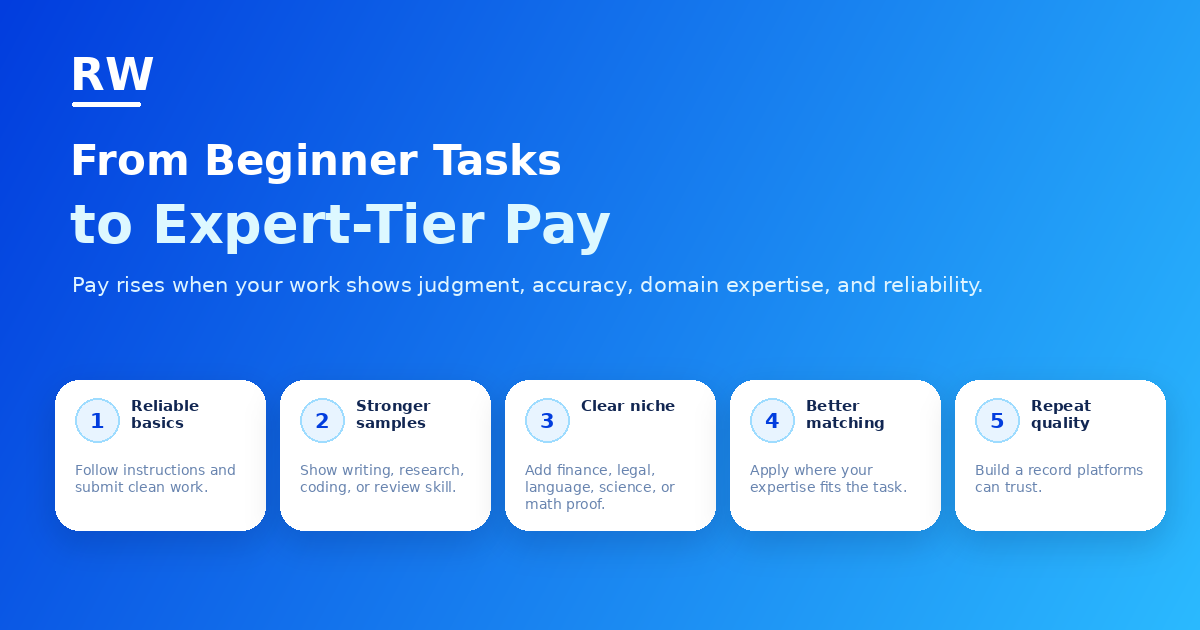
A beginner task may only require strong English, attention to detail, and the ability to follow instructions. An expert task may require years of experience in law, finance, engineering, software development, medicine, marketing analytics, education, accounting, science, operations, or another professional field. Platforms often pay more when they need that expertise.
Pay rates also vary because AI training platforms work like marketplaces. Demand changes by project. One week a platform may need general writing reviewers. Another week it may need bilingual speakers, accountants, prompt engineers, lawyers, data analysts, doctors, PhDs, or people with deep general knowledge. Your goal is to make yourself eligible when the better-matched work appears.
The biggest mistake: treating every platform like a survey app
Many beginners approach AI training like surveys or gig apps. They sign up, wait for any task, complete it fast, and hope the platform sends more.
That is the wrong mindset if you want a higher rate.
AI training platforms are closer to remote contractor marketplaces. They are trying to match the right person to the right task. The worker who looks like a generic applicant may get generic work. The worker who looks like a strong writer, researcher, accountant, paralegal, software developer, marketing analyst, teacher, consultant, translator, engineer, designer, or subject matter expert has a better chance of being matched to specialized work.
Speed matters less than trust. A platform needs to trust that you can read instructions, avoid careless mistakes, explain your reasoning, and handle edge cases. A clean record of accurate work is more valuable than racing through low-value tasks.
Step 1: Make your profile specific enough to match higher-rate work
Your profile is not just a resume. On AI training platforms, your profile is a matching document.
A weak profile says: "I am detail-oriented, hardworking, and interested in remote work."
A stronger profile says: "I have experience writing SEO content, evaluating marketing claims, researching software tools, comparing source quality, editing long-form articles, and explaining why one response is clearer or more accurate than another."
The second version gives the platform more to match against.
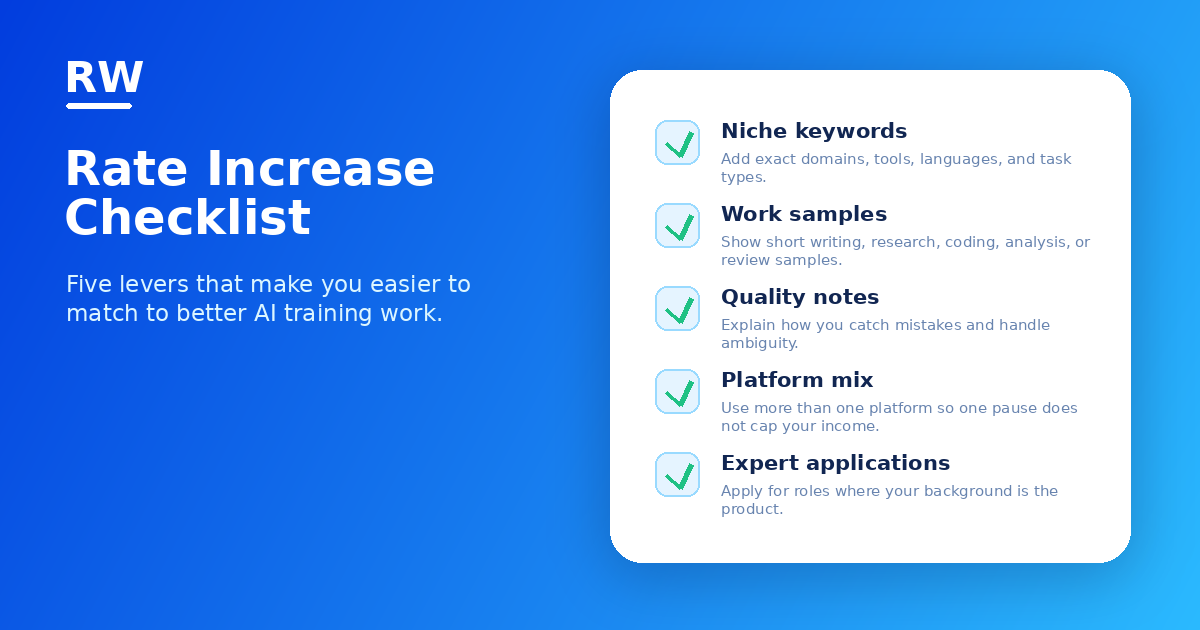
Add specific skills, industries, tools, and task types. Instead of only saying "finance," say whether you understand accounting, valuation, Excel modeling, personal finance, credit, insurance, real estate, financial writing, or market research. Instead of only saying "writing," say whether you can edit, proofread, fact-check, summarize, rewrite, evaluate tone, follow style guides, or compare multiple drafts.
Useful profile keywords can include: AI training, model evaluation, AI response review, prompt writing, data annotation, fact-checking, research, editing, quality assurance, subject matter expertise, coding review, legal review, finance review, healthcare documentation review, multilingual evaluation, safety evaluation, content moderation, technical writing, SEO writing, customer support analysis, and operations analysis.
Do not stuff keywords randomly. The best profile reads naturally and gives platforms real evidence of what you can do.
Step 2: Apply for work that pays for expertise, not just availability
The lowest-value remote work usually pays for availability. The platform needs someone online to complete simple tasks.
Higher-value AI training work pays for judgment. The platform needs someone who can make decisions the AI cannot reliably make yet.
That is why your best pay-rate strategy is to apply for roles where your background matters. A bookkeeper should not only apply for generic data annotation. They should look for finance evaluation, accounting review, spreadsheet reasoning, invoice interpretation, and business writing tasks. A paralegal should look for legal research review, contract language evaluation, policy analysis, and citation checking. A marketer should look for SEO evaluation, ad copy review, audience research, content quality scoring, and brand safety tasks.
The same applies to coders, translators, teachers, engineers, designers, product managers, medical professionals, analysts, customer support leads, and operations managers.
Platforms cannot always guess your best niche. You need to signal it.
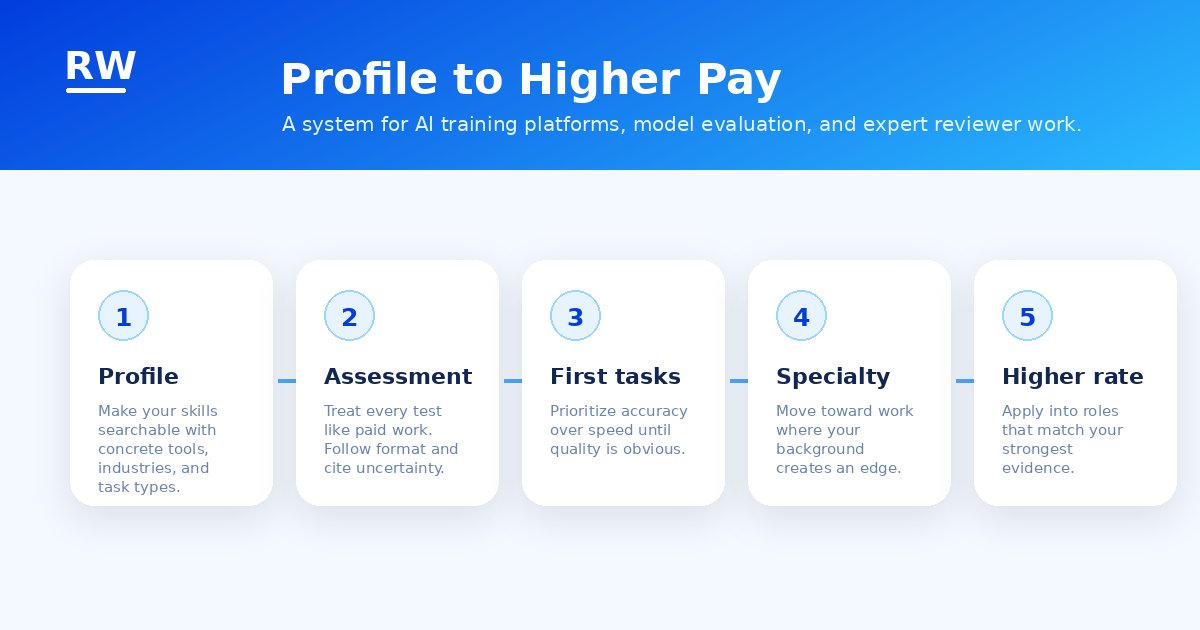
Step 3: Treat assessments like paid work
Your assessment is often the first real proof the platform has.
Do not rush it. Do not use vague answers. Do not submit careless formatting. Do not ignore the instructions because the task looks easy. Many applicants fail because they answer the question they wish they were asked instead of the one in front of them.
Good assessment behavior looks like this: read the instructions twice before starting; identify exactly what the platform wants scored, rewritten, compared, or explained; follow the requested format even if another format seems better; explain your judgment clearly; avoid overclaiming when the task involves uncertainty; check for spelling, grammar, and formatting before submitting; and spend more time on accuracy than speed.
On AI training platforms, your test work is often a preview of your paid work. If your assessment is organized, careful, and specific, you give the platform a reason to trust you with harder tasks.
Step 4: Build a small portfolio of proof
Some AI training platforms rely only on internal assessments. Others allow resumes, profiles, work samples, writing samples, GitHub profiles, LinkedIn pages, or short explanations of your experience.
A small portfolio can help you qualify for better work. This does not need to be complicated. Create proof in the same format the platform needs. For example: a short writing sample that compares two AI responses; a research sample that evaluates source quality; a coding sample that explains a bug and the corrected solution; a finance sample that explains a spreadsheet or business decision; a legal-style sample that evaluates contract language without giving legal advice; a translation sample that explains tone, context, and ambiguity; an editing sample that shows before-and-after improvements; or a prompt-writing sample that shows the prompt, the goal, and the evaluation criteria.
The point is not to create a large portfolio website. The point is to make your skills visible. Higher-paying remote AI jobs often go to people who can prove they can think clearly.
Step 5: Improve task quality before asking for a higher rate
If you want a higher rate, your strongest argument is quality.
High-quality AI training work is not just "correct." It is consistent. It follows the rubric. It catches subtle errors. It explains decisions in a way another reviewer can understand. It avoids lazy reasoning. It does not invent facts. It does not ignore edge cases. It handles ambiguity without becoming messy.
Before asking for a higher pay rate or applying to higher-tier projects, audit your own work. Ask yourself: Did I follow every instruction exactly? Did I explain why I chose one answer over another? Did I separate facts from assumptions? Did I avoid unsupported claims? Did I catch formatting requirements? Did I submit work that another reviewer could defend? Did I improve over time?
If the answer is no, fix quality first. Higher rates usually come after reliability, not before it.
Step 6: Move from generalist to specialized generalist
You do not need to be a coder to increase your AI training pay rate. But you do need to become more specific than "I can do remote work."
A strong position for many people is "specialized generalist." That means you can handle broad AI evaluation tasks, but you also have a few areas where you are especially useful.
Examples: a customer service professional who can evaluate support conversations and customer intent; a marketer who can review SEO content, ad claims, audience targeting, and brand tone; a teacher who can evaluate explanations, lesson quality, and student-facing content; a paralegal who can review legal-style writing, citations, policies, and contracts; a bookkeeper who can evaluate invoices, basic accounting reasoning, and spreadsheet logic; a bilingual speaker who can evaluate translation quality, cultural nuance, and tone; a product manager who can evaluate user flows, feature logic, and prioritization; or a writer who can compare drafts, improve clarity, and judge whether an answer satisfies a prompt.
This is where many remote workers can increase their rate. They stop presenting themselves as beginners and start presenting themselves as useful reviewers.
Remote AI workers who move toward expert-matched roles earn more and work more consistently. Find opportunities hiring now.
Find Roles Hiring Now →Step 7: Use more than one platform
One platform can go quiet. Projects can pause. An account can have no tasks for a week. A platform can need a different skill set than yours at the exact moment you log in.
That does not always mean you failed. It often means supply and demand changed.
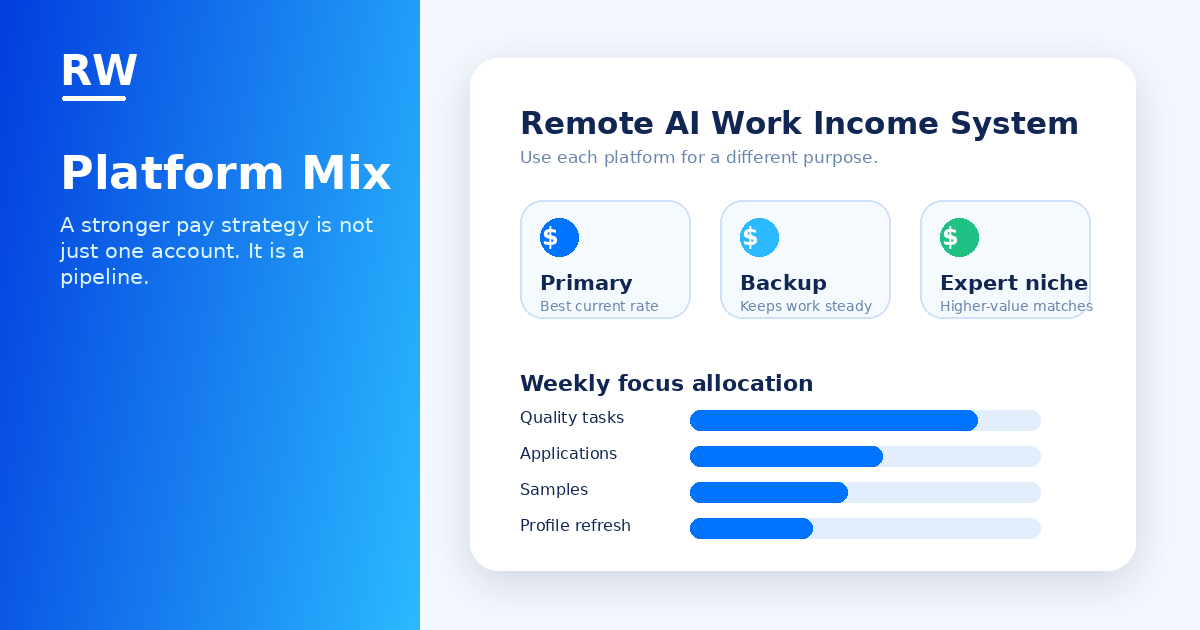
A better strategy is to build a platform mix. For example, you might use micro1 for one type of AI interview or matching process, Mercor for expert-oriented remote work, Handshake AI for additional AI training opportunities, and other platforms for backup projects. The exact mix can change, but the principle stays the same: do not rely on one source of tasks if your goal is steady remote income.
A platform mix also helps you learn which skills get rewarded. If multiple platforms respond to your writing background, that is a signal. If coding assessments get higher rates, that is a signal. If research tasks produce consistent work, that is a signal. Use the market feedback to refine your profile.
Step 8: Reapply or refresh your profile when your skills improve
Many applicants create a profile once and leave it untouched. That is a mistake.
Every few weeks, update your profile with new proof. Add completed work types when allowed. Add better keywords. Clarify your niche. Replace vague claims with specific evidence. Add new platforms, tools, certifications, writing samples, or project experience.
You do not need to exaggerate. In fact, you should not. Misrepresenting expertise can get you rejected or removed. But you should present your real skills in the clearest possible way.
A simple profile refresh can include: a stronger headline; a clearer summary; more specific industry keywords; better task examples; a short list of tools you can use; links to relevant work samples; a note about your availability; and a note about the types of AI training work you are best suited for.
The goal is to make the platform's matching system and human reviewers understand where you belong.
Step 9: Ask for higher-rate work the right way
Some platforms do not negotiate rates directly. Others may allow you to apply to higher-paying projects, update your desired rate, or speak with recruiters. Either way, the right approach is evidence-based.
Do not say: "I deserve more because I need more money."
Say: "I am interested in higher-level model evaluation, expert review, and domain-specific AI training work. My strongest areas are X, Y, and Z. I have experience with A and B, and I am comfortable with tasks that require careful reasoning, fact-checking, and written explanations."
That message gives the platform a reason to match you differently. If you have strong task quality, mention it. If you have relevant professional experience, mention it. If you completed assessments or projects successfully, mention that. If you are applying to a specific role, explain why your background matches that role. Keep it professional. Keep it specific.
Step 10: Avoid the shortcuts that hurt your rate
Trying to increase your AI training pay rate should not mean gaming the system.
Avoid these mistakes: claiming expertise you do not have; using AI tools when the platform prohibits them; copying answers from another worker; submitting fast but sloppy work; ignoring rubrics; applying to every role with the same generic profile; treating assessments like a formality; overloading your profile with keywords that do not match your experience; asking for higher pay before proving quality; and depending on one platform for all income.
The long-term remote workers are usually not the ones who trick a platform once. They are the ones who become reliably useful.
A practical 14-day plan to raise your AI training rate
Here is a simple plan you can use without overcomplicating the process.
Days 1–2: Audit your profile. Rewrite your profile around specific skills, industries, and task types. Replace vague language with examples.
Days 3–4: Create one proof sample. Write a short sample that shows how you evaluate, compare, edit, research, code, translate, or analyze information.
Days 5–6: Apply to expert-matched roles. Search for AI training jobs that match your strongest background. Do not only apply to general data annotation.
Days 7–8: Improve assessment discipline. Slow down on tests. Follow format exactly. Give clear explanations. Proofread before submitting.
Days 9–10: Add a backup platform. Apply to another AI training platform so your income is not controlled by one task queue.
Days 11–12: Refresh keywords. Add terms like model evaluation, AI response review, prompt writing, fact-checking, domain review, and your specific field.
Days 13–14: Follow up selectively. If a platform allows follow-up, send a concise message focused on the higher-value work you are qualified to do.
This will not guarantee a higher rate. No platform can promise that. But it gives you a better chance of being matched to work where your judgment is worth more.
What a higher-paying AI training profile can look like
Here is a simple example:
That profile is much stronger than: "I am looking for remote work and I am good with computers." The difference is specificity.
Final thoughts
Increasing your pay rate on AI training platforms is not about one trick. It is about positioning.
You want to look less like a random remote worker and more like someone who can help AI companies evaluate difficult outputs. That means a stronger profile, better assessments, cleaner work samples, platform diversification, and a move toward tasks that require judgment.
The people who earn more from remote AI work usually treat it like a skill-based contractor path. They learn the platform, prove reliability, specialize where they can, and keep applying to better-matched projects.
If you are currently stuck at beginner tasks, do not assume that is your ceiling. Improve the evidence. Improve the profile. Improve the match.
Frequently Asked Questions
How do I increase my pay rate on AI training platforms?
Build a specific profile around your domain skills, treat assessments like paid work, apply for expert-matched roles rather than only general annotation, improve task quality, and use multiple platforms so you are not limited to one task queue.
What skills lead to higher-paying AI training tasks?
Domain expertise in law, finance, healthcare, education, STEM, marketing, or coding; prompt evaluation; fact-checking; research review; and strong written explanations all qualify for higher-value projects on AI training platforms.
Why am I only getting beginner tasks on AI training platforms?
A generic profile, vague keywords, or applying only to general data annotation can limit your matches. Specificity in your profile, stronger assessment performance, and proof of expertise help platforms route you toward harder, better-paying work.
Should I use one AI training platform or multiple?
Multiple platforms is the better strategy. Project availability varies by platform and week, so diversifying across micro1, Mercor, Handshake AI, Outlier, and others gives more consistent access to tasks that match your skill level.