No. Remote Work Union is not a workers' union in the traditional labor-union sense. It is a free community and resource hub for remote workers.
That distinction matters. People see the word "Union" and reasonably wonder if Remote Work Union collects dues, bargains with employers, organizes workers, or represents people in disputes. It does not. The word "Union" is being used in the everyday sense of unity: remote workers coming together around shared resources, job information, application guidance, and legitimate remote work opportunities.
Remote Work Union exists to make the remote job search easier, especially for people interested in remote AI training, AI evaluation, AI annotation, quality rater work, and other work-from-home roles that reward clear writing, research, judgment, and domain knowledge.
The Clear Answer: Remote Work Union Is a Community, Not a Labor Union
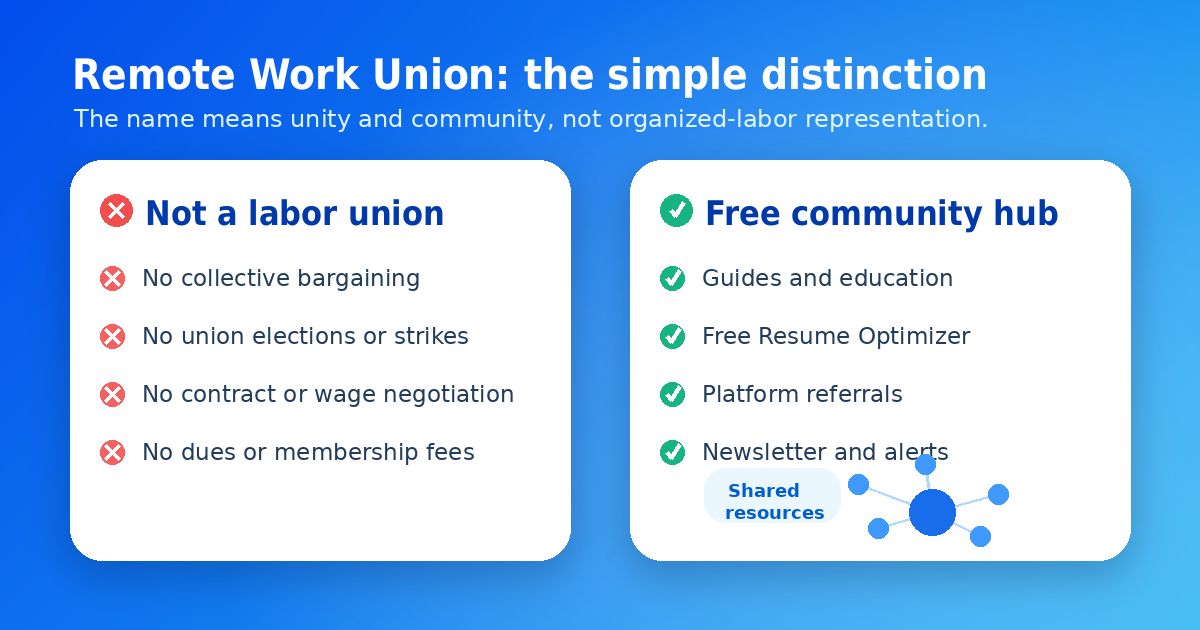
Remote Work Union is a free community and resource hub. It is not a labor union, trade union, or organized-labor body.
That means Remote Work Union does not:
- collect union dues or membership fees
- engage in collective bargaining
- negotiate contracts, wages, or benefits on behalf of workers
- represent workers in disputes with employers or platforms
- organize strikes, union elections, or workplace campaigns
- affiliate with the AFL-CIO or any other labor federation
- hire remote workers directly
- pay workers directly
Remote Work Union is built for people who want better access to remote work information, not for people trying to join a formal union structure. The value is education, curation, and connection.
Why the Word "Union" Is in the Name
The word "union" can mean more than one thing. In a labor context, it can refer to a formal organization that represents workers. In a general context, it can refer to people joining together around a shared goal.
Remote Work Union uses the second meaning.
The idea is simple: remote workers are often isolated. A person applying for remote AI work, freelance AI training projects, work-from-home writing tasks, or online evaluation jobs can easily end up scattered across different platforms, dashboards, application forms, and confusing advice. A community can help by centralizing information, explaining what is legitimate, and showing people how to apply more effectively.
That is the role Remote Work Union plays. It is a place to learn, compare opportunities, improve an application, and find platforms that may be hiring. It is not a bargaining representative.
What Remote Work Union Actually Does
Remote Work Union helps people understand and apply for legitimate remote work opportunities, with a major focus on remote AI work. That includes AI training jobs, AI evaluation jobs, AI data annotation, AI content review, quality rating, fact-checking, research, and other project-based roles.
The community provides practical resources such as:
- free guides that explain how remote AI work works
- education on what platforms are looking for
- a free Resume Optimizer and resume guidance
- referral connections and one-place applications to real hiring platforms
- newsletter alerts when new platforms, projects, or campaigns open
- plain-language explanations of confusing platform dashboards and application steps
This is useful because many applicants do not know how to describe their skills for AI training work. They may have experience in business, marketing, sales, finance, customer support, social media, writing, research, education, operations, or project management, but not realize those skills can translate into AI evaluation work.
Remote Work Union helps people connect those skills to the types of tasks AI platforms often need: reviewing outputs, comparing answers, checking facts, writing prompts, improving responses, rating quality, and applying domain judgment.
What Remote Work Union Does Not Do
Remote Work Union does not hire workers itself. It does not control whether a platform accepts an applicant. It does not assign projects, set hourly rates, approve payments, or manage worker accounts.
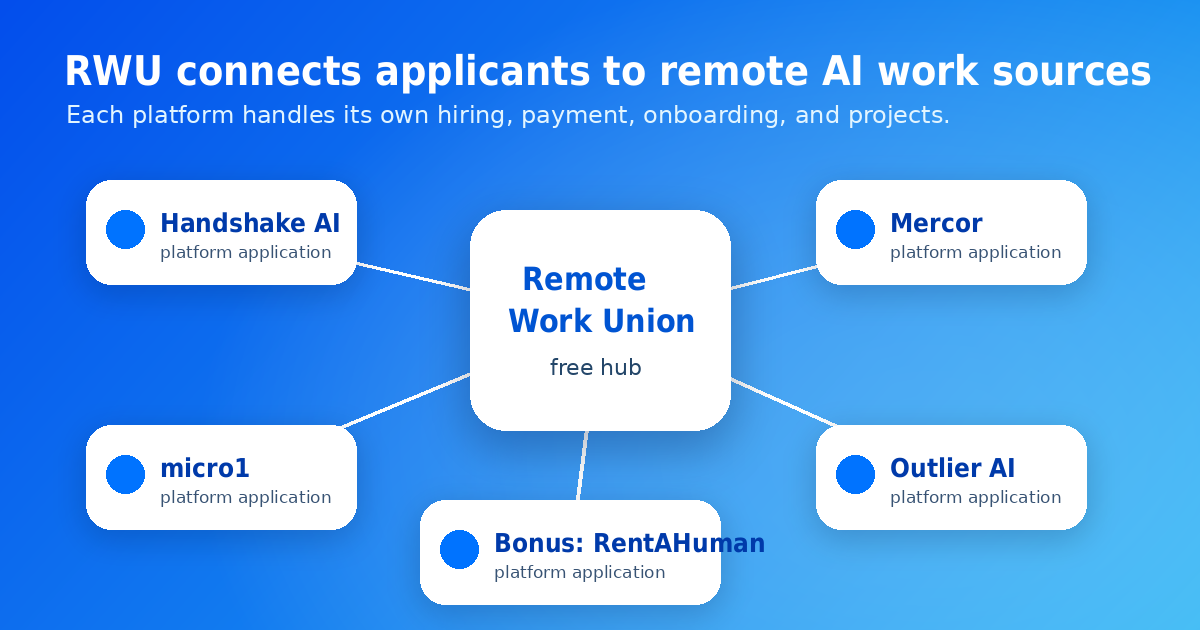
Each platform handles its own hiring, onboarding, testing, project matching, payment methods, and work availability. A person can use Remote Work Union to discover opportunities and prepare more intelligently, but the platform itself decides who gets accepted and what work is available.
This is an important expectation to set. A platform can be legitimate and still have slow onboarding, no projects available for a period of time, or different rates depending on the applicant's background and the current demand. Remote Work Union can help people avoid confusion, but it cannot guarantee placement.
Use Remote Work Union as your free starting point for legitimate remote AI work. No dues, no fees, no formal membership required.
Find Roles Hiring Now →How the Community Helps With Remote AI Training and Evaluation Jobs
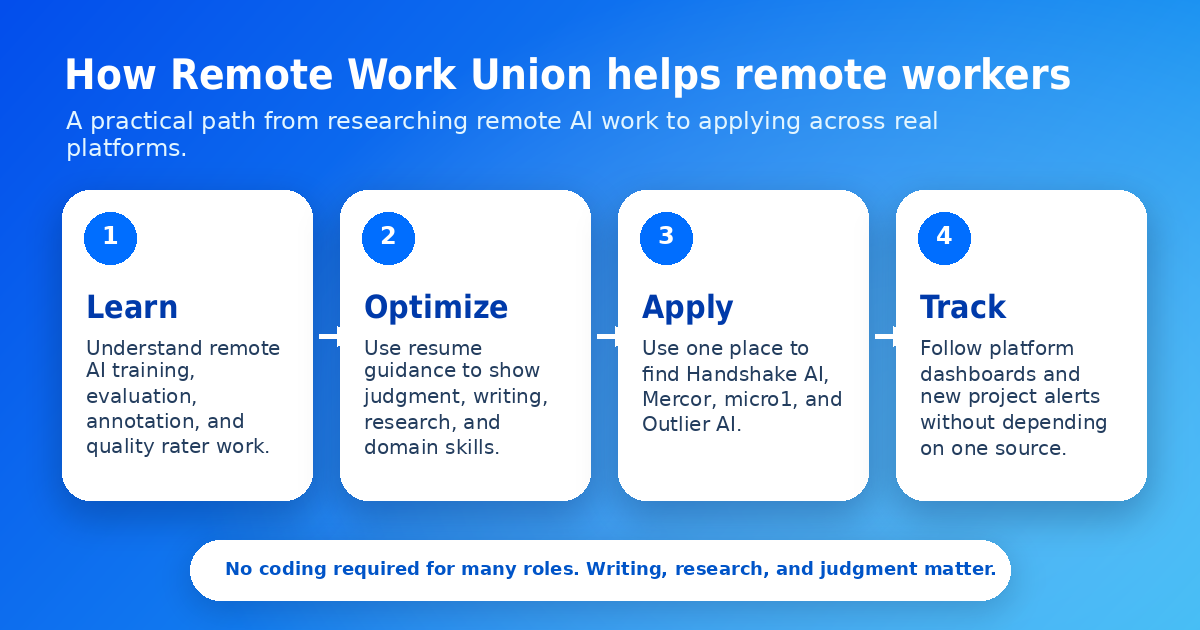
Remote AI work is one of the clearest areas where a community resource can help. The field is growing because AI systems need human feedback, quality review, research, and domain-specific judgment. Many people associate AI jobs with coding, but many AI training and AI evaluation roles do not require software engineering.
A strong applicant might be a marketer who can judge ad copy, a finance professional who can evaluate business reasoning, a writer who can improve tone and structure, a customer support worker who understands clear communication, a project manager who can evaluate instructions, or a bilingual professional who can assess language quality.
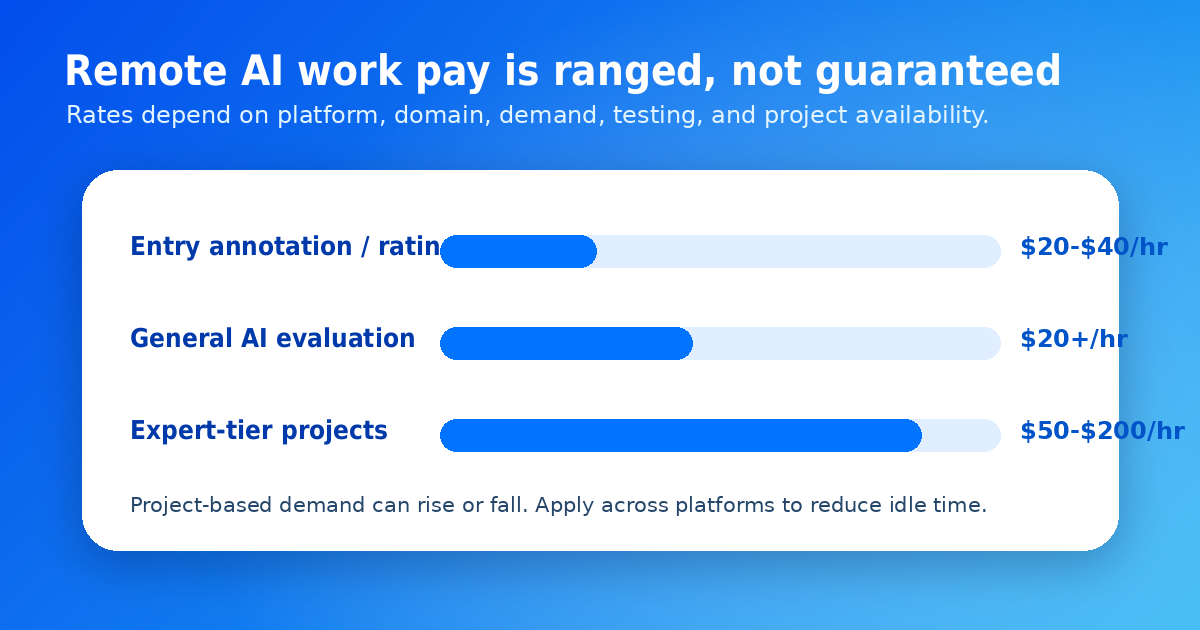
Some projects are generalist. Others are expert-tier roles. Pay varies by platform, domain, testing, and demand. As a practical range, entry-level annotation or rating tasks may be around $20–$40/hr, while expert-tier AI training or AI evaluation work can sometimes reach $50–$200/hr depending on the platform and specialization. Those rates are not guaranteed, and project availability can change.
The reason Remote Work Union emphasizes applying across multiple platforms is simple: one slow dashboard should not stall an entire remote job search.
Platforms Remote Work Union May Point Applicants Toward
Remote Work Union focuses on real platforms that offer remote AI-related opportunities. In general platform-list contexts, the main names are Handshake AI, Mercor, micro1, and Outlier AI. RentAHuman may also be treated as a genuine bonus option.
The goal is not to make every platform sound identical. Each one has its own application process, screening, pay structure, project flow, and availability. The practical advice is to understand the differences, apply carefully, and avoid depending on one source of work.
Remote Work Union is the guide and community layer. The platforms are where the actual applications, onboarding, projects, and payments happen.
Why the Distinction Matters for Applicants
The distinction between a labor union and a free remote work community is not just technical. It changes what a member should expect.
If Remote Work Union were a traditional union, users might expect dues, formal membership, worker representation, bargaining, or political activity. That is not what this is. Because Remote Work Union is a community and resource hub, the barrier is lower. There is no formal union process, no membership fee, and no requirement to join a labor organization.
For most applicants, that is the benefit. They can use the resources, improve their resume, learn which platforms to apply to, and get alerts when opportunities open without giving up money or signing into a formal representation structure.
How to Use Remote Work Union Responsibly
The best way to use Remote Work Union is to treat it as a practical starting point for a wider remote work search.
Start by learning what remote AI work actually involves. Then improve your resume so it clearly shows the skills platforms care about: writing, research, domain knowledge, reasoning, attention to detail, and the ability to follow instructions. Apply across multiple platforms instead of waiting for one application to move. Watch for new project alerts, but keep expectations realistic.
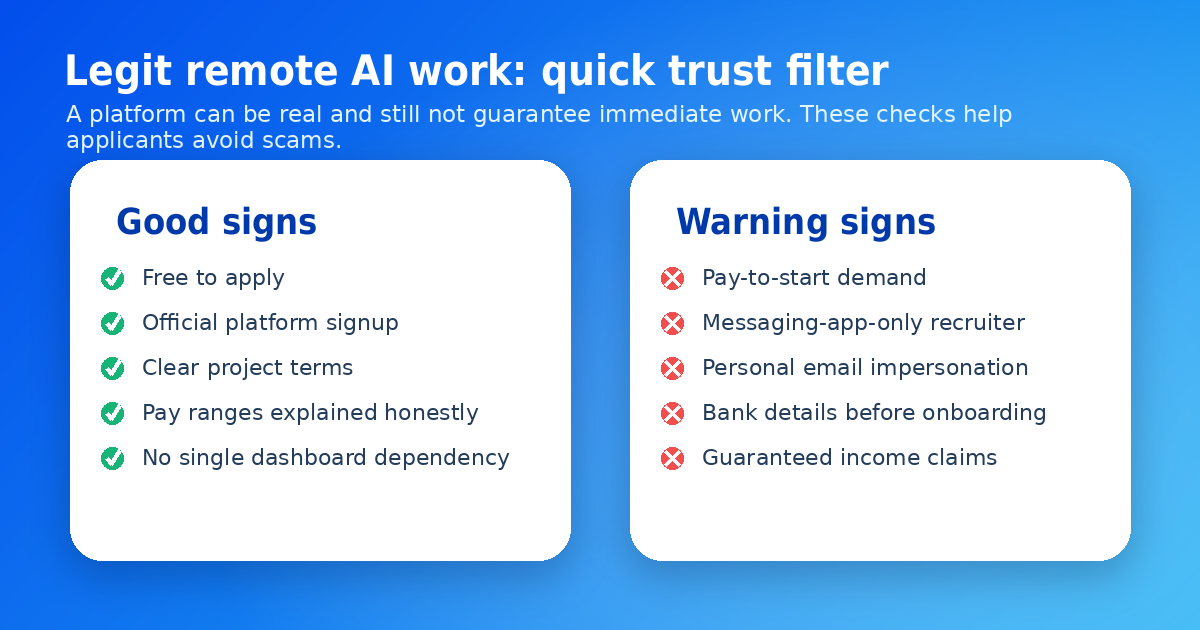
You should also use basic scam filters. Legitimate platforms should not charge you to apply or unlock work. Be careful with recruiters who only use messaging apps, personal email addresses, vague job descriptions, or requests for bank details before proper onboarding. Real project-based remote work may involve screening, tests, and fluctuating availability. It should not require you to pay money to get started.
Frequently Asked Questions
Is Remote Work Union a workers' union?
No. Remote Work Union is not a workers' union in the labor-union sense. It is a free community and resource hub for remote workers.
Does Remote Work Union collect dues?
No. Remote Work Union does not collect union dues or membership fees from workers.
Does Remote Work Union negotiate wages or contracts?
No. Remote Work Union does not negotiate wages, contracts, benefits, or working conditions on behalf of users. Each hiring platform controls its own rates, projects, and terms.
Does Remote Work Union hire people directly?
No. Remote Work Union is not the employer. It helps people find and apply to platforms. Each platform handles its own hiring, onboarding, project assignment, and payment.
Why is it called a union if it is not a labor union?
The word "Union" refers to unity and community. The purpose is to bring remote workers together around shared resources, education, and access to legitimate remote work opportunities.