Starting remote work for the first time feels harder than it should. There are thousands of job listings, most of which are vague, too competitive, or simply not real. There are platforms that promise easy money and deliver nothing. And there is almost no guidance on where someone with a normal background — writing skills, organizational ability, subject knowledge, or people skills — should actually begin.
This guide cuts through that noise. It explains the best remote jobs for beginners based on what you already know, how to tell real jobs from scams, and how to build toward consistent online income using a simple 30-day plan.
Beginner does not mean starting from zero. It means you have not yet translated what you already know into a remote work profile and a consistent application system. That is a fixable problem.
The Best Beginner Remote Jobs
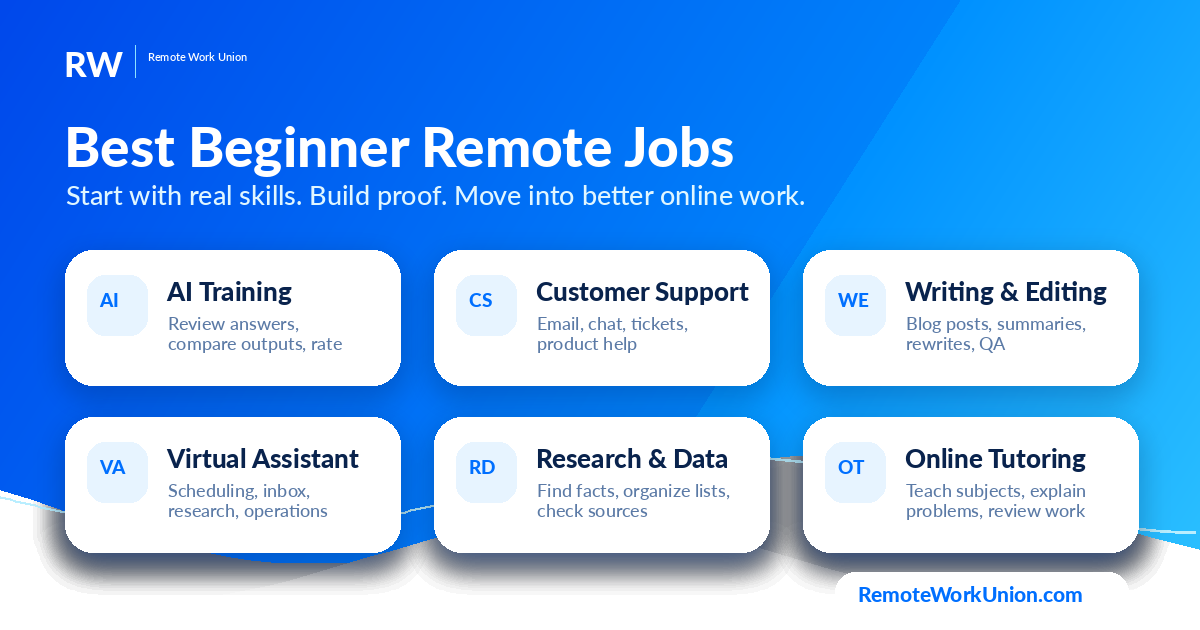
The best first remote jobs share one feature: they let you demonstrate skill quickly without needing an established client base, a professional network, or years of specialized experience. These six categories are where most beginners find their first online income.
1. AI Training and AI Evaluation
AI training is one of the best beginner remote jobs because it rewards clear thinking and careful reading rather than years of experience. Tasks may include reviewing AI-generated answers, comparing two responses and choosing the better one, writing ideal answers to prompts, checking factual accuracy, annotating data, or evaluating whether a model followed instructions.
You do not need to be a software engineer. Many AI training jobs specifically need writers, researchers, subject matter experts, educators, and careful readers. Learn how to get paid to review AI answers from home. Platforms like Handshake AI, Mercor, micro1, and Outlier AI all offer entry points into this category.
2. Customer Support
Remote customer support is one of the most accessible entry-level online jobs. Most roles involve answering email tickets, handling chat conversations, helping customers with product questions, and escalating complex issues. You need to communicate clearly and stay calm under pressure — not code.
Start with email-only or chat-only roles if you want a fully asynchronous option. Avoid roles that require you to be available by phone all day if schedule flexibility matters to you. Good customer support experience also creates a path into customer success, onboarding, community management, and operations roles later on.
3. Writing and Editing
If you write clearly, there is consistent online demand for your skill. Remote writing jobs include blog posts, summaries, rewrites, SEO articles, product descriptions, newsletters, help center articles, and AI writing evaluation. The best beginner writing jobs are not low-paying content mills — look for AI writing evaluation, editorial review, and content QA roles where your judgment is what the client is buying.
Build one or two polished writing samples before you start applying. A clean, specific sample outperforms a long vague resume in almost every writing role.
4. Virtual Assistant
Virtual assistant work is a flexible beginner entry point for organized people. Tasks typically include inbox management, calendar scheduling, lead research, CRM updates, data entry, travel planning, and content uploading. The best virtual assistant jobs give you a clear task list and let you work asynchronously. Avoid vague "do everything" roles where the scope grows without additional pay.
As you build experience, VA work can grow into operations support, project management, and higher-paying remote roles.
5. Research and Data
Online research jobs are output-based, which makes them beginner-friendly. Typical tasks include finding facts, organizing information into spreadsheets or documents, checking sources, comparing products, verifying AI answers, and building research summaries. These roles may be listed as online research assistant, search evaluator, market researcher, fact checker, or data researcher.
Detail-oriented beginners often find these roles easier to start with than writing because the output is more structured and the feedback loop is faster.
6. Online Tutoring
If you know a subject well — math, science, languages, history, coding, music, writing, or anything else people want to learn — online tutoring is a practical beginner remote job. You schedule sessions around your availability, and the work creates immediate proof: satisfied students, repeat bookings, and eventually referrals.
Start with subjects you can teach without preparation. Use platforms that handle matching and payment so you can focus on teaching rather than marketing.
Choose Your First Remote Job by Skill
Beginner does not mean starting from zero. You already have skills. The question is which of those skills maps most directly to remote work demand.
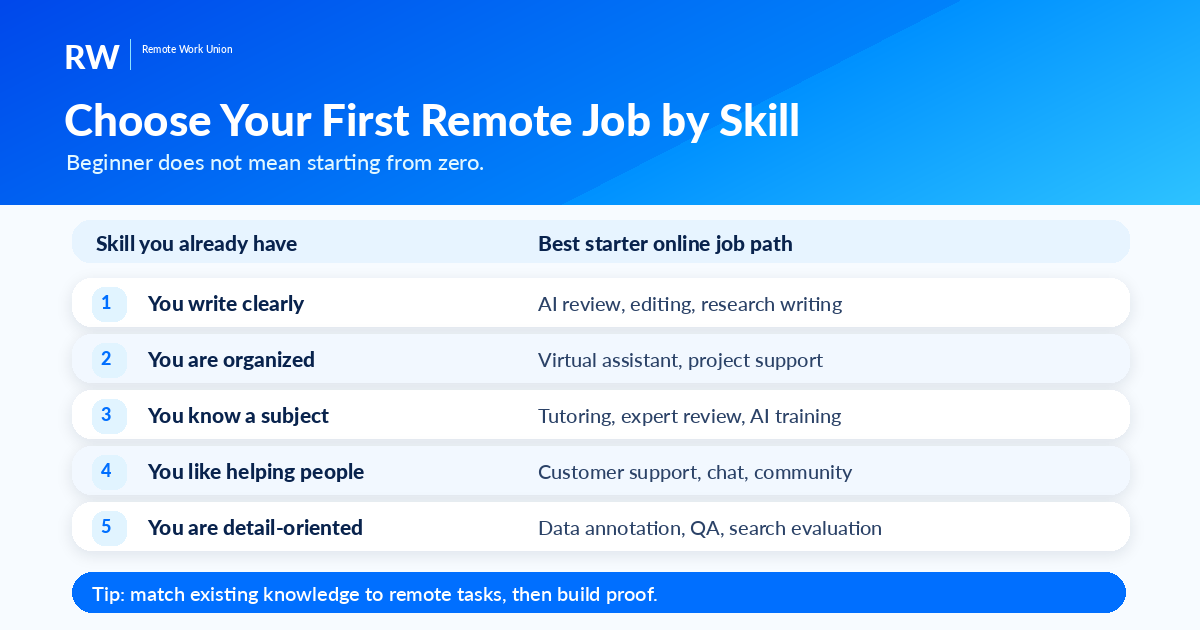
Use this skill matching framework before you apply to anything:
- You write clearly → AI review, editing, research writing, content QA, writing evaluation
- You are organized → Virtual assistant, project support, data entry, operations admin
- You know a subject → Online tutoring, expert review, AI training in your domain
- You like helping people → Customer support, live chat, community moderation
- You are detail-oriented → Data annotation, QA testing, search evaluation, fact-checking
Pick the category where your existing skill is strongest. Do not try to qualify for every category at once. A focused beginner beats a scattered one. Once you build proof in one category — a sample, a passed test, a completed project — it is easier to branch into adjacent work.
Tip: Match existing knowledge to remote tasks, then build proof. The strongest beginner applications are specific, not general. "I write clearly and can evaluate AI-generated health content for accuracy and tone" is more effective than "I am a quick learner open to all opportunities."
Remote Work Union connects beginners to legitimate online jobs that match their skills — browse roles and apply for free.
Find Roles Hiring Now →Real Remote Job or Scam? How to Tell
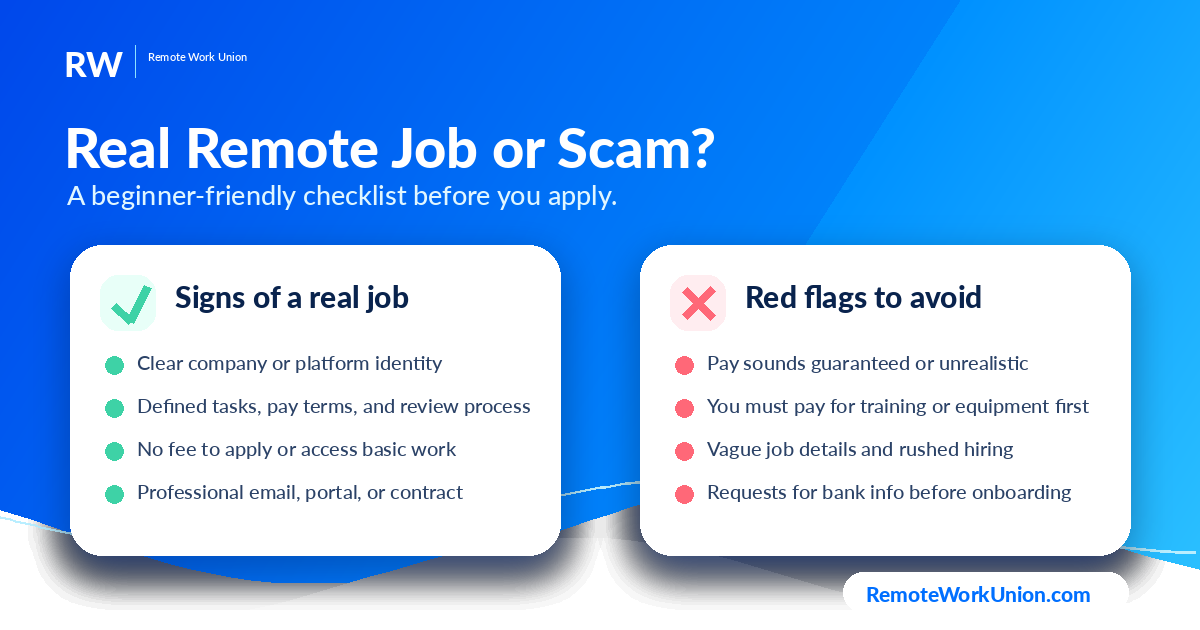
Remote job scams target beginners specifically because beginners are less familiar with what legitimate online work looks like. Before you apply to any remote job, run it through this checklist.
Signs of a Real Remote Job
- Clear company or platform identity: You can find the company online, verify it exists, and understand what it does.
- Defined tasks, pay terms, and review process: The listing explains what you will do, what you will earn, and how your work is evaluated.
- No fee to apply or access basic work: Legitimate jobs do not require you to pay for training, software, or access before you start.
- Professional email, portal, or contract: Communications come from a real domain, a platform dashboard, or a formal contract.
Red Flags to Avoid
- Pay sounds guaranteed or unrealistic: "Earn $500 per day guaranteed" is not how remote work functions. Real pay is tied to completed tasks or hours worked, not guarantees.
- You must pay for training or equipment first: This is almost always a scam. Real employers provide onboarding without charging you for it.
- Vague job details and rushed hiring: If the listing cannot explain what you will actually do, or if you receive a job offer before completing any screening, be cautious.
- Requests for bank info before onboarding: Legitimate companies do not ask for payment details before you have started work and gone through a proper onboarding process.
When in doubt, search the company name plus the word "scam" or "review" before engaging. Legitimate remote jobs can be competitive, but they are not secretive about what they offer.
What to Build Before You Apply
Most beginners apply before they are ready. They submit a generic resume, get no response, and assume remote work is impossible. The real issue is that they have not yet built the proof that remote employers and platforms need to say yes.
Before you apply, build these three things:
One focused skill statement. A single sentence that describes what you can do and for whom. Example: "I evaluate written content for clarity, accuracy, and instruction-following for AI training projects." Or: "I provide inbox and scheduling support for small business owners who need organized, reliable remote assistance." This replaces the vague "open to remote work" language that appears on most beginner applications.
One or two samples. For writing and AI evaluation, create a polished writing sample or a before-and-after edit of weak content. For research, create a structured research summary on a topic in your area. For virtual assistant work, document a real process you have managed. For tutoring, prepare a sample lesson plan. You do not need a portfolio website — a clean document or PDF is enough to start.
A basic tracking system. A simple spreadsheet with columns for platform name, role or project, application date, status, and follow-up date. This keeps you organized and helps you see what is working. Beginners who track applications improve their results faster than those who apply blindly.
A 30-Day Plan to Get Your First Remote Job
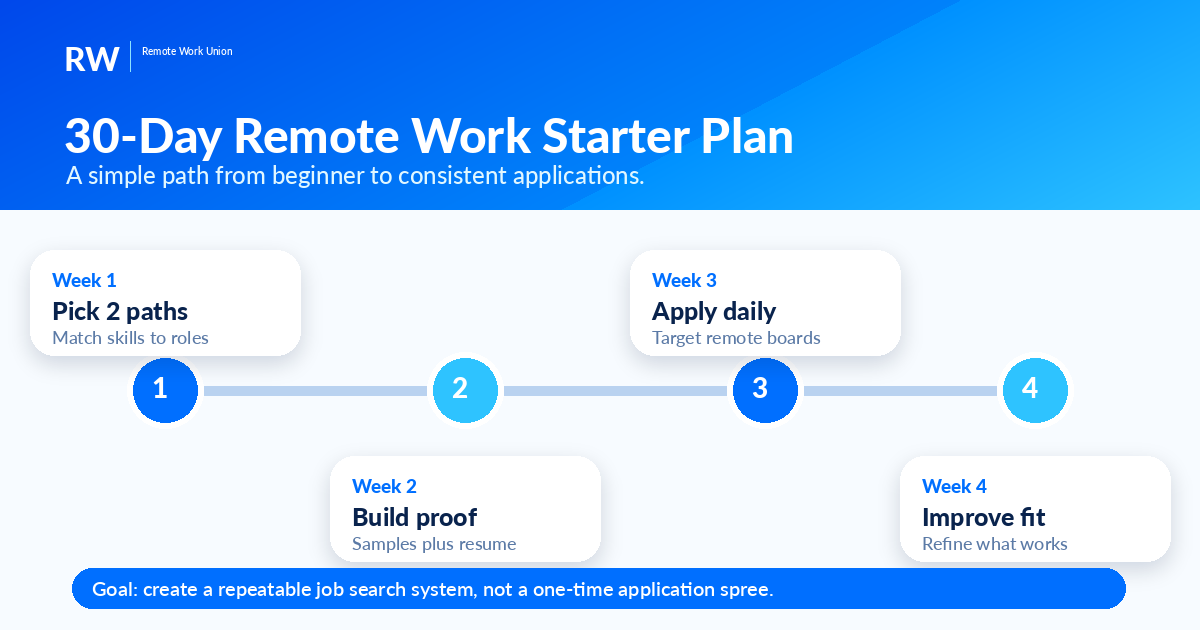
The goal is not to apply once and wait. The goal is to create a repeatable job search system — one that gets smarter each week based on what you learn.
Week 1: Pick 2 Paths and Match Skills to Roles
Choose two categories from the beginner job list above. Use the skill match matrix to confirm you have a genuine fit in each. Write your focused skill statement for each category. Research five to ten platforms or job boards relevant to each category. Do not apply yet — spend the week understanding where the real opportunities are.
Week 2: Build Proof — Samples Plus Resume
Create one or two samples for each category. Polish your resume to emphasize the skills that matter for each role. Remove anything vague or irrelevant. Add any relevant experience — even volunteer work, personal projects, freelance tasks, or academic work counts if it demonstrates judgment, research ability, writing skill, or domain knowledge. Set up your tracking spreadsheet.
Week 3: Apply Daily — Target Remote Boards
Apply consistently — five to ten targeted applications per day is more effective than fifty generic ones per week. Use specific search terms for each category. For each application, tailor the headline or opening line to match the role. Complete any screening tests immediately and carefully. Respond to all platform invitations the same day you receive them.
Week 4: Improve Fit — Refine What Works
Review your tracking data. Which categories generated responses? Which samples got attention? Which platforms were most active? Double down on what is working. Revise your profile in the category that produced the most interest. If no applications have converted yet, get more specific — narrow your skill statement, improve your samples, or try a different search term combination.
Common Beginner Mistakes to Avoid
Applying to everything at once. Beginners often think that more applications equal more responses. In remote work, specificity usually beats volume. A targeted application that speaks directly to a role beats ten generic ones.
Skipping the sample step. Proof matters more than credentials in most remote work categories. If you apply without a sample, you are competing against applicants who have one.
Not tracking applications. Without a tracking system, you cannot improve. You repeat the same mistakes, miss follow-up opportunities, and lose momentum.
Accepting vague listings. If a job cannot explain what you will do, how you will be paid, and who is hiring you, it is not worth your time. Legitimate remote jobs are not mysteries.
Giving up after the first week. Most beginners see their first results in week two or three, not day one. The application system gets better as you refine it. Stay with the plan for at least 30 days before drawing conclusions.
Ignoring tests and screening tasks. Many remote platforms use screening tests to evaluate fit. Beginners often rush through these or treat them as formalities. Slow down. Read the instructions twice. Treat the test like paid client work. This is often the deciding factor in whether you get accepted.
Frequently Asked Questions
What is the easiest remote job to get as a beginner?
The easiest remote jobs for beginners depend on your existing skills. If you write clearly, AI evaluation, editing, or research writing are strong starting points. If you are organized, virtual assistant work or data entry fits. If you know a subject deeply, tutoring or expert review work. If you are detail-oriented, data annotation or QA search evaluation. There is no single easiest job — the best match is the one where your existing skill is obvious.
Do I need experience to get a remote job?
Not always. Many remote jobs hire based on skill demonstrations, tests, and samples rather than years of experience. AI training jobs, data annotation roles, entry-level writing jobs, and virtual assistant work often care more about whether you can do the task than what your resume says. Build proof — a sample, a portfolio piece, or a completed test — before you need it.
How do I know if a remote job offer is a scam?
Check for four warning signs: the pay sounds guaranteed or unrealistic, you are asked to pay for training or equipment before you start, the job details are vague and the hiring feels rushed, or the employer requests bank information before you have been onboarded. Legitimate remote jobs have clear task descriptions, transparent pay structures, and a verifiable company or platform identity.
How long does it take to get your first remote job?
Most beginners who apply consistently can land their first remote role or platform acceptance within two to four weeks. The process goes faster when you match your skill clearly to a role type, create a sample before applying, and use specific search terms instead of broad job boards. The 30-day plan in this article gives a repeatable structure for getting started.
Can I do remote work with no college degree?
Yes. Many remote jobs value demonstrated skill over formal credentials. AI training, writing, research, data annotation, virtual assistant work, customer support, and online tutoring can all be done without a degree. What matters more is whether you can do the work, communicate clearly, and deliver consistently.
What remote jobs pay the most for beginners?
AI training and expert review jobs tend to pay more than basic data entry or generic content tasks because they require judgment, domain knowledge, and careful reading. If you have a background in writing, law, finance, medicine, coding, or research, look for AI evaluation roles in your field — these typically pay more than general online jobs.