When job seekers search for Mercor, they are usually trying to answer several different questions at once. Is Mercor a real company? Who founded it? What does it actually do? Are Mercor AI jobs the same as Mercor careers? Is the work remote, contract-based, project-based, full-time, expert-only, beginner-friendly, or something else entirely? Most importantly, is it worth applying?
Those are reasonable questions. Remote AI work attracts serious applicants, but it also attracts confusion. This guide is a practical research guide for job seekers. It is not an endorsement of any specific role, payout, screening process, project, or application outcome. The goal is to help you understand what Mercor appears to be, how to think about its founders and company background, and how to evaluate legitimacy before you give a platform your time, personal information, resume, work samples, or availability.
What Mercor Is
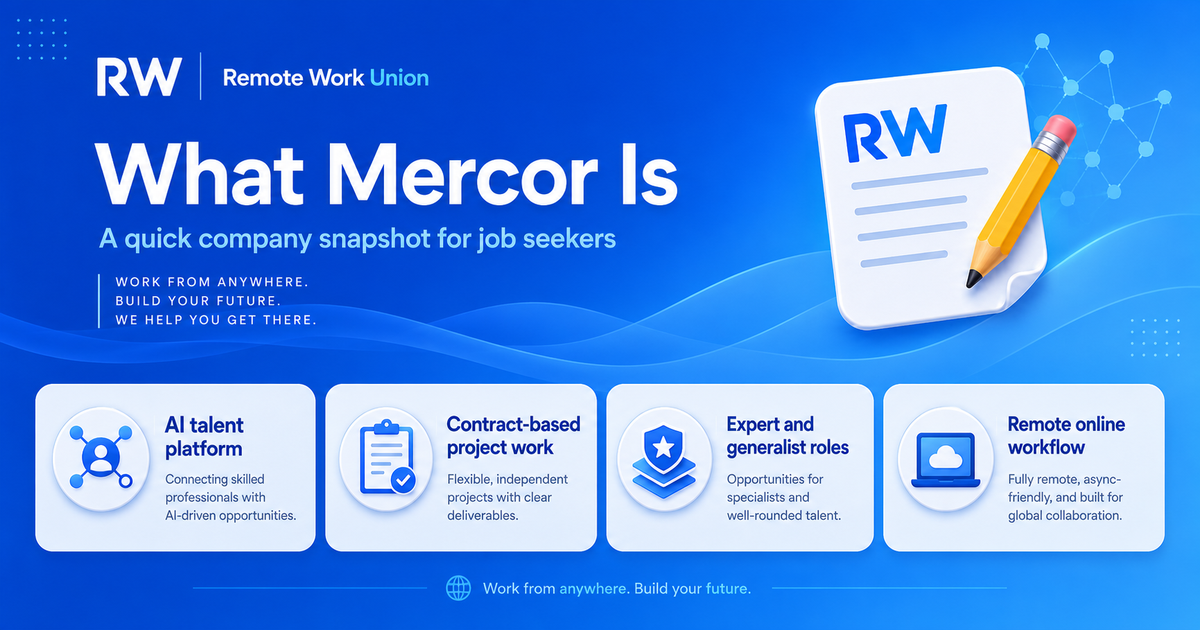
Mercor is best understood as an AI talent and hiring platform connected to the broader AI training economy. Its public materials describe a company focused on organizing human intelligence for AI development. In plain English, that means Mercor connects people with companies that need human expertise for tasks connected to hiring, evaluation, model training, research, and AI workflow development.
For job seekers, the important point is this: Mercor is not just a traditional job board and not just a generic data annotation site. It sits closer to the intersection of AI hiring, contract talent matching, expert networks, and AI model training work. Depending on the role, applicants may see work involving subject-matter expertise, written evaluation, reasoning, domain knowledge, interviewing, model response review, research, ranking, or feedback on AI-generated outputs.
That makes Mercor relevant to people searching for terms like Mercor AI jobs, Mercor careers, remote AI training jobs, AI model evaluation jobs, AI response reviewer jobs, AI rater jobs, RLHF jobs, human feedback jobs, expert AI training jobs, data annotation jobs from home, remote research jobs, and AI contractor jobs. But job seekers should still evaluate each role separately. A company can be real while a specific project may not be the right fit for your background, schedule, pay expectations, or risk tolerance.
Who Founded Mercor?
Mercor's own early company post says it was founded in January 2023 by Brendan Foody, Adarsh Hiremath, and Surya Midha. In that post, Mercor described Brendan Foody as CEO, Adarsh Hiremath as CTO, and Surya Midha as COO. Public startup coverage has also identified the same three founders and described Mercor as an AI recruiting or AI talent startup.
For a job seeker, founder research is useful, but it should not become the whole decision. Founders, valuations, media stories, venture capital rounds, and impressive growth numbers can help establish that a company exists and has attracted outside attention. They do not automatically prove that every applicant will get hired, every project will last, every payout will match expectations, or every contractor experience will be smooth.
Remote Work Union lists verified remote AI work. Browse roles that match your skills and background.
Find Roles Hiring Now →Company Snapshot: What to Verify
A basic company legitimacy check for any AI training platform should cover: Does the company have a real website with clear contact information? Is there verifiable information about its founders, investors, or clients? Has it been covered in legitimate startup or tech media? Are there real project descriptions that explain what the work involves in plain language? Are there real payment terms with a defined schedule and method?
Mercor has been covered by startup publications and has identifiable founders with public professional profiles. That is a baseline legitimacy signal. However, it does not replace the need to evaluate each specific project, understand the pay structure, confirm that the work matches your background, and verify that you understand what you are agreeing to before submitting personal information or work samples.
How to Check Legitimacy Before Applying
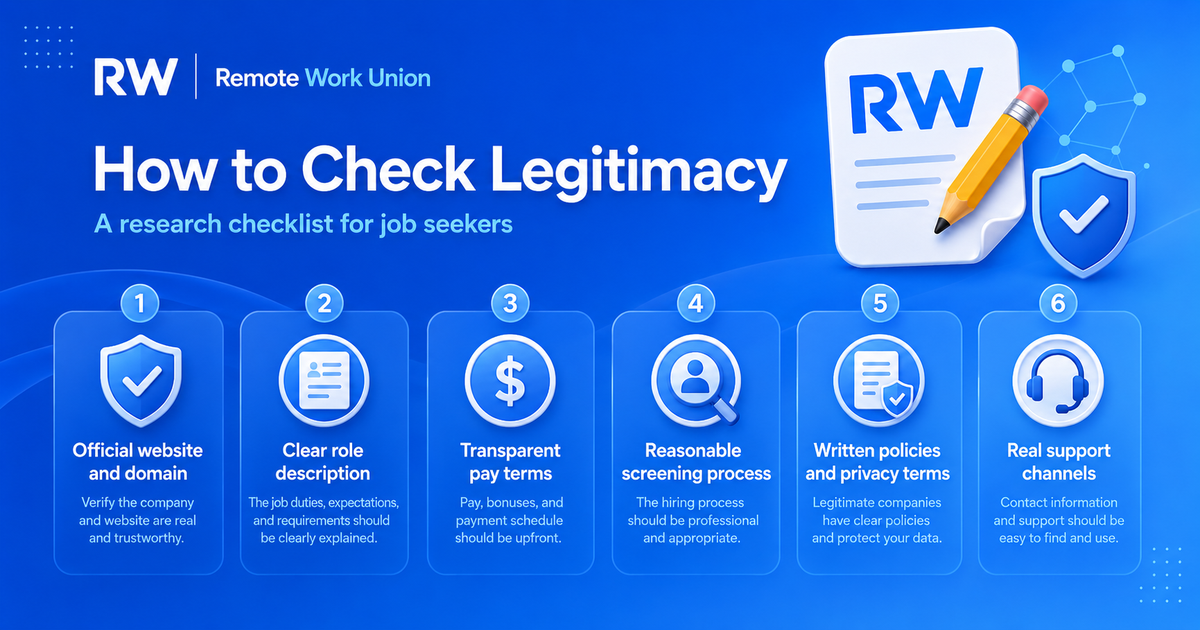
Before applying to any AI training project through Mercor or a similar platform, work through this checklist. First, confirm who is running the project — is it Mercor itself, a client through Mercor, or a third party? Second, understand the pay structure — how much, how often, through what method, and under what contract terms? Third, understand the task — can the project describe in two to three sentences what you will actually do? Fourth, check the required personal information — is any request for sensitive data (bank details, SSN, passport) necessary and appropriate at this stage? Fifth, look for quality feedback mechanisms — does the platform have a way to measure your work quality and communicate the results to you?
A legitimate AI training project can answer all five questions clearly. If any answer is vague, absent, or deflected, slow down and ask more questions before proceeding.
Green Flags and Yellow Flags
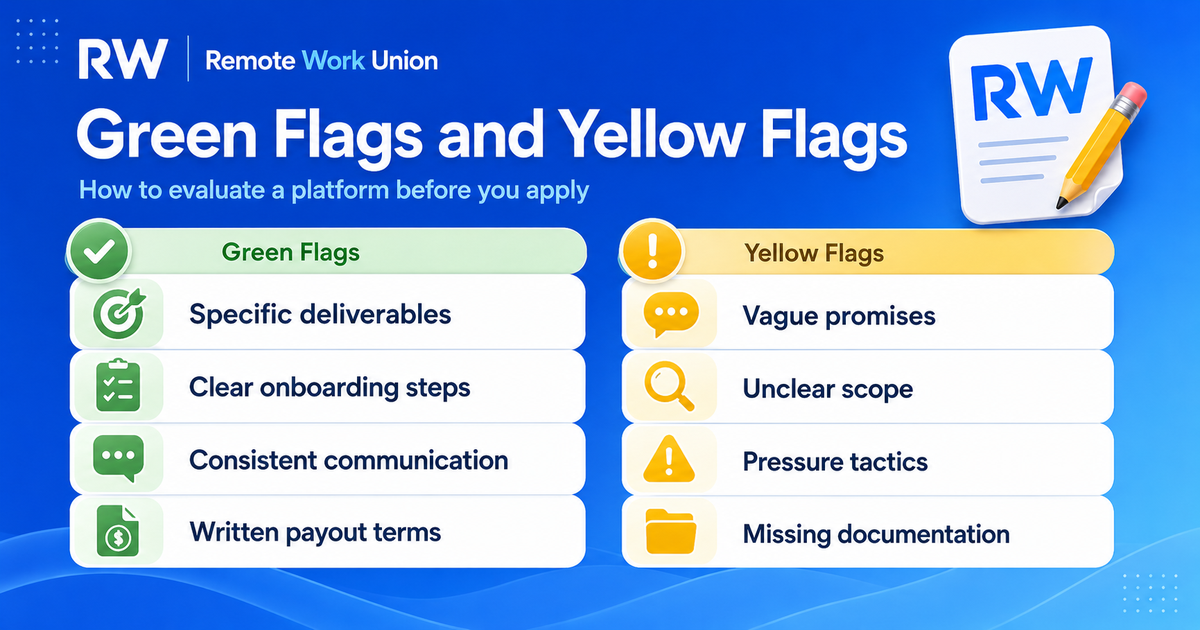
Green flags: Clear task description. Defined pay rate and payment schedule. A screening or qualification process before work begins. Traceable payment method. Public company information. Contract or terms of service. Communication through official platform channels.
Yellow flags: Vague task descriptions. Pay promised "up to" amounts without clarity on what earns the maximum. Requests for payment, purchase, or subscription before seeing project details. Pressure to start immediately without a screening process. Contact exclusively through informal channels. Promises of guaranteed income without mentioning quality requirements.
Key rule: Any legitimate AI training platform — Mercor, Outlier, Surge AI, or otherwise — should be able to describe the work clearly before asking for your personal information or work samples. If the task cannot be explained in plain language, ask before committing.
Research Workflow for Job Seekers
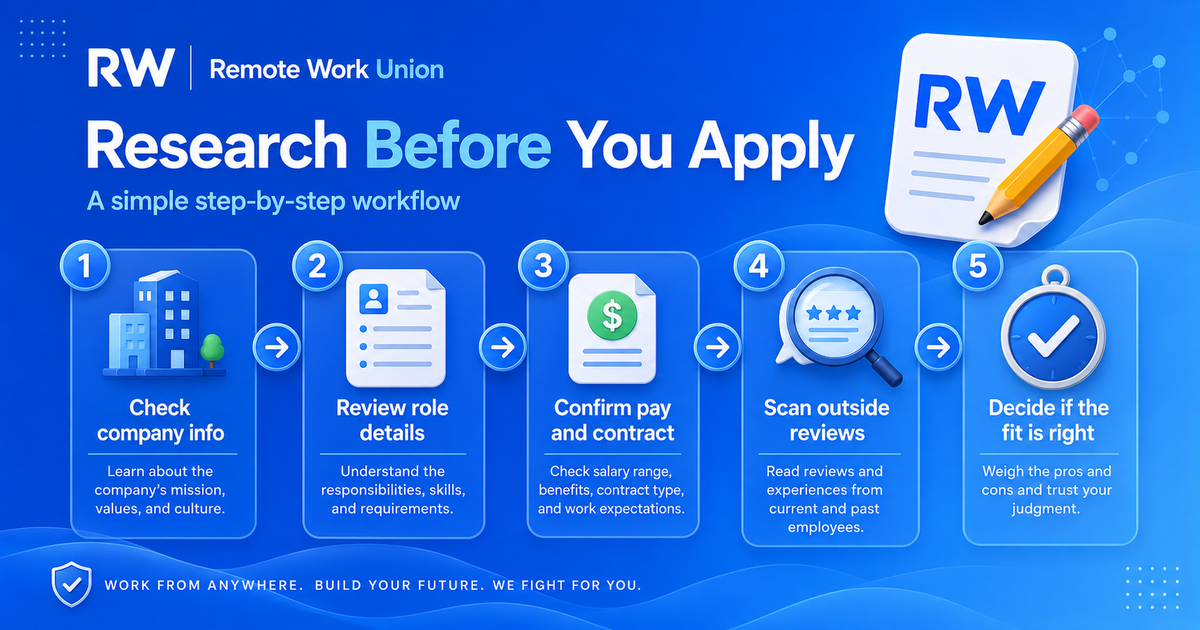
A practical five-step research process before applying: First, read the official platform and project information. Second, search for independent coverage — startup news, LinkedIn activity, founder profiles, and recent reviews. Third, search Reddit and community forums for patterns in applicant experiences, filtering for recency and relevance to your background. Fourth, compare the project requirements against your actual skills — can you genuinely perform this task? Fifth, check the application itself for the five legitimacy questions above before submitting.
What Actually Matters for Your Decision
The company's legitimacy matters, but it is not the only factor in your decision. The more important question is whether a specific project is right for you. A real company can still offer a project that does not match your skills, pays less than your time is worth, communicates poorly, or has inconsistent availability. Conversely, a newer platform can have excellent projects for the right background.
Evaluate each project individually. The questions to answer: Does the task format match what I can do well? Is the pay worth the time required? Is the contract clear? Will I be able to maintain quality on this type of work? If the answers are yes, apply — and use your own experience to calibrate whether the platform delivers what it describes.
Frequently Asked Questions
Who founded Mercor?
According to Mercor's own early company posts and public startup coverage, Mercor was founded in January 2023 by Brendan Foody (CEO), Adarsh Hiremath (CTO), and Surya Midha (COO). The company is focused on organizing human intelligence for AI development.
Is Mercor a legitimate company?
Based on available public information, Mercor is a real company that has received venture capital funding and attracted public coverage as an AI talent and hiring platform. Legitimate companies still require careful evaluation of individual projects before committing your time and personal information.
How do I verify that a Mercor project is legitimate?
A legitimate AI training project should describe the actual task in clear terms, have a defined screening or qualification process, pay through a traceable method, and not require payment before you see the project details. Check who is running the project, confirm payment terms, and verify that the work involves real deliverables rather than vague promises.