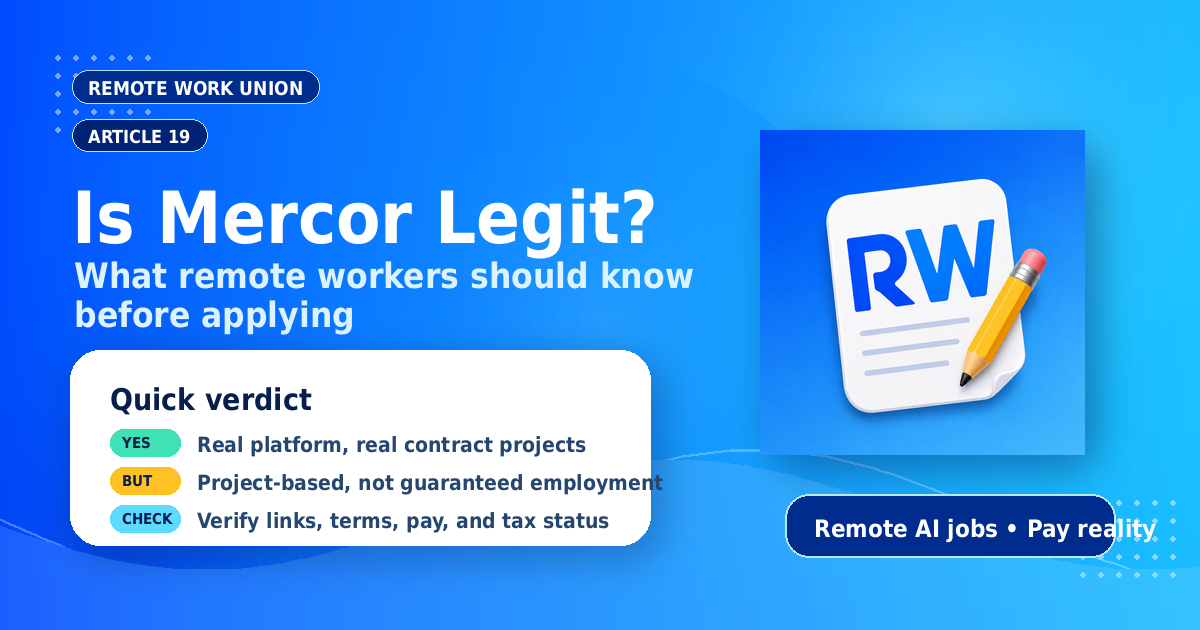
Mercor is one of the most searched names in remote AI work because it sits at the intersection of three things people want: flexible work from home, high hourly pay, and access to the artificial intelligence economy. The short answer is that Mercor appears to be a real platform for contract-based AI training and expert work, not a simple fake-job scheme. Its own public pages describe remote contract opportunities for professionals, and its support documentation explains AI interviews, onboarding, contracts, time tracking, payments, taxes, and identity verification.
That does not mean every Mercor opportunity is a stable job, that every applicant will be accepted, or that every worker will get consistent hours. A better way to frame it is this: Mercor can be legitimate and still be risky, inconsistent, competitive, and easy to misunderstand. Remote workers should treat it like freelance AI training work, not like a guaranteed full-time remote job with benefits.
The Quick Verdict: Yes, But With Major Context
If you are asking, "Is Mercor legit?" the practical answer is yes, but you need to define "legit" correctly. Legit means the company is real, the platform exists, real contractors can receive offers, and real work can be paid. Legit does not mean the work is guaranteed, easy to get, predictable, or equivalent to a regular employee role.
Mercor describes itself as a platform that matches professionals with AI projects and remote contract opportunities. Its official expert page says professionals can get matched to AI projects that fit their expertise and interests. Its contract documentation says hourly contracts are common, weekly pay is based on tracked hours, and work is recorded through the Insightful desktop app. Its payments documentation explains Stripe Connect and Wise payout flows, depending on country support.
Why People Think Mercor Might Be a Scam
Remote workers are skeptical for understandable reasons. The job market is full of fake remote jobs, recruiter impersonation, referral spam, and vague work-from-home listings that promise high pay but ask for personal information too early. The FTC has warned that scammers impersonate well-known companies on LinkedIn and other job platforms, then use fake interviews, fake offer letters, equipment fees, or personal-information requests to steal money or data.
A 2026 report covering LinkedIn job-scam research noted that candidates increasingly verify whether a role is real before applying, and that common red flags include early requests for sensitive information, upfront payments, pressure to act quickly, suspicious profiles, and off-platform messaging.
Mercor also uses an AI interview process, which can feel unfamiliar if you are used to human recruiters. For some applicants, a recorded AI interview, a contractor funnel, and a high hourly rate can create a "too good to be true" feeling. Add in referral links, posts from third-party recruiters, and remote roles advertised across multiple boards, and the confusion gets worse.
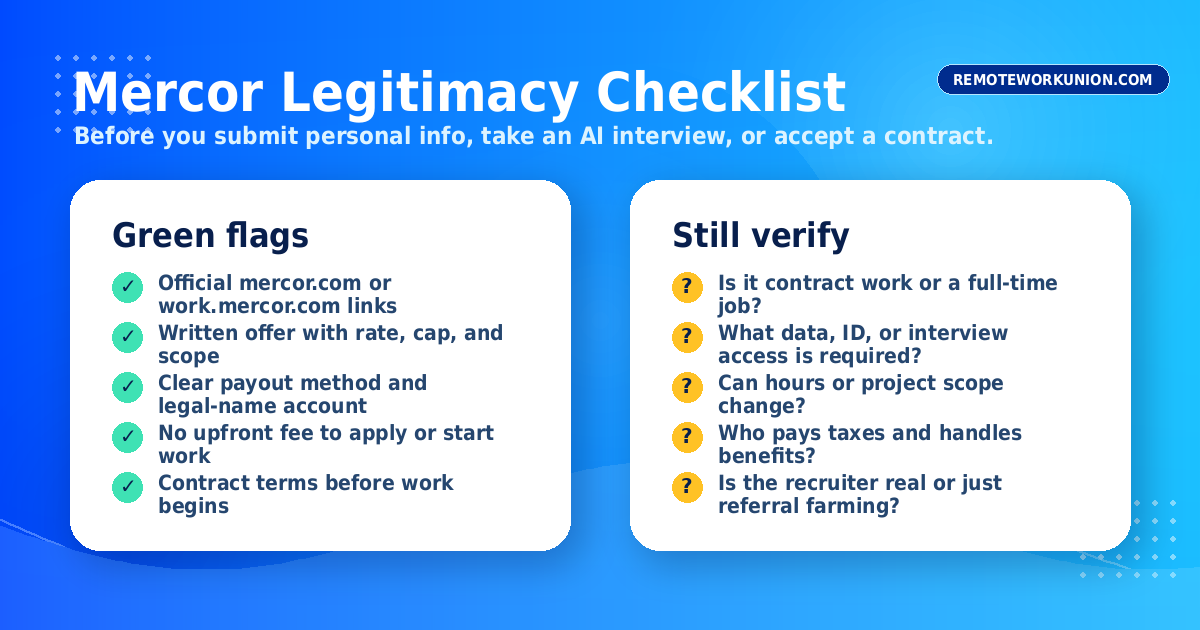
The correct response is not blind trust or instant rejection. The correct response is verification. Use official domains, read the contract, understand the pay structure, and know what kind of work you are applying for before submitting sensitive information.
What Mercor Actually Does
Mercor connects human experts with AI-related projects. In plain English, that usually means companies need people to review, write, rank, test, label, evaluate, or improve AI outputs. These roles can include AI trainer, AI evaluator, model response reviewer, domain expert, coding evaluator, legal reviewer, finance expert, technical writer, research assistant, data annotator, or specialized expert reviewer.
The broader market exists because AI companies still need human judgment. Large language models can produce fluent answers, but they still need examples, rankings, rubrics, expert corrections, and structured feedback. Publications covering the AI training labor market describe professionals creating rubrics, grading model answers, writing ideal responses, producing test prompts, and using their domain expertise to make AI systems more useful.
This is why Mercor attracts writers, marketers, lawyers, finance professionals, engineers, teachers, researchers, doctors, consultants, creatives, and other people with real-world expertise. AI companies do not only need coders. They need people who can judge whether an answer is accurate, useful, safe, persuasive, compliant, or professionally realistic.
How the Mercor Application Process Usually Feels
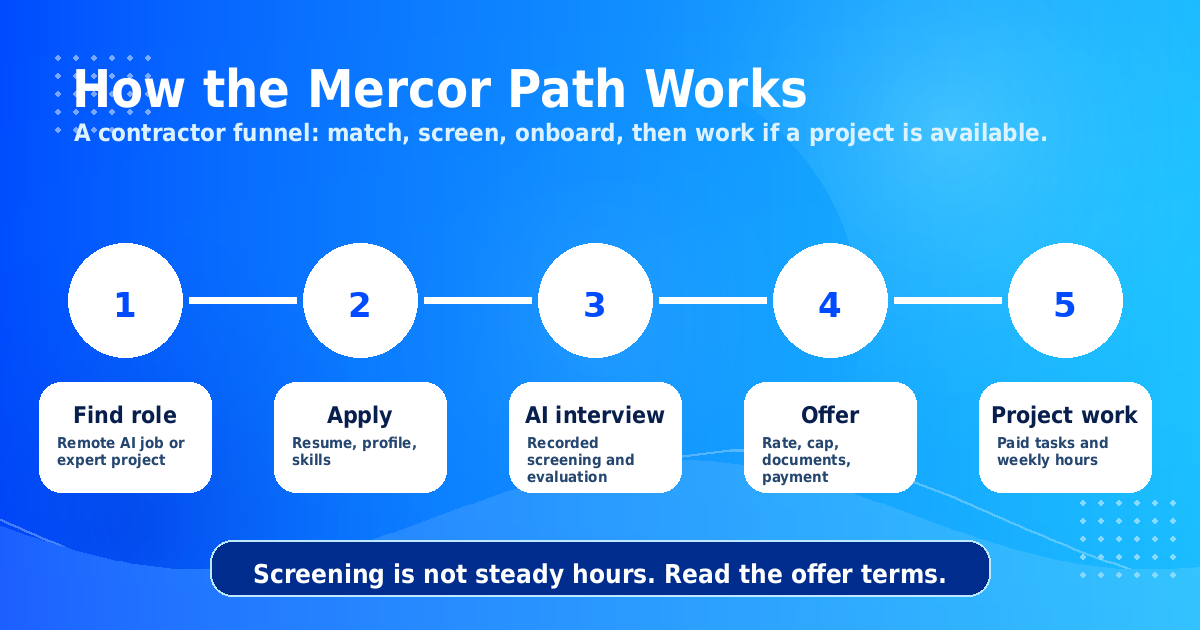
The Mercor process can vary by role, but the typical path is a contractor-style funnel: you find a role, submit your profile or application, complete screening, potentially take an AI interview, then receive onboarding steps if matched to a project. Mercor's AI interview support page describes the AI interview process and covers preparation, retakes, practice interviews, data privacy, accessibility, AI-tool use, and support. Its project-onboarding documentation says offer acceptance can include reviewing the offer, payments, background checks, and document signing.
For remote workers coming from traditional job searches, the biggest adjustment is psychological. This may not feel like a normal hiring process. You may not get a warm human recruiter call at the beginning. You may not know the client. You may not be applying to one permanent job. You may be entering a matching system that screens your expertise and routes you toward projects when demand exists.
How Mercor Workers Get Paid
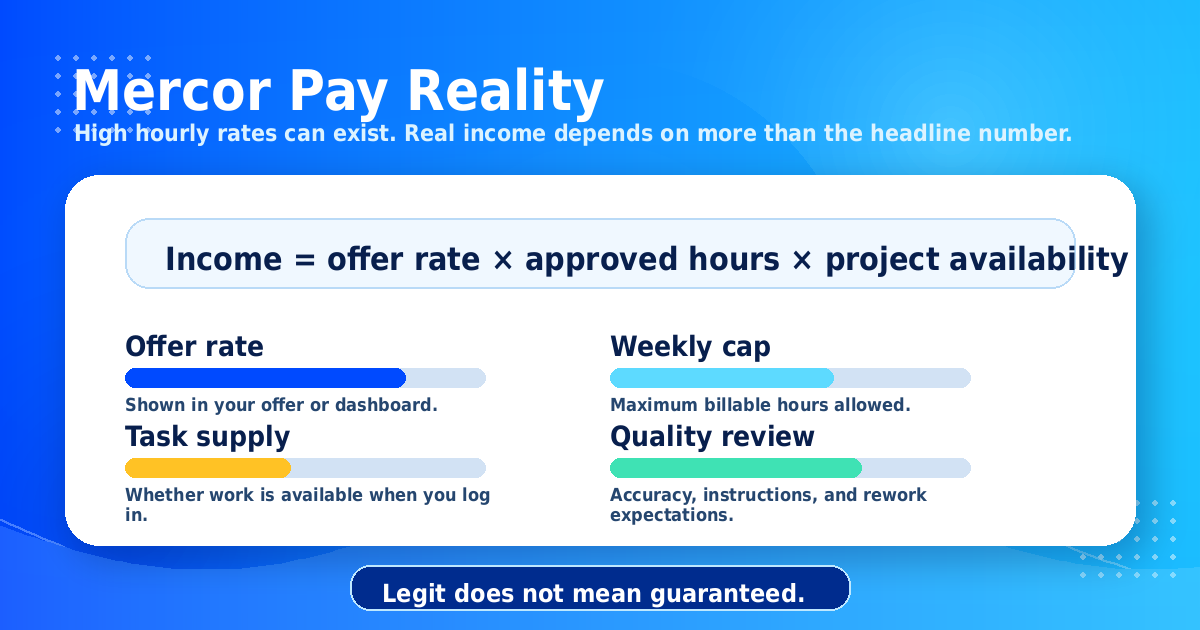
Mercor's public contractor documentation describes several details remote workers should understand before accepting a project. Hourly contracts are described as the most common contract format. Workers are paid weekly based on hours worked, and those hours are tracked through Insightful. The documentation also says each contract specifies a weekly cap, and the hourly rate is displayed in the offer and onboarding dashboard.
Mercor's time-tracking documentation explains a weekly pay cycle based on a Saturday-to-Friday IST period, with payouts for the prior week typically processed by the end of Wednesday PST and funds often arriving Thursday, although timing can vary by provider or bank. Its payments documentation says Stripe Connect is the primary payout method for contractors in Stripe-supported countries, while Wise is used where Stripe Connect is not supported.
The important point: the hourly number is not the whole story. Your real income depends on the hourly rate, approved hours, weekly cap, task availability, project length, quality standards, and whether you remain matched to projects. A $75/hr role with a small cap and inconsistent task supply may earn less than a lower-rate role with steady approved hours. A $100+/hr expert project can be real, but it is usually tied to specific expertise, screening, client demand, and project availability.
Contractor Status Matters
Remote workers should not treat Mercor like a salaried job unless the offer specifically says that. Mercor's tax documentation says it does not deduct taxes from payments and that independent contractors are accountable for local tax obligations. For U.S. citizens and permanent residents, the documentation says a W-9 is required and a 1099 form is issued if annual income surpasses $600.
That means you should think like a freelancer. Track income. Set aside money for taxes. Keep records of offers, contracts, payments, hours, and project communications. Do not calculate your expected monthly income by multiplying the highest advertised hourly rate by 40 hours unless your actual contract supports that assumption.
Freelancer mindset: Treat every Mercor project like an independent contract. Budget for taxes, maintain your own records, and never plan around a rate you have not seen in writing.
The Biggest Misunderstanding: Mercor Is Not Always a Job in the Traditional Sense
Many frustrated applicants are not wrong to feel misled by the broader remote AI job market. A role can be advertised like a job but function like a project marketplace. That difference matters. A job implies ongoing employment, predictable hours, a manager, a stable scope, and possibly benefits. A project marketplace implies screening, matching, contracts, fluctuating work, and uncertainty.
Mercor's own project support FAQ notes that pay rates, weekly hour caps, and work expectations may change after a project transfer, and that movement between projects or multiple-project participation is not automatic. This does not automatically make the platform illegitimate. It means applicants need to evaluate it using freelancer rules, not employee rules.
Looking for remote AI training and expert review roles? Apply through Remote Work Union.
Browse Roles Now →Who Mercor Can Be Good For
Mercor can make sense for people who already have a clear professional skill and want to turn that skill into remote AI work. The best candidates usually have one or more of the following: strong writing ability, domain expertise, clear reasoning, attention to detail, willingness to follow rubrics, comfort with AI tools, and the patience to work inside structured guidelines.
Strong candidate categories include:
- Software engineers and technical professionals who can evaluate code, tests, architecture, or debugging tasks.
- Lawyers, paralegals, compliance professionals, and legal writers who can judge legal reasoning and document quality.
- Finance, accounting, consulting, and business professionals who can evaluate analysis, spreadsheets, memos, and strategic recommendations.
- Writers, editors, marketers, journalists, and content strategists who can judge tone, accuracy, clarity, persuasion, and user intent.
- Teachers, tutors, academics, researchers, and subject-matter experts who can explain concepts and spot weak reasoning.
- Healthcare, science, engineering, and technical specialists whose expertise is valuable for specialized AI evaluation.
The strongest remote AI training applicants do not present themselves as generic online workers. They present a specific, verifiable expertise that can be converted into model evaluation: "I can judge financial analysis," "I can improve legal reasoning," "I can evaluate technical explanations," "I can write and rank marketing copy," or "I can create realistic prompts from my profession."
Who Should Probably Skip It
Mercor may not be a good fit if you need stable income immediately, dislike AI interviews, are uncomfortable with contractor paperwork, do not want time tracking, or expect a simple part-time job where tasks are always available. It may also be a poor fit if you do not want to share identity documents during onboarding after an offer, because Mercor's support documentation describes ID verification as part of onboarding and notes that a background check may be separate depending on client contractual needs.
It is also not ideal if you want passive income. AI training work is active labor. You are being paid to think, evaluate, write, compare, classify, or produce expert-quality work. If you rush, ignore instructions, or submit low-quality output, future access can suffer.
How to Apply Without Getting Burned
The safest way to apply is to treat every step as a verification checkpoint. Start from an official Mercor domain whenever possible. Avoid random DMs that ask you to move to WhatsApp, Telegram, or private messaging immediately. Do not pay a fee to apply. Do not buy equipment through a recruiter. Do not submit banking information through a strange form before a verified offer. Read the contract. Confirm the pay rate, weekly cap, work type, payment method, tax status, confidentiality rules, and whether the work is hourly or deliverable-based.
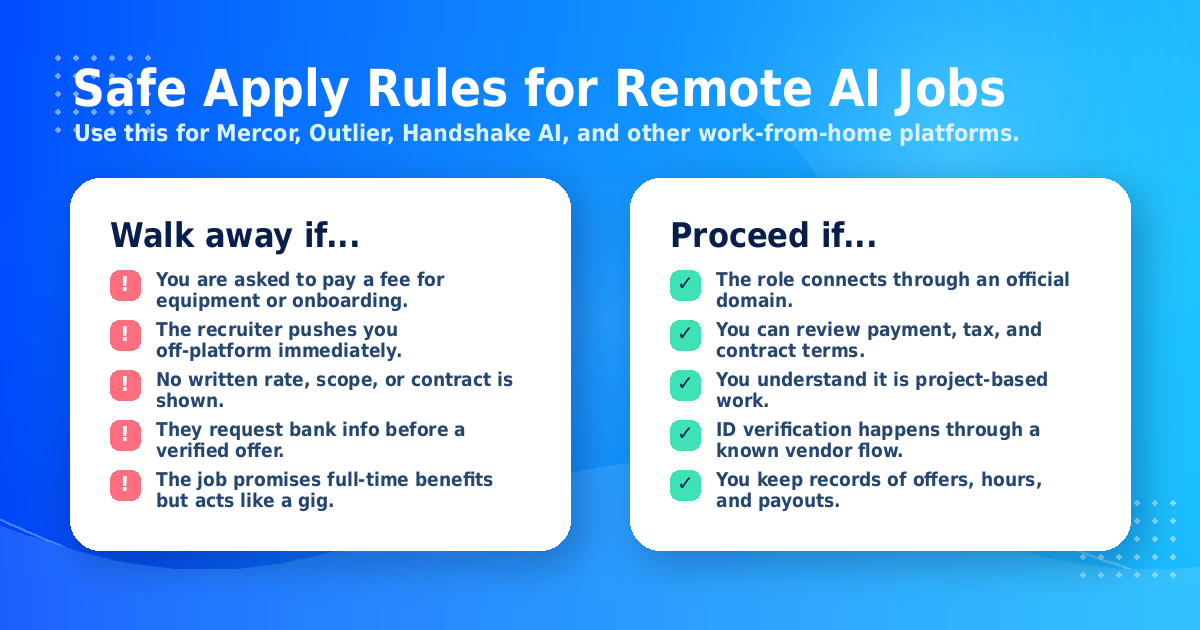
Mercor's data and AI usage documentation says Mercor does not sell your resume, profile, or interview data and does not share practice interviews with companies. That is useful to know, but you should still read the current privacy policy and the terms you are accepting at the time you apply. Terms can change, and the version you agree to is what matters.
What to Put in a Mercor Application
The best Mercor applications are specific. Do not just say you want remote work. Say what kind of expertise you bring and how it maps to AI training. Remote AI companies care about judgment, precision, and reliability. Your profile should make it easy to see why you are useful for model evaluation.
Application tips:
- Lead with your strongest domain: law, finance, marketing, engineering, healthcare, writing, education, research, or another real skill.
- Use clear keywords: AI trainer, AI evaluator, model response reviewer, prompt evaluator, expert reviewer, remote AI jobs, and work from home AI training.
- Mention measurable experience: years in field, industries served, tools used, credentials, publications, clients, projects, or outcomes.
- Show reasoning ability: include examples of analysis, editing, structured feedback, research, QA, testing, or rubric-based evaluation.
- Avoid vague claims like "fast learner" unless paired with proof. Platforms need evidence, not motivation.
How to Think About Mercor vs Outlier vs Handshake AI
Mercor is part of a larger category of remote AI training and expert-review platforms. Outlier AI, Handshake AI, DataAnnotation, and similar platforms all sit in the same search universe: online jobs from home, AI evaluator jobs, remote AI research jobs, expert review, and AI model training work. The right platform is usually the one that has demand for your specific background, a transparent pay structure, clear task expectations, and a process you are comfortable with.
Do not build your entire income plan around one platform. Apply to several legitimate remote AI platforms, keep records, compare actual offers, and judge by real paid work rather than screenshots or social media claims. A platform-specific referral guide can help, but your best long-term strategy is to package your expertise clearly and apply wherever that expertise is valuable.
Strategy: Treat Mercor as one channel in a broader remote AI job strategy. Apply to multiple legitimate platforms, compare real offers, and let your expertise drive the decisions — not the headline hourly rate.
Final Verdict
Mercor is not something to dismiss automatically, and it is not something to trust blindly. It appears to be a real company and a real route into remote AI training work, especially for people with strong professional expertise. But it is not a guaranteed remote job, not a stable salary replacement by default, and not a shortcut around normal job-market uncertainty.
The right way to approach Mercor is simple: apply through official channels, verify the opportunity, read the contract, understand that it is project-based, protect your personal information, and calculate income based on actual approved hours rather than headline rates. If you get matched to a good project, it can be a valuable remote work opportunity. If you do not, keep applying elsewhere and treat Mercor as one channel in a broader remote AI job strategy.
FAQ
Is Mercor legit?
Yes. Mercor appears to be a real platform for remote AI contract work. The better question is whether a specific role, recruiter, offer, and contract are legitimate and worth your time.
Does Mercor pay real money?
Mercor's public docs describe weekly payments for hourly contracts and payout flows through Stripe Connect or Wise, depending on country support. Actual income depends on your offer, approved hours, project caps, and task availability.
Is Mercor a full-time remote job?
Usually, no. Many opportunities should be treated as contract or freelance AI training work unless the offer explicitly says otherwise.
Do I need AI experience?
Not always. Many AI training roles value real-world expertise, writing ability, reasoning, and subject-matter judgment. AI familiarity helps, but the highest-value angle is often domain expertise.
Should I trust a Mercor link from LinkedIn?
Verify it. Use official domains, check the sender, avoid off-platform pressure, and never pay an application or equipment fee. Job-scam impersonation is common across remote work platforms.