The remote AI jobs hiring most right now are not all engineering jobs. The biggest demand is around human judgment: evaluating AI responses, labeling data, writing prompts, checking facts, testing AI agents, reviewing code or math, improving multilingual outputs, and applying professional expertise in fields like law, finance, healthcare, education, marketing, operations, and research.
The best opportunities are usually listed under names like AI evaluator, AI trainer, AI content reviewer, model response reviewer, prompt writer, data annotation specialist, AI research assistant, coding evaluator, language evaluator, domain expert, red-team reviewer, or AI safety evaluator. These jobs are often remote, flexible, and project-based. Some are beginner-friendly. Others require proof of professional experience or a graduate-level specialty.
In This Article
- Why these remote AI jobs are hiring
- 1. AI response evaluator and model reviewer
- 2. AI data annotation and labeling jobs
- 3. Prompt writer and synthetic data creator
- 4. AI research reviewer and fact-checking jobs
- 5. Coding, math, and STEM AI evaluator roles
- 6. Language, translation, and localization evaluator jobs
- 7. Domain expert reviewer jobs
- 8. AI safety, policy, and red-team reviewer jobs
- 9. Multimodal AI evaluation: image, audio, video, and voice
- 10. AI agent workflow testing jobs
- Where to look for these jobs
- How to make your profile more competitive
- A simple application plan for this week
- What to avoid
Why these remote AI jobs are hiring
AI companies are racing to make models more useful, accurate, safe, and specialized. That takes more than raw data. It takes people who can judge whether an answer is correct, whether a source is credible, whether a workflow actually works, whether a policy boundary is reasonable, and whether a model response would satisfy a real customer, patient, student, attorney, analyst, engineer, or business user.
That is why remote AI work has expanded beyond simple data labeling. In 2026, the strongest hiring demand is in work that helps large language models and AI agents improve reasoning, reliability, safety, and real-world performance. Platforms such as Mercor, micro1, Handshake AI, and Outlier describe work that includes remote AI training, model evaluation, domain-specific review, annotation, prompt creation, grading, and expert feedback. Frontier AI companies such as OpenAI, Anthropic, Google, Meta, and xAI/Grok also need human data, evaluations, safety review, and specialized model behavior work, even when the direct full-time roles are not the same as contractor platform roles.
For applicants, the important point is simple: the market rewards people who can prove useful judgment. You do not always need to be a coder. You do need to show that you can read carefully, follow instructions, communicate clearly, and evaluate AI outputs better than a random applicant.
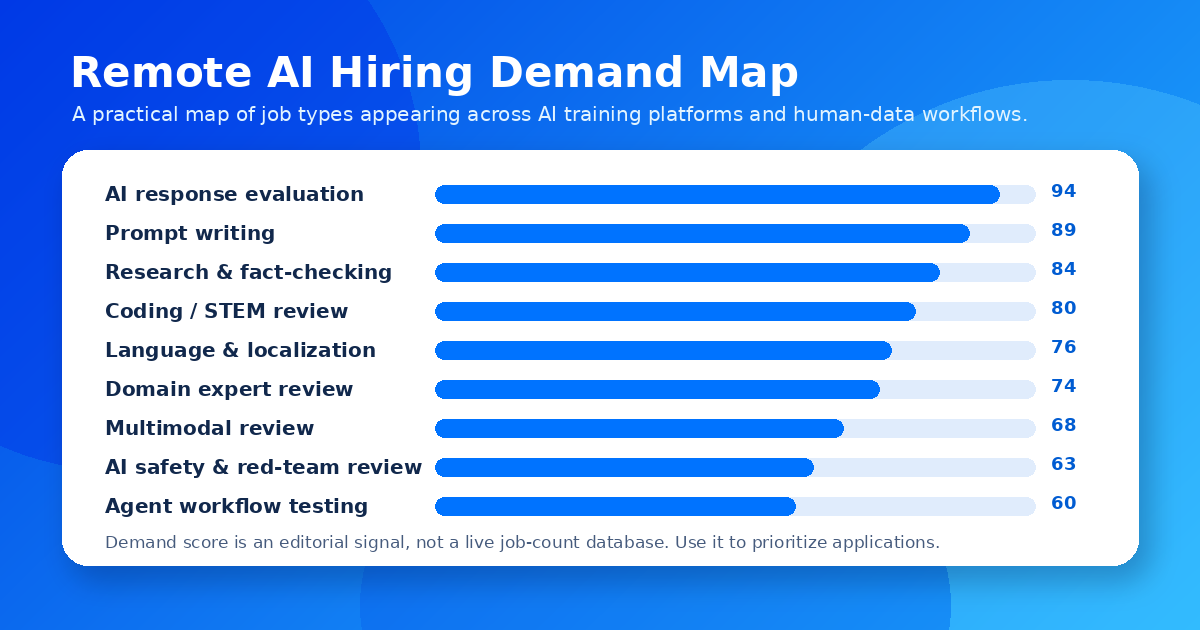
1. AI response evaluator and model reviewer
This is one of the most common remote AI job categories. AI response evaluators compare two or more model outputs, rate which one is better, explain why, and apply a rubric. A task might ask you to judge whether an answer is accurate, helpful, safe, complete, clear, well-sourced, or aligned with instructions.
Search for titles such as AI evaluator, model evaluator, AI trainer, AI content reviewer, model response reviewer, search quality evaluator, LLM evaluator, AI output reviewer, or human feedback specialist. This work can be beginner-friendly if you have strong reading and writing skills, but quality matters. The fastest way to lose access to projects is to rush, ignore instructions, or give shallow explanations.
This category is hiring heavily because every major AI product needs better answers. Chatbots, writing tools, coding assistants, AI search tools, customer service bots, educational tutors, workflow agents, and creative tools all depend on human feedback to improve.
2. AI data annotation and labeling jobs
Data annotation is still a core remote AI job, but the work has become more specialized. Basic labeling still exists, but many projects now require judgment: deciding whether content belongs in a category, tagging errors, labeling intent, identifying policy issues, classifying images or audio, or marking exactly where an AI answer goes wrong.
Common job titles include data annotator, AI data labeler, data labeling specialist, content annotation specialist, text annotation reviewer, image annotation specialist, audio data annotator, and dataset quality reviewer.
This is a strong starting lane for remote workers because it teaches the foundation of AI training work: precision, consistency, guideline reading, and quality control. It is also a good bridge from lower-paid online gig apps into more serious remote work, because the work has clearer business value and can lead to evaluation, research, or domain-specific projects.
3. Prompt writer and synthetic data creator
Prompt writing is not just typing clever questions into a chatbot. In paid AI training work, prompt writers create examples that test whether a model can reason, follow instructions, use tools, solve problems, handle ambiguity, or answer in a specific style. Some projects ask contributors to write challenging prompts and ideal answers. Others ask for realistic work scenarios, grading rubrics, or multi-step tasks that expose weak reasoning.
Search for prompt writer, AI prompt writer, prompt engineer, synthetic data creator, AI training writer, conversation designer, model behavior writer, instruction writer, or rubric writer.
This category is hiring because models need high-quality examples. A company cannot improve AI agents only by scraping the internet. It needs structured tasks that reflect real work: customer support conversations, legal questions, marketing briefs, spreadsheet decisions, coding bugs, finance analysis, medical reasoning, logistics problems, and other expert workflows.
4. AI research reviewer and fact-checking jobs
Research-heavy remote AI jobs are ideal for people who are good at finding information, checking sources, and spotting unsupported claims. The work may involve verifying whether an AI answer is factually correct, identifying missing context, rewriting an answer with better sourcing, checking citations, or reviewing search results for quality.
Relevant titles include AI research assistant, research reviewer, fact-checking specialist, AI search evaluator, source quality reviewer, web research analyst, citation reviewer, model accuracy reviewer, and knowledge quality analyst.
This is one of the best lanes for writers, editors, students, journalists, analysts, paralegals, academics, librarians, and detail-oriented generalists. It is also a good fit for people who do not want phone calls or sales work. The key skill is not speed alone. It is knowing when an answer sounds plausible but is not actually supported.
Remote AI evaluator, annotator, and expert reviewer roles are hiring across platforms. Find opportunities that match your background and start applying today.
Find Roles Hiring Now →5. Coding, math, and STEM AI evaluator roles
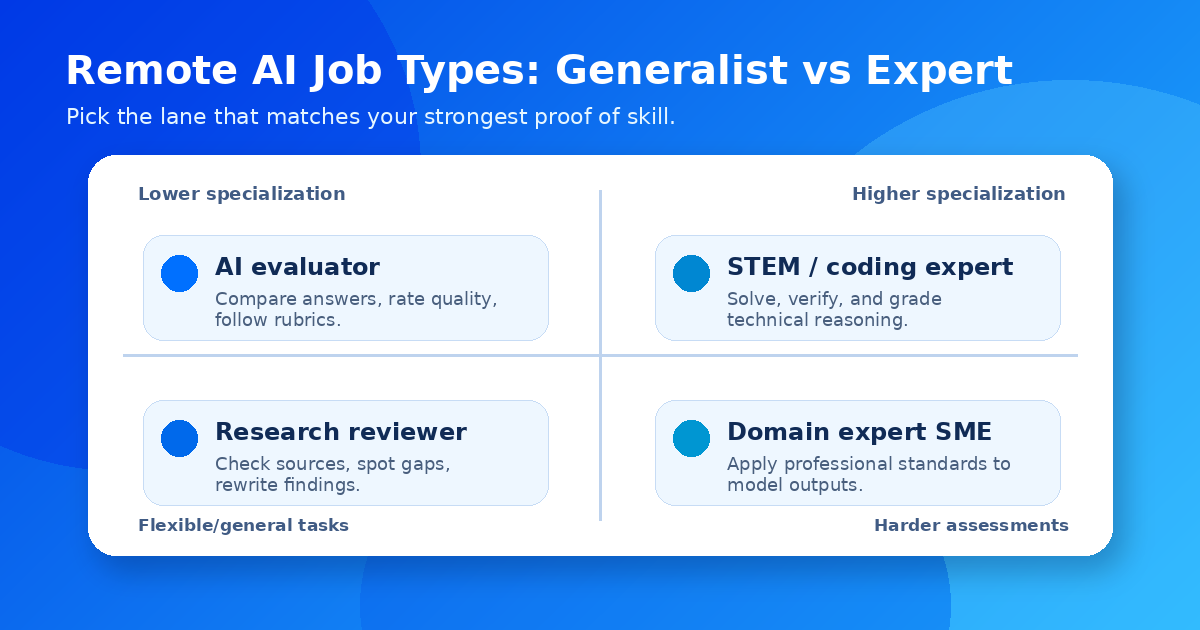
Technical AI training jobs are some of the highest-value remote AI roles because the mistakes are harder to judge. A general reviewer can often evaluate tone, clarity, and basic usefulness. But a coding evaluator must know whether code actually runs, whether an algorithm is efficient, whether a bug fix is correct, and whether a model made a subtle reasoning mistake. The same is true for math, statistics, physics, chemistry, engineering, biology, and data science.
Search for coding evaluator, software engineering AI trainer, code reviewer, math expert, STEM expert, statistics reviewer, data science evaluator, AI coding trainer, ML evaluator, or technical model reviewer.
These roles are usually more competitive, but they can pay more because they require scarce judgment. Applicants should show proof: GitHub projects, technical writing, degrees, work history, certifications, research, tutoring, or portfolio examples. You do not need to be a famous engineer. You do need to prove that you can evaluate technical work reliably.
6. Language, translation, and localization evaluator jobs
Language work is another major remote AI hiring lane. AI products need to perform well in English, Spanish, French, German, Arabic, Hindi, Portuguese, Japanese, Korean, Mandarin, Swahili, Yoruba, Tagalog, Vietnamese, and many other languages. The work is not always simple translation. Many projects need native-level judgment around tone, cultural fit, grammar, slang, safety, meaning, and regional differences.
Search for language evaluator, bilingual AI trainer, translation reviewer, localization specialist, linguistic data annotator, native language reviewer, conversation evaluator, speech data reviewer, or multilingual AI trainer.
This is a strong lane for bilingual professionals, translators, teachers, editors, customer support workers, and people with high written fluency. The best applications usually specify the exact language pair, region, dialect, and professional contexts you understand.
7. Domain expert reviewer jobs
The biggest shift in remote AI hiring is that platforms now want experts in ordinary professional fields, not just AI specialists. AI labs need accountants, attorneys, nurses, doctors, consultants, recruiters, salespeople, designers, marketers, operations managers, teachers, engineers, finance professionals, insurance specialists, procurement experts, and business analysts to judge whether model outputs match real professional standards.
Search for domain expert, subject matter expert, expert reviewer, legal AI trainer, finance AI trainer, healthcare AI evaluator, business strategy expert, marketing expert, accounting expert, tax expert, HR expert, procurement expert, or operations reviewer.
This is where many experienced professionals have an advantage. A mid-career person who understands a field deeply may qualify for better projects than a beginner who only knows how to use ChatGPT. The strongest profile does not say, "I am interested in AI." It says, "I can evaluate AI outputs in this specific field because I have done this work in real life."
8. AI safety, policy, and red-team reviewer jobs
AI safety work focuses on whether models behave appropriately in sensitive or risky situations. Some roles involve red-teaming, where reviewers intentionally test edge cases, failure modes, policy boundaries, or harmful-use scenarios. Others involve writing policy examples, evaluating refusals, checking whether a model over-refuses legitimate requests, or making sure guidance is consistent across difficult cases.
Search for AI safety evaluator, red-team reviewer, trust and safety AI analyst, policy reviewer, model behavior reviewer, risk evaluation specialist, content safety reviewer, adversarial testing reviewer, or AI governance analyst.
This lane can fit people with backgrounds in trust and safety, policy, law, cybersecurity, education, healthcare, social science, content moderation, compliance, journalism, and research. It rewards careful thinking more than hot takes. The work often requires balancing usefulness, safety, and clear reasoning.
9. Multimodal AI evaluation: image, audio, video, and voice
AI is no longer only text. More platforms now need contributors who can evaluate images, audio, video, voice, screenshots, diagrams, charts, maps, and visual workflows. Tasks might involve describing an image, checking whether a model understood a chart, reviewing a voice recording, evaluating a video caption, testing whether an AI system can interpret a screenshot, or creating training examples from real-world visual scenarios.
Search for multimodal AI evaluator, image annotation specialist, video data reviewer, audio evaluator, speech data reviewer, voice AI trainer, visual data annotator, image quality reviewer, chart evaluator, or screenshot workflow tester.
This is a useful category for designers, video editors, musicians, teachers, language speakers, photographers, analysts, and anyone who can explain visual or audio details clearly. Since many applicants only focus on text-based AI jobs, multimodal tasks can be a good way to stand out.
10. AI agent workflow testing jobs
AI agents are systems that do more than answer questions. They may use tools, browse information, write code, fill forms, operate software, plan steps, or complete workflows. That creates demand for people who can test whether an agent actually completed a task correctly.
Search for AI agent evaluator, workflow tester, tool-use evaluator, automation tester, AI operations reviewer, browser agent evaluator, software QA evaluator, AI task tester, or human-in-the-loop QA analyst.
This category is growing because companies want AI to handle real tasks, not just produce text. The best candidates understand processes. They can look at a workflow, identify where it broke, explain what the correct next step should have been, and write clear feedback that helps the system improve.
Where to look for these jobs
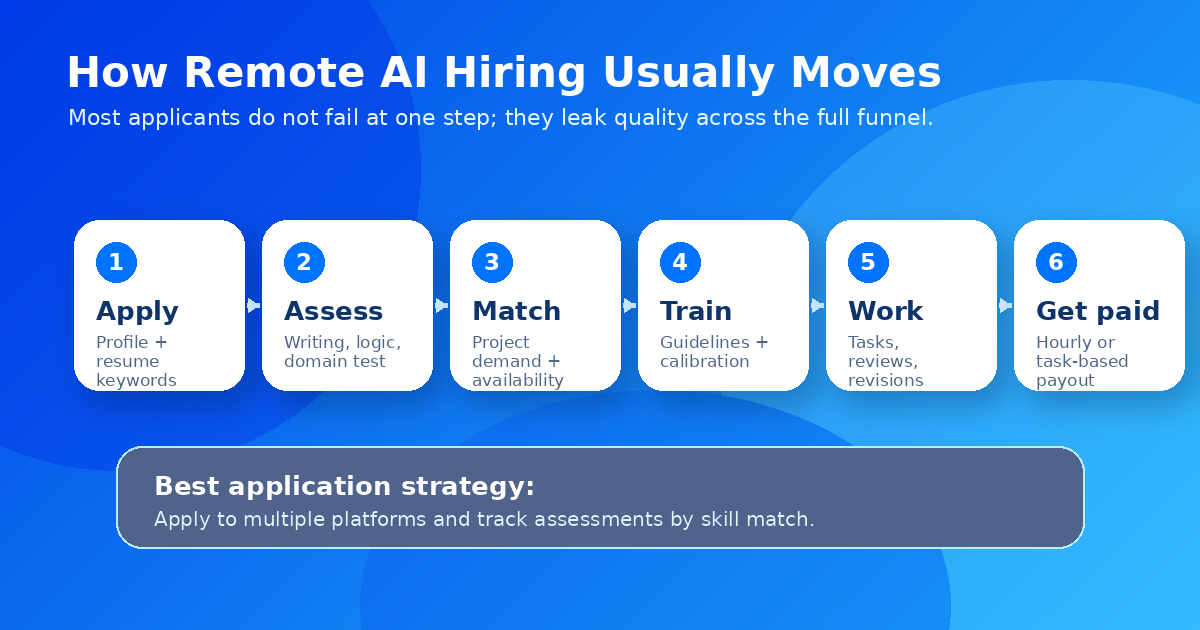
The best approach is to apply across several serious platforms instead of depending on one account. Remote AI work can be inconsistent. A platform may accept you and still have no active project for your skill set. Another platform may reject you for one role but match you to a better role later.
Look at AI training platforms, expert networks, data labeling companies, university-focused AI fellowship programs, and direct AI company career pages. Platforms and programs to watch include micro1, Mercor, Handshake AI, Outlier, DataAnnotation, Toloka-style task platforms, Appen-style evaluator work, and company career pages for OpenAI, Anthropic, Google, Meta, xAI/Grok, and other AI labs. Direct company roles are usually harder to get and often require full-time experience, but they reveal what the market values: human data, evaluations, safety, model behavior, feedback loops, and domain expertise.
Do not assume that every listing is available in every country. Some roles are US-only, some are limited to the US, Canada, UK, Australia, or specific regions, and others are worldwide. Always check location, work authorization, payout method, tax status, and whether the role is contractor-based.
How to make your profile more competitive
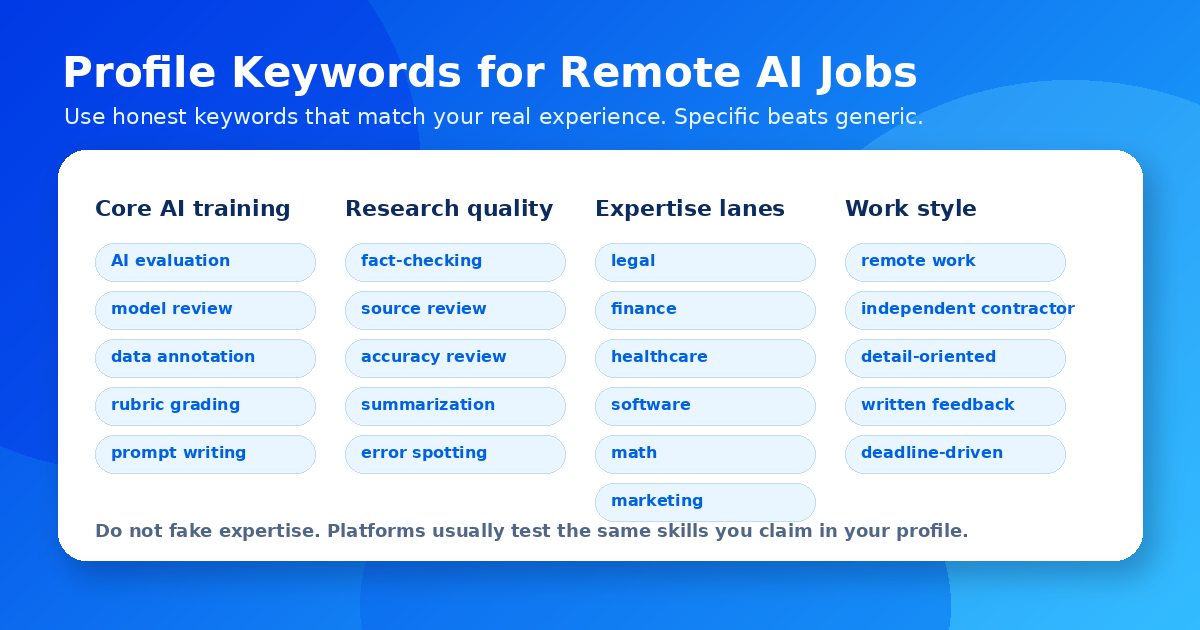
A strong remote AI job profile is specific. Do not write a vague profile that says you are hardworking, passionate, and interested in AI. Write a profile that helps the platform match you to work.
Use clear skills and keywords: AI evaluation, model review, prompt writing, data annotation, fact-checking, research review, rubric grading, written feedback, content quality, source verification, code review, math reasoning, language fluency, domain expertise, and remote work. Then add field-specific proof. A paralegal should mention legal research, case summaries, document review, and citation checking. A marketer should mention SEO, paid ads, campaign analysis, copywriting, and customer research. A developer should mention languages, frameworks, debugging, tests, APIs, and code review. A finance professional should mention financial modeling, FP&A, accounting, valuation, risk, or compliance.
The goal is not to stuff keywords. The goal is to make your real skills machine-readable and human-readable at the same time.
A simple application plan for this week
Start with one strong profile and adapt it for each platform. List your top three skill lanes: for example, research review, prompt writing, and marketing; or coding evaluation, Python, and data science; or Spanish localization, customer support, and content review.
Then apply to roles in batches. Do not apply to one role and wait for weeks. Apply to several roles that fit your actual background. Track the platform, role title, date applied, assessment status, pay range, location rules, and whether you received a response. If you get an assessment, treat it like paid work even if it is unpaid. Read the instructions twice. Slow down. Follow the rubric. Give concise explanations.
After you apply, keep improving your profile. Add examples of your work, revise weak descriptions, and remove skills you cannot defend. The best applicants do not look like they will take any task. They look like they should be trusted with a specific type of task.
What to avoid
Avoid any remote AI job that asks you to pay to apply, buy a starter kit, pay for guaranteed placement, or send money to unlock tasks. Real remote work platforms do not need you to pay them to start. Also avoid exaggerating degrees, employment history, language fluency, or technical skills. Most platforms test quality quickly. If your profile overpromises, the assessment will expose it.
Be cautious with roles that advertise unusually high pay but give no company name, no clear application process, no contract terms, and no explanation of the work. High-paying AI expert projects exist, but they usually require proof of expertise. A legitimate $100/hr or $200/hr role will normally have a serious assessment, a narrow domain, and quality expectations.
Finally, do not depend on one platform for stable income. Remote AI work is real, but project availability changes. Treat it like a portfolio of opportunities, not a guaranteed paycheck from one company.
Bottom line
The remote AI jobs hiring most right now are the jobs that help AI systems become more accurate, useful, safe, and specialized. That means AI evaluators, data annotators, prompt writers, research reviewers, technical experts, language specialists, domain experts, safety reviewers, multimodal reviewers, and AI agent workflow testers.
The strongest applicants are not always the most technical. They are the people who can prove judgment. They know how to follow instructions, explain decisions, catch errors, and apply real-world expertise. If you can do that, remote AI work can be a serious path into flexible work from home jobs in 2026 and beyond.
Frequently Asked Questions
What remote AI jobs are hiring the most right now?
AI response evaluators, data annotators, prompt writers, research reviewers, coding and STEM evaluators, language specialists, domain experts, AI safety reviewers, multimodal evaluators, and AI agent workflow testers are all in strong demand in 2026.
Do you need coding skills to get a remote AI job?
No. Many remote AI jobs are built around writing, research, judgment, domain expertise, or language skills. Technical roles like coding evaluator and STEM reviewer do require technical backgrounds, but many evaluator, annotation, and research roles do not.
How do I apply for remote AI evaluator jobs?
Apply through AI training platforms and expert marketplaces such as micro1, Mercor, Handshake AI, and Outlier. Build a profile that clearly shows your strongest skill area and any domain knowledge. Also check direct career pages for AI companies like OpenAI, Anthropic, Google, Meta, and xAI.
How much do remote AI evaluator jobs pay?
Pay ranges widely. Expert-tier evaluation roles involving law, finance, healthcare, STEM, or coding can pay $50–$200/hr. General AI evaluation typically pays above $20/hr. Beginners usually start with lower-value tasks and move to higher-paying work as they build quality history.