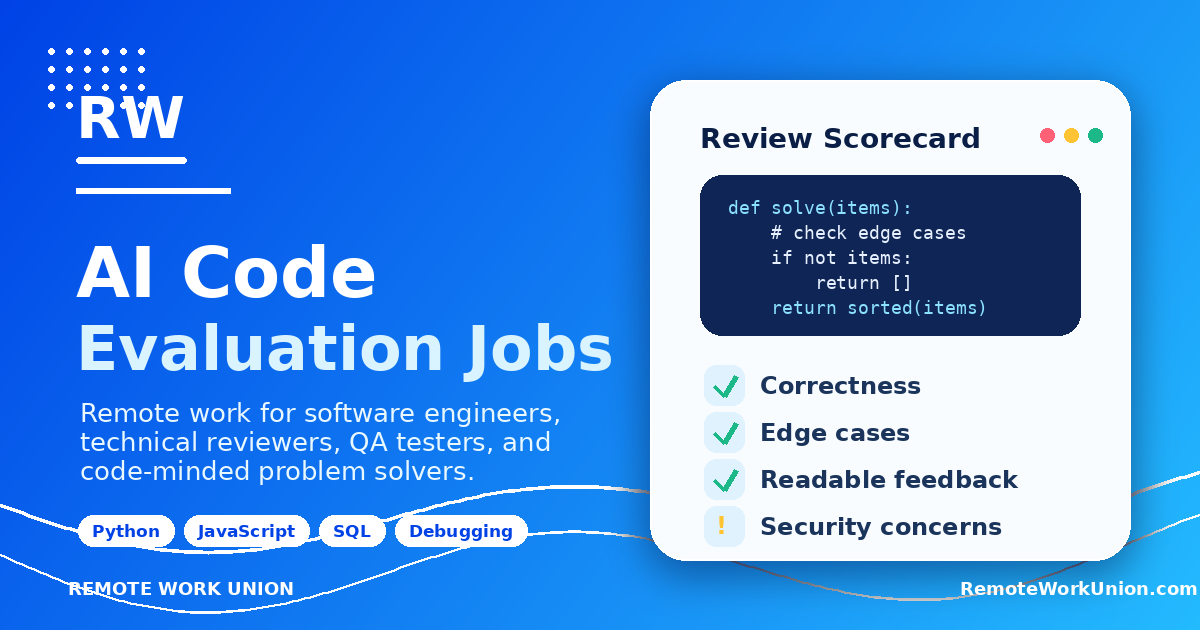
AI code evaluation jobs are a strong fit for software engineers, QA testers, technical writers, data analysts, computer science tutors, and other people who can read code carefully and explain what is right or wrong. These roles are part of the broader category of remote AI training jobs, AI model evaluation projects, and RLHF work that helps improve large language models.
The basic idea is simple: an AI system generates code, an explanation, a debugging suggestion, or a technical answer. A human reviewer checks whether that answer is correct, safe, complete, and useful. For people with a software background, that can make AI code evaluation one of the more natural remote work categories to explore.
What AI Code Evaluation Jobs Actually Are
AI code evaluation is not the same thing as being a full-time software engineer at an AI company. It is usually contract, freelance, project-based, or part-time remote work where the reviewer evaluates model outputs. Instead of owning a production codebase, you might review model answers to programming prompts, compare two responses, write ideal solutions, create tests, label bugs, or explain why one answer is better than another.
This kind of work exists because AI systems such as ChatGPT, Claude, Gemini, Copilot-style tools, and other large language models are increasingly used for coding help. Major AI companies and AI product teams need human feedback from people who understand programming. Human reviewers help models improve at writing correct code, explaining technical concepts, following developer instructions, and avoiding misleading answers.
Who This Work Fits Best
AI code evaluation is best for people who can combine technical accuracy with clear writing. You do not always need to be a senior engineer, but you do need to understand the programming language, the task, and the difference between code that looks plausible and code that actually works.
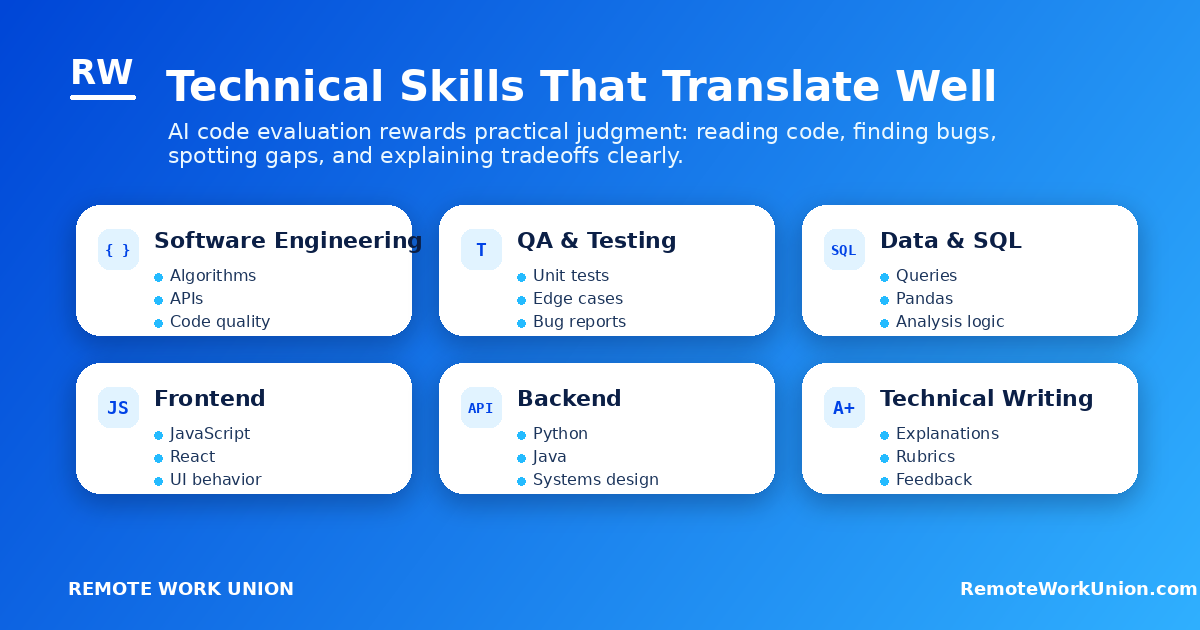
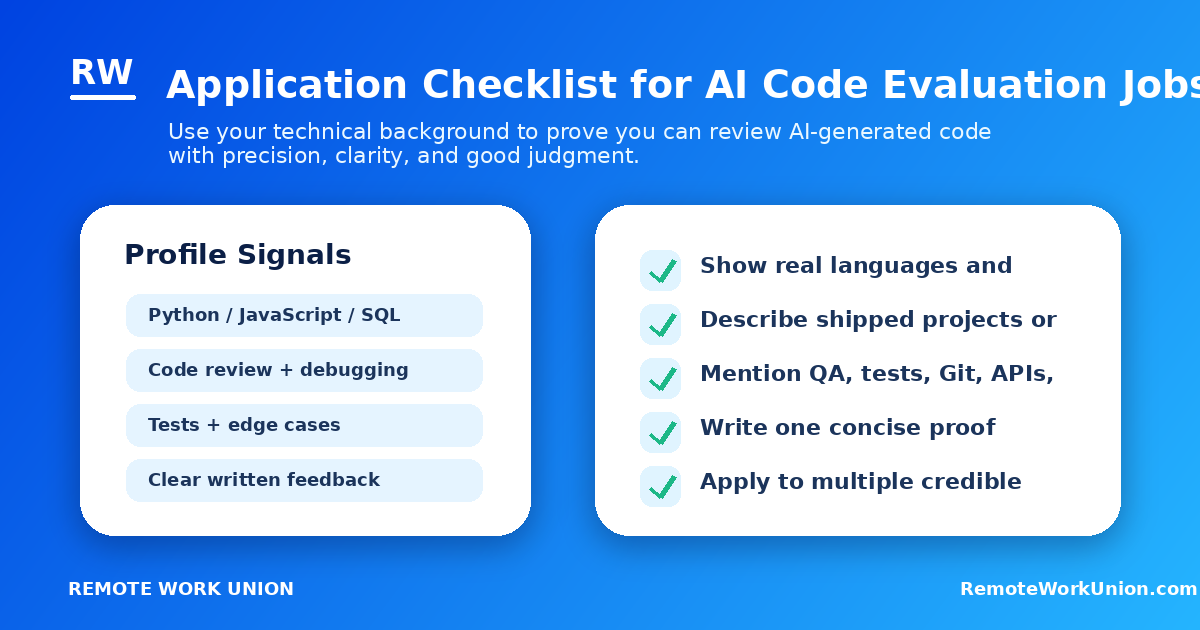
The strongest applicants often come from software engineering, web development, QA testing, data analytics, computer science education, IT automation, DevOps, technical support, or technical writing. Good candidate profiles include:
- Software engineers who can review code quality and logic
- QA testers who are strong at edge cases and bug reports
- Data analysts who can evaluate SQL, Python, spreadsheets, and data workflows
- Technical writers who can explain programming concepts clearly
- Computer science tutors who can judge whether an answer teaches the right concept
- DevOps and automation specialists who understand scripts, terminals, cloud tools, and deployment workflows
Common Programming Areas in AI Code Evaluation
Python is common because it is heavily used for automation, data analysis, machine learning, and educational examples. JavaScript and TypeScript appear often because many coding questions involve frontend behavior, APIs, Node.js, or React. SQL is important for data analysis, database questions, reporting, and business logic. You may also see Java, C, C++, Go, Rust, Swift, Kotlin, R, Bash, and framework-specific tasks.
The best strategy is to present a clear technical profile. If you are strongest in Python, SQL, and data analysis, make that obvious. If you are strongest in frontend JavaScript and React, lead with that. If you are strongest at QA, tests, and debugging, position yourself as a technical reviewer who catches the problems other people miss.
What You Might Do in a Typical Task
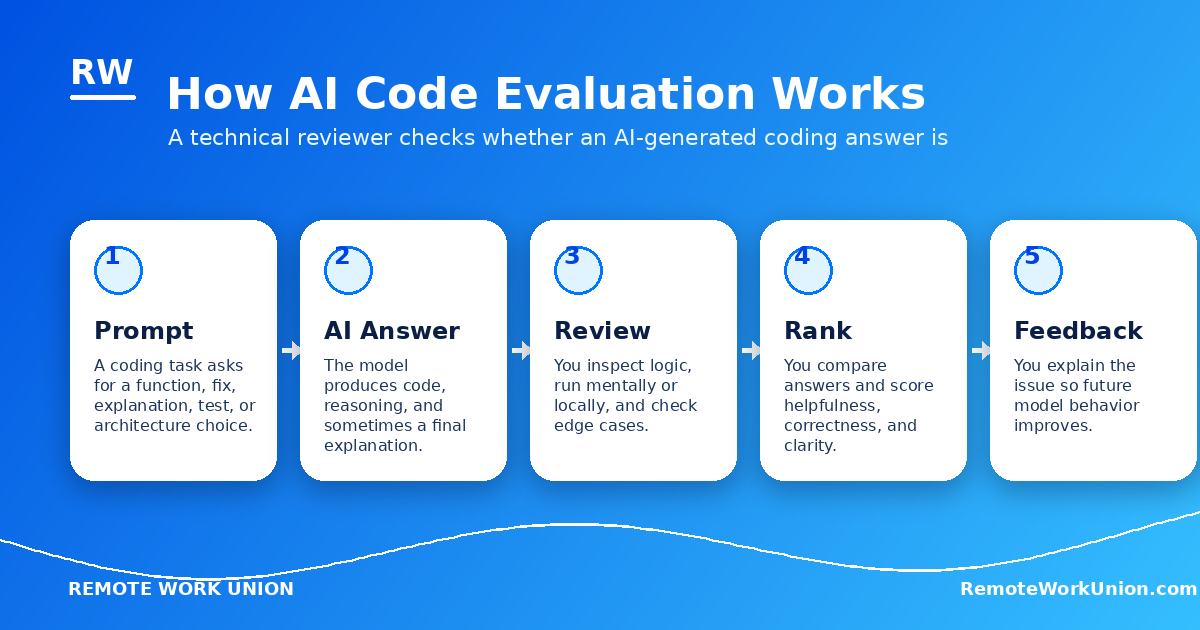
Most AI code evaluation tasks are structured. You receive a prompt, a model response, a rubric, and scoring instructions. Your job is to apply the rubric consistently and write feedback that helps the model improve.
One task might ask: "Write a Python function that removes duplicates from a list while preserving order." Your job is to check whether the answer handles empty lists, unhashable values, large inputs, or type assumptions. Another task might involve a SQL query — you verify whether the joins, filters, and grouping logic match the requested output. Common task types include: ranking two AI-generated coding answers, rating one response for correctness and helpfulness, rewriting a weak answer, identifying bugs or hallucinated APIs, and flagging unsafe or misleading code.
Remote Work Union connects technical professionals to legitimate remote AI evaluation roles. Apply for free and find roles hiring now.
Find Roles Hiring Now →How Technical Reviewers Judge AI-Generated Code
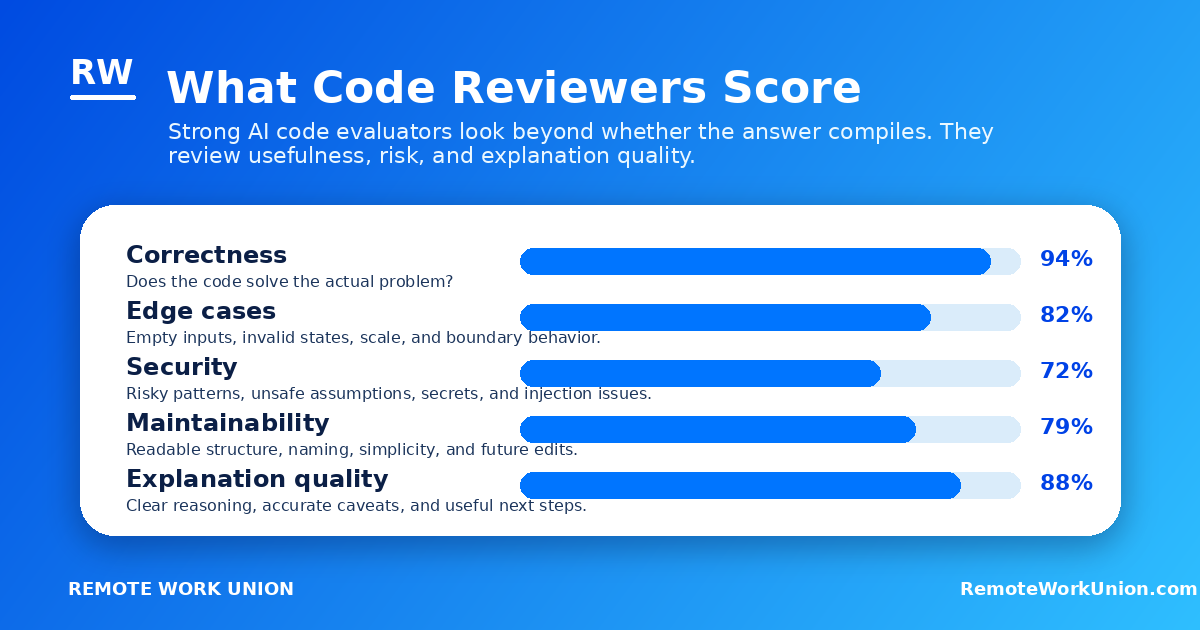
Strong reviewers do not stop at surface-level style. AI-generated code can look polished while still being wrong. A code evaluator has to inspect the actual logic, the user request, the assumptions, and the likely runtime behavior.
Correctness is the first test. Does the response solve the exact problem? Does it use the right inputs and outputs? Robustness is the second layer — does the answer handle edge cases, scale reasonably, and fail safely? Usefulness is the third — a technically correct answer may still be poor if it is confusing, overcomplicated, or undocumented.
Why Clear Writing Matters as Much as Coding Skill
AI code evaluation jobs are not only about knowing the right answer. They also require explaining your judgment. A reviewer who can identify a bug but cannot explain it clearly may struggle with model evaluation work. Good feedback does not need to sound academic — it should be direct and grounded in the prompt.
How to Prepare Your Resume or Profile
Your profile should make your technical judgment easy to see. Many applicants undersell themselves by listing generic job titles without showing the skills that matter for AI model evaluation. A better profile highlights languages, frameworks, debugging experience, testing experience, technical writing, code review, data analysis, and any history of explaining technical concepts.
Resume and profile keywords to consider: AI code evaluation, AI model evaluation, technical reviewer, code reviewer, Python, JavaScript, TypeScript, SQL, APIs, Git, unit tests, debugging, QA, code quality, edge cases, documentation, prompt writing, response ranking, RLHF, data annotation, technical writing, and developer education.
How to Approach Coding Assessments
Many AI training platforms use assessments before assigning work. Instead of building a system from scratch, you may be asked to judge model responses, explain mistakes, or write an ideal answer under a rubric. The best approach is to slow down and read the instructions carefully.
When reviewing code, look for obvious runtime errors first: missing imports, wrong variable names, syntax issues, incompatible types, off-by-one errors, bad assumptions, and hallucinated library behavior. Then check deeper issues: edge cases, security, scalability, incomplete instruction following, and misleading explanations. When writing explanations, be specific: what is wrong, why it matters, and what would fix it.
Assessment tip: Do not invent requirements that the prompt did not ask for. Be consistent with the rubric even when you personally prefer another style. One or two decisive issues beat listing every minor imperfection.
Frequently Asked Questions
Do you need to be a senior engineer for AI code evaluation jobs?
Not always. Some coding evaluation tasks are accessible to people with strong beginner or intermediate programming knowledge. Others require professional software engineering experience. The key is to position yourself honestly in the areas where you can reliably catch errors.
What programming languages are most common in AI code evaluation work?
Python is very common because it is heavily used for automation, data analysis, and machine learning. JavaScript and TypeScript appear often for web development. SQL is important for data analysis tasks. You may also see Java, C++, Go, Rust, and framework-specific tasks depending on the project.
Is AI code evaluation the same as a software engineering job?
No. AI code evaluation is usually contract, freelance, or part-time remote work where you evaluate model outputs rather than owning a production codebase. Instead of sprint planning and deployments, you review model-generated code, compare responses, write feedback, and identify errors.
Why does clear writing matter for a technical reviewer?
AI evaluation jobs are not only about knowing the right answer — they also require explaining your judgment. A reviewer who can identify a bug but cannot explain it clearly may struggle. Platforms use the written feedback to improve model training, so specificity and clarity in explanations matters as much as technical accuracy.