Remote AI jobs for coders are a strong fit for people who enjoy programming but do not want a traditional full-time software engineering job. You may like solving technical problems, reviewing code, testing model answers, writing clear explanations, or spotting bugs faster than other people. That does not always mean you want sprint planning, standups, pager duty, product roadmaps, or a permanent engineering role.
That is where AI coding evaluation work can be useful. Modern AI systems are trained, tested, and improved with help from people who can judge whether a coding answer is correct, safe, efficient, and well explained. Some projects need professional software engineers. Others need sharp coders who can read Python, JavaScript, SQL, HTML, APIs, or command-line examples and explain what works or what fails.
This guide breaks down the best remote AI jobs for coders who want flexible technical work instead of a full-time software role.
What Counts as a Remote AI Coding Job?
A remote AI coding job is any online role where your coding knowledge helps improve, evaluate, or organize AI-generated technical work. These jobs can appear under many names, including AI coding evaluator, AI model trainer, code reviewer, prompt evaluator, data annotation specialist, AI rater, technical reviewer, RLHF coding specialist, or AI response reviewer.
The common thread is that you are not always building a product from scratch. You are often reviewing output. A task may ask you to compare two AI-generated Python answers, identify which SQL query is correct, write tests for a function, rate a model response against a rubric, or explain why one answer is more useful than another.
For coders who want remote flexibility, this is the appeal: you can use technical skill without signing up for the full structure of a conventional engineering job.
Why Coders Are Useful in AI Training Work
General AI evaluation is about judgment. Coding AI evaluation adds another layer: technical correctness. A response can sound confident and still fail. A model may produce code that looks clean but ignores an edge case. It may explain an algorithm correctly but implement it incorrectly. It may write SQL that runs but returns the wrong rows. It may use outdated library behavior, skip error handling, or invent an API method that does not exist.
Human reviewers catch those problems. Coders are valuable because they can judge both the code and the reasoning around the code. They can tell when an answer is merely fluent versus when it is actually correct. They can also translate technical problems into clear feedback, which is one of the most important skills in AI training jobs.
Best Remote AI Jobs for Coders
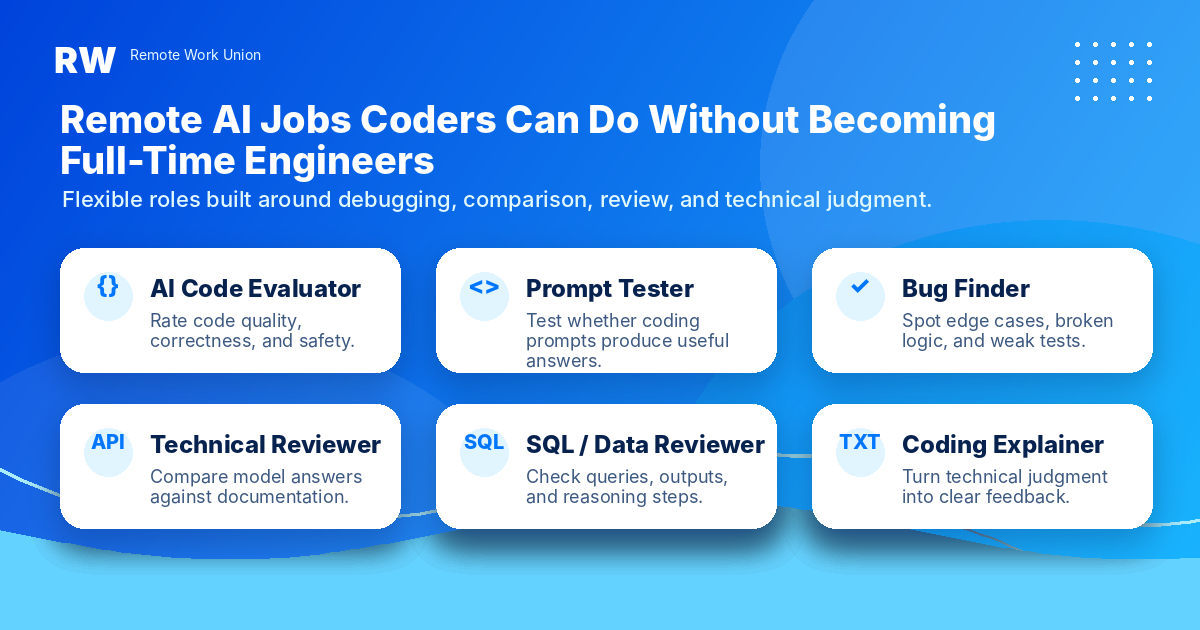
1. AI Code Evaluator
AI code evaluator jobs are among the most direct fits for coders who want flexible remote work. In this role, you review code written by an AI model and judge whether it solves the prompt. You may check for correctness, completeness, runtime errors, missing edge cases, security concerns, or confusing explanations. A typical task might show two model responses to the same coding prompt. Your job is to decide which response is better and explain why. Useful keywords: AI code evaluator jobs, LLM code evaluation jobs, coding AI rater, remote code evaluation, AI coding reviewer.
2. AI Coding Prompt Tester
AI coding prompt testers focus on the instructions given to AI models. The job is to create, test, or evaluate prompts that ask an AI system to solve programming tasks. You may write a prompt, inspect the model's answer, and decide whether the result meets the requirements. You might test prompts involving Python functions, JavaScript UI snippets, SQL joins, regex, API calls, shell commands, or data cleaning. The work rewards clarity more than speed. Useful keywords: prompt evaluation jobs, AI prompt tester, coding prompt evaluator, AI training jobs for coders.
3. Code Review and Bug Finding Tasks
Some AI training projects need people who can identify bugs in generated code. You may not be merging pull requests or maintaining a production codebase. Instead, you are checking whether a response contains logical errors. Good reviewers look beyond obvious syntax issues: does the function handle empty input? Does the SQL query filter before or after grouping? Does the JavaScript example handle async behavior correctly? This is one of the best remote AI jobs for coders who like debugging more than building. Useful keywords: remote code review jobs, bug finding AI jobs, AI debugging evaluator, technical QA for AI.
4. Technical Answer Ranking
In technical answer ranking, you compare multiple AI-generated answers and decide which one is best. This role is different from standard programming because the main output is a decision. You are ranking answers based on a rubric. One answer may be concise but skip an edge case. Another may include a working solution but overcomplicate the explanation. A third may provide correct code but use a library the prompt did not allow. Your job is to make a grounded call. Useful keywords: AI response reviewer jobs, AI answer ranking jobs, model evaluation jobs, RLHF coding jobs.
5. SQL and Data Analysis Review
Many coding AI tasks involve data. SQL reviewers check whether queries produce the right output. Data analysis reviewers may inspect Python, pandas, spreadsheets, charts, or statistical reasoning. This can be a good path if you are not a full-stack engineer but you are comfortable with structured data. SQL is especially useful because AI models often make small mistakes in joins, filters, aggregations, date handling, or grouping logic. These tasks can also fit business analysts, finance analysts, and data analysts. Useful keywords: SQL AI training jobs, data analysis AI evaluator, remote SQL reviewer, Python data reviewer.
6. Documentation and API Reviewer
AI systems often answer questions about APIs, software libraries, SDKs, command-line tools, and frameworks. A documentation reviewer checks whether the AI answer matches the source material and whether the instructions are usable. You may compare an AI answer against official documentation, identify invented functions, check parameter names, or rewrite unclear technical explanations. You do not have to be the person who builds the whole integration. You need to know when an answer would send a developer in the wrong direction. Useful keywords: API documentation reviewer, AI technical evaluator, developer documentation AI jobs.
7. Coding Tutor-Style AI Reviewer
Some AI coding work is closer to tutoring than engineering. You may evaluate whether an AI explains recursion clearly, whether it teaches a beginner the right concept, or whether it gives a helpful debugging path. This is a strong fit if you like explaining code. It can be especially useful for people with teaching, tutoring, bootcamp, or mentoring experience. The best reviewers are not just correct — they are clear. Useful keywords: coding tutor AI evaluator, technical writing AI jobs, programming explanation reviewer.
8. Test Case Writer for AI-Generated Code
AI coding projects often need better tests. A test case writer creates examples that reveal whether code is correct. This may include normal cases, edge cases, invalid inputs, performance concerns, or hidden assumptions. This role is ideal for coders who think in edge cases. You may write a few compact tests rather than a whole software project. Good test writers are valuable because many AI answers look right until they are tested. Useful keywords: AI test case writer, code testing evaluator, software QA AI training.
Best Languages for Remote AI Coding Jobs
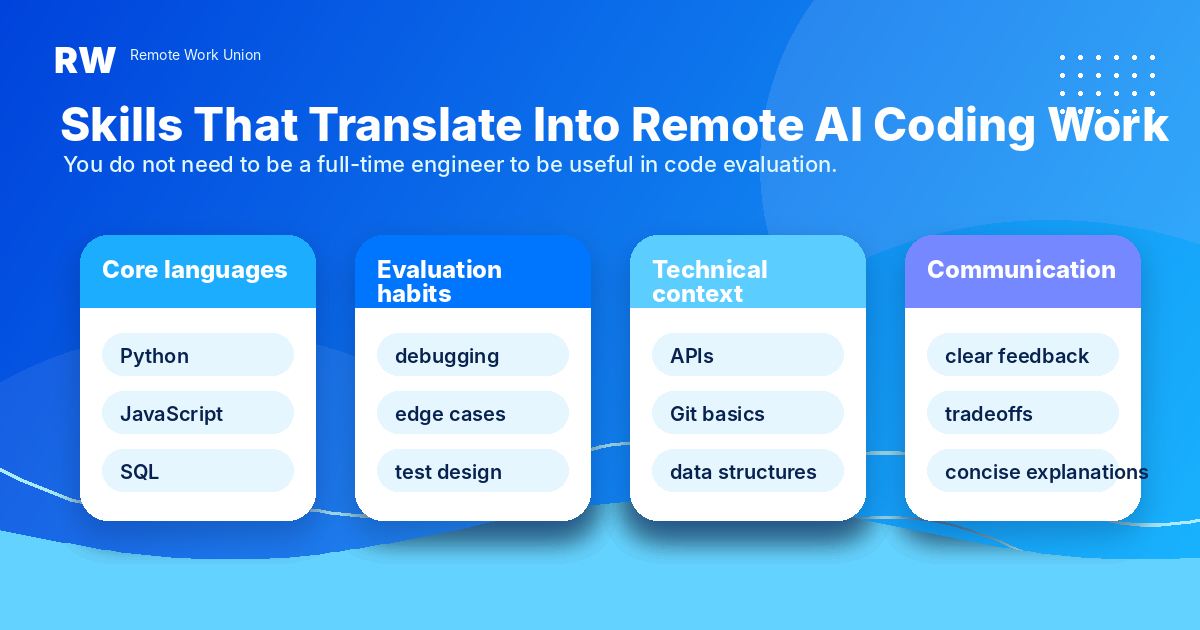
The most useful languages depend on the project, but several skills appear repeatedly in remote AI training and coding evaluation work. Python is useful because many AI coding prompts involve automation, data analysis, scripting, algorithms, and backend logic. JavaScript is useful for web development prompts, frontend examples, Node.js, asynchronous behavior, and common app logic. SQL is useful for data tasks, business analysis, database questions, and query evaluation. HTML and CSS can help with web prompts, UI snippets, and accessibility-related tasks. Bash and command-line basics can help when tasks involve setup, scripts, or developer workflows.
You do not need to know every language. It is better to be honest and specific. A profile that says "Python, SQL, debugging, API documentation, and test cases" is more believable than a profile that claims every programming language.
Remote Work Union connects you to legitimate remote AI coding evaluation and training roles. Apply for free.
Find Roles Hiring Now →How These Jobs Differ From Full-Time Software Engineering
Traditional software engineering jobs usually involve long-term product ownership. You may work on a team, attend recurring meetings, maintain code over time, handle production issues, and ship features on a roadmap. Remote AI coding jobs can be more task-based. Instead of owning a codebase, you may complete evaluations, comparisons, annotations, or reviews. The output may be a rating, a written explanation, a corrected answer, or a set of test cases.
If you dislike corporate software workflows but still enjoy technical problem solving, AI evaluation can be a better match. You can use the same instincts — correctness, debugging, logic, clarity — in a more flexible format.
What Companies and Platforms Are Relevant?
Job seekers often search around major AI names such as OpenAI, Anthropic, Claude, Google Gemini, Microsoft Copilot, Meta AI, Amazon, and other companies building AI tools. Those are useful keywords because they reflect the ecosystem. However, many remote AI training projects are posted through talent platforms, AI data companies, contractor marketplaces, staffing companies, and specialized evaluation platforms rather than directly through a major AI lab.
Search broadly. Try phrases like "remote AI coding evaluator," "LLM code reviewer," "AI trainer Python," "AI model evaluation coding," "RLHF coding," "technical AI reviewer," "prompt evaluator coding," and "AI data annotation coding." Also search job boards, LinkedIn, contractor platforms, and remote work communities.
How to Make Your Profile Stronger
Your application should make it easy for a platform or hiring team to understand what you can evaluate. Do not only say "I code." Say what kind of coding judgment you can provide.
A stronger profile might include:
- Languages you can review confidently, such as Python, JavaScript, SQL, HTML, CSS, or Bash.
- Task types you handle well, such as debugging, test case design, API documentation review, data analysis, or algorithm explanations.
- Evidence of technical communication, such as tutorials, GitHub notes, code review examples, documentation samples, or concise explanations.
- Experience comparing options, following rubrics, labeling mistakes, or writing structured feedback.
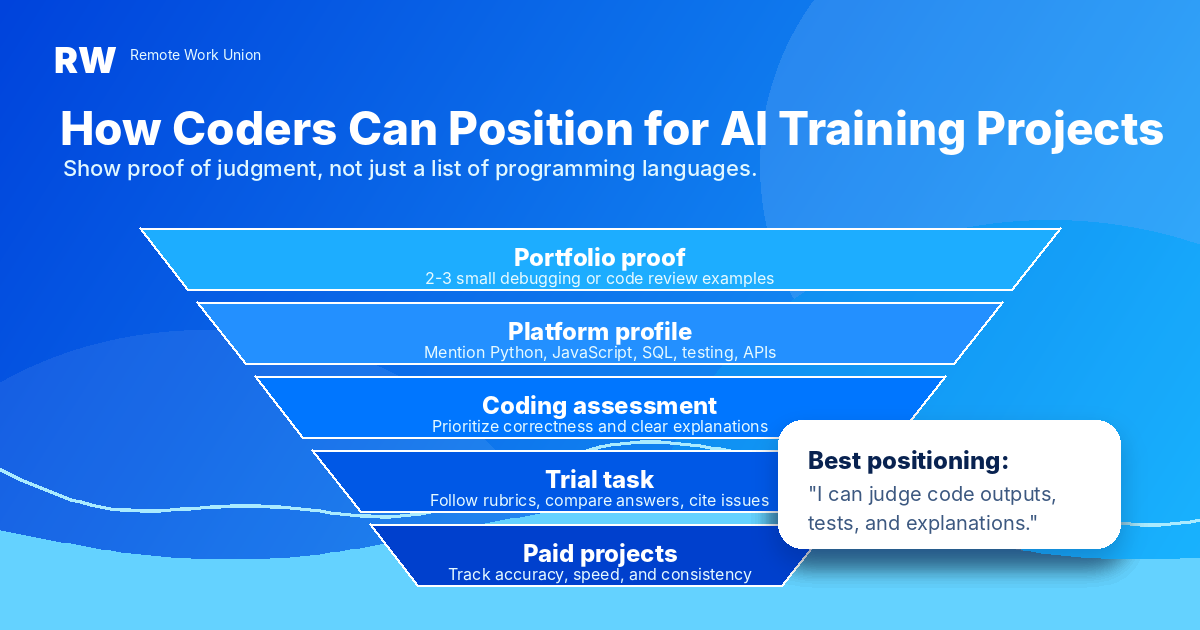
A simple portfolio can help. You do not need a massive app. Three small examples are enough: a bug you found and fixed, a SQL query you reviewed, and a prompt-response comparison where you explain which answer is better.
How to Avoid Applying to the Wrong Coding Jobs
Many coders looking for flexible remote work accidentally apply to roles that are really full-time engineering jobs in disguise. Watch for phrases like "own the architecture," "join daily standups," "on-call rotation," "ship features weekly," or "long-term product team." Those may be good jobs, but they are not the same as task-based AI evaluation work.
If your goal is flexibility, look for terms like contract, project-based, part-time, evaluator, reviewer, rater, annotator, AI trainer, assessment, rubric, comparison, feedback, or remote task work. Also be careful with unrealistic promises. Real AI coding evaluation work usually involves assessments, quality standards, and careful review.
A Practical Application Strategy
Start with one clear lane. If your strongest skill is Python, build your search around Python AI evaluator, AI coding reviewer, and LLM Python evaluation. If your strongest skill is SQL, search for SQL AI training, data analysis AI evaluator, and remote SQL reviewer. If your strongest skill is explaining code, search for coding tutor AI reviewer and technical writing AI jobs.
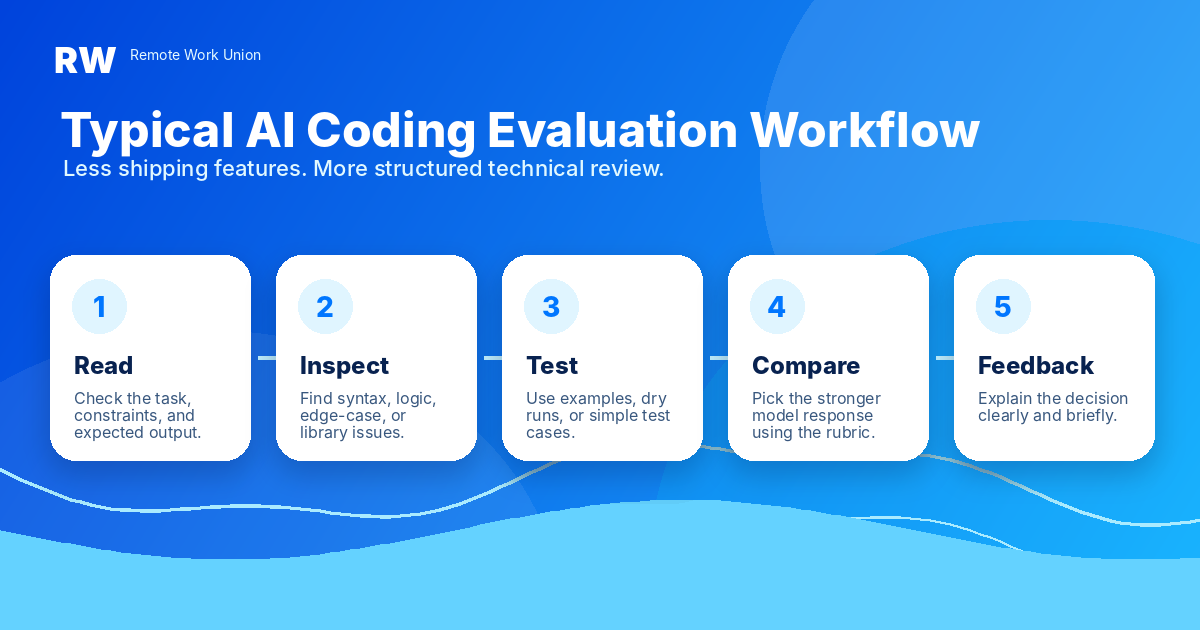
Then prepare a short profile that highlights technical judgment. Mention that you can compare AI-generated code, find bugs, design tests, and explain why one answer is better than another. Use examples, not vague claims. When you take an assessment, slow down. AI coding assessments often reward careful reasoning more than raw speed. Read the rubric, check the prompt, look for hidden constraints, test edge cases, and explain your decision clearly.
Who These Jobs Are Best For
Remote AI coding jobs are best for coders who enjoy technical review, debugging, and explanation. They are especially good for people who want coding-adjacent work without a full-time software engineering commitment. They can fit self-taught coders, bootcamp graduates, computer science students, data analysts, QA testers, technical writers, former engineers, part-time freelancers, and people who know enough programming to judge model output.
Frequently Asked Questions
Do I need a computer science degree for remote AI coding jobs?
Not always. Some projects prefer degrees or professional experience, especially for advanced coding tasks. Others care more about whether you can pass the assessment and produce accurate reviews. A degree can help, but demonstrated coding judgment can also matter.
Can beginners get remote AI coding jobs?
Complete beginners may struggle with coding evaluation because the work requires you to catch mistakes. However, beginner-to-intermediate coders can start with simpler tasks if they are honest about their skill level. SQL, Python basics, HTML/CSS, and debugging small functions are useful entry points.
Is remote AI coding evaluation the same as data entry?
No. AI coding evaluation is more technical than data entry. You may be labeling, rating, or annotating, but the value comes from judging code, outputs, prompts, tests, and explanations.
Is this the same as prompt engineering?
Sometimes it overlaps. Prompt engineering usually focuses on writing better instructions for AI systems. AI coding evaluation focuses more on judging whether the result is correct. Many projects include both.
Can remote AI coding work become a full-time career?
It can lead to broader AI training, technical writing, QA, data analysis, or software roles. But it is also useful as flexible work for coders who specifically do not want a permanent software engineering job.