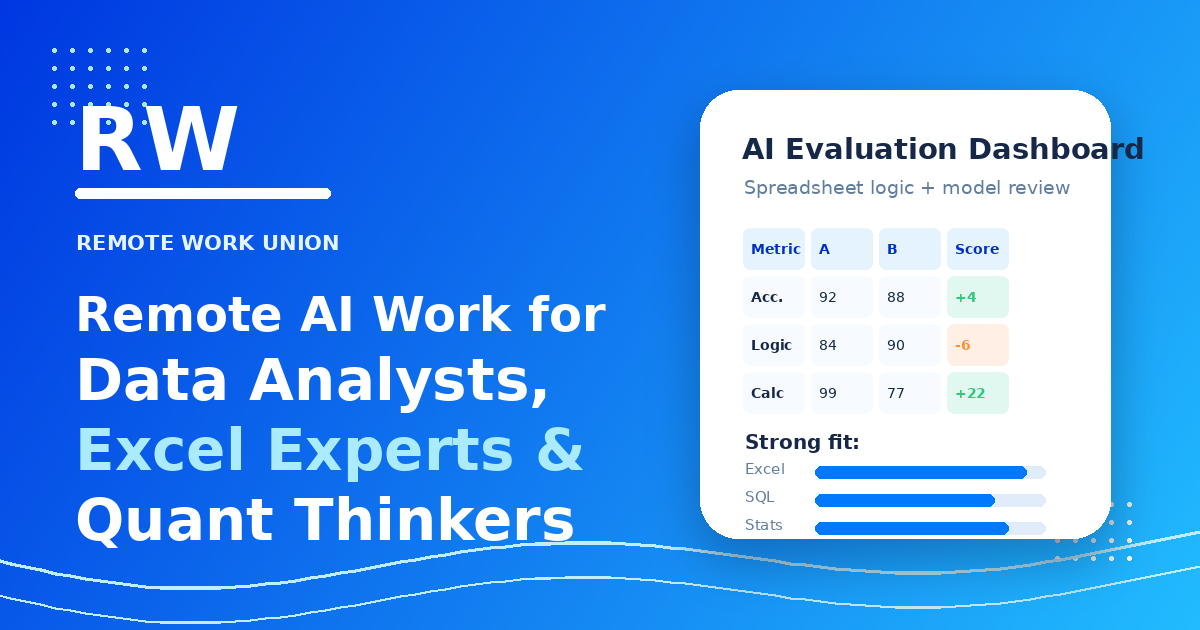
Remote AI work is not only for software engineers. Data analysts, Excel experts, spreadsheet power users, operations analysts, finance analysts, business analysts, and quantitative thinkers can be strong candidates for AI training and AI model evaluation work because many AI systems need human reviewers who can judge numbers, logic, calculations, structured data, and business reasoning.
A model can write a polished answer and still be wrong. It may use the wrong formula, misread a table, make a math error, ignore an assumption, overstate a trend, or produce an answer that sounds confident but fails a basic spreadsheet check. That is where data-minded reviewers can add value.
Why Data Analysts Fit Remote AI Evaluation Work
AI models are increasingly used for spreadsheet help, business analysis, financial reasoning, data interpretation, market research, operations planning, and reporting. Companies need human reviewers who can evaluate whether those answers are actually useful. A general writer may be able to judge grammar and tone, but a data analyst can notice when the model used the wrong denominator, confused revenue with profit, double-counted a category, or made a chart recommendation that does not match the data.
A strong evaluator is not just asking whether the answer sounds good. They are asking whether the answer is grounded, whether the steps are correct, whether the final recommendation follows from the data, and whether the response would help a real user make a better decision.
What These Jobs Are Usually Called
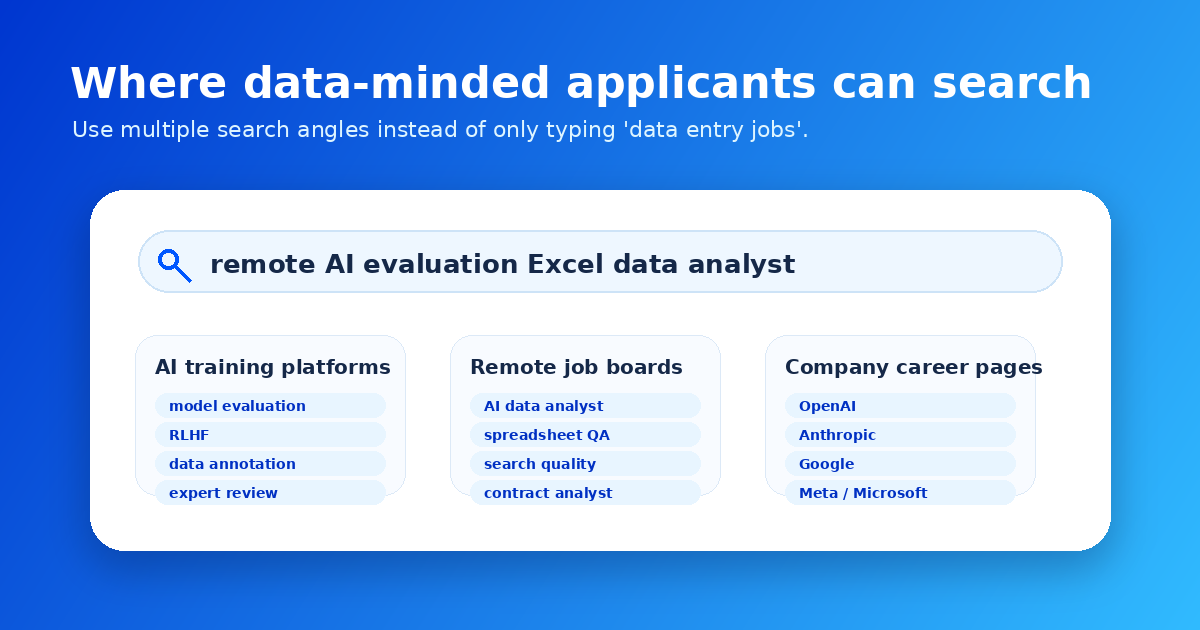
The title on the listing may not say "data analyst." Many remote AI jobs use broader language. Look for terms like AI evaluator, AI trainer, AI data trainer, model evaluator, AI response reviewer, AI rater, AI data annotation specialist, search quality rater, RLHF evaluator, AI writing evaluator, AI fact-checker, data quality analyst, spreadsheet reviewer, expert reviewer, or domain expert.
Do not search only for "remote data analyst." Also search for phrases like "AI training data analyst," "AI model evaluation spreadsheet," "AI evaluator statistics," "RLHF math reviewer," "AI data quality contractor," "remote spreadsheet QA," "AI finance evaluator," and "model response analyst." The more search angles you use, the more likely you are to find roles before they are saturated.
The Core Tasks: Review, Compare, Rate, and Explain
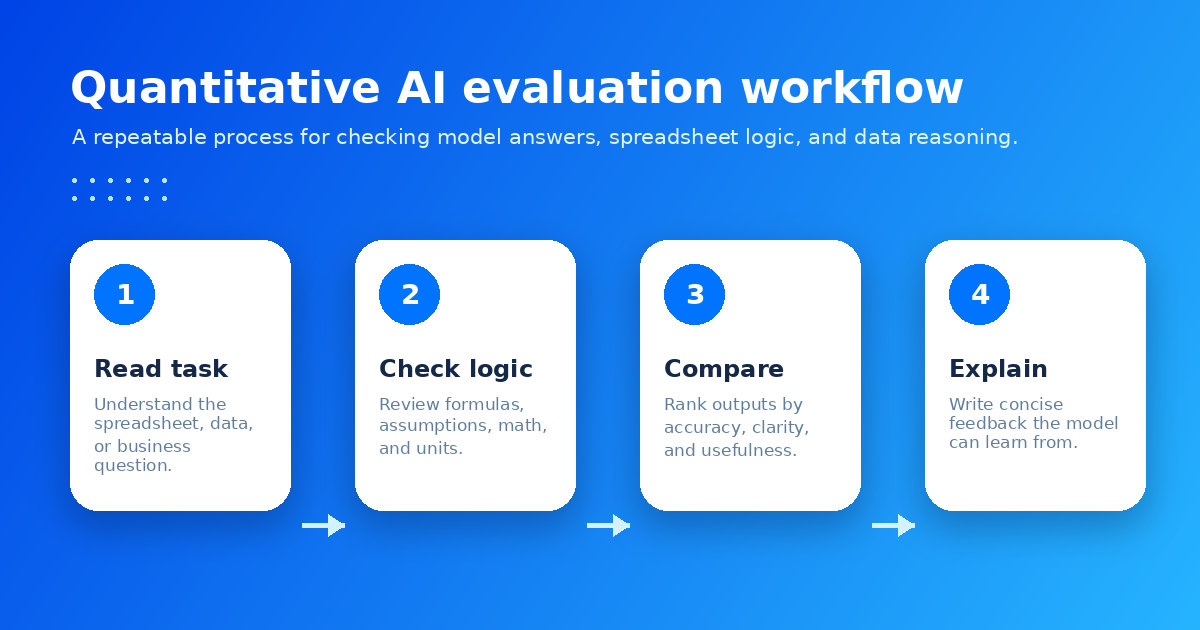
Most AI evaluation work can be reduced to four activities. First, you read the task and understand what the user asked the model to do. Second, you inspect the answer for accuracy, reasoning, completeness, and usefulness. Third, you compare one answer against another or rate one answer against a rubric. Fourth, you write a short explanation of your decision.
For data analysts, the review step is where the skill shows. You may need to check whether the model calculated a percentage correctly, used a reasonable assumption, selected the right formula, described a chart accurately, or gave spreadsheet instructions that would actually work. The explanation step matters just as much — a useful reviewer can write: "Response B is better because it identifies the correct growth rate formula, keeps the units consistent, and explains the assumption behind the forecast."
Remote Work Union connects data and analytics professionals to legitimate remote AI evaluation roles. Apply for free and find roles hiring now.
Find Roles Hiring Now →Where Excel Experts Have an Advantage
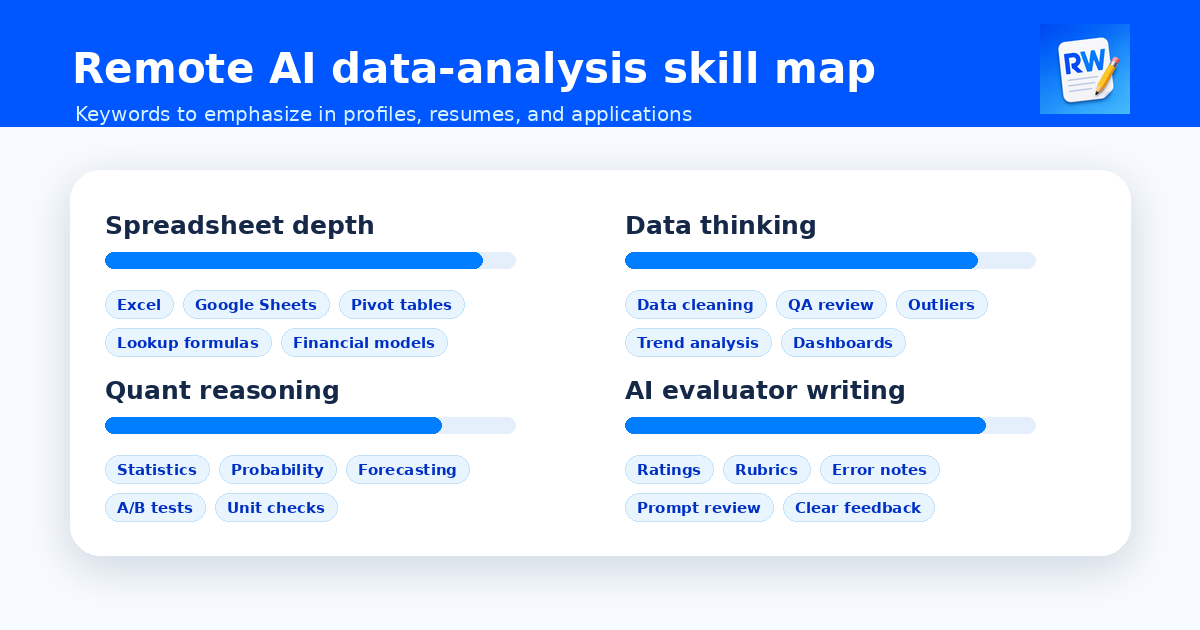
Excel expertise is underrated in AI work. Many people can type prompts into ChatGPT, Claude, Gemini, or Grok, but fewer can verify spreadsheet logic. If you know lookup formulas, pivot tables, filters, conditional formatting, data validation, charts, basic financial models, or nested formulas, you can evaluate a category of AI answers that general applicants may struggle with.
Excel experts can review whether a formula is syntactically plausible, whether a spreadsheet workflow is efficient, and whether an answer explains steps in a way a nontechnical user could follow. Google Sheets experience also helps — mention skills such as VLOOKUP, XLOOKUP, INDEX MATCH, SUMIFS, COUNTIFS, pivot tables, charts, dashboard creation, and spreadsheet QA.
Where Quantitative Thinkers Have an Advantage
Quantitative thinkers do not need to have a perfect resume title. A person who has built reports, checked numbers, compared trends, analyzed survey data, worked with budgets, managed inventory, tracked sales performance, evaluated campaign data, or created forecasts may have relevant skills.
AI models often produce answers that are directionally useful but numerically fragile. They may round too aggressively, confuse averages and medians, imply causation from correlation, make a projection from a tiny sample, or ignore base rates. A quantitative reviewer can flag these issues in finance, marketing, healthcare, logistics, education, product analytics, operations, and research contexts.
How to Position Your Resume or Profile
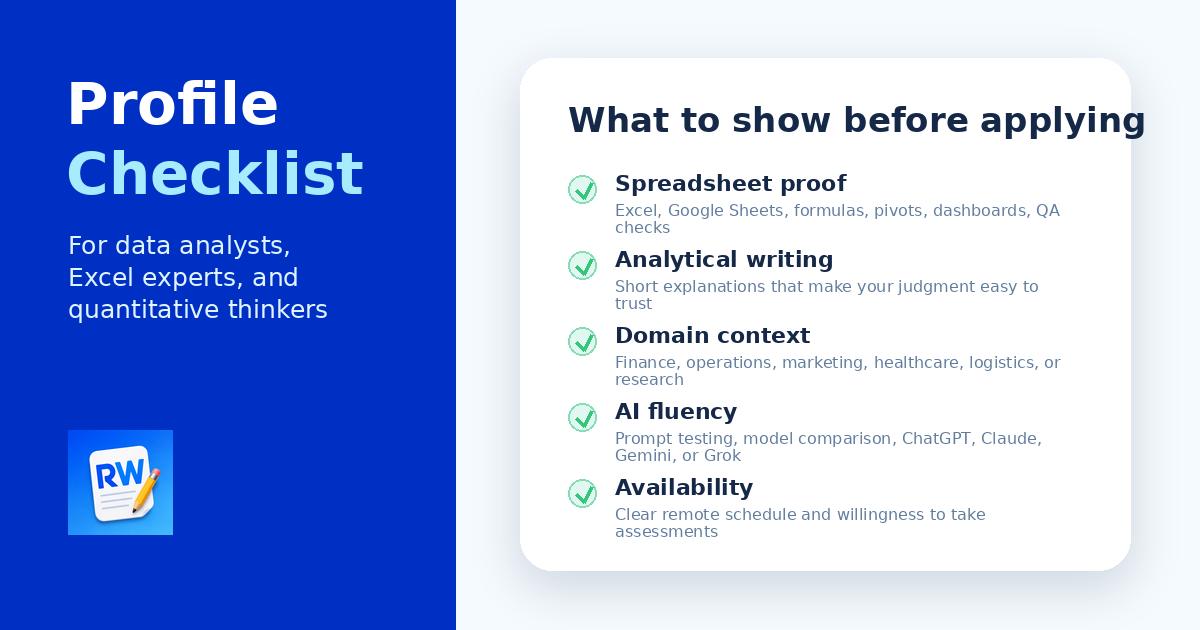
Your resume or AI platform profile should make your analytical skills easy to see quickly. Include a skills section that names tools and tasks directly: Excel, Google Sheets, SQL, dashboards, data cleaning, data validation, reporting, financial modeling, statistics, forecasting, quality assurance, A/B testing, data visualization, Tableau, Power BI, or Python if relevant.
For AI training work specifically, add language that connects your background to model review: "evaluated AI-generated answers for accuracy," "reviewed spreadsheet logic," "identified calculation errors," "wrote concise feedback," "compared outputs against rubrics," "fact-checked business and finance claims," and "translated complex analytical findings into plain English."
Portfolio Examples That Can Help
A portfolio is not always required, but it can help if you do not have a traditional analyst title. Create simple, non-confidential examples that show your skill — a one-page spreadsheet dashboard, a short data cleaning walkthrough, a financial model explanation, or a mock AI response review can all demonstrate that you know how to think analytically.
For AI evaluation roles, a useful sample is a short comparison between two AI answers to a spreadsheet question. Prompt two models to explain a formula, then write a short note explaining which answer is better and why, focusing on accuracy, clarity, assumptions, and usefulness. This mirrors the kind of work many AI training platforms need.
How to Pass Assessments for Analytical AI Work
Assessments for AI evaluation roles often test patience more than brilliance. Many applicants rush. A data-minded applicant should slow down and treat the assessment like a quality check. Read the rubric, identify the actual user request, compare the answers against that request, and explain your choice using specific evidence.
When a question involves numbers, do not trust the model's final answer. Recalculate the important parts. Check units. Look for hidden assumptions. The best assessment explanations are usually specific and restrained — avoid vague comments like "B is more detailed" unless detail is the reason it is better.
Common mistakes to avoid: Applying only to roles with "data analyst" in the title. Presenting yourself as only a spreadsheet user instead of an analytical reviewer. Writing too much feedback — AI evaluation work rewards concise, useful explanations.
Frequently Asked Questions
Do data analysts need coding skills for AI model evaluation work?
Not always. Many AI evaluation roles reward analytical judgment, spreadsheet skills, and clear written feedback rather than programming ability. SQL and Python can help for technical tasks, but Excel-heavy analysts without coding backgrounds can qualify for many data-focused AI review projects.
What makes Excel expertise valuable in AI evaluation work?
Excel expertise is underrated in AI work. Fewer applicants can verify spreadsheet logic, check formula correctness, or trace financial model assumptions. If you know XLOOKUP, pivot tables, SUMIFS, financial models, or dashboard creation, you can evaluate a category of AI answers that general applicants may struggle with.
How should a data analyst search for remote AI training jobs?
Do not search only for "remote data analyst." Also try phrases like AI training data analyst, AI model evaluation spreadsheet, RLHF math reviewer, AI data quality contractor, remote spreadsheet QA, AI finance evaluator, and model response analyst. Combine analytical keywords with AI evaluation terms.
What does a good assessment answer look like for analytical AI tasks?
Strong assessment feedback is specific and restrained. Instead of "B is more detailed," write something like: "B is better because it uses the correct formula for percentage change and explains the result in plain language. A gives a confident answer but reverses the starting and ending values, so the final percentage is wrong."