Teachers, professors, tutors, curriculum writers, test prep specialists, and academic editors are often a stronger fit for AI model evaluation than they realize. A large part of AI training work is not coding. It is judgment: deciding whether an answer is correct, clear, complete, safe, age-appropriate, and useful for the person who asked the question.
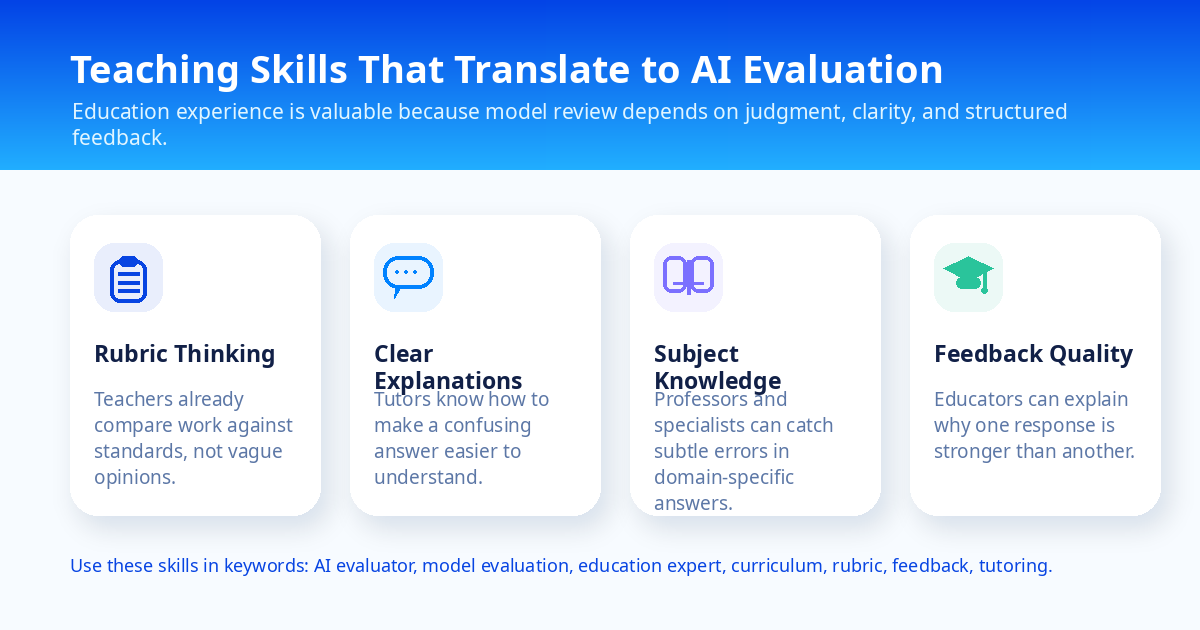
That is close to what educators already do. A teacher grades answers against a rubric. A professor checks whether an argument is accurate and supported. A tutor spots the exact step where a student gets confused. These same skills can translate into remote AI model evaluation jobs, AI training projects, and subject matter expert review work.
Why Education Experience Fits AI Model Evaluation
AI model evaluation work is about improving the quality of model outputs. A reviewer may compare two AI responses, rate one response against a rubric, check whether an answer is factually accurate, or write a short explanation of why one answer is better. Education professionals already practice these skills in a structured way.
The strongest education backgrounds for this work are not limited to classroom teaching. They can include tutoring, grading, academic advising, curriculum design, test prep, language instruction, instructional design, educational publishing, online course creation, academic research, and subject-specific teaching in math, science, humanities, business, law, healthcare, coding, writing, or foreign language learning.
What AI Model Evaluation Jobs Usually Involve
AI model evaluation jobs can be described in different ways depending on the platform. You may see titles such as AI evaluator, AI trainer, AI data annotator, model response evaluator, LLM evaluator, AI content reviewer, educational AI reviewer, prompt response rater, search quality evaluator, subject matter expert, academic evaluator, writing evaluator, or RLHF reviewer.
Common tasks include: reading a prompt and deciding what the user is really asking; comparing two AI-generated answers and choosing the stronger one; rating an answer for accuracy, helpfulness, completeness, tone, and safety; checking whether an explanation is appropriate for a certain grade level; writing a short explanation of why an answer should be improved; and flagging hallucinations, unsupported claims, confusing steps, or misleading explanations.
Remote Work Union connects educators to legitimate remote AI evaluation roles. Apply for free and find roles hiring now.
Find Roles Hiring Now →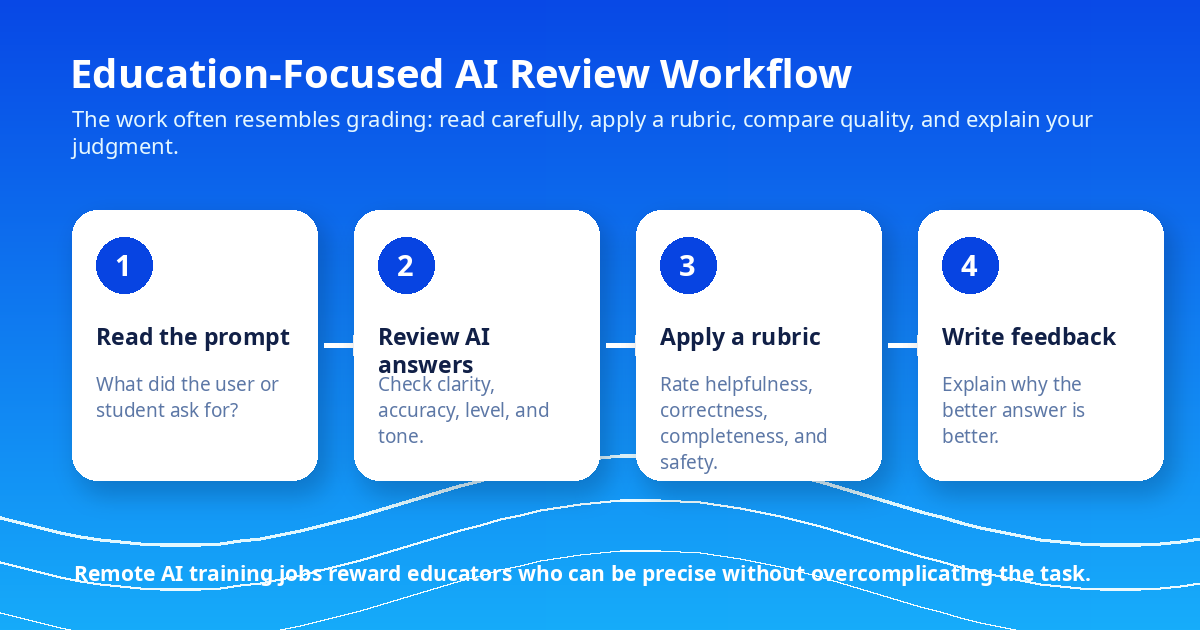
The Best AI Evaluation Angles for Teachers
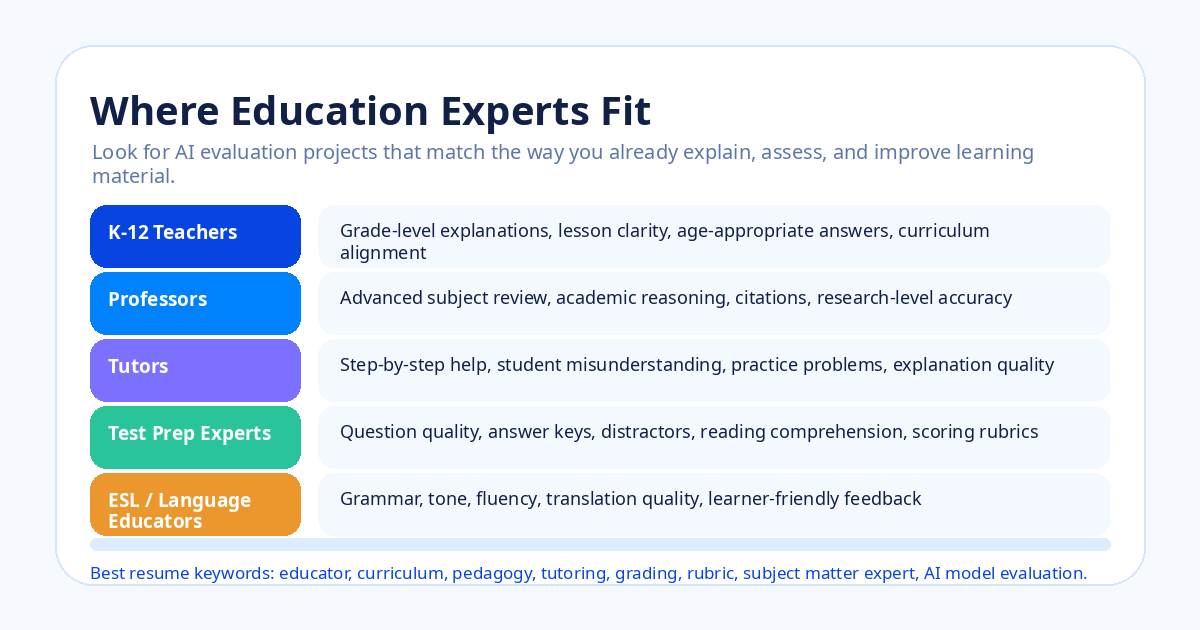
K-12 teachers should look for AI training jobs that involve grade-level explanations, classroom material, lesson clarity, reading comprehension, writing feedback, math steps, science explanations, social studies content, grammar support, or student-safe chatbot responses.
Lesson clarity and instruction quality is a core skill — a teacher can judge whether an answer moves in a logical sequence, defines terms before using them, or skips a step that would confuse a student. Student safety and appropriateness is another — teachers can review whether an AI answer gives advice that is too advanced, too casual, too risky, or unsuitable for a younger audience.
The Best AI Evaluation Angles for Professors and Academics
Professors, lecturers, PhD students, graduate assistants, academic researchers, and subject matter experts can fit higher-level AI evaluation projects. These roles often require deep knowledge rather than general writing ability. Academic reviewers may evaluate advanced explanations, research summaries, citations, mathematical reasoning, scientific claims, economics answers, legal reasoning, or technical writing.
The value is not just knowing facts. It is knowing what a good answer looks like in the field — catching subtle errors in an answer that sounds plausible to a non-specialist, judging whether claims are supported or overstated, recognizing when an AI answer invents sources, or misrepresents evidence.
The Best AI Evaluation Angles for Tutors and Test Prep Specialists
Tutors are a natural fit for AI model evaluation because they focus on the learner's point of confusion. A tutoring background can be more relevant than a formal teaching credential if the project involves step-by-step explanations, practice problems, answer correction, or learner feedback.
Test prep specialists have a useful edge — they know how questions are structured, how answer choices distract, how explanations should justify the correct answer, and how scoring rubrics work. This can translate into AI tasks involving exam questions, reading comprehension, math reasoning, grammar correction, LSAT-style logic, SAT-style explanations, GMAT-style quantitative reasoning, or professional certification study material.
How to Translate Education Experience Into AI Evaluator Language
Many educators understate their fit because they describe themselves only as teachers. For AI evaluation applications, you need to translate your experience into the language of review, judgment, quality control, and written feedback.
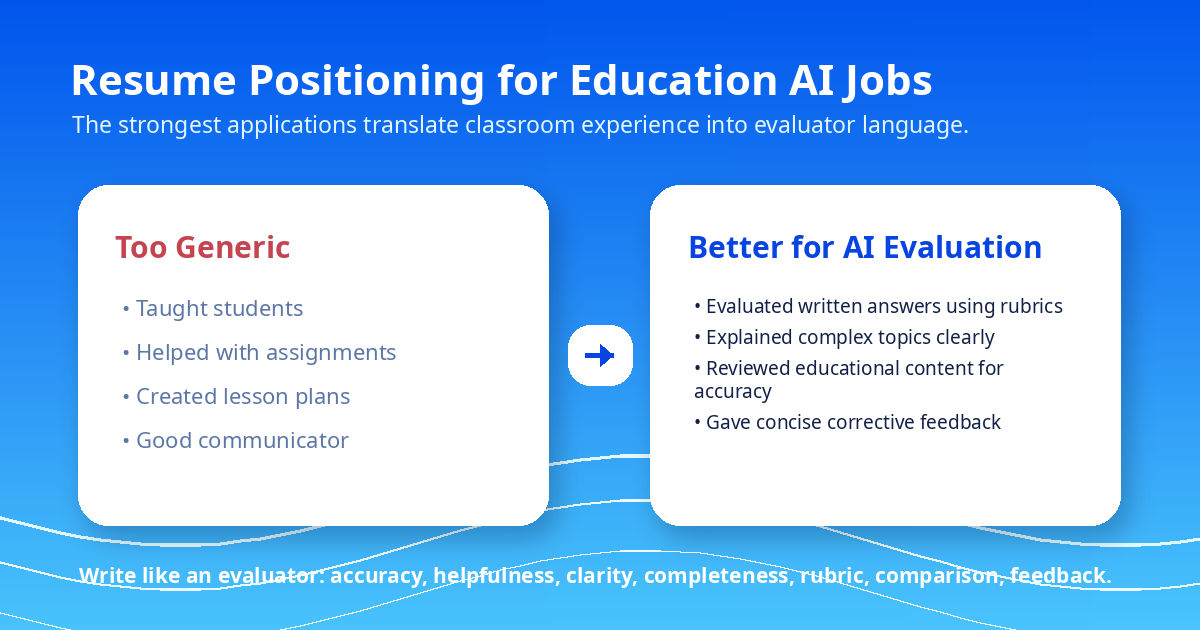
Instead of "tutored algebra students," write: "Reviewed step-by-step quantitative reasoning, identified incorrect solution paths, explained math concepts at beginner and intermediate levels, and corrected confusing or incomplete answers." The goal is to make the connection obvious: your background plus your ability to review AI outputs.
Resume Keywords Educators Should Use
Strong keywords for education AI applicants include: AI model evaluation, AI training, LLM evaluation, prompt response review, rubric-based evaluation, written feedback, educational content review, curriculum development, lesson planning, instructional design, subject matter expert, academic research, grading and assessment, student feedback, fact-checking, content accuracy, clear explanations, writing evaluation, math reasoning, test prep, ESL instruction, and remote contract work.
A good education-to-AI resume bullet should show that you can judge quality, not just deliver information. The more specific your subject area is, the more important it is to include it. A biology professor, Spanish tutor, AP English teacher, accounting instructor, coding bootcamp mentor, or statistics tutor should say so clearly.
Where to Search for AI Model Evaluation Jobs
Search across both AI-focused platforms and mainstream job boards. Search terms to try include: AI model evaluation jobs for teachers, remote AI evaluator education, AI training jobs for tutors, AI content reviewer education, LLM evaluator subject matter expert, AI writing evaluator remote, educational content reviewer remote, AI data annotation education jobs, remote curriculum evaluator AI, AI trainer professor, AI fact-checking jobs remote, chatbot response evaluator remote, RLHF evaluator remote, and AI safety evaluator education.
Platforms may use different labels. The key is to search by skill category, not only by one exact title. A job that says "AI Data Annotation Specialist" may still involve judging answer quality. A job that says "Subject Matter Expert" may be a model evaluation project. Do not reject a listing just because it does not include the word "teacher."
Application tip: If you already use ChatGPT, Claude, Gemini, or other AI tools in your teaching or grading workflow, mention that carefully. The point is not that you use AI casually — it is that you understand how to judge whether an AI answer is actually useful.
Frequently Asked Questions
Can teachers qualify for remote AI model evaluation jobs?
Yes. Teachers, professors, tutors, instructional designers, and education specialists can qualify for many remote AI model evaluation jobs because the work rewards grading ability, rubric judgment, feedback writing, subject knowledge, and the ability to identify when an explanation is unclear or inappropriate.
What kinds of education backgrounds fit best for AI model evaluation?
English teachers, math tutors, science professors, ESL instructors, test prep specialists, curriculum designers, academic editors, and subject matter experts across K-12, higher education, and professional training can all find relevant AI evaluation projects.
How should educators translate their experience for AI evaluator applications?
Instead of saying "taught students," describe evaluating written work, applying rubrics, explaining complex material, correcting inaccurate answers, and improving learning outcomes. Connect grading, lesson planning, and feedback skills to the language of AI model evaluation, response review, and quality control.
Do AI model evaluation jobs require technology or coding experience?
Many model evaluation jobs are about language, reasoning, education, and quality judgment rather than technology. Some jobs may involve basic familiarity with AI tools like ChatGPT, Claude, or Gemini, but coding is not required for most education-focused evaluation roles.