Teachers, tutors, curriculum writers, instructional designers, academic coaches, and education experts already do a large amount of the thinking that modern AI projects need. They explain complicated ideas in plain language. They evaluate answers against standards. They notice when an explanation is technically correct but confusing. They know how to grade with rubrics, identify gaps in reasoning, and give useful feedback without rewriting the entire assignment from scratch.
That skill set transfers directly into remote AI work. Many AI training jobs, AI response evaluator jobs, AI model evaluation jobs, prompt evaluation jobs, and education-focused data annotation projects are built around judgment. For educators who want flexible online work, this creates a practical path.
Why Educators Are a Strong Fit for Remote AI Work
Education experience is valuable because AI systems need more than raw information. They need examples of strong explanations, safe tutoring behavior, fair scoring, reliable feedback, and clear reasoning. That is where teachers and tutors have an advantage.
A good educator understands the difference between an answer that is technically correct and an answer that actually helps a learner. AI companies care about that distinction because users do not only ask for facts — they ask for explanations, summaries, practice problems, writing feedback, coding help, math walkthroughs, and study guidance. The best AI outputs must be accurate, readable, safe, and useful.
Teachers are also used to working with instructions. A classroom rubric, grading standard, IEP accommodation, curriculum map, state standard, lesson plan, or test-prep framework all require consistency. Remote AI jobs often use similar structures: rate an answer from 1 to 5, choose the better response, flag unsupported claims, label a mistake, or explain why one response is more helpful than another.
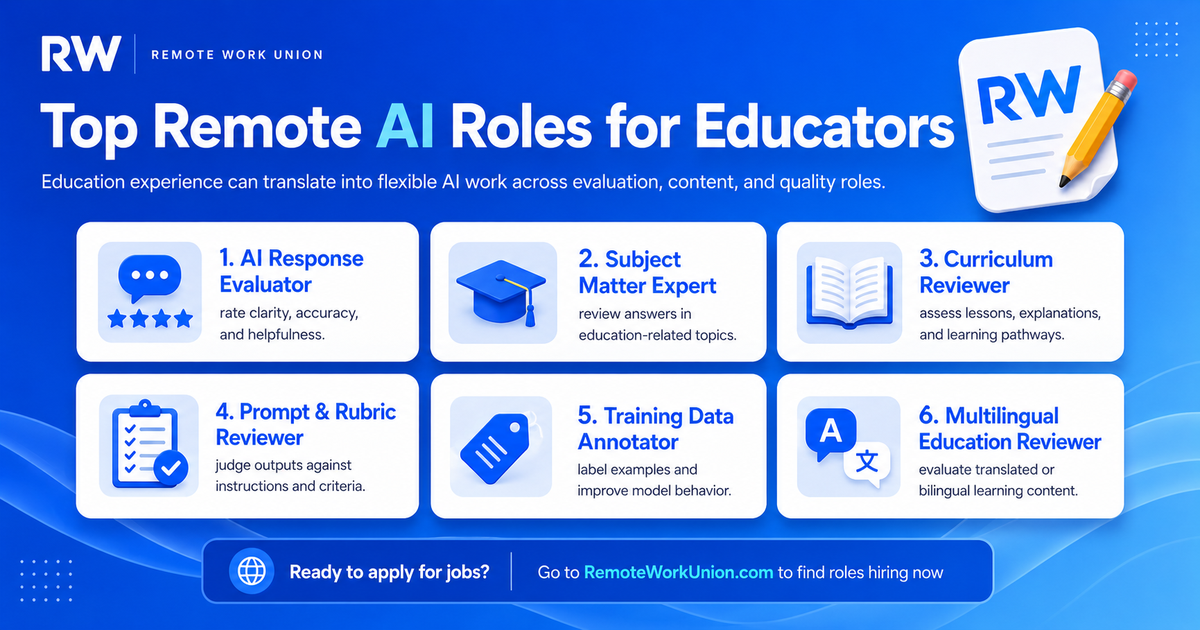
10 Best Remote AI Job Types for Educators
1. AI Response Evaluator
AI response evaluators compare model answers and judge whether they are accurate, helpful, clear, safe, and aligned with the prompt. For a teacher or tutor, this feels similar to grading short-answer work, reviewing a student explanation, or deciding whether a response meets the assignment criteria. Common tasks include rating chatbot responses, choosing the better answer between two AI outputs, identifying hallucinations, checking whether the AI followed instructions, and writing short explanations for your judgment.
Search terms: AI response evaluator, AI answer reviewer, AI model evaluator, chatbot evaluator, AI rater, and human feedback jobs.
2. AI Tutor Evaluator
AI tutor evaluator roles focus on how well an AI system teaches. The work may involve reviewing step-by-step math solutions, science explanations, language-learning conversations, essay feedback, study plans, or test-prep responses. The goal is to decide whether the AI is guiding the learner in a productive way rather than simply giving an answer.
Tutors are especially strong candidates because they know how to diagnose confusion — they can spot when a model skips a step, overexplains, uses the wrong level of difficulty, or gives feedback that sounds polished but does not help the student improve.
3. Subject Matter Expert Reviewer
SME review is one of the best fits for experienced educators. These projects need people who can verify answers in a specific discipline: elementary math, algebra, calculus, biology, chemistry, physics, history, literature, writing, economics, business, psychology, computer science, ESL, test prep, or professional certification topics.
The work can include fact-checking AI answers, judging whether a solution method is valid, improving explanations, writing gold-standard examples, or reviewing whether a model response is appropriate for the learner level. Search for subject matter expert AI jobs, education SME AI reviewer, math AI evaluator, science AI reviewer, writing AI evaluator, and domain expert AI training.
4. Curriculum Reviewer
Curriculum reviewers assess whether educational content is well sequenced, accurate, age appropriate, and aligned with learning goals. In AI work, this can involve reviewing lesson plans, worksheet explanations, skill progressions, practice problems, quiz items, and learning pathways produced by an AI system.
A good curriculum reviewer does not just ask "Is this correct?" They also ask "Does this teach the right thing at the right time in the right way?"
5. Prompt and Rubric Reviewer
Prompt and rubric reviewers look at the instructions given to AI systems and the scoring rules used to judge the outputs. This role is a strong fit for educators because teaching already involves writing assignments, building rubrics, clarifying expectations, and interpreting criteria. The task may ask you to decide whether a rubric is fair, whether a prompt is ambiguous, or whether two graders would likely score the response the same way.
Search terms: prompt evaluator, rubric reviewer, AI prompt evaluation, AI quality analyst, and AI training reviewer.
Educator ready for remote AI work? RemoteWorkUnion.com lists roles hiring now.
Find Roles Hiring Now →6. Training Data Annotator
Training data annotation jobs involve labeling examples so AI systems can learn from them. Education-focused annotation can be more judgment-heavy: labeling the skill being tested, identifying the error type in a math solution, tagging the reading level of an explanation, categorizing student intent, or marking whether feedback is constructive.
Teachers and tutors can stand out because they understand learning signals — they know the difference between a minor wording issue, a conceptual misunderstanding, and an answer that is correct but not developmentally appropriate.
7. Assessment and Test-Prep Item Reviewer
AI projects may need experts to review quiz questions, answer choices, rationales, exam explanations, and practice tests. The strongest candidates understand distractors, fairness, difficulty, coverage, and alignment with learning objectives. Educators with SAT, ACT, GRE, GMAT, LSAT, MCAT, AP, state testing, or professional exam experience can position that background as domain expertise.
Search for assessment item reviewer, test-prep AI reviewer, educational content reviewer, AI question writer, AI quiz reviewer, and learning content quality analyst.
8. Writing Feedback Evaluator
Teachers who have graded essays, edited student writing, coached college applications, or taught English can look for writing-focused AI evaluation projects. These roles may involve reviewing AI essay feedback, judging grammar explanations, rating writing suggestions, identifying tone issues, or checking whether feedback is useful without being too vague.
The best writing evaluators can explain why one response improves a draft and another merely sounds polished. They can also detect when an AI model makes a style suggestion that conflicts with the writer's goal, academic level, or assignment instructions.
9. Multilingual Education Reviewer
Bilingual teachers, ESL tutors, language instructors, and translation reviewers can search for multilingual AI evaluation work. These projects may involve reviewing translated educational content, comparing responses across languages, rating grammar explanations, or checking whether an AI tutor communicates naturally with language learners.
Search terms include bilingual AI evaluator, language AI reviewer, ESL AI training jobs, translation evaluator, localization reviewer, and multilingual data annotation. Fluency matters, but so does teaching judgment — a bilingual educator can evaluate whether the explanation actually helps a learner, not just whether the words are translated.
10. Education Safety and Appropriateness Reviewer
Some AI work requires reviewing whether content is appropriate for learners. This can include checking age appropriateness, sensitive topics, classroom suitability, bullying or harassment concerns, self-harm sensitivity, privacy issues, and whether an AI response gives responsible guidance.
Educators who have worked with minors, school policies, academic integrity, counseling-adjacent support, special education teams, or online learning environments may have relevant judgment for this type of review. These roles can appear under titles such as trust and safety reviewer, AI safety evaluator, content quality reviewer, policy reviewer, or educational content moderator.
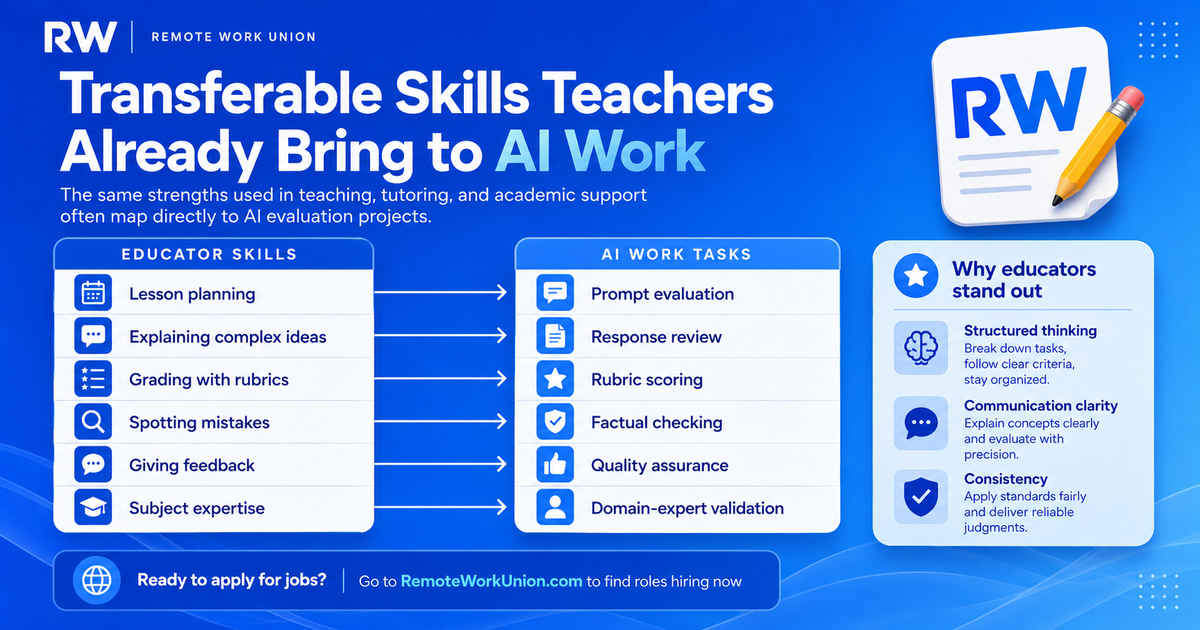
What the Work Actually Looks Like
A typical remote AI evaluation task starts with instructions. You read the prompt, review one or more AI responses, apply a rubric, select ratings, and sometimes write a short justification. The work can feel like a mix of grading, editing, tutoring, fact-checking, and quality assurance.
For example, a task might ask whether an AI math tutor solved a problem correctly. Another might compare two explanations of the American Revolution for middle school students. Another might ask whether a chatbot gave useful feedback on an essay introduction. In each case, the value comes from human judgment.
Some projects are generalist. Others require a credential, degree, teaching background, tutoring experience, or subject test. Many are contract or project-based rather than permanent full-time jobs — useful for educators who want flexible work, but applicants should still read the terms carefully and understand how pay, task availability, deadlines, and quality reviews work.
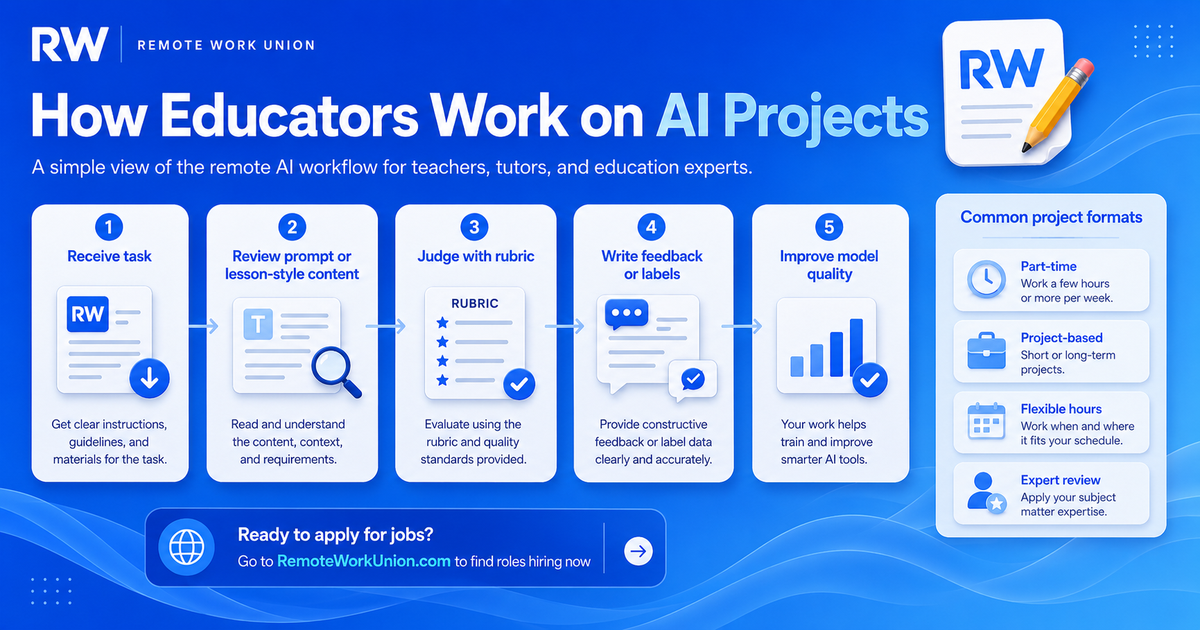
Skills to Highlight on Your Resume or Profile
Educators should avoid describing themselves only as teachers. AI platforms often scan for skills that match evaluation workflows. Translate classroom experience into remote AI language.
Strong skill phrases include rubric-based evaluation, response review, factual accuracy checking, curriculum alignment, lesson planning, assessment design, feedback writing, academic editing, quality assurance, learning objectives, student support, content review, annotation, error analysis, and subject matter expertise.
A tutor might write: "Evaluated student reasoning, identified conceptual gaps, and provided concise feedback aligned with learning goals." A teacher might write: "Designed rubrics, reviewed written responses, assessed accuracy and clarity, and maintained consistent grading standards across large volumes of student work." An instructional designer might write: "Reviewed lessons, assessments, and explanations for clarity, sequence, accessibility, and learner outcomes."
How to Prepare Before Applying
The best preparation is to build proof that you can evaluate AI outputs clearly and consistently. You do not need a complicated portfolio, but a few simple samples can help. Create a short document with examples of a prompt, two AI-style responses, your rating, and a concise explanation of which response is better and why. Use education topics you know well.
Practice writing short justifications. Many AI projects do not want long essays — they want precise, evidence-based reasoning. A strong justification might say: "Response A is better because it solves the equation correctly, explains each step, and avoids introducing a shortcut that has not been taught yet. Response B reaches the right answer but skips the distribution step, which would make it less useful for an Algebra I student."
Key preparation tip: Also practice identifying vague feedback. In education and AI evaluation, "good answer" is not enough. You need to explain what made it good: accuracy, completeness, instruction following, learner level, clarity, structure, tone, safety, and usefulness.
Where Educators Can Look for Remote AI Work
Start with broad remote job boards, AI training platforms, education technology companies, tutoring companies, learning platforms, curriculum companies, and contractor marketplaces. Use different searches for each site. On a general job board, search remote AI evaluator or curriculum reviewer. On a platform marketplace, search subject matter expert, writing evaluator, annotation, or AI trainer. On education company sites, search content quality, assessment reviewer, learning designer, or AI tutor quality.
Do not assume every good opportunity uses the phrase "AI job." Some roles are labeled learning content reviewer, quality analyst, curriculum contractor, assessment editor, prompt writer, data reviewer, or domain expert. If the job involves reviewing outputs, applying criteria, labeling content, or improving model behavior, it may still be relevant AI work.
Strong searches include: remote AI evaluator jobs, AI training jobs from home, AI model evaluation jobs, AI rater jobs, prompt evaluation jobs, AI response reviewer jobs, data annotation jobs from home, human feedback jobs, RLHF jobs, education AI jobs, curriculum reviewer remote, AI tutor evaluator, subject matter expert AI jobs, and online education reviewer jobs.
How Teachers Can Stand Out From General Applicants
Many applicants say they are detail-oriented. Educators should be more specific. Show that you can evaluate work against criteria, explain decisions, and maintain consistency. Mention the grade levels, subjects, learner types, or assessment systems you know best. If you have online teaching or tutoring experience, emphasize written communication and asynchronous feedback.
A strong applicant profile: "I am an experienced middle school math teacher with a background in rubric-based scoring, step-by-step explanation review, assessment design, and student feedback. I can evaluate AI-generated math explanations for accuracy, clarity, grade-level appropriateness, and instructional usefulness." That is far stronger than saying "I am looking for remote AI jobs and I am good with technology."
Common Mistakes to Avoid
Applying only to jobs with the word teacher in the title. Many relevant roles are not listed that way. Search across evaluator, reviewer, rater, trainer, annotator, quality analyst, prompt, rubric, and SME titles.
Overclaiming technical skills. Many remote AI jobs do not require coding, but they do require careful reading, consistency, and clear written explanations. It is better to position yourself as a strong evaluator and education expert than to pretend to be a machine learning engineer.
Ignoring platform quality. Before accepting work, read the project terms, pay structure, task availability expectations, dispute rules, and confidentiality requirements. Remote AI work can be flexible, but it is still work. Treat it like a professional contract.
Teachers, tutors, and education experts are not outsiders to AI work. They are exactly the kind of evaluators many AI projects need. The strongest opportunities are about using education experience to make AI systems clearer, safer, more accurate, and more useful for real learners.