AI training jobs can be a strong fit for PhD students, researchers, postdocs, professors, adjunct instructors, academic editors, and subject matter experts who want flexible remote work. These roles may be called AI model evaluation, AI response rating, RLHF, data annotation, prompt evaluation, expert review, research fact-checking, AI writing evaluation, or chatbot quality review — but beneath the different titles, many tasks depend on the same skills that academic workers already use every day.
For many academics, the biggest challenge is not whether they are qualified. It is knowing how to translate academic experience into the language used by remote AI platforms, staffing companies, and job boards. This article explains how academic skills transfer into remote AI training jobs, what kinds of tasks researchers often fit best, how to position your background, and what to look for when applying.
What Are AI Training Jobs for Academics?
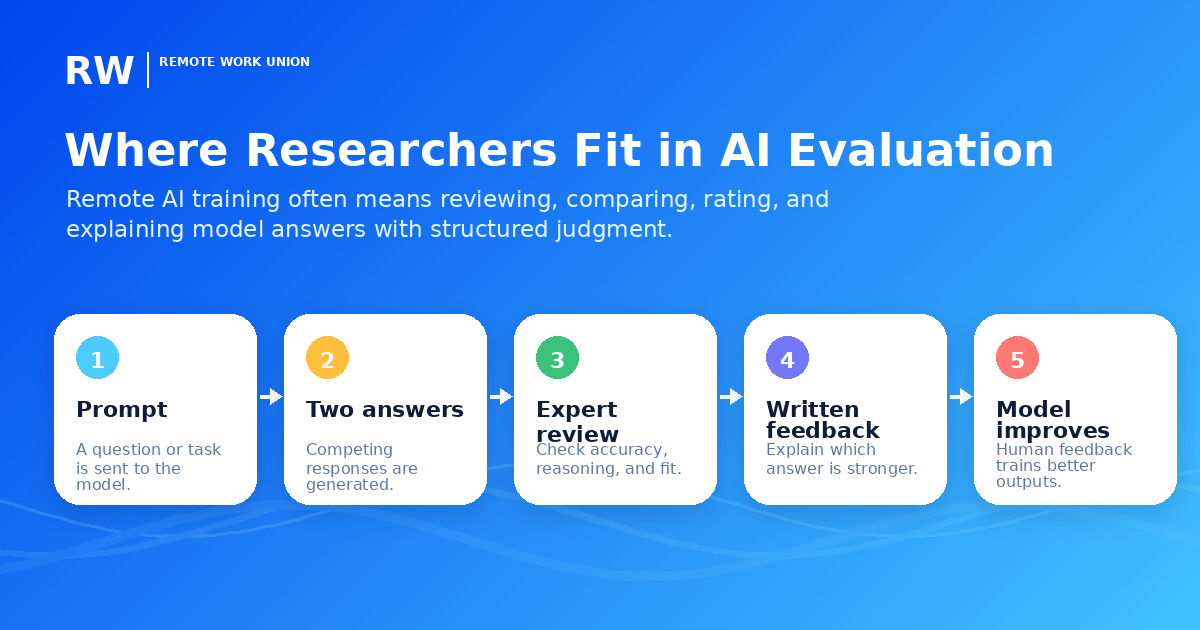
AI training jobs are remote or contract roles where humans help improve AI systems by reviewing model outputs, labeling information, comparing answers, writing prompts, fact-checking claims, or explaining which response is better. For academic applicants, the most relevant roles are usually the ones that need judgment rather than repetition — reviewing long answers, checking whether reasoning is sound, judging whether the model followed instructions, or identifying subtle factual mistakes.
Common job titles and search phrases include remote AI evaluator, AI trainer, AI model reviewer, AI response evaluator, AI writing evaluator, AI fact-checker, RLHF rater, research evaluator, AI data annotator, subject matter expert AI trainer, AI content quality analyst, prompt evaluator, and expert AI reviewer.
Why PhD Students and Researchers Are Strong Candidates
Academic work trains people to evaluate information under uncertainty. That matters in AI training because model outputs can sound confident even when they are incomplete, misleading, or subtly wrong. A strong reviewer has to read beyond fluency and decide whether the answer is actually useful, accurate, relevant, and well-supported.
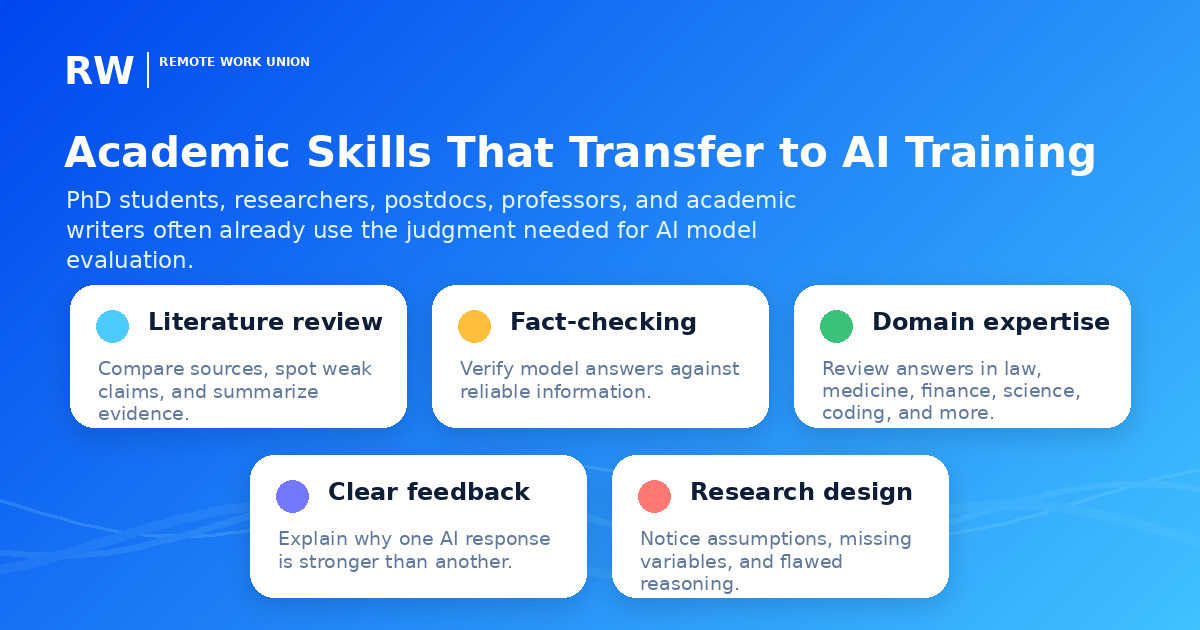
PhD students and researchers often bring five strengths that are valuable in AI evaluation work: they know how to read complex material closely; they are used to separating strong evidence from weak claims; they can explain reasoning in writing; they usually have a defined subject area, which can help with expert projects; and they understand that a polished answer is not always a correct answer.
Remote Work Union connects academics and researchers to legitimate remote AI evaluation roles. Apply for free and find roles hiring now.
Find Roles Hiring Now →Academic Skills That Translate Directly
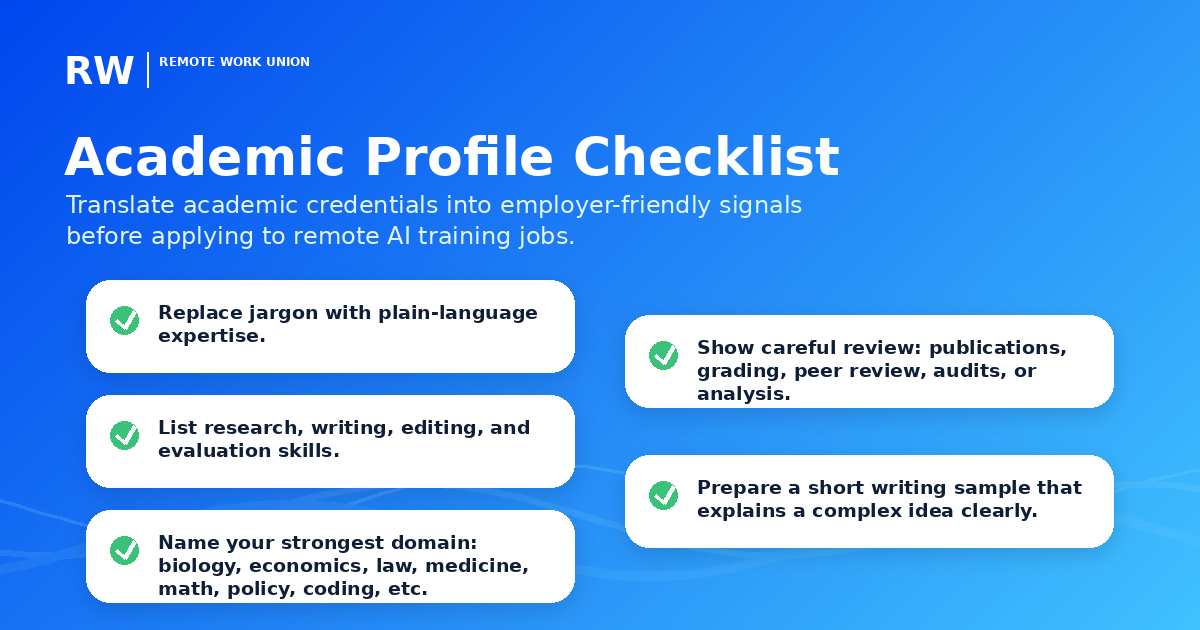
The best way to position yourself is to translate academic language into practical job language:
- Literature review → useful for checking whether an AI answer fairly summarizes a topic or overstates evidence
- Peer review → useful for giving constructive, precise feedback on model responses
- Teaching and grading → useful for applying rubrics consistently and explaining why an answer deserves a higher or lower score
- Research methods → useful for spotting bad assumptions, weak causal claims, missing controls, and unsupported generalizations
- Statistical reasoning → useful for evaluating data-heavy answers, charts, quantitative explanations, and probability claims
- Domain expertise → useful for specialized projects in science, medicine, law, finance, economics, history, policy, linguistics, math, or computer science
Best AI Training Tasks for Researchers and Academics
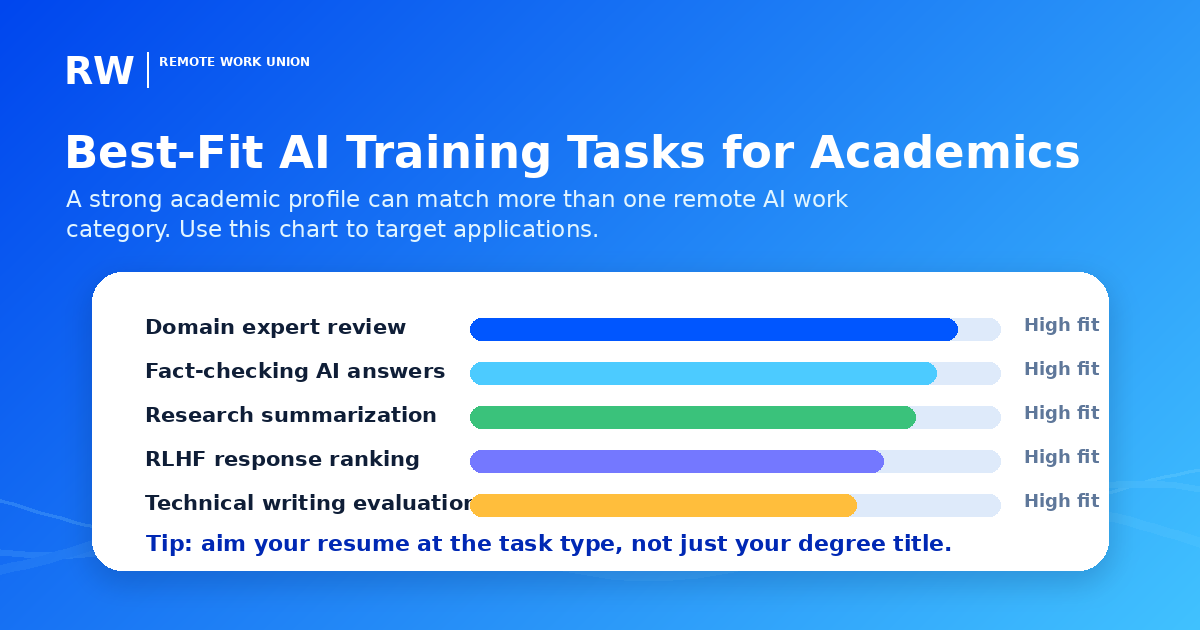
Response ranking — compare two AI answers and decide which one better follows the prompt. A weak answer may be vague, incomplete, overconfident, unsafe, or off-topic.
Fact-checking — review claims in an AI answer and identify what is correct, uncertain, or unsupported. Especially relevant for researchers who are comfortable checking sources and explaining nuance.
Prompt and answer writing — some projects ask experts to write high-quality prompts, model ideal answers, or create evaluation examples.
Subject matter expert review — these projects look for people with advanced knowledge in law, medicine, biology, chemistry, physics, finance, accounting, economics, computer science, education, psychology, public policy, or other fields.
AI safety and policy evaluation — some projects ask reviewers to identify risky advice, sensitive topics, overconfident claims, bias, privacy issues, or harmful instructions. Researchers with ethics, policy, social science, legal, or medical backgrounds may be especially relevant.
How to Position a PhD or Academic Background
A mistake many academic applicants make is leading with credentials but not translating what those credentials mean. Instead of saying only "PhD candidate in sociology," add the practical skills: qualitative research, literature review, survey design, policy analysis, academic writing, teaching, grading, and data interpretation. Instead of "postdoctoral researcher in biology," add experimental design, scientific writing, peer-reviewed publications, statistical analysis, and technical fact-checking.
Resume Keywords Academics Should Include
Strong keywords include: AI model evaluation, AI training, data annotation, RLHF, response ranking, prompt evaluation, fact-checking, research synthesis, literature review, academic writing, technical writing, subject matter expertise, rubric-based evaluation, peer review, analytical writing, editing, domain expertise, data analysis, statistical reasoning, qualitative research, quantitative research, source evaluation, and written feedback.
Where to Search for Academic AI Training Work
Search broadly because these jobs are not always posted under the same title. Try platform searches, general job boards, LinkedIn searches, remote work sites, AI contractor platforms, university-adjacent networks, and specialized expert marketplaces. Search for combinations of your subject and AI terms — "biology AI evaluator," "legal AI trainer," "finance AI model evaluation," "math AI reviewer," "medical AI fact-checker," "academic writing AI evaluator," or "research AI training remote."
Do not assume that a job must mention PhD in the title. Many roles are written for "experts," "reviewers," "evaluators," "writers," "analysts," or "contractors." Your degree can still help, but you may need to search by skill instead of credential.
How to Prepare for Assessments
Many AI training platforms use assessments before assigning work. The assessment may ask you to compare two AI answers, identify factual errors, write a prompt, explain a rating, or edit a response. Treat it like a professional evaluation, not a casual opinion. Read the instructions carefully. Apply the rubric exactly. Do not overcomplicate the answer.
Assessment tip: For subject matter expert assessments, show your expertise without making the answer hard to read. A strong reviewer can recognize nuance and still communicate clearly. That combination — expertise plus clarity — is what AI training work values most.
Frequently Asked Questions
Can PhD students and academics qualify for remote AI training jobs?
Yes. PhD students, researchers, postdocs, professors, adjunct instructors, and academic editors can qualify for many AI training roles because the work rewards careful reading, evidence-based judgment, clear writing, structured reasoning, and subject expertise — skills academic work actively builds.
What academic skills translate directly into AI training work?
Literature review, peer review, teaching and grading, research methods, statistical reasoning, academic writing, and domain expertise all translate well. The key is to translate academic language into practical job language — for example, peer review becomes structured feedback, grading becomes rubric-based evaluation.
Can AI training replace academic income?
AI training income can be useful, but it should be treated realistically. Many roles are contract-based with variable project availability. It is a strong side income option for graduate students, adjuncts, postdocs, and academics between roles, but it may not behave like a stable salaried job.
How should academics search for AI training opportunities?
Search broadly by combining your subject with AI evaluation terms — for example, "biology AI evaluator," "legal AI trainer," "math AI reviewer," or "research AI training remote." Do not assume the job title will mention PhD. Many roles are written for "experts," "reviewers," "evaluators," or "contractors."