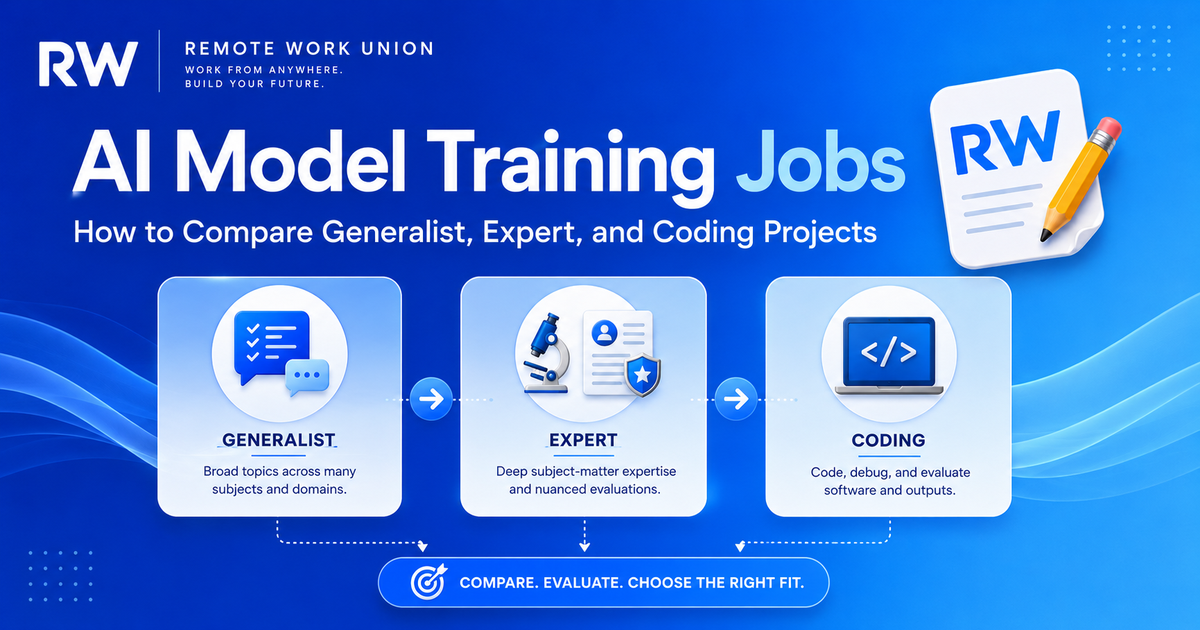
AI model training jobs are not one single category of remote work. The phrase can describe several types of human feedback, AI evaluation, data annotation, prompt review, chatbot response rating, AI rater work, and model improvement projects. Some roles are built for strong writers and careful readers. Some are built for marketing and sales professionals, finance and business experts, customer service leads, social media managers, consultants, teachers, researchers, and other subject-matter specialists. Some are built for lawyers, healthcare experts, and other credentialed professionals. Others are built for software engineers, technical writers, computer science students, and coders who can test and explain code.
That difference matters. A remote worker searching for AI model training jobs may see listings that all use similar language: AI trainer, AI evaluator, AI data annotator, AI response reviewer, prompt evaluator, search quality rater, RLHF specialist, AI model evaluator, or human feedback contractor. But the day-to-day work can be very different depending on whether the project is generalist, expert, or coding-focused.
What AI Model Training Jobs Usually Mean
An AI model training job is usually a human review role that helps improve the quality, safety, usefulness, or reliability of AI systems. The work may involve reading prompts, comparing model responses, editing answers, checking factual claims, writing ideal responses, labeling examples, evaluating search results, testing model behavior, or reviewing outputs against detailed guidelines.
In many cases, you are not literally building a model from scratch. You are helping create or evaluate the data that teaches an AI system what a better answer looks like. That is why these jobs often overlap with terms like human feedback jobs, RLHF jobs, AI evaluation jobs, AI rater jobs, prompt evaluation jobs, AI response reviewer jobs, data annotation jobs, and chatbot quality review jobs.
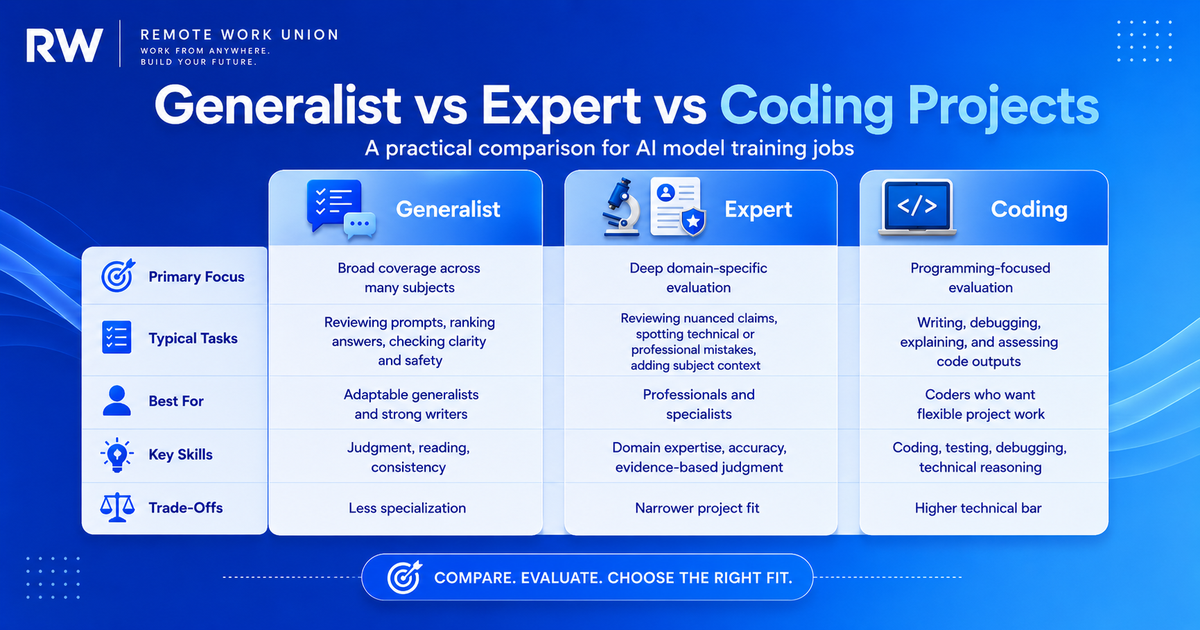
The Three Main Project Types
Generalist projects are broad evaluation projects. They usually reward clear reading, good judgment, careful writing, consistency, and the ability to follow instructions. You may compare two AI answers, choose the better response, explain your rating, rewrite an answer, or mark whether a response follows the prompt.
Expert projects require deeper subject knowledge. These can include legal review, medical writing review, finance analysis, accounting, education, science, engineering, tax, insurance, cybersecurity, business operations, public policy, language expertise, or other specialized fields. The main value is not just that you can read and write; it is that you can recognize when an answer is technically incomplete, misleading, oversimplified, or wrong.
Coding projects focus on programming tasks. They may involve writing code, debugging code, evaluating code answers, checking whether a solution passes tests, explaining a technical concept, comparing two code responses, or reviewing whether an AI model handled an engineering prompt correctly. These projects often require stronger technical proof than generalist work.
Generalist AI Model Training Projects
Generalist projects are often the best entry point for remote workers who are strong readers, writers, researchers, editors, students, recent graduates, former teachers, customer support professionals, operations workers, journalists, content marketers, assistants, or people with a broad knowledge base.
Typical generalist tasks may include comparing two chatbot answers and selecting the better one, rating whether an AI response followed the prompt, checking if an answer is clear and safe, rewriting a weak answer into a stronger answer, categorizing prompts or model outputs, identifying obvious hallucinations or unsupported claims, and explaining your judgment in concise written feedback.
The biggest advantage of generalist projects is accessibility. You usually do not need a law degree, medical license, or software engineering background. You do need patience, consistency, and the ability to follow detailed guidelines without overcomplicating the task.
For generalist applicants: Your application needs to show proof of judgment — clear writing, clean formatting, examples of research ability, and a work sample that demonstrates you can evaluate answers carefully. Vague claims of "attention to detail" are weak without a concrete example to back them up.
Remote Work Union connects you to AI model training roles across all three project types. Browse roles now.
Find Roles Hiring Now →Expert AI Model Training Projects
Expert projects are built around specialized knowledge. These roles can be more selective, but they can also be a better fit for applicants with professional experience that does not look like traditional tech experience.
Examples of expert project backgrounds include lawyers, paralegals, and legal researchers; accountants, finance analysts, and investment researchers; doctors, nurses, and medical writers; teachers, tutors, and curriculum developers; scientists, engineers, and technical specialists; operations managers, business analysts, and consultants; journalists, editors, and specialized writers; bilingual speakers and translators; and public policy, compliance, and regulatory professionals.
Expert projects tend to have less competition than generalist projects because fewer applicants can credibly claim the required background. If you have professional experience in a specialized field, that background is often more useful than a general claim of "AI experience."
Coding AI Model Training Projects
Coding projects focus on software engineering, data science, mathematics, and technical reasoning tasks. They may involve writing a solution to a coding problem, reviewing AI-generated code for bugs or inefficiency, comparing two code responses, evaluating whether an explanation of an algorithm is accurate, or testing whether a coding assistant's output actually runs correctly.
These projects typically require stronger proof of technical ability upfront. You may be asked to demonstrate coding skills in a specific language, show experience with particular frameworks, or pass a technical assessment before accessing project work. The upside is that verified coding expertise often earns premium rates compared to generalist evaluation work.
Strong coding applicants should highlight their specific programming languages, areas of expertise such as machine learning, data science, web development, systems programming, security, or embedded systems, and their ability to evaluate code quality, explain technical reasoning clearly, and identify edge cases and logical errors.
Core Skills Across All Three Types
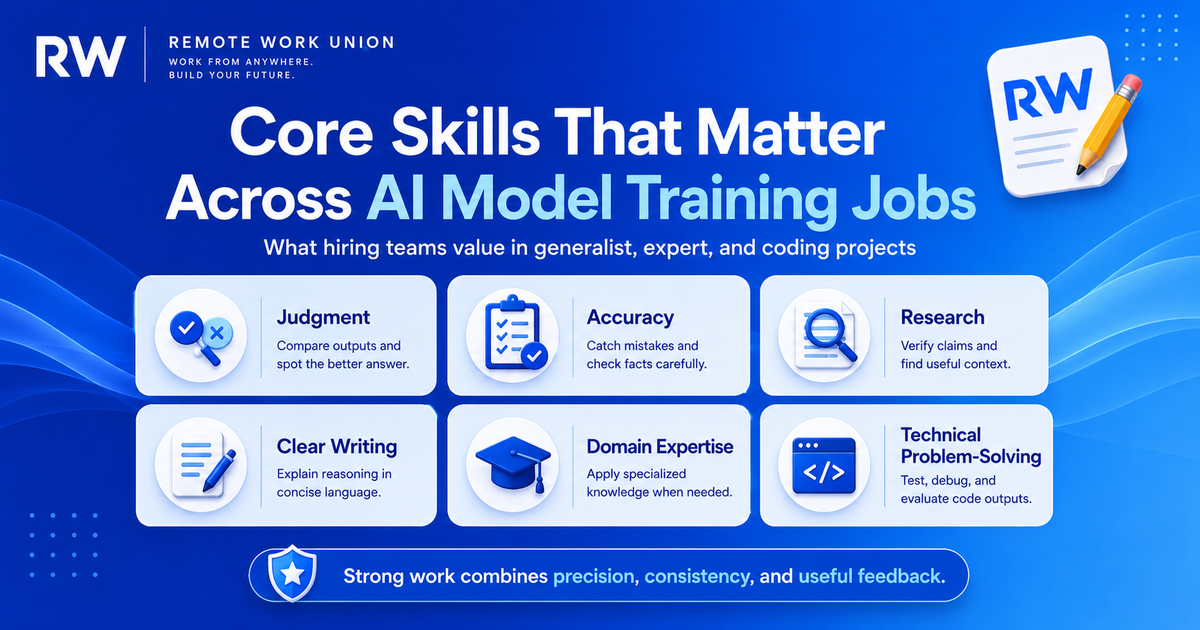
Regardless of project type, all AI model training work rewards a common set of core skills. Consistency matters in every project — platforms measure whether your ratings are reliable across similar tasks, not just on a single excellent submission. Instruction-following matters too — a reviewer who adds personal opinions the rubric did not ask for is less useful than one who stays within the guidelines. Written explanation matters across all types — even coding projects often ask reviewers to explain why a solution is stronger, not just mark it correct.
The difference is in what you bring to the table above that baseline. For generalist work, reading comprehension and writing clarity are the differentiators. For expert work, professional knowledge and the ability to judge specialized content are the differentiators. For coding work, technical proficiency and the ability to reason about program behavior are the differentiators.
How to Choose the Right Project Type
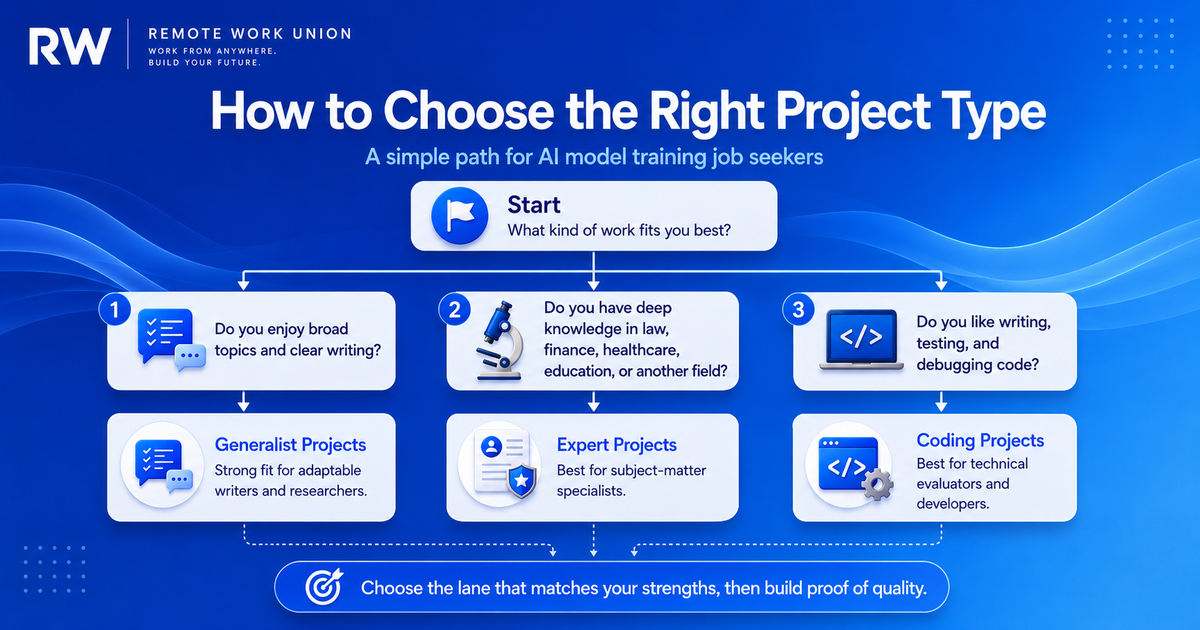
The simplest question to ask is: what expertise can I defend under pressure? Not what you think sounds impressive, but what you could explain in detail if someone asked you follow-up questions about your reasoning.
If you can explain in specific terms why one piece of writing is better than another, and you can do that consistently across many examples, generalist work may be your strongest entry point. If you can evaluate whether a legal explanation handles the key issue correctly, or whether a medical summary makes an appropriate recommendation, expert work is likely a better fit and a less competitive application. If you can explain why code solves or fails to solve a given problem, coding work is your lane.
Application Strategy by Project Type
For generalist applications: lead with clear writing samples, editing examples, or research verification work. Show that you follow rubrics carefully. Demonstrate consistency in your reasoning across multiple examples if the application allows it.
For expert applications: make your professional background the headline. Do not bury your law degree, medical credential, finance certification, or domain experience. Explain specifically what types of content you can evaluate in your field — not just "I know about finance" but "I can evaluate investment explanations, accounting assumptions, and market research summaries."
For coding applications: show your technical stack clearly. Provide code samples if requested. Emphasize your ability to write clear technical explanations, not just correct code. Platforms often need reviewers who can explain why a solution is better — not just reviewers who can write one.
Frequently Asked Questions
What is the difference between generalist and expert AI model training jobs?
Generalist AI model training jobs require strong reading, writing, and judgment skills. Expert AI training jobs require professional knowledge in a specific field like law, medicine, finance, or education. Expert roles are usually less competitive and may pay more because the required background is harder to find.
Do I need to be a programmer for AI model training jobs?
No. Most AI model training jobs do not require programming. Coding evaluation projects do require programming experience, but generalist and expert review projects typically reward domain knowledge, writing clarity, and careful judgment over technical coding ability.
How do I choose the right AI model training project for my background?
Start by identifying your strongest skill lane: writing, research, a professional domain, or programming. Then look for projects that explicitly require that background. Applying to projects where your background matches the task description results in better acceptance rates and higher-quality work experiences.