An AI rater job is a human review role focused on evaluating the quality of AI-generated responses. A rater may review answers from chatbots, search assistants, coding helpers, writing tools, customer support bots, or AI research systems. The goal is to create structured feedback that product teams and machine learning teams can use to improve model behavior.
In practice, the task usually looks like this: you receive a user prompt, read one or more model responses, check the answer against instructions, and assign ratings. Some projects ask for side-by-side comparisons, where you choose which answer is better. Others ask for single-response scoring, where you grade one answer on factuality, relevance, clarity, safety, formatting, and instruction following. This work matters because large language models can sound confident even when they are wrong — AI raters help identify those problems.
What AI Raters Review
AI rater jobs can cover many types of content. Generalist projects may ask you to review everyday chatbot answers about writing, travel, shopping, education, recipes, or personal productivity. Specialist projects may focus on legal reasoning, finance, accounting, healthcare writing, coding, math, science, education, marketing, or language translation.
The most common review categories include accuracy, relevance, completeness, helpfulness, tone, clarity, safety, source quality, and instruction following. Some projects also measure whether an answer is too verbose, too vague, overly cautious, biased, repetitive, or poorly structured.
The Day-to-Day Workflow
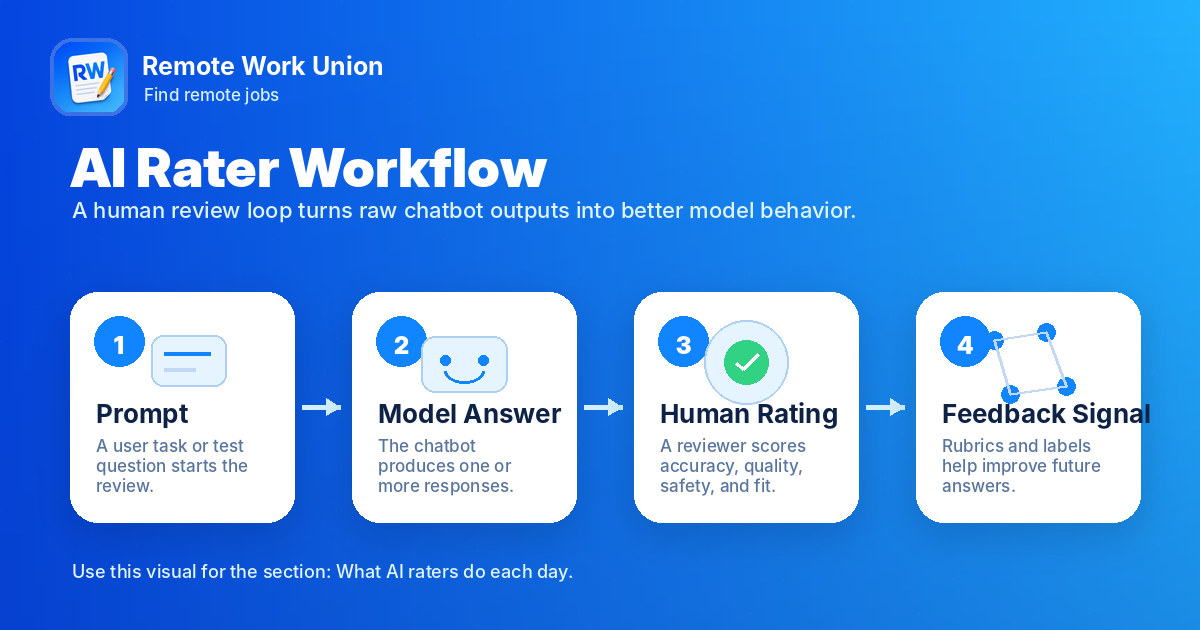
Most AI rater work follows a repeatable loop. First, the platform presents a task with a prompt, one or more AI answers, and a rubric. Second, the rater reads the prompt carefully and identifies what the user actually asked for. Third, the rater checks the AI answer against the rubric. Fourth, the rater assigns scores, selects the better response when asked, and writes a short explanation when needed.
Accuracy review is often the most important step. A rater may need to verify factual claims, spot outdated information, notice when the model makes assumptions, and decide whether the answer has enough evidence. Quality review is broader than fact-checking. A response can be accurate but still low quality if it ignores part of the prompt, uses confusing structure, gives unhelpful advice, or fails to mention important limitations.
How to Judge Chatbot Accuracy
To judge accuracy, start by separating claims from presentation. A polished answer can still be wrong. Identify every concrete claim that could be checked: numbers, names, definitions, dates, comparisons, legal or medical statements, product details, technical instructions, and causal explanations. Then ask whether the answer is supported, current enough for the task, and appropriately qualified.
Common accuracy problems include fabricated details, outdated facts, false equivalence, missing edge cases, wrong calculations, weak source interpretation, and confident claims about topics that change quickly. When writing feedback, be specific. Instead of saying "bad answer," say "the response makes a factual claim about pay without evidence" or "the answer ignores the user's location constraint."
How to Judge Chatbot Quality
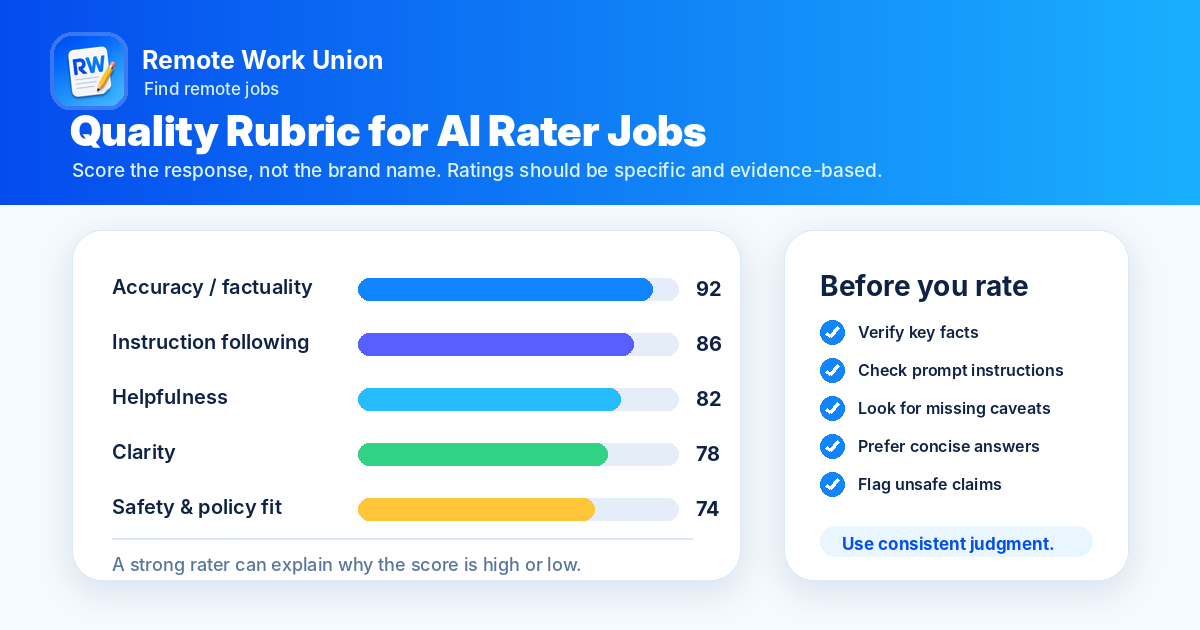
Quality means the response solves the user's problem in the right way. A high-quality chatbot answer is relevant, complete, clear, concise, safe, and aligned with the prompt. It follows instructions, respects constraints, and gives the user a useful next step.
Instruction following is often where strong raters outperform casual reviewers. If the prompt asks for three options, the model should not provide ten. If the prompt asks for no phone calls, the answer should not recommend call center jobs. Clarity matters too. Many AI answers are technically correct but bloated. A good rater can tell when a response is clear enough and when it hides the answer under unnecessary background.
Remote Work Union connects you to legitimate AI rater and chatbot evaluation roles. Apply for free.
Find Roles Hiring Now →Skills That Help You Get AI Rater Jobs
The best AI raters usually have strong reading comprehension, careful writing, research ability, attention to detail, and consistent judgment. You do not always need to code, but you do need to understand instructions and apply rubrics precisely.
Writing and editing experience is valuable because many projects involve judging clarity, tone, grammar, structure, and audience fit. Research experience helps because many tasks require fact-checking. Teaching and tutoring experience helps because good raters understand whether an answer explains a concept clearly. Professional expertise helps on specialist projects because the rater can identify mistakes that a generalist may miss.
Useful resume phrases include: AI response evaluation, chatbot answer review, rubric-based scoring, factuality assessment, instruction-following analysis, side-by-side model comparison, prompt evaluation, data annotation, human feedback, quality review, and source verification.
AI Rater Jobs vs Data Annotation Jobs
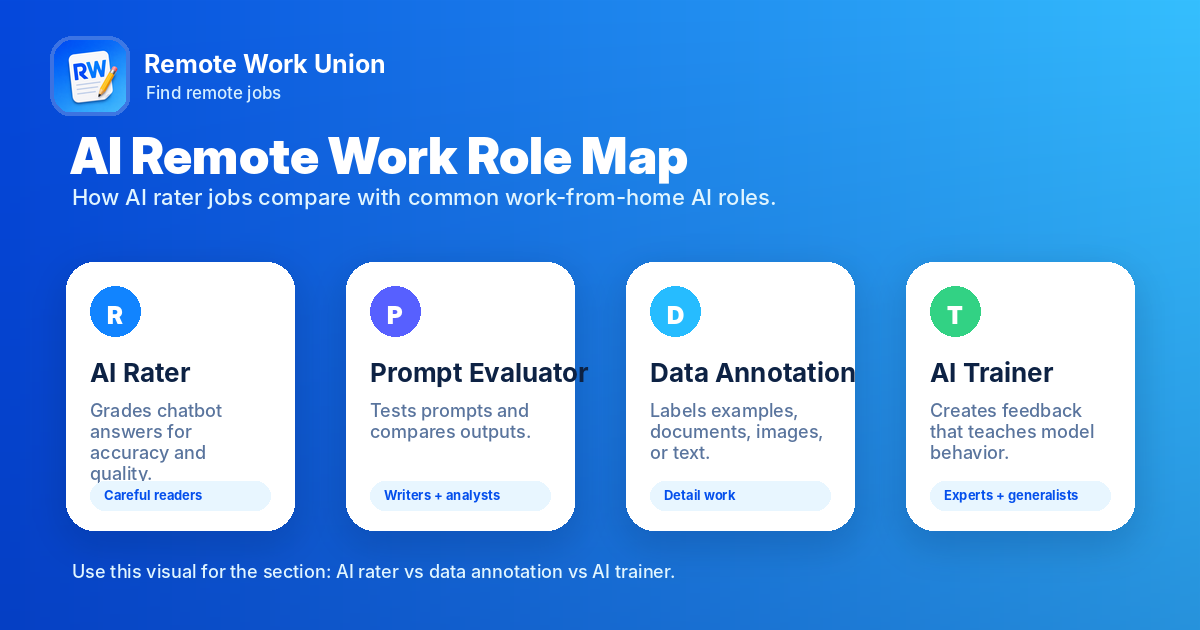
AI rater jobs overlap with data annotation, but they are not always the same. Data annotation often means labeling text, images, audio, documents, or examples so a model can learn from structured data. AI rater work is more focused on judging model outputs and explaining which response is better. Titles can be inconsistent across platforms — a role called AI trainer may involve rating answers, while a role called data annotation may involve prompt evaluation. Use multiple keywords rather than relying on one title.
Where to Search for AI Rater Jobs
Use search terms that match how platforms describe the work. Try AI rater jobs, AI response reviewer jobs, chatbot evaluator jobs, AI model evaluator jobs, prompt evaluation jobs, AI trainer jobs, human feedback jobs, RLHF jobs, LLM evaluator jobs, and remote data annotation jobs. Also search around major AI ecosystems: ChatGPT evaluator, Claude AI evaluation, Gemini AI training, Grok response review, Microsoft Copilot evaluation, and Google AI training jobs.
When reviewing a listing, look for details about the project type, required expertise, expected hours, contractor status, assessment process, pay structure, confidentiality rules, and whether the work is truly remote. Avoid listings that promise instant income, ask for unusual upfront payments, or provide no clear company or platform information.
How to Prepare Your Application
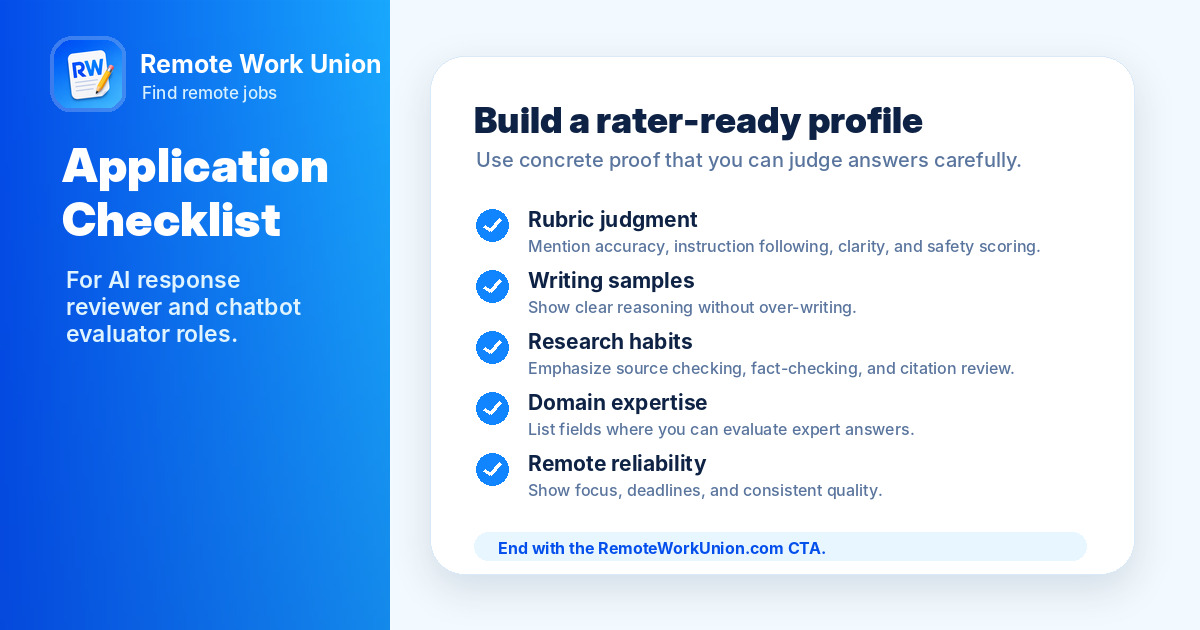
A strong application should prove that you can judge AI answers carefully. Position your background as evidence: a teacher can emphasize grading and feedback; a lawyer can emphasize careful reading and issue spotting; a finance worker can emphasize accuracy and compliance awareness; a writer can emphasize editing, voice, clarity, and structure; a coder can emphasize debugging, logic, and test cases.
Before taking an assessment, practice comparing two answers to the same prompt. Ask which answer is more accurate, which follows instructions better, which is safer, which is clearer, and which is more useful to the user. Then write one short explanation that points to the deciding factor.
Common Mistakes to Avoid
The first mistake is rating based on writing style alone — a response can sound smooth and still be wrong. The second mistake is ignoring the prompt — the best answer is not always the most detailed; it is the one that best satisfies the user's request. The third mistake is over-explaining feedback when the task asks for a short answer. The fourth mistake is inconsistent scoring across similar mistakes. The fifth mistake is applying personal preference instead of the rubric — good raters are consistent and evidence-driven.
Who AI Rater Jobs Fit Best
AI rater jobs can fit people who like reading, comparing, researching, and explaining judgments. They are especially relevant for writers, editors, teachers, tutors, researchers, students, analysts, legal professionals, healthcare writers, finance professionals, coders who want flexible work, and bilingual workers. They may not fit people who want passive income, instant approval, or purely repetitive data entry. The work can be mentally demanding because you are making judgment calls across many tasks.
Frequently Asked Questions
Are AI rater jobs real?
Yes, AI rating and human feedback work are real categories of remote AI work. The exact title varies by platform and project, so search for related terms such as AI evaluator, AI trainer, AI response reviewer, chatbot evaluator, prompt evaluator, RLHF, and data annotation.
Do AI rater jobs require coding?
Some projects require coding, but many generalist and writing-focused AI rater jobs do not. Non-coding projects usually emphasize reading comprehension, writing quality, research, factuality, and rubric-based judgment.
Can AI rater jobs be done from home?
Many AI rater roles are remote or contract-based, but each listing is different. Check location restrictions, tax requirements, expected hours, and whether the company allows work from your country or state.
What is the most important skill for AI rater jobs?
Consistent judgment. The best raters can apply a rubric the same way across many examples and explain the key reason behind each score.