Remote AI evaluator jobs have become one of the most practical work-from-home paths for people who can read carefully, write clearly, and judge the quality of AI answers. These jobs are not usually traditional software engineering roles. They are closer to quality assurance, research, writing review, fact-checking, search evaluation, and structured human feedback.
A remote AI evaluator may compare two chatbot responses, decide which answer is more helpful, check whether an AI model followed instructions, flag unsafe or inaccurate claims, review prompts, rate summaries, evaluate search results, or write short feedback that helps improve future model behavior. The work can appear under many titles: AI evaluator, AI rater, AI response reviewer, AI model evaluator, prompt evaluator, data annotator, AI trainer, search quality rater, human feedback specialist, RLHF contractor, chatbot reviewer, or AI quality analyst.
The best way to approach remote AI evaluator jobs is to understand the tasks first, then match your resume and application to the exact type of evaluation work you want.
What Remote AI Evaluators Actually Do
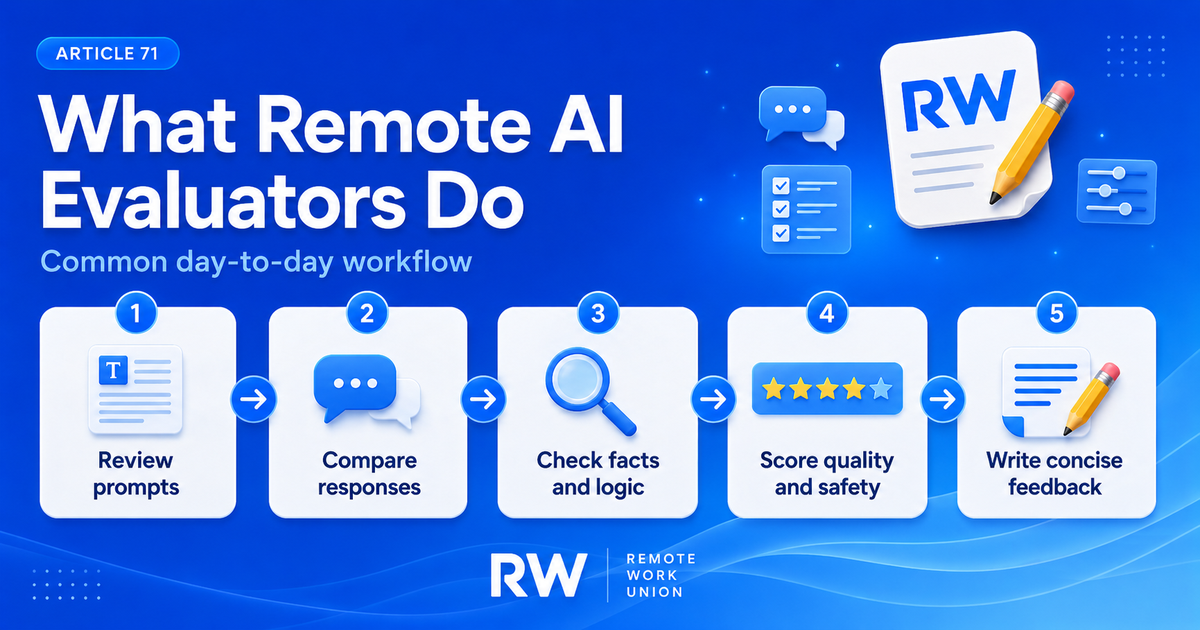
AI evaluators help companies understand whether an AI system is producing useful, accurate, safe, and well-written answers. The evaluator is not simply clicking random ratings. Good projects require judgment. You are usually reading a prompt, reviewing one or more model responses, applying a rubric, and explaining your decision in a concise way.
Common tasks include comparing two AI answers and selecting the stronger one, rating whether an answer follows the user request, checking factual accuracy, identifying hallucinations, reviewing tone and clarity, judging completeness, rewriting poor responses, labeling unsafe content, testing prompt behavior, evaluating search relevance, scoring summaries, or writing notes for model improvement.
Many AI evaluator jobs use rubrics. A rubric is a scoring guide that explains what counts as a good answer. It may ask you to judge instruction following, helpfulness, truthfulness, safety, clarity, formatting, reasoning, citation quality, or user intent. Strong evaluators learn the rubric, apply it consistently, and explain decisions without over-writing.
Common Job Titles to Search For
Do not search only for one phrase. The same work can appear under several titles. Useful search terms include remote AI evaluator jobs, AI rater jobs, AI model evaluation jobs, AI response reviewer jobs, prompt evaluation jobs, AI trainer jobs, AI model trainer jobs, data annotation jobs from home, RLHF jobs, human feedback jobs, chatbot evaluator jobs, search quality evaluator jobs, LLM evaluator jobs, generative AI evaluator, AI content reviewer, and AI quality analyst.
You can also combine titles with your strengths. A lawyer might search for legal AI evaluator, legal AI trainer, legal response reviewer, or remote legal AI jobs. A teacher might search for education AI evaluator, curriculum reviewer, or AI tutoring evaluator. A bilingual applicant might search for Spanish AI evaluator, bilingual AI rater, translation evaluator, or language model evaluation jobs.
Skills That Help You Get Hired
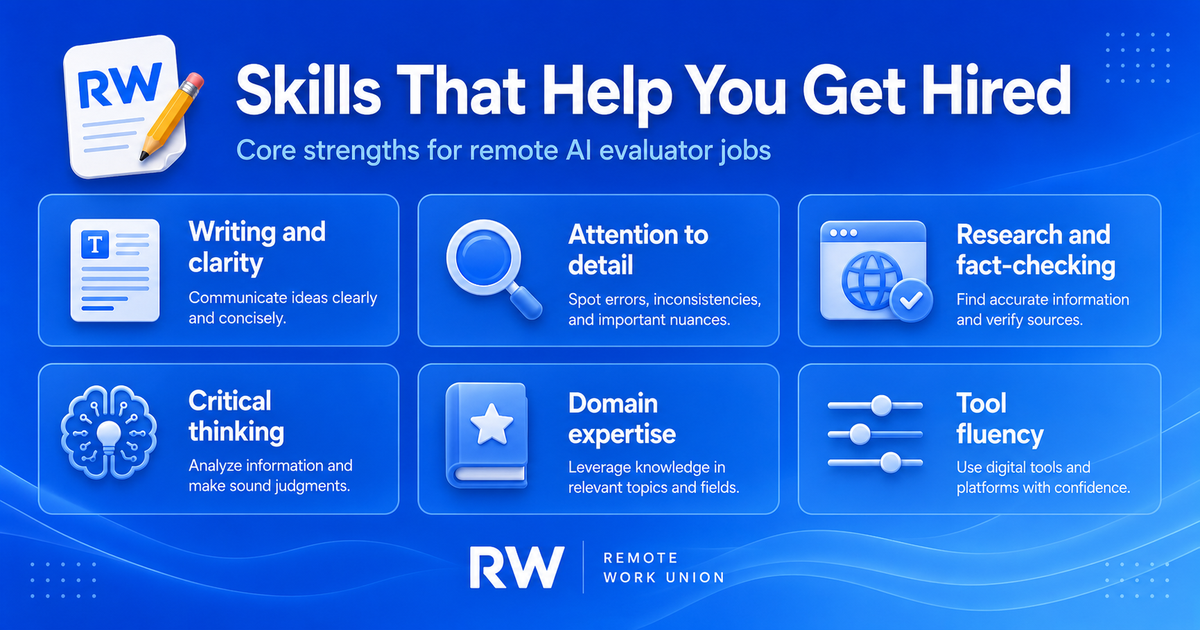
The strongest applicants are not always the most technical. Many remote AI evaluator jobs reward clear thinking, strong writing, careful reading, and consistent judgment. If you have experience in writing, editing, tutoring, research, customer support, QA testing, teaching, law, healthcare, finance, coding, marketing, operations, or academic work, you may already have relevant skills.
Writing and clarity matter because evaluators often need to explain why one response is better than another. Attention to detail matters because small instruction-following errors can change the correct rating. Research and fact-checking matter because AI models can sound confident while being wrong. Critical thinking matters because many tasks require judgment, not simple keyword matching.
Domain expertise can raise your value. AI systems need feedback from people who understand specific fields. Coding, math, science, law, medicine, accounting, finance, education, engineering, languages, creative writing, and business analysis can all be useful depending on the project. Tool fluency also helps — remote evaluators may work inside online annotation platforms, spreadsheets, project dashboards, browser tools, and document editors.
How Pay Usually Works
Pay for remote AI evaluator jobs varies because the work varies. A general data annotation task is different from a coding evaluation project. A basic chatbot rating task is different from a legal, medical, finance, language, or expert review task. A short task-based project is different from a long-term hourly contract.
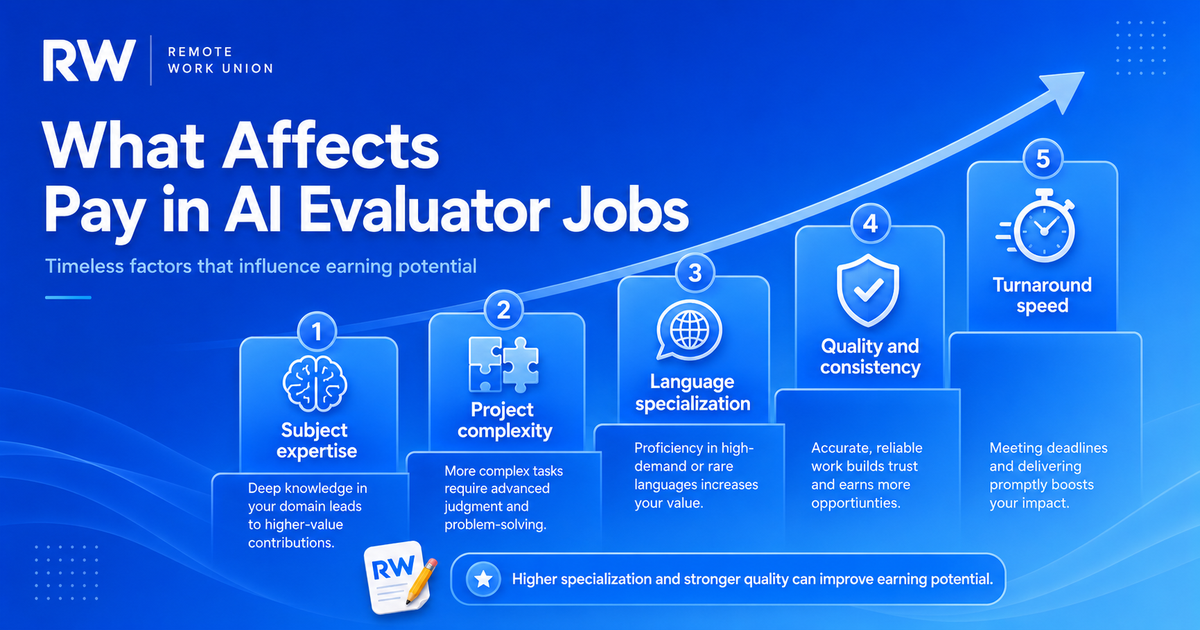
The biggest pay factors are subject expertise, project complexity, language specialization, quality and consistency, turnaround speed, availability, assessment performance, and whether the role is employee, contractor, hourly, task-based, or project-based. Higher specialization can improve earning potential, but only if the project actually needs that specialization and the applicant can pass the required screening.
Treat remote AI evaluator jobs like skilled contract work, not passive income. You are being paid for judgment, consistency, and reliability. A high advertised rate does not help if there is little work available, unclear approval criteria, or long unpaid onboarding.
Remote Work Union connects you to legitimate remote AI evaluator and training roles across multiple platforms. Apply for free.
Find Roles Hiring Now →How to Apply for Remote AI Evaluator Jobs
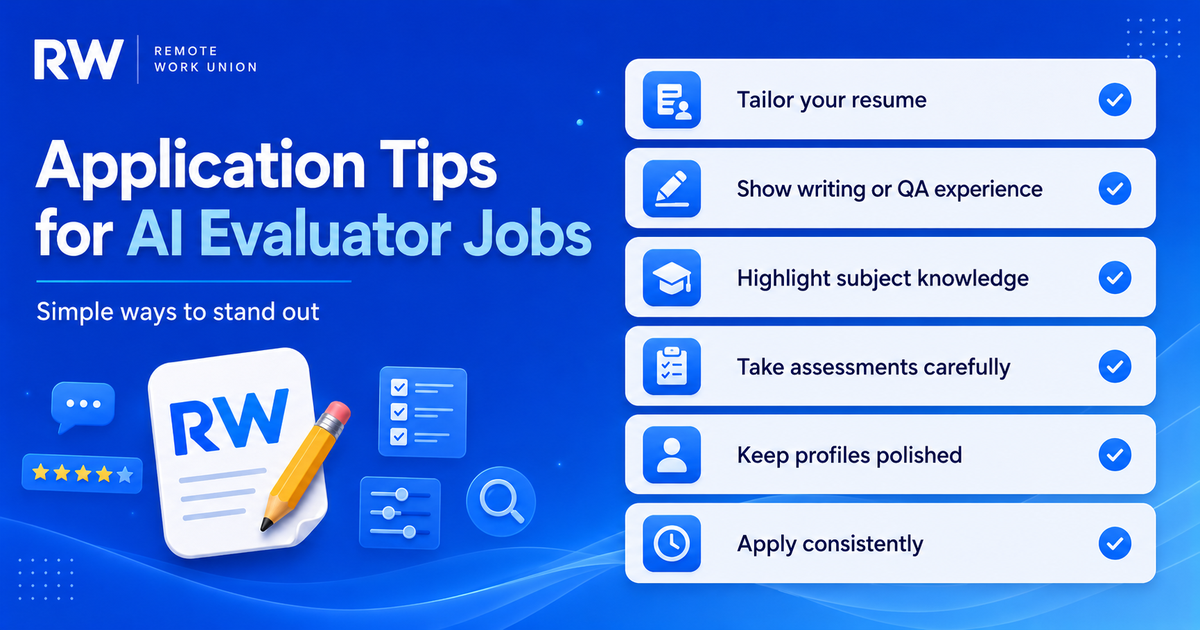
Start with a focused resume. Do not send a generic remote-work resume to every AI evaluator listing. Emphasize writing, editing, research, QA, annotation, rubric use, A/B comparison, fact-checking, domain expertise, prompt evaluation, response review, and any experience where you judged quality against a standard.
Create a simple profile that makes your strengths obvious. Good AI evaluator profiles usually answer three questions quickly: What can you evaluate? What proof do you have? Why should the platform trust your judgment?
Assessments matter. Many applicants rush them because the work looks easy. That is a mistake. Read the instructions, follow the rubric, write concise explanations, and check your answers before submitting. The assessment is often testing whether you can apply instructions consistently, not whether you can sound smart.
Resume Keywords and Phrases to Use
Useful resume keywords include AI evaluation, model evaluation, response review, prompt evaluation, data annotation, rubric-based assessment, quality assurance, A/B comparison, fact-checking, research, content review, editing, domain expertise, structured feedback, instruction following, LLM evaluation, chatbot evaluation, search quality, reasoning assessment, and human feedback.
Instead of saying only "good writer," use more specific language: "Reviewed written outputs for clarity, factual accuracy, instruction following, and user intent." Instead of saying only "attention to detail," use: "Applied detailed rubrics to compare options and document quality judgments."
Who Remote AI Evaluator Work Fits Best
Remote AI evaluator jobs can fit writers, editors, teachers, tutors, students, researchers, analysts, lawyers, paralegals, finance professionals, accountants, healthcare professionals, nurses, medical writers, coders, bilingual workers, consultants, and detail-oriented generalists. The work may be especially appealing if you want remote jobs with no phone calls, flexible online work, part-time AI work, project-based remote income, or a way to use your judgment without moving into full-time software engineering.
It is less ideal if you need guaranteed full-time hours immediately, dislike detailed instructions, rush through written assessments, or want work that requires no concentration. AI evaluation can be flexible, but it still requires accuracy and patience.
How to Avoid Weak or Misleading Listings
A legitimate AI evaluator listing should explain the task type, skill requirements, location eligibility, pay method, assessment process, contractor or employee status, and expected work structure. Be cautious with listings that promise easy money, guarantee unrealistic earnings, require suspicious upfront payments, avoid explaining the actual work, or use major AI company names without a clear relationship.
Before applying, check whether the platform explains how work is approved, whether tasks are available in your country, whether payment timing is clear, whether assessments are unpaid or paid, and whether your field of expertise is actually relevant to the project.
Practical Application Checklist
Prepare one general AI evaluator resume and one specialized version for your strongest field. Add a short writing or review sample if the platform allows it. Make a list of your strongest domains. Search multiple title variations instead of one keyword. Apply to both generalist and specialist projects where appropriate. Take assessments slowly. Track applications, pay terms, and project status in a spreadsheet. Revisit your profile after each assessment and improve weak areas.
Tip: Remote AI evaluator jobs are competitive, but the work is not mysterious. Companies need people who can judge whether AI answers are useful, accurate, safe, and clear. If you can apply instructions, write concise feedback, and bring real subject knowledge to the right projects, this can be one of the most practical remote AI job categories to explore.
Frequently Asked Questions
What do remote AI evaluators actually do?
Remote AI evaluators compare AI responses, rate answer quality against a rubric, check factual accuracy, identify hallucinations, review tone and clarity, flag unsafe content, and write concise explanations of their decisions. The work helps AI companies understand which model outputs are useful, accurate, and safe.
Do you need coding skills for remote AI evaluator jobs?
Not always. Many generalist AI evaluator jobs focus on writing, research, rating, and judgment. Coding projects exist, but they are only one lane within the broader remote AI evaluation market. Writers, researchers, teachers, lawyers, and healthcare experts can all qualify for relevant projects.
How does pay work for remote AI evaluator jobs?
Pay varies by task complexity, expertise, language, quality score, and contract structure. Some projects pay hourly, some pay per task. Higher specialization can improve earning potential. Read the terms carefully — a high advertised rate does not help if task volume is low or onboarding is slow.
What search terms should I use to find these jobs?
Search for remote AI evaluator jobs, AI rater jobs, AI model evaluation jobs, AI response reviewer jobs, prompt evaluation jobs, data annotation jobs from home, RLHF jobs, human feedback jobs, chatbot evaluator jobs, and LLM evaluator jobs. Combine titles with your domain for more targeted results.