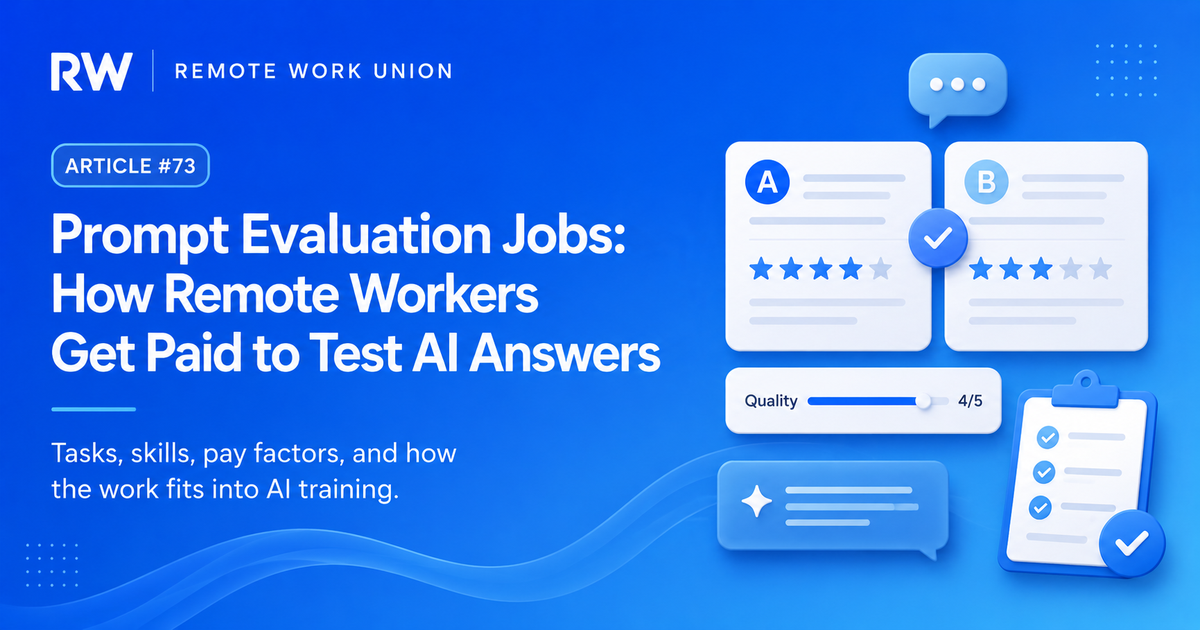
Prompt evaluation jobs are one of the clearest examples of how remote workers participate in AI training without building software themselves. The work is simple to describe: a worker reads a prompt, reviews one or more AI answers, judges which answer is better, explains the decision, and submits structured feedback. The actual skill is more demanding. Good evaluators have to notice weak reasoning, missing context, vague claims, unsafe advice, bad formatting, factual errors, and answers that sound confident but fail the task.
This type of remote AI work appears under many names: prompt evaluation, AI model evaluation, AI answer testing, AI rater work, chatbot response review, data annotation, RLHF, human feedback, and AI training jobs. For remote workers, prompt evaluation can be attractive because it rewards judgment more than phone presence. It is closer to quality review, research, writing, editing, and analytical scoring than customer support or data entry.
What Are Prompt Evaluation Jobs?
Prompt evaluation jobs are remote roles where workers test how AI systems respond to written instructions. A prompt might ask an AI assistant to summarize a document, compare two products, solve a math problem, write an email, research a topic, classify a request, rewrite a paragraph, explain a concept, or follow a detailed style guide. The evaluator does not simply say whether the answer is good or bad — they usually score the answer against specific criteria.
A typical evaluation may ask whether the AI answer is helpful, harmless, truthful, complete, concise, well-formatted, relevant to the prompt, and compliant with instructions. Some projects require a side-by-side comparison between Answer A and Answer B. Others ask the worker to rate a single answer. More advanced projects may require editing a response, writing a better answer from scratch, checking citations, identifying policy issues, or explaining exactly where the model failed.
How Prompt Evaluation Jobs Work
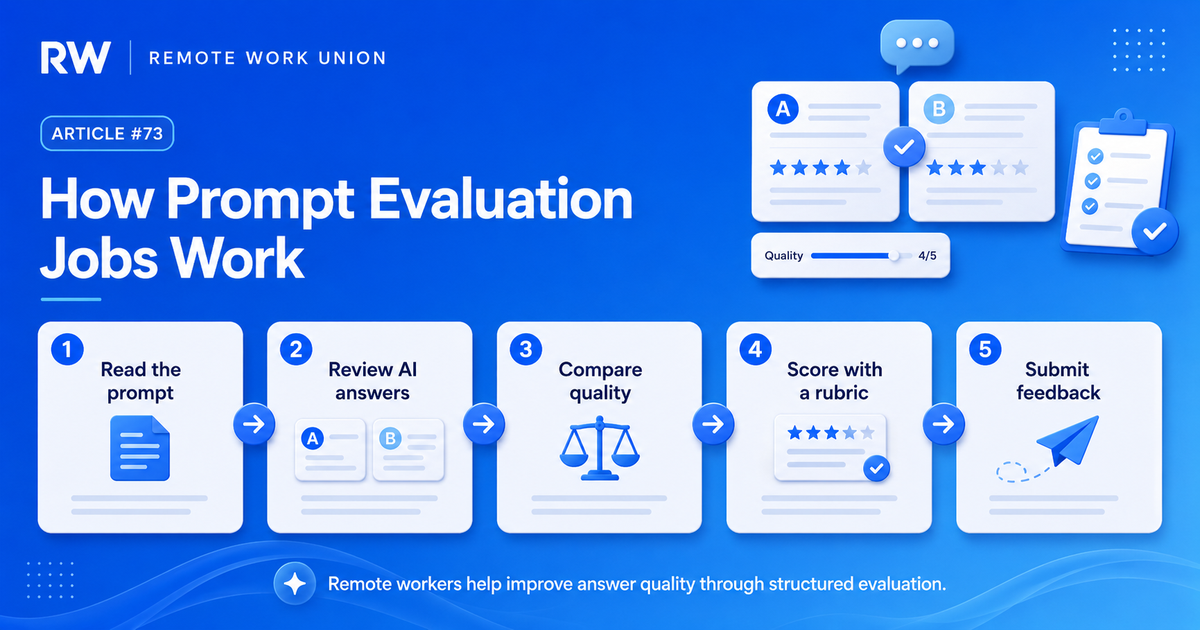
Most prompt evaluation projects follow a repeatable workflow. The platform gives you a task, prompt, rubric, and set of answers. You read the instructions first because the rubric usually matters more than personal taste. Then you review the AI response or compare multiple responses. You look for instruction-following, factual reliability, clarity, formatting, safety, tone, and usefulness. Finally, you select a score, choose a preferred answer if required, and write a short explanation.
A simple example: the prompt asks an AI assistant to explain how to prepare for a remote job interview. Answer A gives a practical checklist, addresses video setup, recommends testing the microphone, and explains how to discuss remote collaboration. Answer B is polished but generic, skips the remote-specific details, and repeats broad career advice. A good evaluator would not choose the answer that sounds more impressive. They would choose the answer that best satisfies the prompt.
Common Prompt Evaluation Tasks
Prompt evaluation work can range from beginner-friendly quality checks to expert-level analysis. The most common task types include side-by-side response comparison, single response rating, instruction-following review, factuality checking, citation checking, tone and style review, safety review, rewrite assessment, search result evaluation, and domain-specific answer review.
Side-by-side comparison is common because it forces a clear preference. You may be asked which AI answer is better and whether the difference is small, moderate, or large. Fact-checking tasks require stronger research habits because you have to verify whether the model's statements are accurate. Domain-specific tasks may involve legal, medical, finance, education, coding, science, or language expertise.
Prompt Evaluation vs Data Annotation vs AI Rater Jobs
These job titles overlap, but they are not identical. Data annotation is the broadest category — it can include labeling images, tagging text, categorizing documents, or creating datasets. AI rater jobs often involve evaluating search results, ads, maps, recommendations, or AI-generated responses. Prompt evaluation is more specific: it focuses on how an AI model responds to a prompt.
Prompt evaluation also overlaps with RLHF (reinforcement learning from human feedback). Many RLHF tasks ask people to compare outputs, rank answers, or provide preference data. For job seekers, the best strategy is to search multiple labels — do not only search for "prompt evaluation jobs." Also search for remote AI evaluator jobs, AI response reviewer jobs, chatbot rater jobs, AI model trainer jobs, data annotation jobs from home, human feedback jobs, and AI training jobs.
Skills That Make Someone Good at This Work
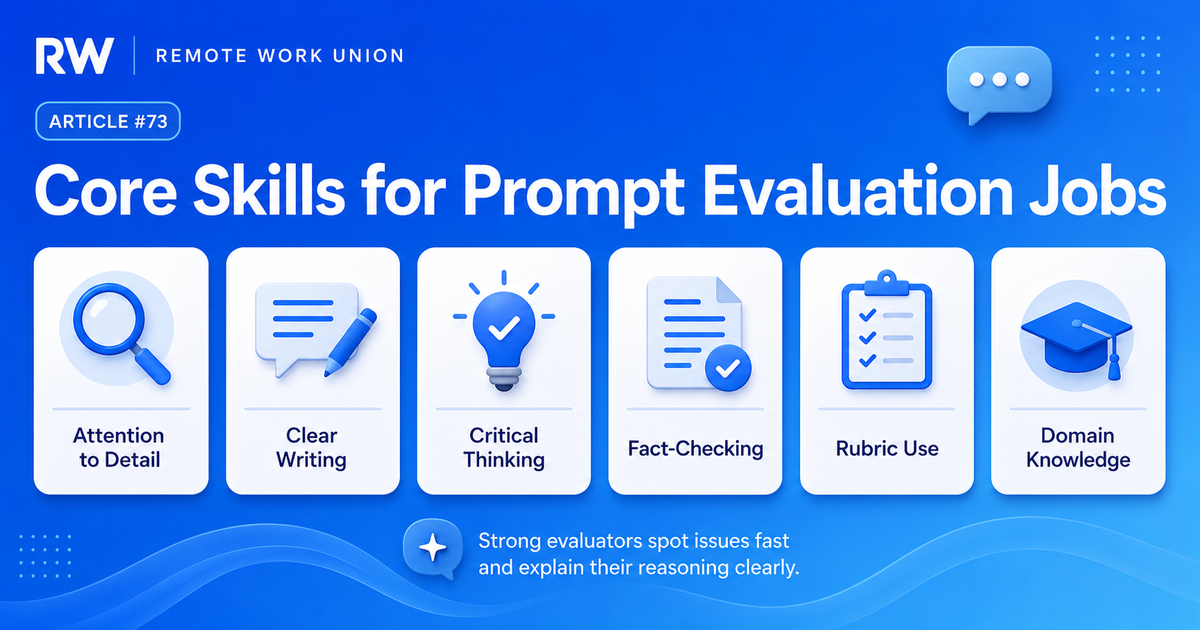
The strongest prompt evaluators are careful readers. They do not skim the instructions and jump straight to the answer. They check the prompt, the rubric, the constraints, the format, and the user's likely intent. Small details often decide the correct rating: if the prompt asks for five bullets and the AI gives a paragraph, that is an instruction-following issue. If the prompt asks for beginner-friendly language and the AI uses technical jargon, that is a usefulness issue.
Clear writing is also important. Many evaluation platforms require a brief explanation for each rating. Weak feedback says "Answer A is better." Strong feedback says "Answer A follows the requested checklist format, includes remote interview setup advice, and avoids generic career tips. Answer B is polished but misses the remote-work angle."
Critical thinking matters because AI answers can sound smooth while still being wrong. Fact-checking becomes more important in research-heavy tasks. For expert projects, domain knowledge can make a major difference.
Who Prompt Evaluation Jobs Are Best For
Prompt evaluation jobs are a strong fit for people who like reading, comparing, judging, editing, and explaining. Writers often do well because they understand tone, clarity, structure, and audience. Researchers do well because they know how to check claims and identify weak sourcing. Teachers and tutors do well because they are used to grading responses and explaining why an answer works. Analysts do well because they can separate evidence from opinion.
Legal professionals may review legal reasoning tasks. Healthcare experts may review medical explanation quality. Finance and accounting workers may evaluate business or investment-adjacent responses. Bilingual workers may review translation, localization, grammar, cultural context, or multilingual answer quality. The work may not be ideal for everyone — if you dislike detailed instructions, repetitive tasks, or written explanations, it may feel tedious.
What Affects Pay in Prompt Evaluation Jobs?
Pay varies widely by platform, project type, expertise, geography, availability, performance, and contract structure. Some projects are paid hourly. Others are paid per task. Some require unpaid screening or qualification tests before paid work begins.
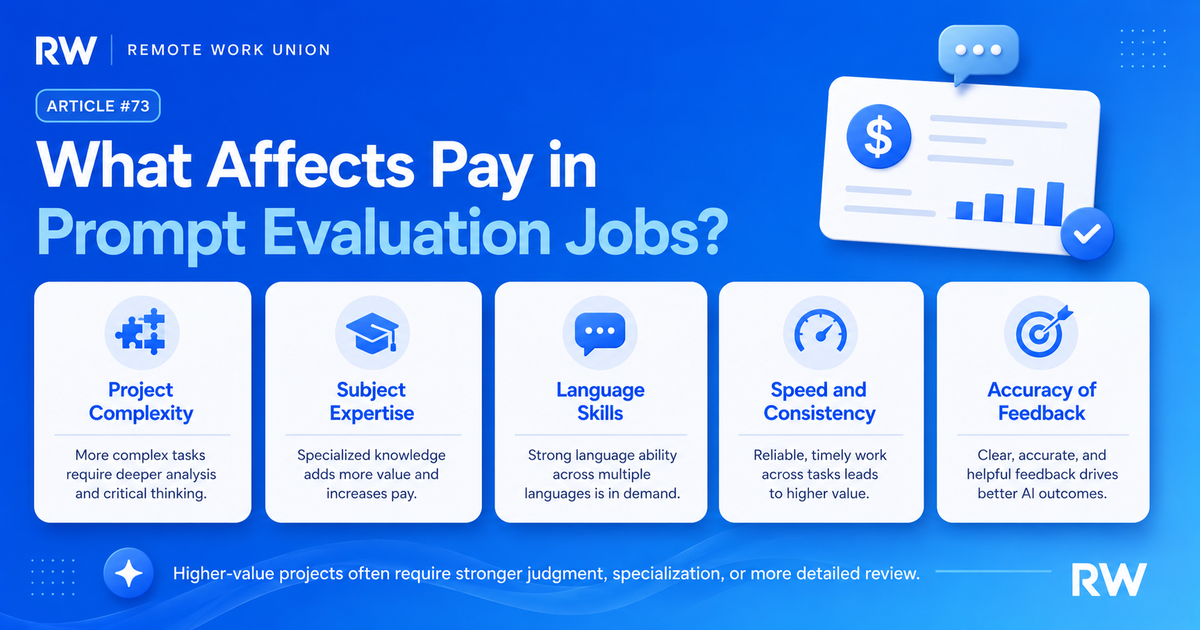
The most important pay factor is usually task complexity. Simple rating tasks are easier to train and may attract more applicants. Complex tasks that require writing, coding, legal review, medical review, finance knowledge, scientific reasoning, or multilingual evaluation may be more selective. Speed matters, but accuracy matters more — a worker who completes tasks quickly but misses rubric details will not last long on quality-controlled projects.
Remote Work Union connects you to legitimate prompt evaluation and AI training roles. Apply for free.
Find Roles Hiring Now →How to Apply for Prompt Evaluation Jobs
A strong application should show that you can evaluate quality, not just that you are interested in AI. Your resume or profile should include relevant terms naturally: AI evaluation, prompt evaluation, model evaluation, response review, rubric-based scoring, annotation, fact-checking, research, writing, editing, quality assurance, A/B comparison, and domain expertise.
For generalist roles, emphasize careful reading and clear written feedback. For specialist roles, lead with credentials, work history, and subject knowledge. For coding roles, include languages, frameworks, debugging experience, and examples of technical judgment. For bilingual roles, state your language pair, fluency level, and localization experience.
When completing a screening test, slow down. Most rejections happen because applicants miss instructions, not because they are incapable. Read the rubric before reading the answers. Watch for hidden constraints. Keep explanations concise. The best answer is the one that satisfies the task.
Red Flags to Avoid
Legitimate remote AI work should still feel like a real work opportunity. Be cautious with any listing that promises fast money with no screening, asks for payment to access jobs, hides the client and platform details, refuses to explain pay structure, or pushes you into a messaging app immediately. Also be careful with unrealistic expectations — prompt evaluation is not a guaranteed full-time income stream for every applicant. Task volume can rise and fall. Treat it like a remote work category to build around, not a magic button.
How to Stand Out as an Evaluator
The easiest way to stand out is to write better justifications. Many beginners give vague comments. Strong evaluators explain the decision in concrete terms: one answer followed the format, answered all subquestions, avoided unsupported claims, used safer wording, gave more useful examples, or matched the user's requested tone.
Tip: Develop a repeatable evaluation checklist. Before submitting, ask: Did the answer follow the prompt? Did it answer every part? Is it accurate? Is it useful? Is it concise enough? Is it formatted correctly? Is there any safety issue? Does the explanation match the score? That simple review step can reduce careless mistakes.
Frequently Asked Questions
Do you need coding skills for prompt evaluation jobs?
Not always. Many prompt evaluation jobs are writing, research, language, or general reasoning tasks. Coding skills can unlock technical projects, but they are not required for every remote AI evaluation role.
Are prompt evaluation jobs the same as prompt engineering?
No. Prompt engineering usually involves designing prompts to get better AI output. Prompt evaluation involves judging the output or judging the quality of prompts and responses. Some projects combine both, but the skills are different.
Can beginners apply for prompt evaluation jobs?
Yes, beginners can apply for generalist projects if they write clearly, follow instructions, and pass qualification tests. Specialist projects usually require stronger credentials or experience.
Is prompt evaluation work full-time?
Sometimes, but many opportunities are contract, project-based, or part-time. Task availability can change. Read the terms carefully and avoid assuming steady hours until a project proves consistent.
What should I search for besides prompt evaluation jobs?
Search for AI evaluator jobs, AI model evaluation jobs, AI rater jobs, chatbot response reviewer jobs, AI response reviewer jobs, data annotation jobs from home, RLHF jobs, human feedback jobs, and remote AI training jobs.