AI data annotation jobs are no longer just simple click-and-label tasks. For many Australian applicants, the most interesting remote AI work now sits at the intersection of writing, research, judgment, and subject matter expertise. Companies building large language models, AI search tools, chatbots, coding assistants, and productivity software need humans who can judge whether an AI answer is accurate, helpful, safe, well-written, and appropriate for the user.
That creates a strong opening for skilled applicants in Australia. If you can write clearly, follow detailed instructions, compare two answers carefully, fact-check claims, explain why one response is better than another, or bring professional knowledge from fields like law, finance, healthcare, education, science, or coding, you may be a better fit for AI training work than you realize.
What Are AI Data Annotation Jobs?
AI data annotation jobs involve preparing, reviewing, labelling, or evaluating data so artificial intelligence systems can learn from human feedback. For large language models and AI assistants, data annotation can be judgment-based. Instead of labelling a photo, you might read a prompt and compare two AI-generated answers. You may be asked which answer is more accurate, which is more helpful, which follows the instructions better, which uses better reasoning, or which avoids unsupported claims.
Common task types include AI response rating (scoring answers for helpfulness, accuracy, clarity, safety, and instruction-following), model evaluation (comparing two or more AI outputs), RLHF work (providing human preference data), prompt response writing (writing ideal answers to sample prompts), fact-checking (verifying whether an AI answer is supported), search quality evaluation (judging whether results satisfy user intent), data labelling (tagging text, images, or audio), and domain expert review (evaluating AI answers in a specialised field).
Why Australian Applicants Can Be a Strong Fit
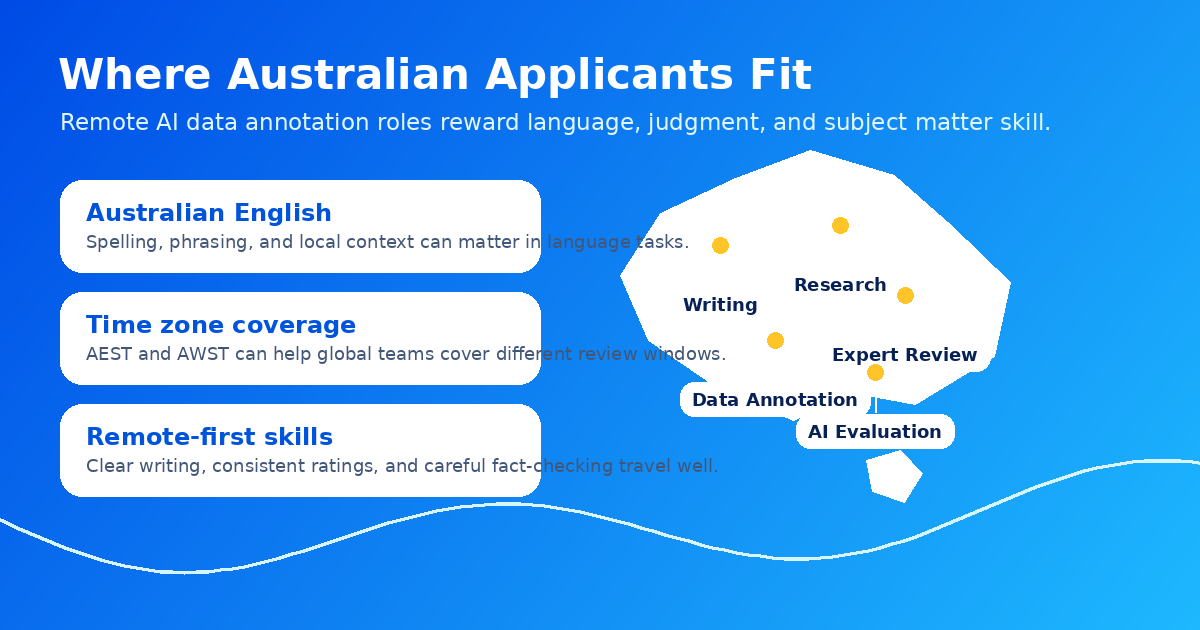
Australian applicants can be appealing for several reasons. Many AI training projects need excellent English. Native or fluent English skills are useful for writing tasks, conversation evaluation, grammar review, tone assessment, content editing, and user-intent judgment. Australian English can also matter when a project needs regional spelling, local context, or English-language diversity beyond the United States.
Australia also sits in useful time zones for global remote work, and has a large pool of educated professionals, freelancers, writers, researchers, students, graduates, and specialists who can bring real-world knowledge into AI model evaluation. The strongest Australian applicants position themselves as more than "remote workers" — they show that they can review AI outputs with precision, identify weak reasoning, catch hallucinations, write concise feedback, and follow policy guidelines consistently.
Basic Data Labelling vs. Higher-Skill AI Evaluation
When people search for "AI data annotation jobs Australia," they may see a wide range of opportunities. Basic data labelling may involve tagging images, categorising short text, or reviewing content for obvious labels. Higher-skill AI evaluation is different — these roles ask you to read a prompt, inspect an AI answer, compare it against another answer, and explain what is better or worse.
The title "data annotation" does not always tell the full story. Look for signals like "AI model evaluator," "AI trainer," "expert reviewer," "RLHF," "response ranking," "prompt evaluation," "human feedback," "fact-checking," and "domain expert" to identify higher-judgment work.
Skills That Matter Most for Remote AI Annotation Work
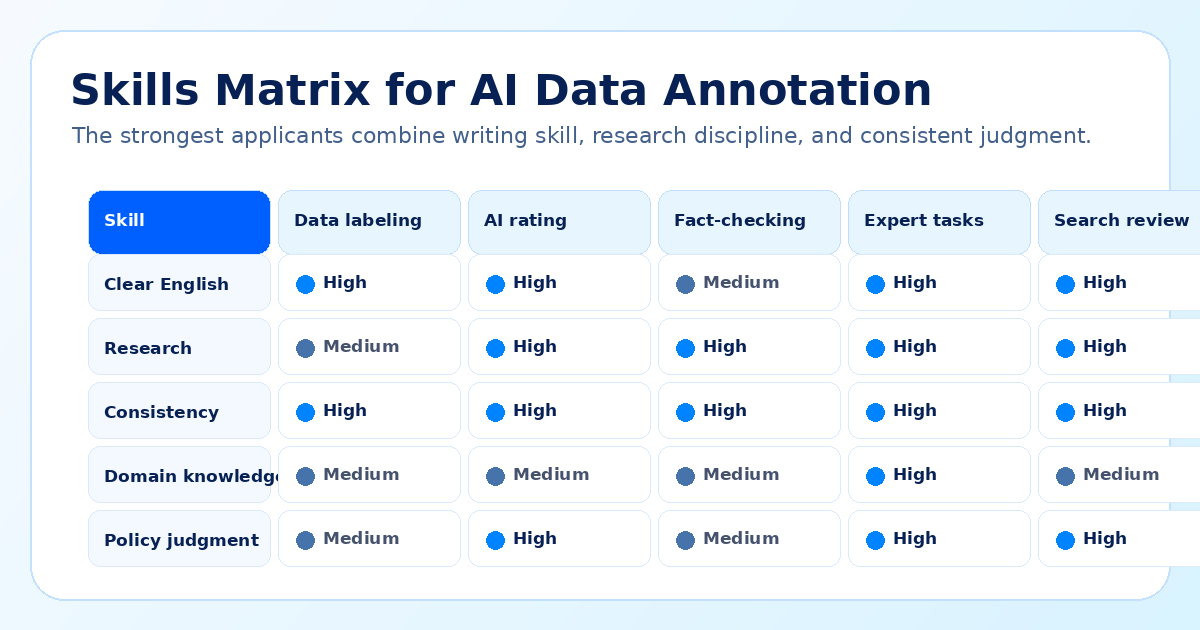
The best applicants are not always the fastest typists or the most technical people. Many remote AI training projects reward reliability, clear reasoning, and the ability to make consistent judgments under detailed guidelines. Important skills include clear written English, research discipline, consistent judgment, the ability to follow instructions, domain knowledge, and comfort with AI tools.
Key insight: Strong applicants can explain specific problems in an AI answer: "the response did not address the user's question," "the tone was too formal," "the conclusion added unsupported claims," or "the response failed to follow a formatting instruction." Vague feedback like "this is better" is usually too weak.
Remote Work Union connects you to legitimate remote AI training and evaluation roles. Apply for free and find roles hiring now.
Find Roles Hiring Now →What Australian Applicants Should Put on a Resume or Profile
Your profile should answer three questions quickly: What kind of AI work can you do? Why are you qualified? Can you work reliably online? Useful resume phrases include AI model evaluation, AI response review, data annotation, data labelling, human feedback for AI systems, prompt response writing, search quality evaluation, fact-checking and source verification, content editing, technical writing, research analysis, quality assurance, rubric-based evaluation, error identification, written feedback, and domain expert review.
For Australian applicants, also mention Australian English, remote collaboration, independent contractor experience, and time-zone availability where relevant. Do not bury the AI-relevant parts at the bottom — if the platform uses automated screening, the right keywords matter.
How to Search for AI Data Annotation Jobs From Australia
Search terms to use include: AI data annotation jobs Australia, remote AI jobs Australia, work from home AI jobs Australia, AI training jobs Australia, AI evaluator jobs, AI model evaluation jobs, data labelling jobs remote, search quality rater jobs, RLHF jobs, AI writing evaluator jobs, prompt evaluator jobs, AI fact-checking jobs, chatbot evaluator jobs, LLM evaluator jobs, and AI response rating jobs.
You can also search by field: legal AI evaluator jobs, finance AI training jobs, medical AI reviewer jobs, coding AI evaluator jobs, education AI training jobs, and marketing AI content evaluation jobs. The practical move is to apply widely but selectively — build a strong profile, prepare for assessments, and apply across several legitimate remote AI training sources.
How Applications and Assessments Usually Work
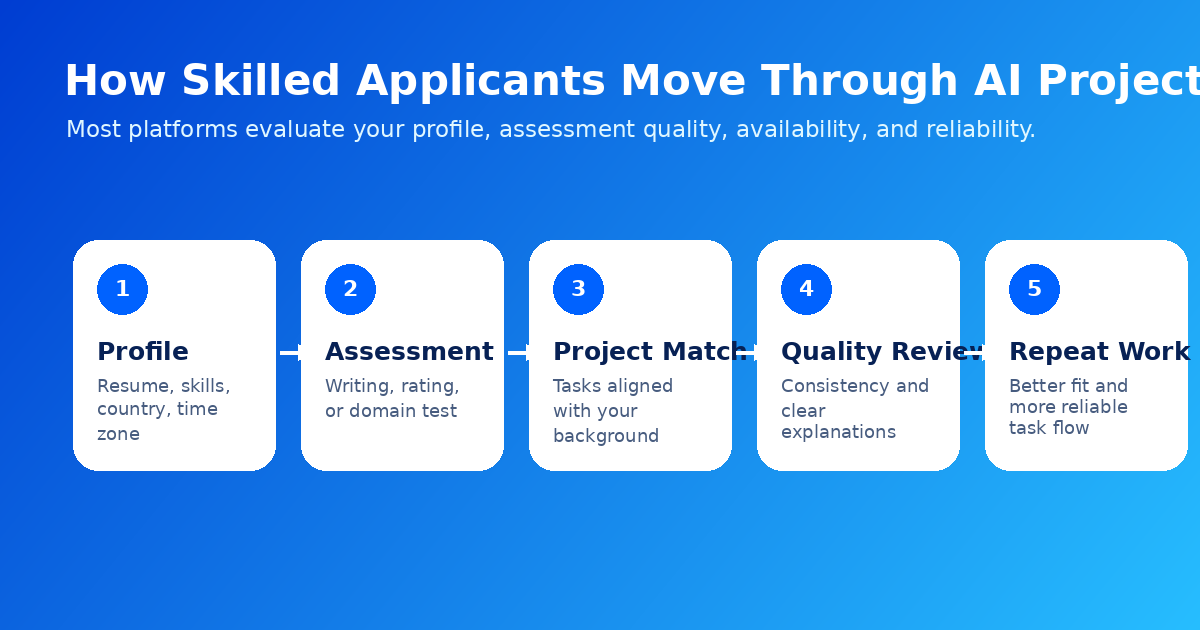
Most AI training platforms want to know whether you can follow directions before they give you paid tasks. First, you create a profile. Second, you take an assessment — this may test writing, grammar, reasoning, fact-checking, coding, or your ability to compare AI answers. Third, you may be matched to a project. Fourth, your early work may be reviewed closely.
Skilled applicants should take assessments seriously. Read the instructions slowly. Avoid rushing. Use clear explanations. Most platforms want practical, direct reasoning that shows you understood the task.
What to Watch Out For Before Accepting Work
Remote AI work can be legitimate, but not every listing is good. Be cautious if a job promises guaranteed high income with no screening, asks you to pay a fee to access work, uses a copied brand name or suspicious email domain, avoids explaining the task type, refuses to show contract terms, asks for bank details too early, or pressures you to move the conversation to an encrypted messaging app immediately.
Australia-Specific Practical Checklist
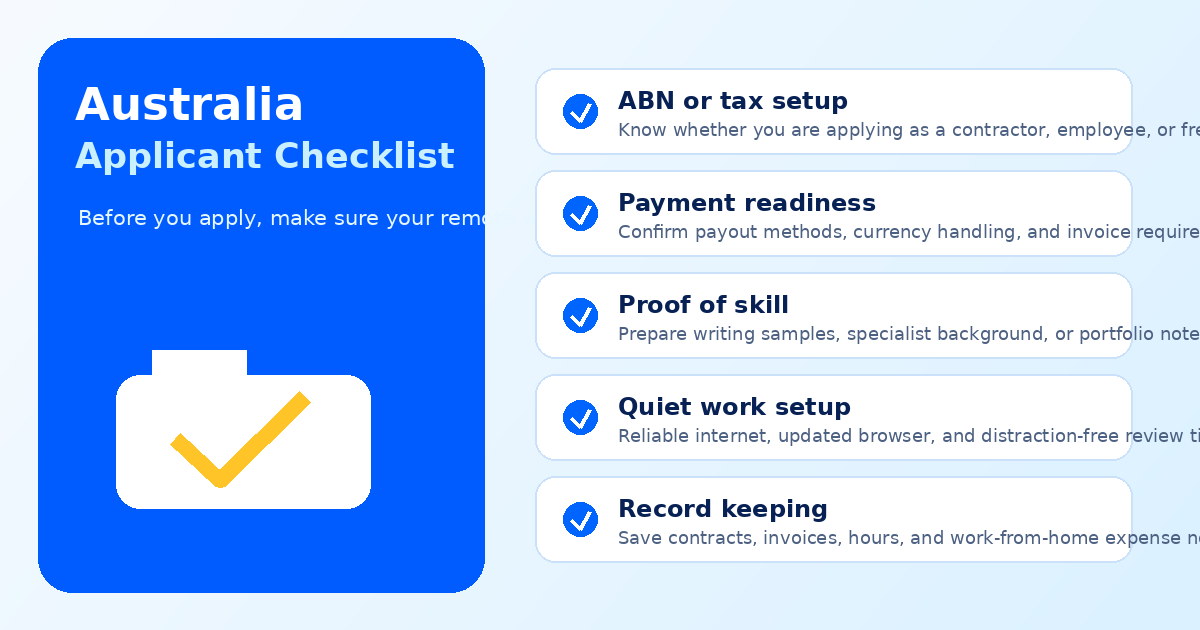
Before applying, make sure you can check off these items:
- Know your work status — understand whether the role is contractor, freelance, or employee-based, and what that means for tax and super.
- Prepare a clean online resume with AI evaluation keywords and relevant skills.
- Build short proof points — writing samples, research summaries, or technical explanations.
- Set up a reliable work environment with stable internet and a quiet workspace.
- Track your applications in a spreadsheet with platform, role, date, assessment status, and follow-up notes.
- Keep tax and payment records — save contracts, invoices, payout receipts, and work-related expense records.
Common Mistakes That Hurt Applicants
Applying with a generic resume that does not show AI evaluation fit. Treating assessments casually. Chasing only the easiest jobs when professional expertise could qualify you for higher-value specialist projects. Ignoring location rules. Overpromising expertise you cannot back up. Not applying widely enough to multiple platforms.
Frequently Asked Questions
Are AI data annotation jobs available in Australia?
Yes. Australian applicants can find remote AI data annotation, AI model evaluation, writing evaluator, research reviewer, and expert AI training roles through dedicated AI training platforms, general job boards, and contractor marketplaces. Availability varies by project, platform, and skill set.
What is the difference between basic data labelling and higher-skill AI evaluation?
Basic data labelling involves tagging images, categorising short text, or checking obvious labels. Higher-skill AI evaluation asks you to compare AI answers, judge reasoning quality, fact-check claims, write feedback, and evaluate specialist content. Higher-skill work often pays more and requires clearer writing and subject expertise.
Do Australian AI data annotation jobs require a tech background?
Not for most roles. Many AI data annotation and model evaluation jobs reward writing ability, research skill, domain expertise, and careful attention to guidelines rather than technical or engineering backgrounds. Writers, researchers, teachers, lawyers, healthcare professionals, and business analysts can all qualify.
What should Australian applicants include on a resume for AI training work?
Include terms like AI model evaluation, data annotation, data labelling, prompt evaluation, RLHF, human feedback, chatbot evaluation, AI content review, writing evaluation, editing, fact-checking, research review, source verification, search quality, classification, quality assurance, guideline adherence, and written feedback. Also mention Australian English and relevant domain expertise.
Are remote AI jobs in Australia full-time or part-time?
Most remote AI data annotation and model evaluation roles are contract-based, part-time, or project-based rather than full-time employment. Task volume can change as projects start and pause. Applying to multiple legitimate platforms creates more consistent income opportunities.