AI evaluation jobs are one of the clearest remote work opportunities for educated applicants in the United States, Canada, the United Kingdom, and Australia. These roles sit inside the broader world of AI training, model evaluation, data annotation, response ranking, RLHF, prompt writing, and human review. The work is usually not about building artificial intelligence from scratch. It is about helping AI systems produce better answers by reviewing outputs, comparing responses, checking facts, and writing clear feedback.
For native or highly fluent English speakers, this can be a strong fit. Many AI products are built for global English-speaking users, and major AI companies such as OpenAI, Anthropic, Google, Meta, Microsoft, and xAI all depend on some form of human feedback, expert review, data quality work, safety evaluation, or model assessment.
What AI Evaluation Jobs Actually Involve
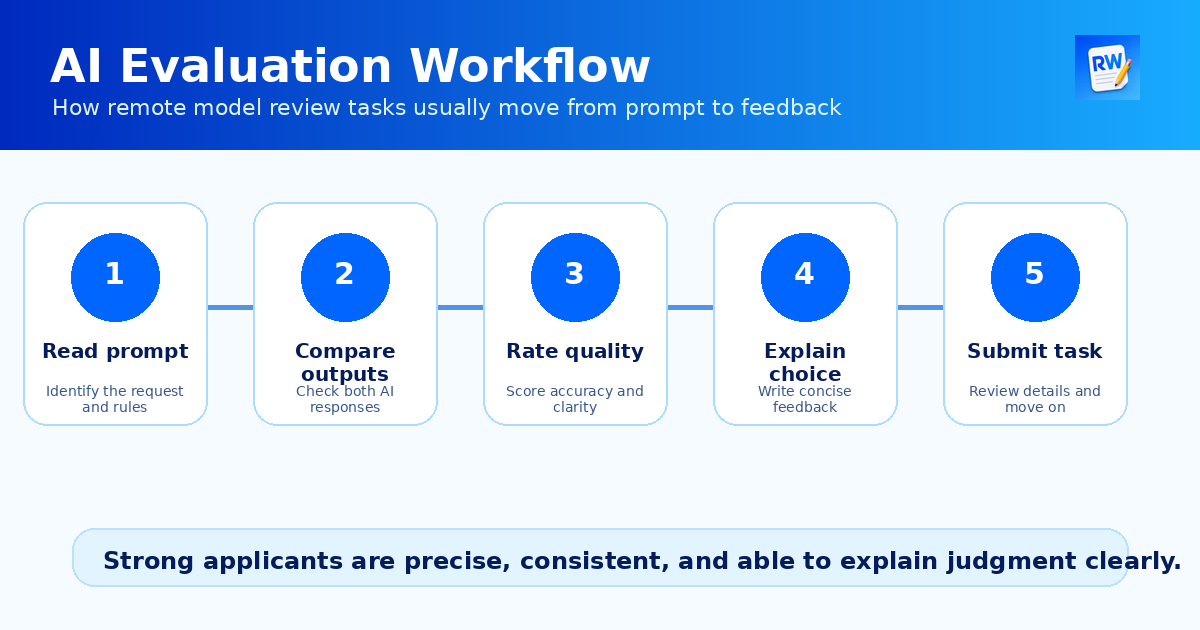
AI evaluation jobs are remote roles where human reviewers help judge the quality of AI-generated answers. A task may show you a prompt and two model responses. Your job is to decide which response is more helpful, accurate, clear, safe, and aligned with the instructions. In other tasks, you may write the ideal answer yourself, fact-check a response, label whether an answer contains a hallucination, or explain why a response fails the rubric.
Common tasks include comparing two AI answers, ranking chatbot responses, writing feedback for model outputs, testing prompts, identifying unsafe or low-quality answers, checking sources, rewriting weak answers, labeling data, and reviewing specialized content in areas such as law, finance, healthcare, education, coding, business, science, and creative writing.
Why US, Canadian, UK, and Australian Applicants Are Often a Strong Fit
Applicants from these countries often match the language and market requirements of English-language AI evaluation projects. Many tasks require strong English judgment, cultural fluency, spelling and grammar awareness, and the ability to recognize whether an answer sounds natural to a particular audience. That does not mean every role is open in every country — some projects are country-specific because of client requirements, payment setup, tax documentation, legal rules, language variety, or timezone coverage.
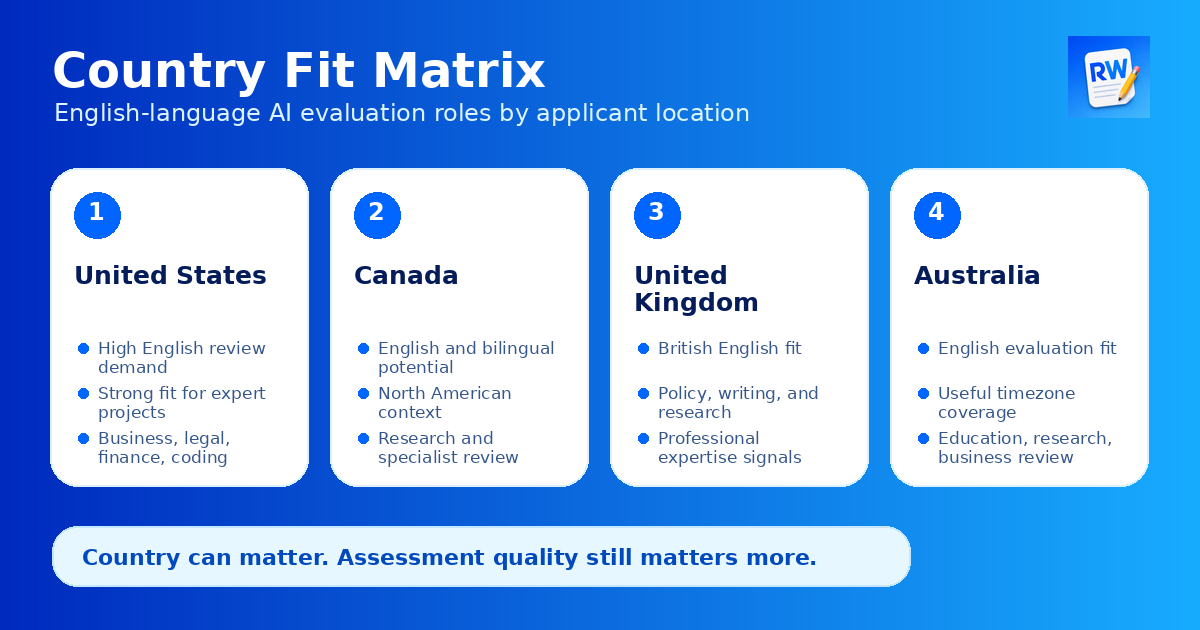
The US market often has a high volume of English-language model evaluation and domain-specific AI training projects. Canadian applicants may fit both English and bilingual projects, especially where French-English review or North American context is useful. UK applicants can be valuable for British English, policy review, academic writing, and professional expertise. Australian applicants may be a good fit for English evaluation, education, research, and timezone coverage.
The Best Types of AI Evaluation Jobs for English-Speaking Applicants
The most accessible roles are general AI response evaluation and English-language review. These tasks reward people who can read carefully and explain why one answer is better than another. Strong writers, editors, researchers, tutors, analysts, and college-educated applicants often do well.
Writing evaluator roles suit people in content, marketing, journalism, editing, academic writing, tutoring, or communications. Fact-checking and research roles suit applicants who are good at verifying claims, reading sources, and distinguishing confident AI language from accurate information. Domain expert AI evaluation roles can pay more because they require specialized knowledge in law, finance, coding, healthcare, education, science, or business operations.
How These Jobs Differ From Ordinary Data Annotation
Traditional data annotation can involve labeling images, tagging text, or sorting examples into categories. AI evaluation may include annotation, but many roles require more reasoning. You may need to compare two long answers, identify subtle instruction-following issues, explain factual weaknesses, and justify a rating. A basic data entry resume is usually not enough — the best applicants show evidence of reading comprehension, writing ability, research skill, domain knowledge, remote work discipline, and comfort using AI tools.
Remote Work Union connects you to legitimate remote AI training and evaluation roles. Apply for free and find roles hiring now.
Find Roles Hiring Now →Country-Specific Positioning Tips
US applicants should emphasize clear written English, professional experience, domain knowledge, remote reliability, and any background in research, writing, coding, legal analysis, finance, healthcare, education, or business operations. Make your US location easy to confirm in your profile and resume.
Canadian applicants should highlight English fluency, bilingual ability if relevant, North American context, research skills, and professional expertise. If you can review Canadian English, US English, or French-English content, mention that clearly when the platform allows it.
UK applicants should highlight British English, editorial judgment, policy awareness, academic training, professional writing, and legal or financial experience. Some projects care about local language conventions and cultural context, so spelling, phrasing, and regional understanding can matter.
Australian applicants should highlight English-language review, education, research, remote availability, timezone coverage, and domain experience. Being in a different timezone from most evaluators can sometimes be useful for coverage.
Resume Keywords to Include Naturally
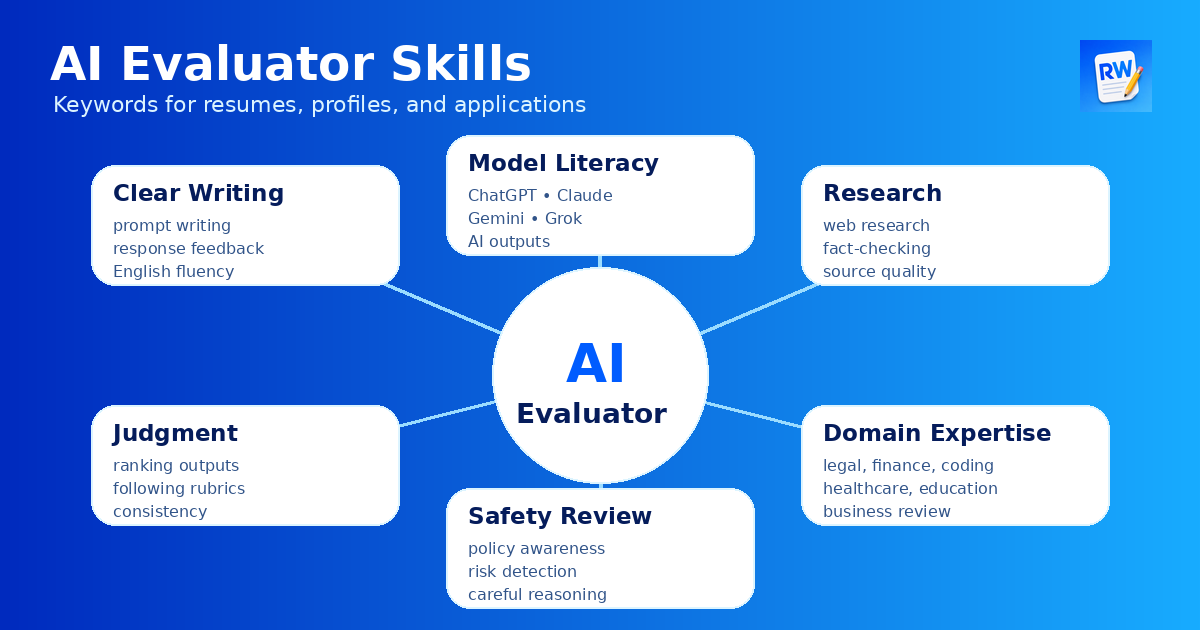
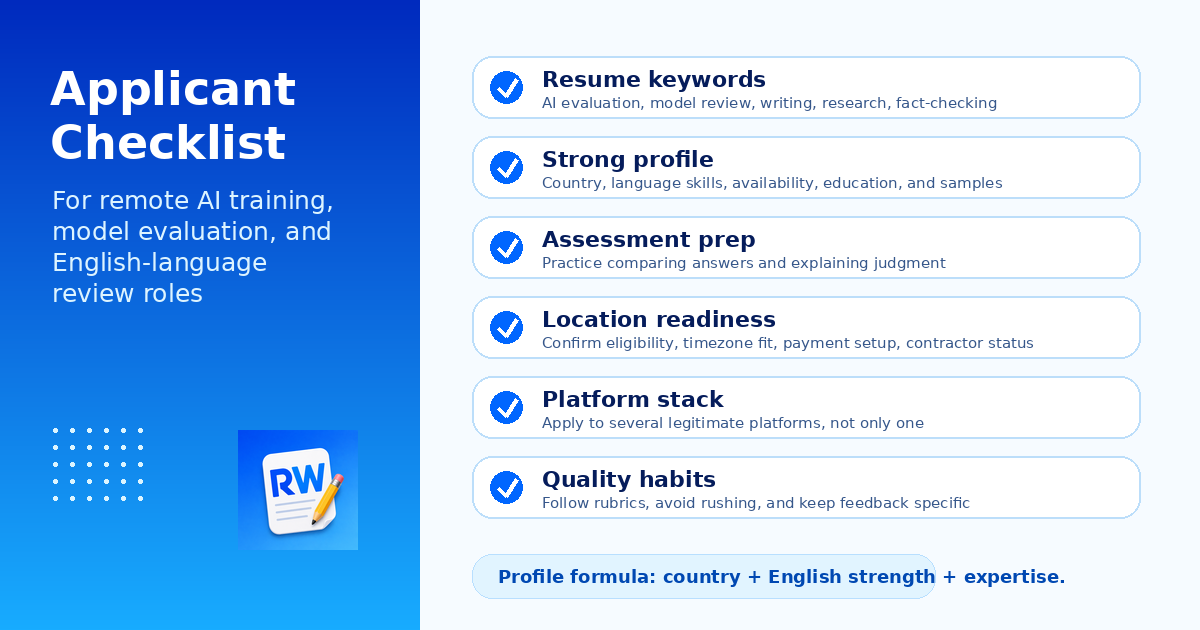
Relevant phrases include AI evaluation, AI training, model evaluation, response ranking, data annotation, RLHF, prompt writing, prompt evaluation, chatbot review, English-language evaluation, fact-checking, research, editing, writing feedback, rubric-based review, quality assurance, content review, search quality, safety evaluation, and instruction following.
You can also include tool and company keywords where accurate: ChatGPT, Claude, Gemini, Grok, OpenAI, Anthropic, Google, Meta, Microsoft, AI search, large language models, generative AI, LLMs, AI outputs, and prompt engineering.
How to Prepare for AI Evaluator Assessments
Most serious AI evaluation platforms use some form of assessment. Before taking an assessment, practice asking three questions: Did the answer follow the prompt? Is it factually accurate? Is it helpful and clear for the user? Then look for safety issues, unsupported claims, missing constraints, bad formatting, irrelevant sections, and overconfident statements.
When you explain your choice, be specific. Instead of saying one answer is better, say why: it follows all constraints, cites stronger evidence, avoids speculation, answers the user directly, or uses clearer structure. Good feedback is concise but not vague — two to four sentences are often better than a long paragraph.
How to Apply Without Relying on One Platform
Remote AI work can be inconsistent. Projects start, pause, fill up, change requirements, or become unavailable in certain locations. A better approach is to build a small platform stack and keep your profile updated across several legitimate sources. Search for terms such as remote AI evaluator, AI training jobs, AI model evaluation, AI data annotation, prompt evaluator, RLHF reviewer, AI writing evaluator, AI fact-checking jobs, chatbot response reviewer, search quality rater, and LLM evaluation. Also search by expertise.
What Makes a Strong Applicant Profile
A strong applicant profile is specific. Instead of saying you are good at computers, say you have experience reviewing written content, researching claims, working remotely, using spreadsheets, writing professional feedback, or evaluating technical information. For expert roles, connect your background directly to the work: a lawyer can mention legal research, issue spotting, citation review, and analytical writing; a finance professional can mention accounting, Excel, and business analysis; a teacher can mention curriculum, tutoring, grading, and feedback.
Mistakes to Avoid
Do not describe yourself only as a data entry worker if you are applying for model evaluation roles that require judgment. Do not overpromise technical skills you do not have. Do not rush assessments. Do not ignore country eligibility. Do not submit a resume that never mentions AI, writing, research, evaluation, or domain expertise. Do not assume remote means work is always available.
Frequently Asked Questions
Why are US, Canadian, UK, and Australian applicants often a strong fit for AI evaluation jobs?
Applicants from these countries often match the language and market requirements of English-language AI evaluation projects. Many tasks require strong English judgment, cultural fluency, spelling and grammar awareness, and the ability to recognize whether an answer sounds natural to a particular audience.
How do AI evaluation jobs differ from ordinary data annotation?
Traditional data annotation can involve labeling images, tagging text, or sorting examples into categories. AI evaluation often requires more reasoning — comparing two long answers, identifying subtle instruction-following issues, explaining factual weaknesses, and justifying a rating. Strong written judgment matters more than speed.
What resume keywords should I use for AI evaluation jobs?
Use: AI model evaluation, data annotation, response ranking, prompt evaluation, RLHF, research, fact-checking, editing, writing, quality assurance, content review, subject matter expertise, instruction following, analytical reasoning, error detection, classification, rubric-based scoring, search evaluation, technical review, and feedback writing.
How do I prepare for an AI evaluator assessment?
Read the instructions carefully before starting. Identify what dimension the task is measuring — accuracy, tone, instruction-following, safety, or completeness. Apply the rubric, not your gut preference. Explain your judgment in two to four specific sentences. Slow down at the beginning and speed up at the end — never rush the instructions.