Native and fluent English speakers have a natural advantage in many remote AI training jobs. A large portion of AI model evaluation, writing review, content quality assessment, chatbot improvement, and research verification work is built specifically for people who can judge English the way real users experience it — not just grammatically, but for tone, flow, cultural accuracy, and meaning.
This matters because AI systems are not just being tested for grammar. They are being judged for whether answers feel helpful, natural, trustworthy, and appropriate. A model trained on feedback from fluent English speakers produces better English outputs. That is why platforms consistently look for native or near-native English reviewers across US English, UK English, Canadian English, and Australian English.
Why Native English Matters in AI Training
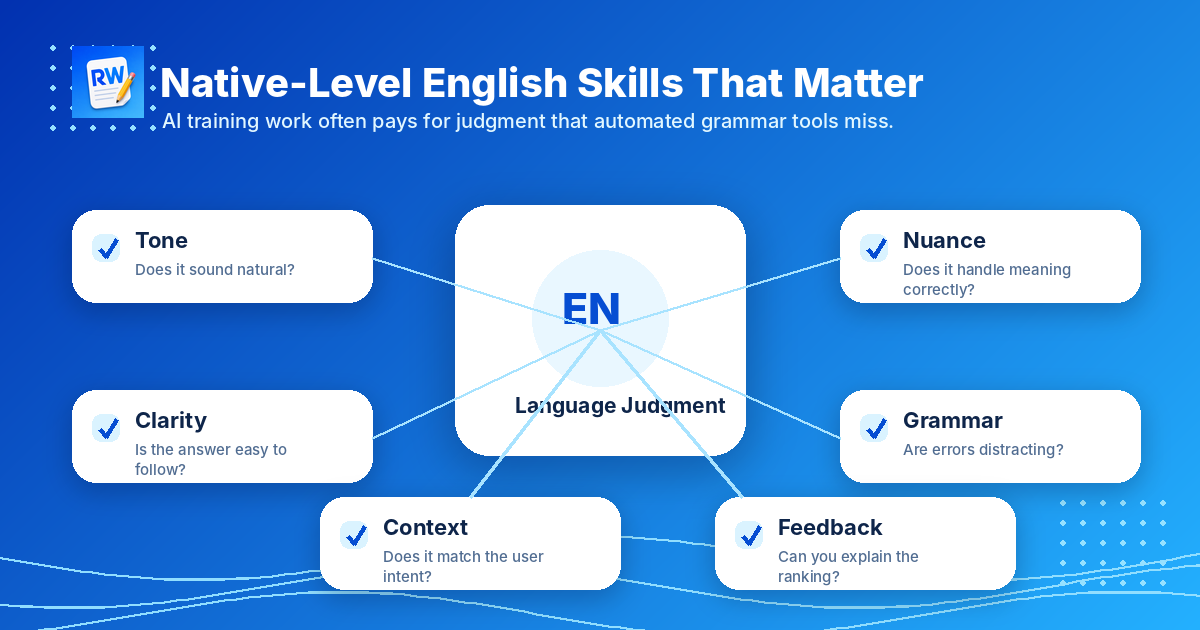
English-language AI evaluation is not just about avoiding grammatical errors. The work is often about subtle judgment: Does this answer sound like something a real expert would say? Does the tone match what the user asked for? Is the phrasing natural for an American audience, or British, or Australian? Does the response miss an obvious cultural assumption? Does a confident-sounding answer actually contain a factual error?
Non-native speakers can catch many of these issues, but native fluency provides a finer-grained instinct for what sounds right. That instinct is what AI companies are paying for when they specify "native or fluent English" in their evaluator requirements.
The Best Role Types for Native English Speakers
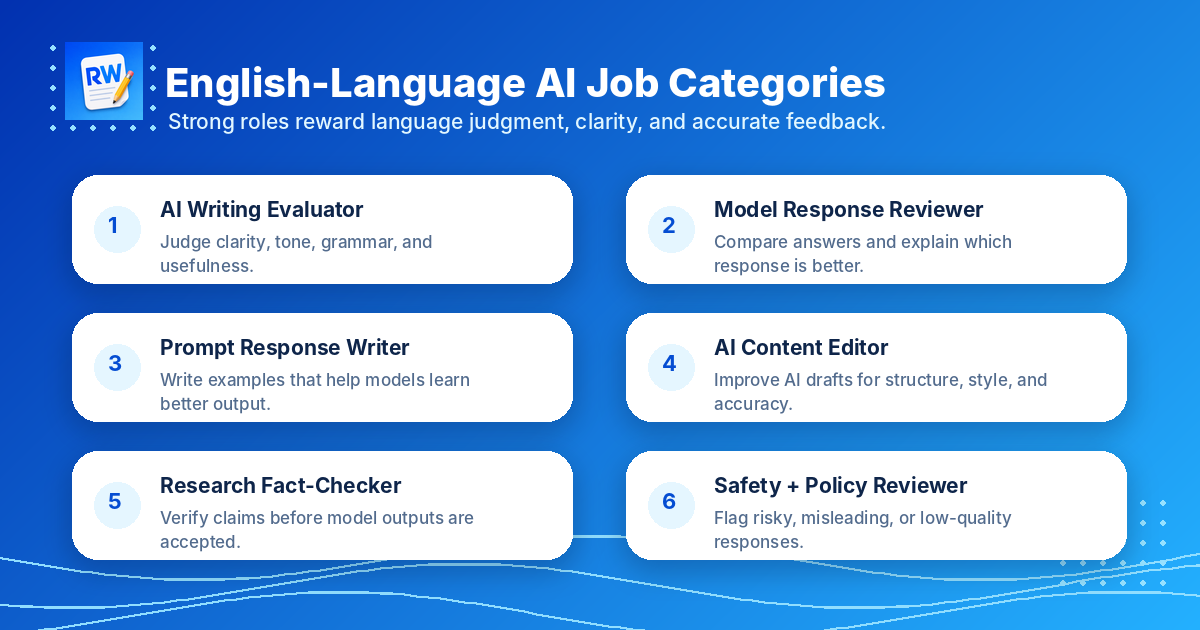
Not all English-language AI training roles are the same. Some are broad and beginner-friendly. Others require domain expertise or advanced research skills. The five strongest categories for native English speakers are writing evaluation, response comparison, search quality rating, fact-checking, and specialist domain review.
Writing and editorial roles suit people who can judge whether language is clear, concise, natural, and purposeful. Research roles suit people who can verify claims, evaluate sources, and identify when a confident answer is actually unsupported. Specialist roles suit people with professional credentials in law, finance, healthcare, education, coding, or business.
Best English-Language Writing Evaluation Roles
AI writing evaluator is one of the most common entry points for native English speakers. These roles ask you to compare two AI-generated responses and explain which is better — clearer, more natural, more accurate, or better suited to the user's intent. Strong writers, editors, journalists, and communications professionals often excel in this category.
AI response comparison reviewer roles show you a prompt and two model outputs. Your job is to select the better one and justify your choice with specific, rubric-based reasoning. The key skill is not just choosing — it is explaining concisely and precisely. "Response A is better because it follows the formatting instruction, avoids speculation, and gives a complete answer" is more useful than "A seems better."
Content quality reviewer roles evaluate whether AI-generated content meets standards for accuracy, tone, instruction-following, clarity, and safety. These may include reviewing email drafts, blog posts, customer service responses, educational content, or product descriptions generated by AI.
Best English-Language Research and Fact-Checking Roles
AI fact-checking reviewer roles are strong for English speakers with research or journalism backgrounds. The task is to verify whether an AI response contains accurate claims, supported evidence, and appropriate uncertainty. AI models frequently produce fluent answers that contain subtle factual errors, outdated information, or fabricated citations. A careful researcher can catch these where a less disciplined reader might miss them.
Search quality rater roles ask you to judge whether AI search results or AI-generated summaries actually satisfy a user's query. This requires understanding not just what the user asked, but what they probably needed — and whether the result truly delivered that. English fluency and cultural familiarity are directly relevant here because query intent often depends on local knowledge.
Remote Work Union connects you to legitimate remote AI training and evaluation roles. Apply for free and find roles hiring now.
Find Roles Hiring Now →Best Specialist Roles for English-Speaking Experts
Domain expert review is where native English ability combines with professional credentials to create strong value. These roles require both fluent English judgment and subject matter knowledge.
Legal experts can review AI-generated legal summaries, contract explanations, compliance responses, and issue-spotting exercises. Finance and accounting experts can evaluate investment explanations, accounting concepts, spreadsheet reasoning, and business analysis. Healthcare professionals and medical writers can review health-related AI responses for accuracy, patient safety, and appropriate caveats. Educators and tutors can evaluate learning content, tutoring responses, and student-friendly explanations. Software engineers and technical writers can review code explanations, debugging output, algorithm logic, and technical documentation.
Tip: For specialist roles, be accurate about your credentials. A paralegal is not the same as a solicitor. A student is not the same as a practicing clinician. Platforms may test your knowledge, and overstatement can lead to failed assessments and lost access.
Core Skills Native English Evaluators Need
The most important skills for English-language AI training roles are consistent with what makes any careful reviewer strong: clear explanation, attention to instructions, skepticism about confident-sounding answers, and the ability to follow a rubric without substituting personal preference for objective criteria.
- Clear, concise written English — feedback that explains the reasoning, not just the conclusion.
- Instruction-following — applying the rubric exactly, not improvising.
- Skepticism — noticing when a fluent answer is actually incorrect or incomplete.
- Consistency — making the same judgment under the same conditions across many tasks.
- Domain knowledge — when applicable, the ability to evaluate specialist content for accuracy.
- Familiarity with AI tools — experience using ChatGPT, Claude, Gemini, or similar systems.
Resume Keywords and Profile Tips
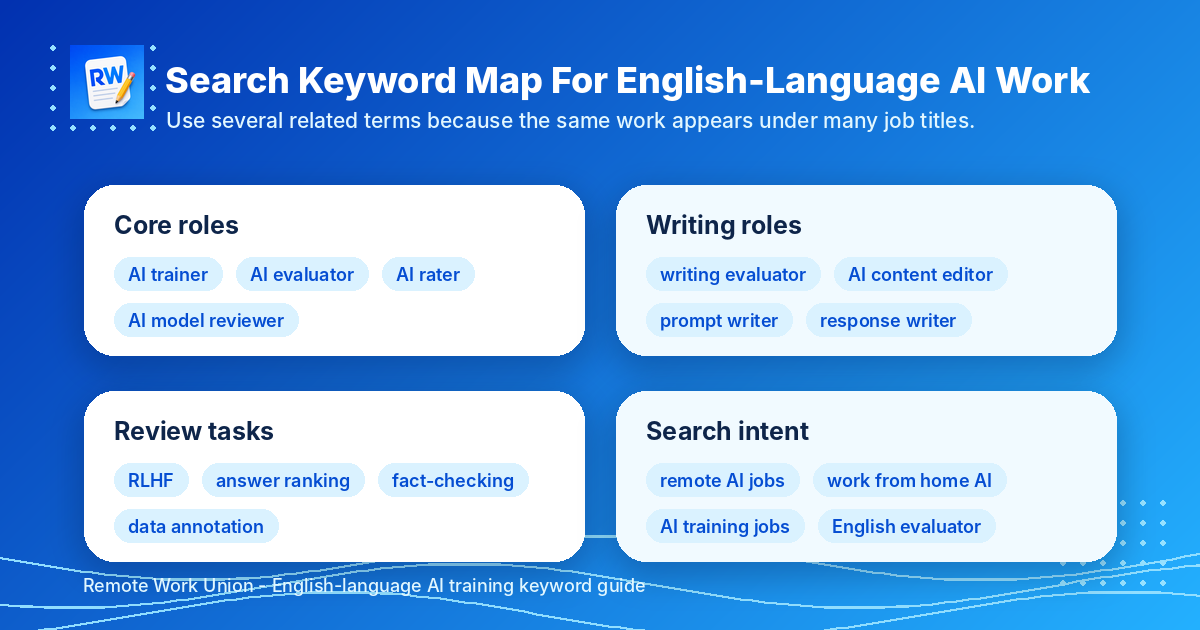
Your resume should use the language AI training platforms actually look for. Useful keywords include: AI writing evaluation, AI response review, AI model evaluation, RLHF, human feedback, prompt evaluation, data annotation, content quality review, search quality rating, fact-checking, source verification, rubric-based evaluation, editorial judgment, instruction following, domain expert review, and native English evaluation.
In your profile summary, name your English variety and your strongest skill: "US-based writer with 8 years of editorial experience, specialising in AI writing evaluation, response comparison, and fact-checking." Or: "UK legal researcher with experience in AI model evaluation for legal reasoning, citation review, and compliance writing." Specificity wins over generic enthusiasm.
Application Path and Assessments
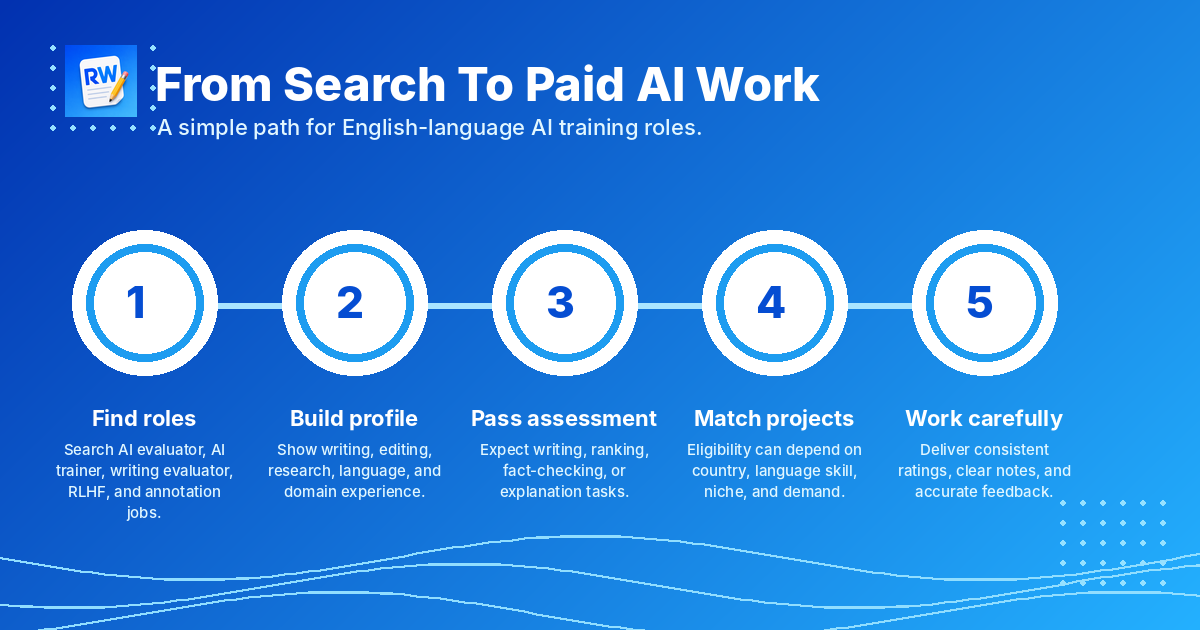
Most English-language AI training applications follow a predictable path: profile creation, skills selection, assessment, project matching, onboarding, and tasks. The assessment is where most applicants either advance or stall. Read every instruction twice. Identify what the task is actually measuring — not just "which answer is better" but specifically what dimension: accuracy, tone, instruction-following, safety, or completeness.
Write your feedback in plain language. Avoid academic jargon unless the task calls for it. Two to four clear sentences that identify the deciding factor are usually more effective than a long paragraph that repeats the same point. Remember: AI platforms are not grading your writing ability. They are grading your judgment reliability.
Frequently Asked Questions
Why do AI training jobs often require native or fluent English?
Many AI products are built for English-speaking users, and the AI systems need human reviewers who can judge whether answers sound natural, accurate, and appropriate for a native English speaker. Subtle language issues — tone, register, cultural assumptions, and idiomatic phrasing — are hard for non-native reviewers to catch consistently.
What are the best AI training jobs for native English speakers?
The best fits are AI writing evaluator, AI response comparison reviewer, search quality rater, AI fact-checking reviewer, content quality reviewer, and domain expert AI review. Writers, editors, researchers, and professionals with subject expertise are especially competitive for higher-value roles.
Do English-language AI training jobs require coding?
Most English-language AI writing and evaluation roles do not require coding. Coding evaluation roles exist as a separate category. The majority of English-language AI training jobs reward clear writing, careful judgment, research skill, and the ability to follow a detailed rubric.
What keywords should I use for English-language AI training job searches?
Try: native English AI evaluator, AI writing evaluator remote, English-language AI training jobs, AI response reviewer English, AI model evaluation English speakers, RLHF jobs English, data annotation English, search quality rater, AI content reviewer native English, and English AI trainer jobs.
How do I stand out as a native English applicant?
Be specific about your English variety and context — US English, UK English, Canadian English, or Australian English. Add your domain expertise and show clear proof points in your profile. Take assessments carefully and explain your judgments with precise reasoning rather than vague preferences.