Phone support teaches real workplace skills, but it can also become exhausting. Constant calls, strict availability windows, angry customers, scripts, and back-to-back queues make many customer service reps want remote work without living on the phone all day.
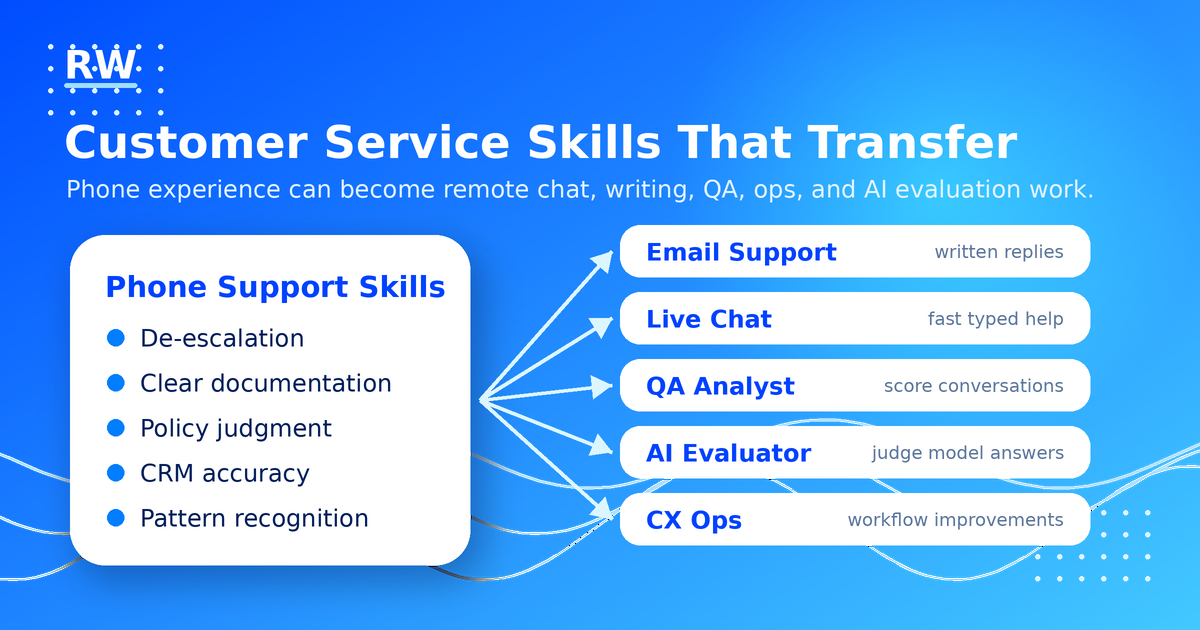
The good news is that customer service experience transfers well into many work from home jobs. A strong support rep already knows how to understand a problem, read between the lines, document what happened, follow policy, and communicate clearly. Those same skills are useful in chat support, email support, quality assurance, customer success operations, help center writing, trust and safety, and remote AI training jobs.
Leaving the phones does not mean starting over. It means repositioning your customer service background for roles where written judgment, accuracy, and customer empathy matter more than call volume.
Why customer service reps are stronger remote candidates than they think
Many customer service reps underestimate their value because their job title sounds basic. In reality, phone support builds a combination of speed, patience, pattern recognition, and judgment that many remote employers need.
A customer service rep who has handled hundreds or thousands of calls has usually practiced several high-value skills: interpreting messy customer requests, calming tense situations, identifying what information is missing, applying company policy, escalating when needed, using CRM tools, writing internal notes, and protecting the customer experience without promising things the company cannot deliver.
Those skills are especially relevant for remote roles because remote teams rely heavily on documentation. When there is no manager standing nearby, the person doing the job has to write clearly, make reasonable decisions, and leave a clean record of what happened. That is exactly what good support reps already do.
The best remote jobs for customer service reps leaving the phones
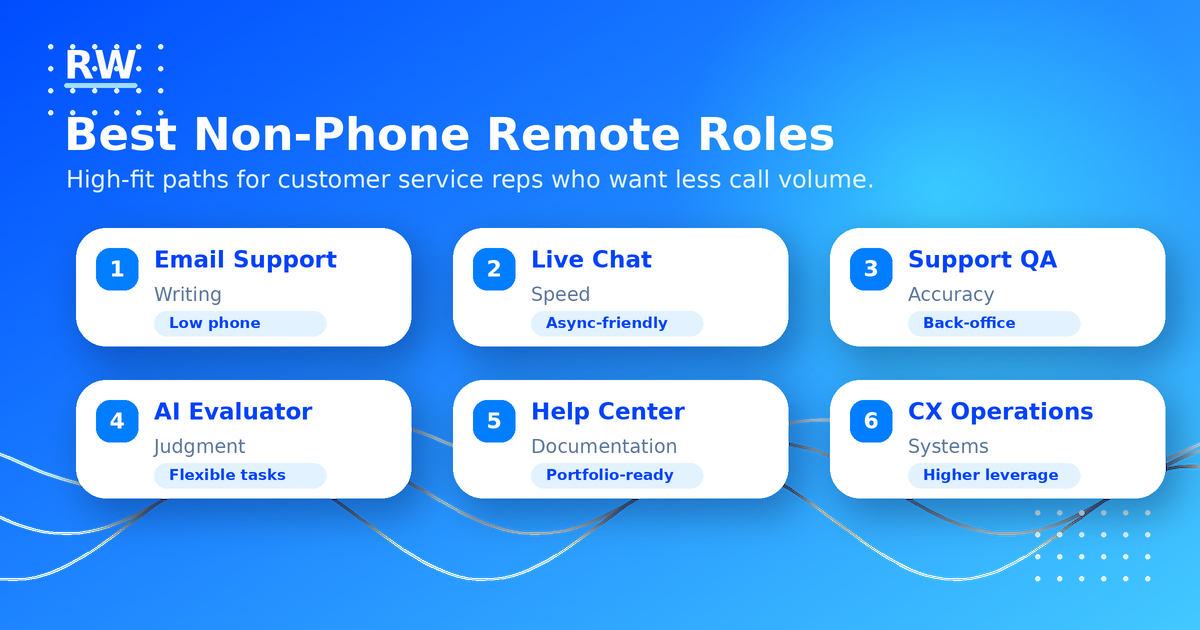
These are the strongest work from home jobs to target if you want to move away from phone-heavy customer service while still using your background.
1. Email support specialist
Email support is one of the cleanest transitions from phone customer service. You are still helping customers, but the work is written instead of spoken. That means fewer interruptions, more time to think, and a clearer paper trail.
This role is a good fit if you are strong at explaining policies, writing concise replies, and handling customers who are upset without sounding robotic. Employers often look for experience with ticketing systems such as Zendesk, Intercom, Freshdesk, Gorgias, Salesforce Service Cloud, HubSpot, or similar tools.
To position yourself, emphasize ticket resolution, written notes, customer satisfaction, refunds, account updates, order issues, troubleshooting, and policy-based decision making. Even if your previous role was phone-first, mention any email follow-ups, case notes, escalation summaries, or CRM documentation you created.
2. Live chat support representative
Live chat support is usually faster than email but less draining than phone work. You may handle multiple conversations at once, answer product questions, walk customers through account issues, or triage problems before sending them to a specialist.
This role rewards speed, typing clarity, multitasking, and calm written communication. It is a strong fit for customer service reps who are tired of calls but still like helping customers directly.
On your resume, use keywords such as live chat, chat support, customer inquiries, multitasking, macros, canned responses, escalation, first response time, customer satisfaction, and CRM documentation.
3. Customer support QA analyst
Support quality assurance is one of the best next steps for experienced customer service reps. Instead of answering every customer yourself, you review support interactions and score whether agents followed policy, communicated clearly, solved the issue, and represented the company well.
This can include reviewing phone transcripts, chat logs, email threads, refund decisions, escalation notes, and support tickets. It is a strong remote role because the work is document-based and can often be done asynchronously.
If you have ever trained new reps, corrected mistakes, spotted policy issues, or helped improve templates, you have useful experience for support QA. Position yourself around accuracy, coaching, process improvement, policy compliance, quality scorecards, and customer experience standards.
4. Remote AI response evaluator
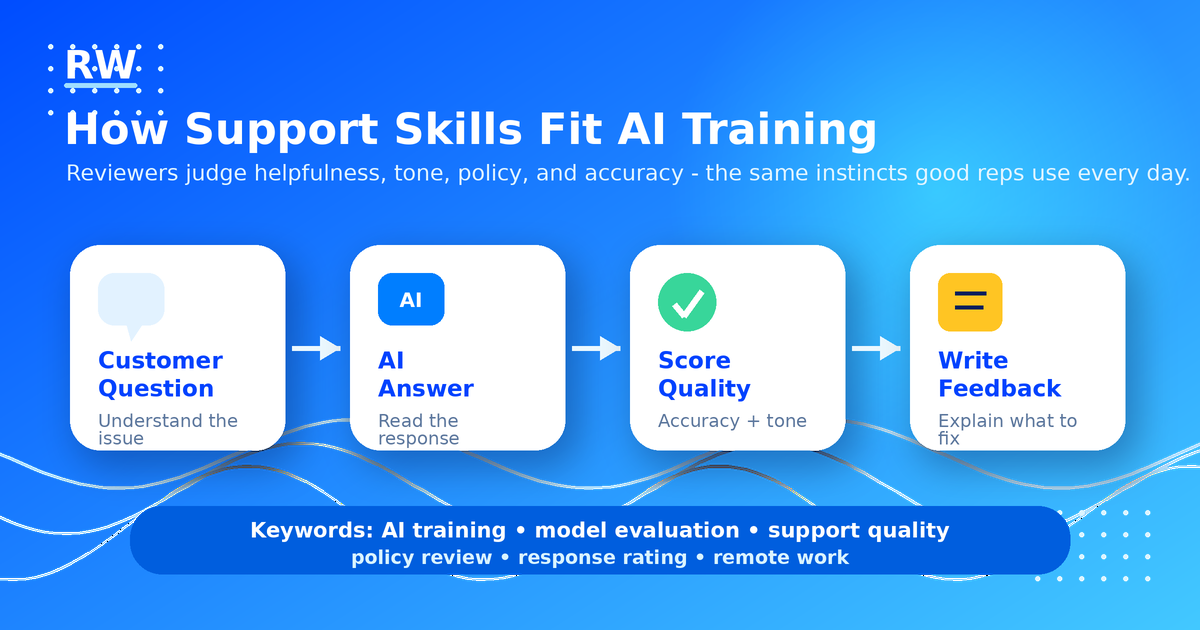
AI training and AI response evaluation can be a strong fit for customer service reps because the work often requires human judgment. In many tasks, you read a prompt or customer-style question, compare possible AI responses, rate which answer is more helpful, and explain what makes one response better than another.
Customer service reps are used to judging whether an answer is helpful, accurate, empathetic, and appropriate. That is directly relevant to model evaluation, chatbot evaluation, support-response review, content quality rating, and AI feedback tasks.
This category may appear under job titles such as AI trainer, AI evaluator, response evaluator, AI data annotator, model evaluator, conversation reviewer, search quality evaluator, prompt response reviewer, or AI customer support reviewer. Platforms and companies connected to the broader AI labor market may include micro1, Mercor, Handshake AI, and other remote AI work platforms. Major AI companies such as OpenAI, Anthropic, Google, Meta, and xAI/Grok also create demand for human feedback, evaluation, and review work across the AI ecosystem.
The key is to present your experience as judgment-based, not just service-based. Use language like: evaluated responses, followed policy, identified unsafe or incorrect answers, improved customer outcomes, documented reasoning, and reviewed communication quality.
Your customer service experience is more valuable than you think for remote AI training and evaluation roles. Find opportunities hiring now.
Find Roles Hiring Now →5. Help center content specialist
A help center content specialist writes or updates support articles, FAQ pages, how-to guides, troubleshooting steps, product instructions, and internal knowledge base documents. This is one of the best remote paths for customer service reps who are good writers.
Support reps often know exactly where customers get confused. That makes them valuable for documentation work. If you can turn repeated customer questions into clear help articles, you can move from answering the same issue over and over to preventing the issue from becoming a ticket in the first place.
A simple portfolio can help. Create a sample help center article, a rewritten FAQ page, or a before-and-after customer email template. Employers want to see that you can explain a process clearly without adding unnecessary complexity.
6. Customer success coordinator
Customer success roles can include calls, but many coordinator roles are lower-call than traditional support. The work may include onboarding customers, tracking renewals, updating account notes, preparing reports, coordinating handoffs, and helping account managers keep customers engaged.
This role is especially relevant if you have worked with business customers, subscription products, software accounts, renewals, billing issues, or onboarding. It can be a step toward higher-paying customer success manager roles if you want to stay in the customer experience field.
When applying, read the job description carefully. Some customer success roles are call-heavy. Others are mostly account operations, documentation, email follow-up, and CRM work.
7. Customer operations specialist
Customer operations is a strong path for support reps who like systems more than constant customer interaction. These roles may involve cleaning CRM data, updating workflows, creating macros, organizing tags, routing tickets, improving support processes, and reporting on common issues.
This is a good fit if you are the person who notices broken processes, repeated customer complaints, missing internal documentation, or inefficient handoffs. It can also lead into operations, support systems, revenue operations, or business analyst roles over time.
Useful keywords include customer operations, CX operations, support operations, CRM, ticket routing, workflow, macros, automations, reporting, process improvement, knowledge base, and support analytics.
8. Trust and safety or policy support reviewer
Trust and safety work often involves reviewing content, accounts, reports, user behavior, appeals, or policy decisions. Customer service reps with strong judgment can be a good fit because they are used to applying rules while dealing with sensitive or emotional situations.
This work can be repetitive and requires consistency. It may also involve reviewing uncomfortable material depending on the company and role, so read job descriptions carefully. For the right person, it can be a remote path that uses support skills without requiring constant phone calls.
9. Refunds, billing, and order exceptions specialist
Many companies separate complex billing, refunds, shipping, chargebacks, and order exceptions from general phone support. These roles are often written, ticket-based, and policy-heavy.
This is a strong option if you have experience with ecommerce, subscriptions, logistics, healthcare administration, insurance support, fintech support, or any role where you had to review records before making a decision.
The best resume language here focuses on accuracy, policy compliance, fraud prevention, chargeback documentation, refunds, account updates, order research, and escalation management.
10. Community support moderator
Community support roles sit between customer service, social media, moderation, and customer education. You may answer questions in online communities, flag issues, route feedback, enforce rules, or help users find resources.
This role is a good fit if you are comfortable writing in a brand voice and responding publicly without escalating tension. It can be especially relevant for customer service reps with experience in social media support, product communities, creator platforms, gaming, software, or online education.
How to translate phone support experience into remote work keywords
The biggest mistake customer service reps make is describing their experience only as answered calls. That makes the job sound narrow. Instead, describe the skills underneath the calls.
For example, instead of saying "answered inbound calls," write something more specific: resolved customer issues across account, billing, order, and product questions while documenting outcomes in a CRM. Instead of "handled angry customers," write: de-escalated high-friction customer interactions while following policy and protecting customer satisfaction.
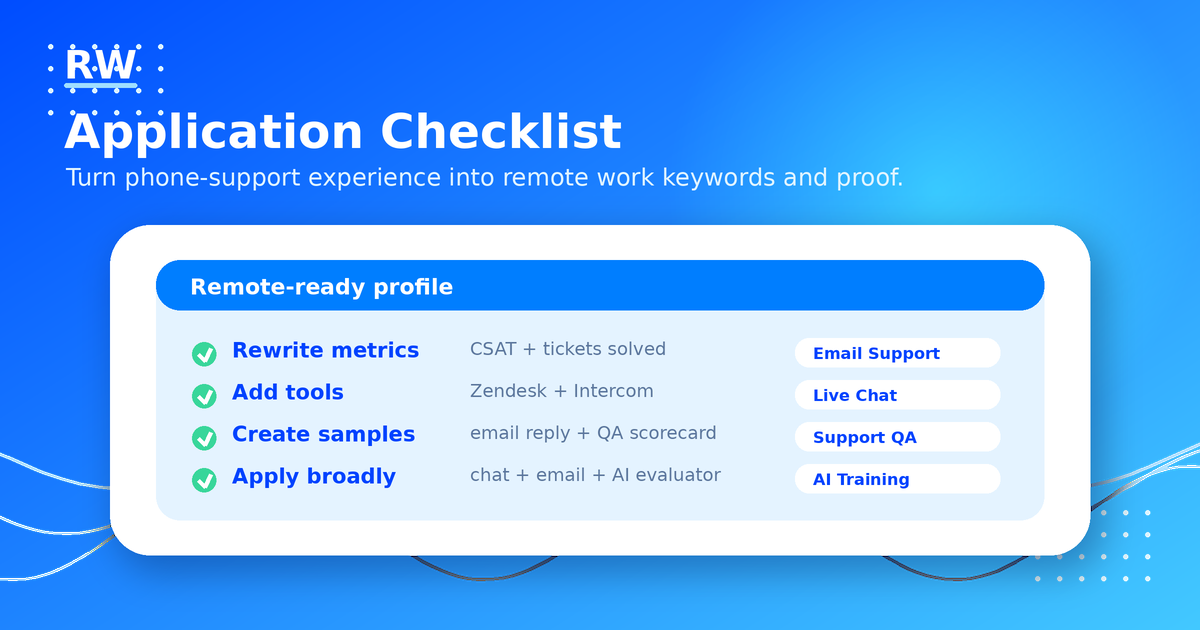
Use numbers when possible. Strong metrics include customer satisfaction score, average tickets resolved per day, first response time, resolution rate, quality score, retention saves, refund accuracy, upsell conversion, training responsibilities, escalation volume, and CRM documentation accuracy.
Remote employers are scanning for evidence that you can work independently. Your resume should show that you can read instructions, communicate in writing, make judgment calls, and document your work without constant supervision.
A simple resume section for leaving phone support
A customer service rep moving into remote work can use a skills section like this:
Remote Customer Experience Skills: email support, live chat, customer escalation, CRM documentation, Zendesk, Intercom, Salesforce, HubSpot, policy review, customer satisfaction, quality assurance, refund review, knowledge base updates, written communication, remote collaboration, AI response evaluation, model feedback.
This kind of section makes it easier for recruiters and matching systems to connect your background with remote support, operations, and AI training roles.
How customer service reps can build proof without a new degree
You do not need a new degree to move out of phone-heavy support. You do need proof that you can do the next role.
Create a short portfolio with three simple samples. First, write a professional email response to a difficult customer. Second, write a help center article that explains a common problem in plain English. Third, create a support QA scorecard that grades a sample reply on accuracy, tone, policy, and completeness.
For AI evaluation roles, add a sample where you compare two possible chatbot responses to the same customer question and explain which one is better. Focus on helpfulness, accuracy, clarity, empathy, safety, and whether the response follows the instructions.
This kind of proof is simple, but it shows that you understand the work. It also gives you something concrete to discuss in applications and interviews.
Which roles are most likely to reduce phone time?
If your main goal is to leave the phones, target roles where the core work is written, review-based, or operational. Email support, support QA, help center writing, AI response evaluation, and customer operations are usually better bets than general customer success manager roles, account management roles, or sales development roles.
Live chat can still be intense because it is real-time, but it usually avoids the emotional drain of back-to-back calls. Customer success can pay more, but many roles include meetings and customer calls. Read each job description carefully and search for phrases like email-first, chat-based, asynchronous, ticket-based, back-office, quality assurance, documentation, no phone, low phone, and remote-first.
What to avoid when applying
Avoid remote jobs that charge you to start. Real remote work platforms and legitimate employers do not require an upfront fee just to apply. Also be careful with commission-only phone sales roles that are advertised as customer service, vague business opportunity listings, fake check scams, and companies that promise high pay with no clear job description.
You should also be cautious with any role that says no experience needed but asks for your bank login, identity documents before an interview, or payment for training. Legitimate remote work may involve onboarding, contracts, and verification, but the process should still make sense.
Best path for a customer service rep leaving the phones
Start with the closest transition: email support or live chat. These roles use your existing customer service background and are easier to explain to employers.
Next, apply for support QA, help center content, and customer operations roles. These are better long-term paths because they move you away from frontline volume and closer to quality, systems, and process improvement.
At the same time, apply to AI training and model evaluation roles that reward communication judgment. Customer service reps can be competitive for these roles when they show that they can evaluate responses, follow instructions, identify weak answers, and explain their reasoning clearly.
The best strategy is not to wait for one perfect job. Apply across several categories: chat support, email support, support QA, AI evaluator, customer operations, help center writing, and trust and safety. The more closely your application matches the language of each role, the more likely you are to get a response.
Frequently Asked Questions
What remote jobs can customer service reps get without phone calls?
Customer service reps can transition into email support, live chat support, support QA analyst, AI response evaluator, help center content specialist, customer operations, trust and safety reviewer, and billing or refund exceptions roles. All of these use the same core skills — clear communication, judgment, and customer empathy — but are written or review-based rather than phone-heavy.
Can customer service experience help you get an AI training job?
Yes. AI training and model evaluation work often requires judging whether a response is helpful, accurate, empathetic, and appropriate — exactly the same evaluation customer service reps do all day. Platforms like micro1, Mercor, and Handshake AI match reviewers with AI evaluation projects, and support experience translates directly into chatbot response review and quality rating tasks.
How do I rewrite my customer service resume for remote work?
Translate call-based experience into written deliverables and judgment language. Instead of "answered inbound calls," write "resolved customer issues across billing, account, and product questions while documenting outcomes in a CRM." Add metrics like customer satisfaction score, resolution rate, tickets per day, and quality score. Use keywords like email support, live chat, CRM, policy compliance, written communication, and AI response evaluation.
What is a support QA analyst and how do I get into that role?
A support QA analyst reviews completed customer service interactions and scores whether agents followed policy, communicated clearly, solved the issue, and represented the company appropriately. It is well-suited for experienced reps who have trained new agents, spotted policy gaps, or helped improve templates. Position yourself around accuracy, coaching, process improvement, and quality scorecards.
Are there remote AI jobs for people with no tech background?
Yes. Many remote AI training and evaluation roles do not require technical skills. They require good judgment, clear writing, and the ability to follow instructions and explain your reasoning. Customer service reps, writers, educators, and generalists can all qualify for AI response evaluation, chatbot review, and model feedback roles. The key is positioning your communication skills and attention to detail correctly on your application.