Social media managers and content creators are better positioned for remote work than most people realize. The work already happens online: research, writing, editing, posting, testing hooks, reading comments, measuring performance, and adjusting based on feedback. Those same habits translate directly into a wide range of remote work jobs, including marketing roles, creative operations roles, community roles, copywriting roles, and remote AI training jobs.
The biggest mistake many creators make is treating their background as too informal. A creator who has written hundreds of captions, edited short videos, managed a posting schedule, tested thumbnails, or learned what makes people stop scrolling has real workplace skills. The key is translating those skills into the language that remote hiring platforms, AI companies, startups, agencies, and recruiting teams already use.
Why Content Creators Are Strong Remote Work Candidates
Remote teams need people who can communicate clearly without being in the same room. Content creators practice that every day. They learn how to explain an idea quickly, make information easier to understand, adapt tone for different audiences, and judge whether a message is working. Those are not just social media skills; they are remote work skills.
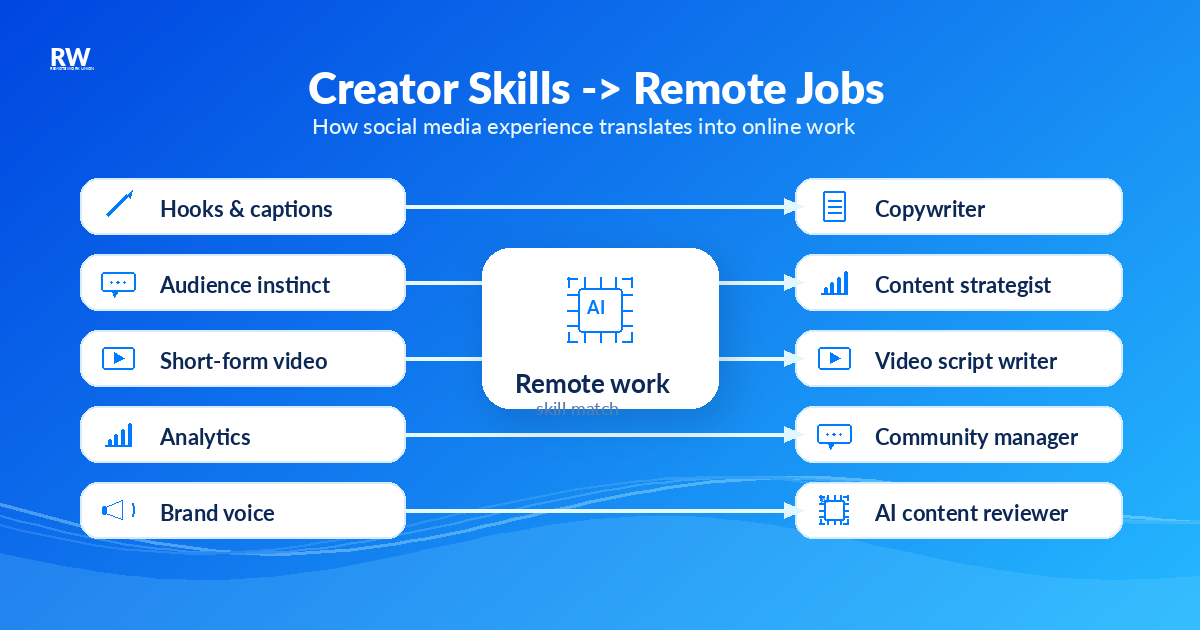
A social media manager also understands deadlines, calendars, brand consistency, client feedback, performance reporting, and platform-specific communication. The rise of AI has made these skills more valuable, not less. AI models can generate drafts, captions, scripts, images, and summaries, but companies still need people to judge quality — to tell whether an answer sounds natural, whether a post matches brand voice, whether a short-form script is engaging. That is where content people have an advantage.
1. Remote Social Media Manager
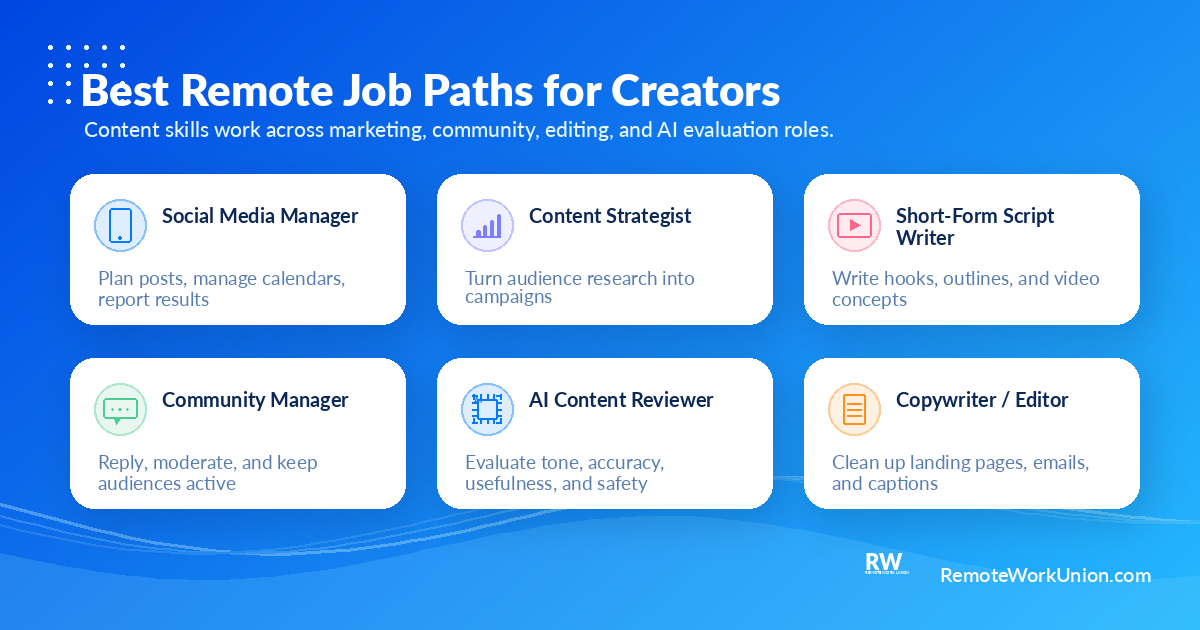
A remote social media manager handles day-to-day posting, scheduling, captions, content calendars, audience replies, and performance reporting. This is the most direct path for someone who already runs accounts for themselves, a brand, a local business, a podcast, a creator, or a client.
Strong candidates can show that they understand platform fit. A LinkedIn post should not read like a TikTok caption. An Instagram carousel should not be treated like a blog post. Remote social media managers who understand these differences can work for agencies, startups, e-commerce brands, software companies, newsletters, and online communities. For applications, use specific terms: content calendar, caption writing, short-form video strategy, engagement reporting, brand voice, analytics, and cross-platform publishing.
2. Content Strategist
Content strategy is a strong remote work path for creators who like planning more than posting. A content strategist decides what should be created, who it is for, what problem it solves, which format fits best, and how success should be measured. Creators often develop strategy informally — they notice which topics perform, which hooks fail, and which formats build trust. The remote job version turns that instinct into documents, briefs, calendars, and campaign plans.
The best portfolio proof is a simple case study: the goal, the audience, the content plan, the execution, and what changed after the content went live.
3. Short-Form Video Script Writer
Short-form video has created a remote job category that did not exist at the same scale a few years ago. A brand may not need someone to film, but it may need someone to research topics and turn them into 30-second, 60-second, or 90-second video scripts. This role is a good fit for creators who understand pacing — good short-form writing requires a clear opening, a reason to keep watching, a simple structure, and a payoff.
When applying, include examples of hooks, script outlines, before-and-after rewrites, or short video concepts. If you do not have client work, create sample scripts for fictional brands or public topics. Label them clearly as samples.
4. Community Manager
Community manager roles are a natural fit for people who understand online conversations. A remote community manager may answer questions, welcome new members, moderate discussions, organize prompts, track common complaints, and report what users are saying back to the team. This work is common around Discord communities, Slack groups, membership products, newsletters, AI tools, and software companies. Focus on response quality, escalation judgment, tone control, and the ability to stay calm in public conversations.
5. UGC Creator and Brand Content Producer
User-generated content is still one of the clearest work-from-home paths for people who can create natural brand content. A UGC creator produces videos, photos, scripts, testimonials, demos, or ad-style content for brands without necessarily posting the content on their own account. Some projects require a physical product shipment, while others only need screen recordings, app demos, or voiceover. To stand out, build a small portfolio by category: product demo, problem-solution video, testimonial-style script, and educational short.
6. Copywriter, Caption Writer, and Content Editor
Copywriting is one of the most flexible remote work categories for creators. Caption writing, email writing, landing page copy, product descriptions, ad copy, newsletter writing, and social post editing all reward clarity, tone, hooks, persuasion, and concise structure. A creator who writes strong captions can often become a better remote copywriter by learning a few business formats. For your portfolio, include before-and-after edits — show a weak caption or landing page paragraph, then show your improved version and explain why the new version is clearer.
7. SEO Content Assistant or Blog Editor
Many creators overlook SEO because it sounds more technical than social media. But SEO content work can be a strong remote path for people who are good at research, organization, and clear writing. A remote SEO content assistant may update blog posts, outline articles, research keywords, improve headings, add internal links, or summarize search intent. This role pairs well with social media experience because both require understanding what people are trying to find.
8. Remote AI Content Reviewer
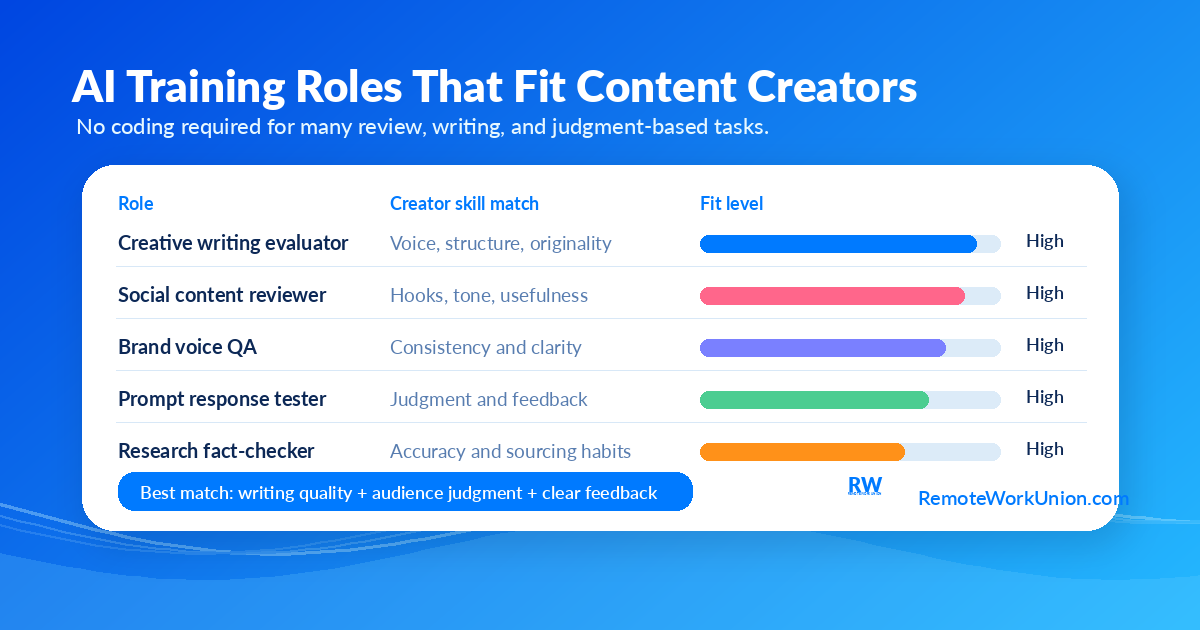
Remote AI content review is one of the most relevant paths for social media managers and content creators. AI companies and AI training platforms need people to evaluate model outputs, compare responses, judge writing quality, flag problems, and explain which answer is better. This work may appear under titles like AI content reviewer, AI response evaluator, AI trainer, AI data annotator, model evaluator, or creative writing evaluator.
This does not always require coding. Many projects need strong readers and writers who can judge tone, accuracy, relevance, helpfulness, structure, and brand safety. A content creator is used to asking: Is this clear? Is it interesting? Is the tone right? Would a real person keep reading? Does this answer the prompt? Those questions are directly relevant to AI model evaluation. OpenAI, Anthropic, Google, Meta, xAI, and the wider AI ecosystem have created demand for this kind of work.
Remote Work Union connects content and social media professionals to AI training and remote marketing roles. Find work that matches your skills.
Find Roles Hiring Now →9. Prompt Writer and AI Response Evaluator
In remote AI work, prompt writing can mean designing tasks, testing whether a model follows instructions, creating examples, rating responses, and explaining what went wrong. This can fit content creators because prompts often require clarity, context, constraints, and audience awareness. A good AI response evaluator can compare two answers and explain why one is more useful, more accurate, more natural, or better aligned with the user request. For applications, use accurate language: prompt writing, AI response evaluation, content quality review, instruction following, rubric-based feedback, writing assessment, tone evaluation, and factual review.
How to Translate Creator Experience Into Resume Language
Creator experience becomes more valuable when it is translated into business language. "I post on TikTok" becomes "short-form content production." "I know what people comment on" becomes "audience research and community insight." "I make captions better" becomes "copy editing and brand voice alignment." "I track what works" becomes "content performance analysis."
Use numbers when you have them. Strong examples include posting frequency, engagement rate, views, email subscribers, content volume, response time, or the number of assets produced. A useful resume bullet might say: "Planned and wrote weekly short-form content across Instagram, TikTok, and LinkedIn, adapting hooks, captions, and calls to action for each platform." Another might say: "Reviewed AI-generated drafts for tone, clarity, accuracy, and user intent, providing written feedback to improve response quality."
Portfolio tip: A hiring manager should not need to dig through your entire social profile to understand what you can do. Curate three to six best examples and label them by skill — captions, briefs, AI evaluation samples, SEO outlines, or community responses.
Frequently Asked Questions
Can social media managers get remote AI training jobs?
Yes. Social media managers and content creators have strong transferable skills for AI content review, prompt evaluation, and model evaluation work. Their judgment about writing quality, tone, audience fit, and content accuracy is directly useful for reviewing AI-generated outputs.
What remote jobs use content creator skills?
Content creators can find remote work as social media managers, content strategists, short-form video script writers, community managers, UGC creators, copywriters, SEO content assistants, AI content reviewers, prompt writers, and newsletter or creator operations assistants.
How do I translate creator experience into a remote work resume?
Replace informal language with business terms. "I post on TikTok" becomes "short-form content production." "I track what works" becomes "content performance analysis." Use specific metrics where available: posting frequency, engagement rate, content volume, or campaign output.