Your Experience Is More Useful Than You Think
A lot of people search for remote AI jobs and immediately assume they need to be machine learning engineers. That is not the whole market. Some remote AI jobs are technical, but many of the best AI training, evaluation, research, and expert review roles depend on judgment from people who already understand a field. The strongest of these expert-tier roles commonly pay $50–$200/hr, depending on your field and the depth of expertise a project requires.
AI systems do not only need more code. They need better answers, better explanations, better reasoning, better examples, cleaner data, stronger feedback, and human experts who can tell when a response sounds plausible but is actually weak. That is where real-world experience becomes valuable.
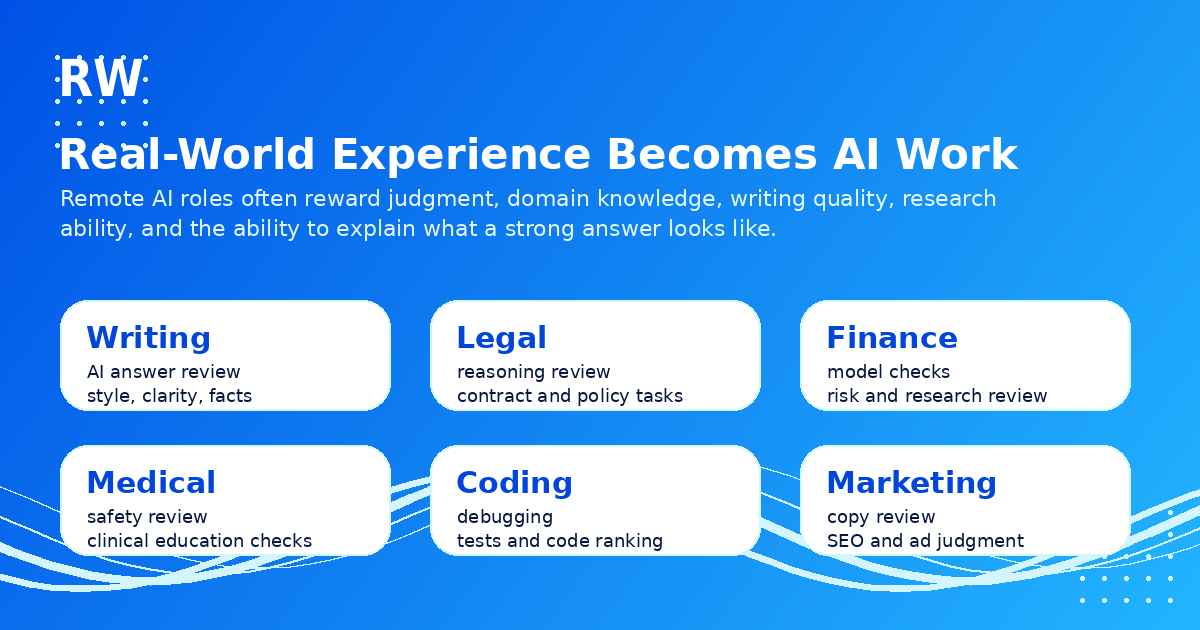
A lawyer can spot bad legal reasoning. A finance professional can evaluate whether a model understands risk, accounting, valuation, or market logic. A nurse, doctor, pharmacist, or healthcare operator can recognize when an answer is unsafe or misleading. A writer can tell whether an AI response is clear, accurate, natural, and useful. A marketer can judge ad copy, search intent, audience fit, brand voice, and conversion quality. A software engineer can review code, tests, bugs, and architecture. A teacher can evaluate whether an explanation actually helps someone learn.
The mistake most applicants make is that they describe their background in normal resume language, then search for normal remote job titles. Remote AI work often uses different wording. The opportunity is to translate that experience into AI task language: evaluation, ranking, annotation, expert review, prompt testing, rubric scoring, model improvement, response comparison, data quality, fact-checking, and domain-specific AI training.
What Counts as a Remote AI Job?
A remote AI job is any online role where your work helps build, test, train, evaluate, improve, or apply AI systems. Some roles are full-time jobs at AI companies. Others are flexible contractor projects on AI training platforms, expert networks, research marketplaces, or remote work sites.
Common remote AI job categories include:
- AI response evaluator — comparing multiple AI answers and deciding which is more accurate, helpful, clear, or safe.
- AI trainer — creating examples, judging outputs, correcting mistakes, or giving feedback that helps models perform better.
- Expert reviewer — using a specific background such as law, finance, medicine, coding, or education to evaluate specialized AI responses.
- Prompt tester — writing prompts, testing model behavior, identifying failure cases, and explaining how the output should improve.
- AI research assistant — gathering information, verifying claims, checking sources, summarizing findings, and evaluating model-generated research.
- Data quality specialist — cleaning, labeling, categorizing, or reviewing datasets used for AI training or evaluation.
- Coding evaluator — reviewing AI-generated code, debugging, writing tests, judging solution quality, and comparing code outputs.
- AI content reviewer — checking AI-generated writing for tone, accuracy, originality, SEO fit, brand voice, and usefulness.
These jobs may appear under many titles: AI trainer, AI evaluator, model evaluator, search evaluator, prompt engineer, AI data specialist, domain expert, expert AI reviewer, LLM evaluator, AI content analyst, AI safety reviewer, AI rater, AI tutor, AI research contractor, or generative AI specialist. The better strategy is to search by task, not just by job title.
Why Real-World Experience Matters in AI Training
AI companies and AI platforms need people who can identify subtle mistakes. Basic errors are easy to catch. The valuable feedback comes from people who know when an answer is technically correct but incomplete, polished but misleading, confident but unsupported, or useful for a beginner but not for a professional.
Real-world experience gives you three advantages. First, you understand context — a generic answer might be fine for a casual search, but not for a legal memo, investment analysis, medical explanation, or marketing strategy. Context changes what "good" means. Second, you can evaluate quality — someone with experience can explain why one answer is more precise, safer, clearer, or better aligned with the user intent. Third, you can create better examples — a strong writer creates better writing examples; a strong analyst creates better reasoning examples; a strong coder creates better debugging examples.
Step 1: Name Your Actual Expertise
Start by getting specific about what you know. "Business" is too broad. "Marketing" is still broad. "I can evaluate SEO content, paid ad copy, landing page structure, audience positioning, and conversion-focused messaging" is much stronger.
Use this simple inventory: What industries have you worked in? What tools, systems, or workflows do you understand? What kinds of decisions have you made professionally? What mistakes can you spot faster than a beginner? What would someone pay you to review, improve, or explain?
Step 2: Translate Your Experience Into AI Job Language
Remote AI job applications often do not ask, "Are you experienced?" They ask whether you can perform a specific task. Your job is to translate your background into the language of AI work.
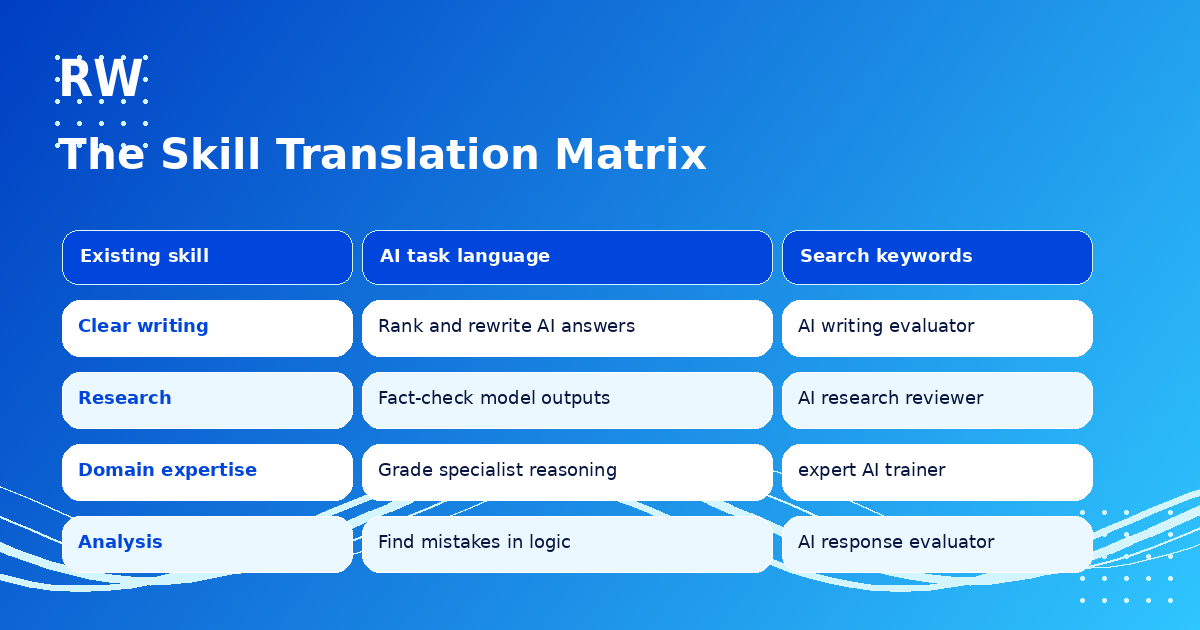
- I write blog posts → I can evaluate AI-generated writing for clarity, accuracy, search intent, structure, tone, originality, and usefulness.
- I work in finance → I can review model responses involving financial reasoning, spreadsheet logic, market analysis, accounting concepts, risk, and investment explanations.
- I am a lawyer → I can evaluate AI answers for legal reasoning quality, issue spotting, contract interpretation, policy logic, citation quality, and overconfident claims.
- I work in medicine or healthcare → I can review healthcare explanations for patient safety, clinical clarity, misinformation risk, and appropriate limitations.
- I code → I can evaluate AI-generated code, debug outputs, write tests, compare solutions, and explain why one answer is more correct.
- I teach or tutor → I can judge whether an AI explanation is pedagogically useful, age-appropriate, accurate, and easy to follow.
Step 3: Search for Tasks, Not Just Titles
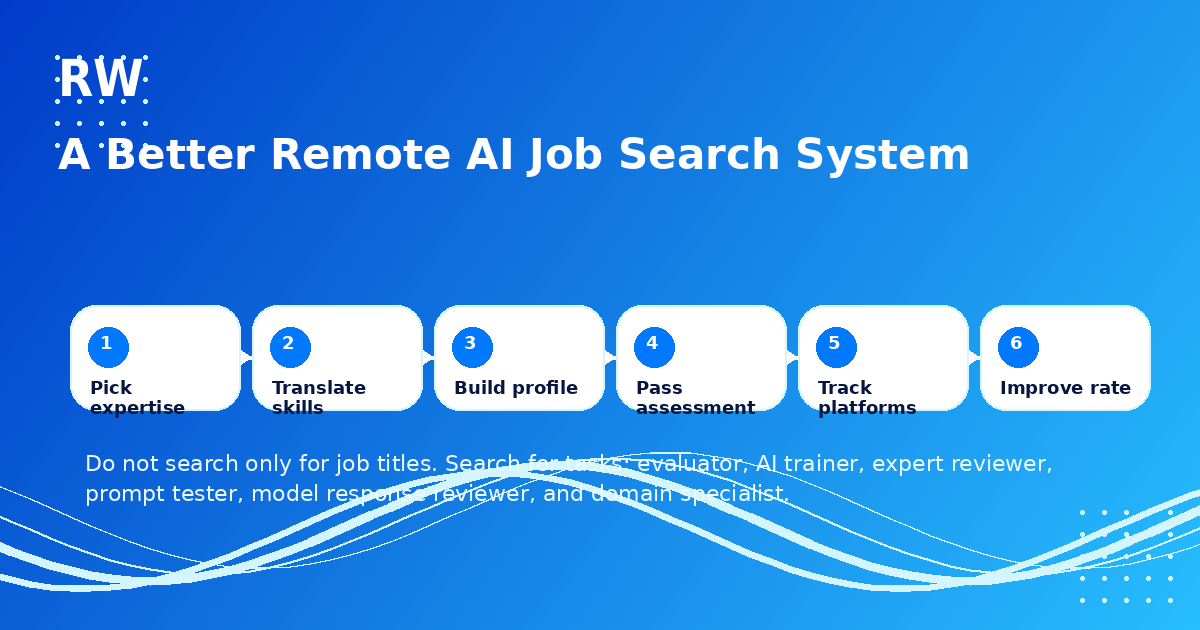
The most obvious search query is "remote AI jobs." Use it, but do not stop there. Many strong roles are hidden under task-based titles. Search phrases to use: remote AI training jobs, AI evaluator jobs remote, AI response evaluator, AI model evaluator, LLM evaluator, AI trainer remote, prompt evaluator, generative AI evaluator, AI data annotation remote, expert AI reviewer, domain expert AI training, AI research reviewer, AI content evaluator, search quality evaluator, AI coding evaluator, AI writing evaluator, work from home AI jobs.
Then add your specialty: legal AI evaluator remote, finance AI trainer remote, medical AI reviewer remote, coding AI evaluator remote, writing AI training jobs, marketing AI evaluator, math AI tutor remote, accounting AI trainer.
Step 4: Look Beyond Traditional Job Boards
Traditional job boards can help, but they are not enough. Remote AI work often appears in places that look different from standard full-time listings: AI training platforms, expert networks and marketplaces, remote job aggregators, university and early-career platforms, company career pages at AI labs and data companies, and community sources like newsletters, Discord groups, and LinkedIn posts.
Platforms such as Mercor, Outlier, Handshake AI, micro1, DataAnnotation-style marketplaces, expert networks, and AI task platforms can be useful search targets. Do not rely on one platform. Build profiles across several legitimate sources, track every application, and keep improving the way you present your expertise.
Step 5: Build a Profile That Makes Matching Easier
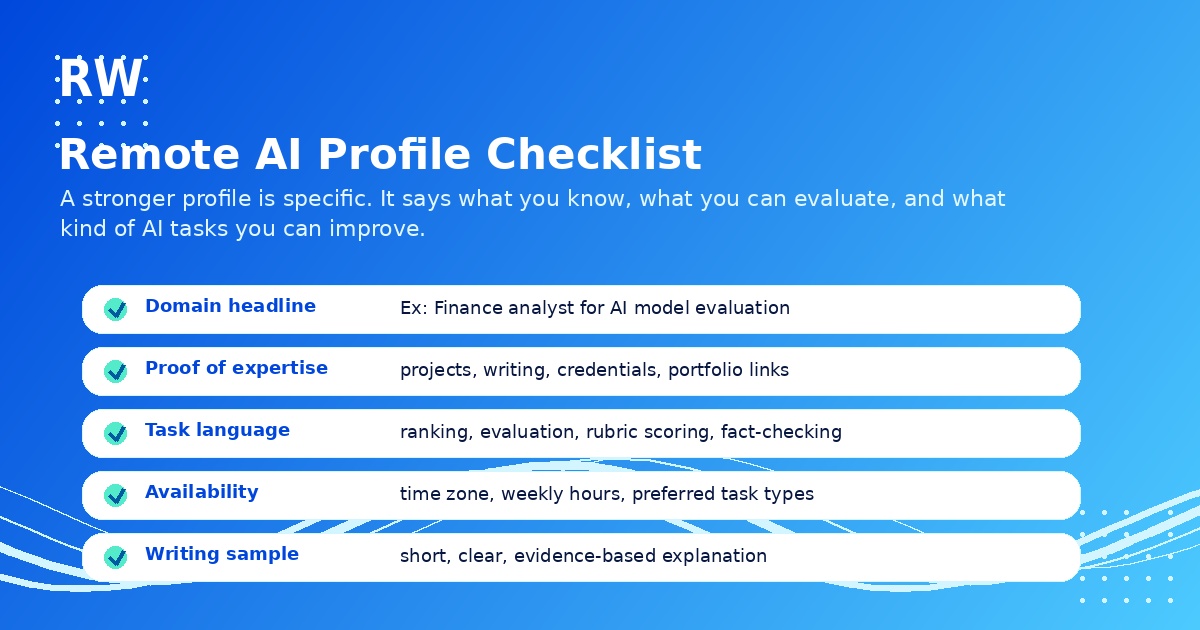
A remote AI profile should not read like a normal resume summary. It should make it easy for a platform to understand what tasks you should receive.
A strong profile includes: a specific headline ("Finance analyst for AI response evaluation" is stronger than "finance professional"), clear domain tags, task language (evaluate, rank, compare, fact-check, annotate, rewrite, score, review, test, debug), proof of expertise (work history, portfolio links, writing samples, GitHub, certifications), and availability details.
Step 6: Prepare for AI Training Assessments
Many remote AI training jobs require an assessment before you get accepted. The assessment may ask you to compare responses, correct an AI answer, write a prompt, solve domain questions, review code, fact-check a passage, or explain why one output is better than another.
The assessment is not only testing what you know. It is testing whether you can communicate judgment. How to perform better: read the instructions carefully before starting, explain your reasoning — not just your conclusion, be precise about the flaw, avoid overconfidence, and match the tone requested by the task. The people who do well tend to be the ones who can write a clean explanation of why something is right, wrong, incomplete, unsafe, unclear, or less useful than another answer.
Step 7: Match Your Background to the Right Remote AI Roles
Writers and editors should search for AI writing evaluator, AI content reviewer, AI response editor, SEO AI evaluator, model response reviewer. Your value is clarity, structure, accuracy, tone, and audience fit.
Marketers should search for AI marketing evaluator, ad copy evaluator, SEO evaluator, content strategist AI, brand voice evaluator. Your value is knowing what persuasive, useful, and conversion-oriented content looks like.
Lawyers and legal professionals should search for legal AI evaluator, legal AI trainer, contract review AI, policy AI reviewer, legal reasoning evaluator. Your value is issue spotting, scope control, careful wording, and reasoning quality.
Finance, accounting, and investment professionals should search for finance AI trainer, accounting AI evaluator, investment research reviewer, spreadsheet QA, financial reasoning AI. Your value is catching bad assumptions, weak calculations, and misleading explanations.
Healthcare professionals should search for medical AI reviewer, healthcare AI evaluator, clinical content reviewer, patient education AI, health information quality reviewer. Your value is safety, clarity, appropriate caution, and misinformation detection.
Software engineers should search for coding AI evaluator, code reviewer AI, AI coding trainer, programming assessment reviewer, software QA AI, model-generated code evaluator. Your value is testing, debugging, edge cases, architecture, and explanation quality.
Teachers and tutors should search for AI tutor evaluator, education AI reviewer, curriculum AI evaluator, learning content reviewer, subject matter expert AI training. Your value is turning knowledge into clear learning steps.
Step 8: Avoid Low-Quality Remote AI Listings
Remote AI jobs are popular, so low-quality listings exist. Warning signs include: no clear description of the task, no information about pay structure or project type, unrealistic income claims with no explanation of qualifications or hours, requests for upfront payment to access jobs, vague promises of "AI income" with no actual role, and endless assessments with no feedback or real path to paid work.
Good listings usually explain the task category, the required expertise, the assessment process, the work arrangement, and the pay method.
Step 9: Use a Simple Application Tracking System
Remote AI work rewards volume, but only if the volume is organized. Track everything: platform or company name, role title or task category, link to application, specialty used in the application, date applied, assessment status, approval status, pay range, notes about what the platform seemed to value, and follow-up date.
This matters because you will start noticing patterns. Maybe your finance applications get better traction than general writing applications. Maybe coding assessments take longer but pay better. Treat the job search like a system, not a lottery.
Step 10: Build Proof While You Apply
You do not need a huge portfolio to start, but proof helps. Simple portfolio ideas: write a sample AI response evaluation showing two model answers and explaining which is better and why; create a one-page domain guide ("How to evaluate AI finance answers" or "What makes an AI legal explanation risky"); publish a short writing sample that shows clear reasoning; build a GitHub repo with code review examples if you are technical; or create a rubric for judging AI answers in your specialty.
The point is to make it obvious that you can evaluate quality. Remote AI platforms often need people who can explain decisions clearly. A small proof asset can do that better than a long resume.
A Strong Remote AI Application Formula
Use this structure when writing your profile, application summary, or outreach message: (1) State your domain clearly. (2) State the AI tasks you can perform. (3) Explain the quality standards you understand. (4) Mention proof or relevant experience. (5) Keep it specific and concise.
FAQ: Remote AI Jobs That Use Real-World Experience
Do I need coding experience for remote AI jobs?
Not always. Coding is important for technical AI roles, but many remote AI training jobs use writing, research, legal, finance, healthcare, marketing, education, operations, or general reasoning experience.
Can beginners get remote AI training jobs?
Yes, but beginners should focus on clear writing, careful instruction-following, and general AI evaluation tasks. People with specialized experience should use that experience to target higher-quality matches.
Are remote AI jobs full-time or part-time?
Both exist. Some are full-time roles at AI companies or startups. Many are flexible contractor projects, task-based platforms, expert review assignments, or part-time remote opportunities.
What is the best search term for these jobs?
Start with remote AI training jobs, AI evaluator jobs remote, AI response evaluator, AI trainer remote, expert AI reviewer, model evaluator, LLM evaluator, and work from home AI jobs. Then add your specialty — finance, legal, medical, writing, coding, or marketing.
Should I apply to Mercor, Outlier, Handshake AI, and similar platforms?
They can be useful places to research and apply, but do not rely on only one platform. Use multiple legitimate sources and track your applications carefully. See our Mercor vs Outlier vs Handshake AI comparison for details on each platform.
Final Takeaway
The best remote AI job search strategy is not to pretend you are a machine learning engineer if you are not one. The better strategy is to identify the experience you already have, translate it into AI training language, and search for roles where human judgment matters.
Remote AI jobs can use writing, research, law, finance, medicine, coding, marketing, teaching, operations, sales, recruiting, real estate, customer support, and many other backgrounds. The common thread is not a single credential. It is the ability to evaluate quality, explain reasoning, and improve AI outputs.
Strongest move: Search by task. Build a specific profile. Prepare for assessments. Apply across multiple remote AI job platforms. Track everything. Keep refining how you present your expertise.