Analytical thinkers are often better suited for remote work than they realize. Many people hear work from home jobs and think of customer service, virtual assistant work, sales calls, or low-paid gig tasks. Those jobs exist, but they are not the only option. If you are the kind of person who notices patterns, checks details, compares options, catches contradictions, or wants to understand why something is true, there are remote jobs that reward that kind of thinking.
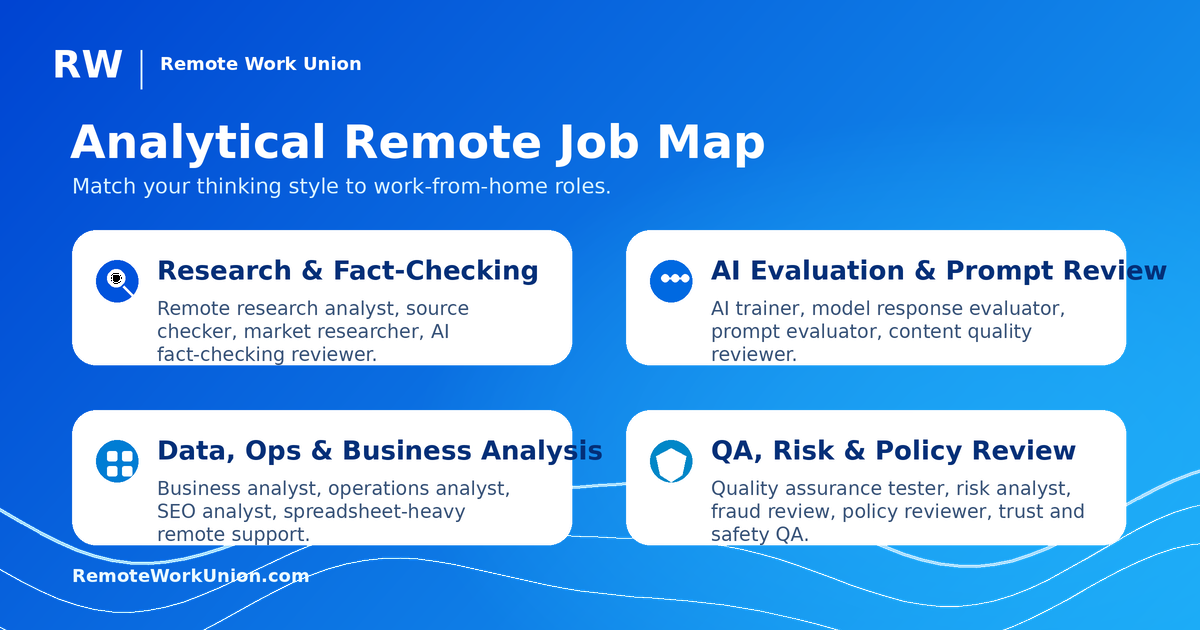
The best work from home jobs for analytical thinkers usually sit in one of five areas: research, AI evaluation, quality assurance, data analysis, and operations. These roles do not always require a computer science degree. Some require domain experience, some require strong writing, some require comfort with spreadsheets, and some mainly require careful judgment. That is why analytical people can be strong candidates for remote AI jobs, AI training jobs, prompt evaluation, data annotation, search quality review, business analysis, SEO analysis, fraud review, and other remote work jobs built around decision-making.
This guide breaks down the best work from home jobs for analytical thinkers, what each role actually does, which skills matter, which jobs are most beginner-friendly, and how to position yourself when applying.
What This Article Covers
- Why Analytical Thinkers Fit Remote Work So Well
- Remote AI Evaluator or Model Response Reviewer
- Remote Research Analyst
- Data Analyst or Reporting Assistant
- Business Analyst or Operations Analyst
- SEO Analyst or Content Quality Analyst
- Quality Assurance Tester or QA Reviewer
- Fraud, Risk, Trust, and Safety Analyst
- Financial Analyst, Bookkeeping Analyst, or Remote Accounting Support
- UX Researcher or Customer Insights Analyst
- Prompt Writer, Prompt Evaluator, or AI Workflow Specialist
- How to Choose the Right Analytical Work From Home Job
- Skills Analytical Thinkers Should Highlight on Applications
- Beginner-Friendly Analytical Jobs to Start With
- Red Flags to Watch For
- A Simple 30-Day Plan for Analytical Thinkers
- Frequently Asked Questions
Why Analytical Thinkers Fit Remote Work So Well
Remote work rewards people who can operate without constant supervision. Analytical thinkers tend to be strong at this because they naturally break vague problems into smaller steps. Instead of waiting for someone to explain every detail, they read the instructions, test assumptions, compare examples, and look for the rule behind the task.
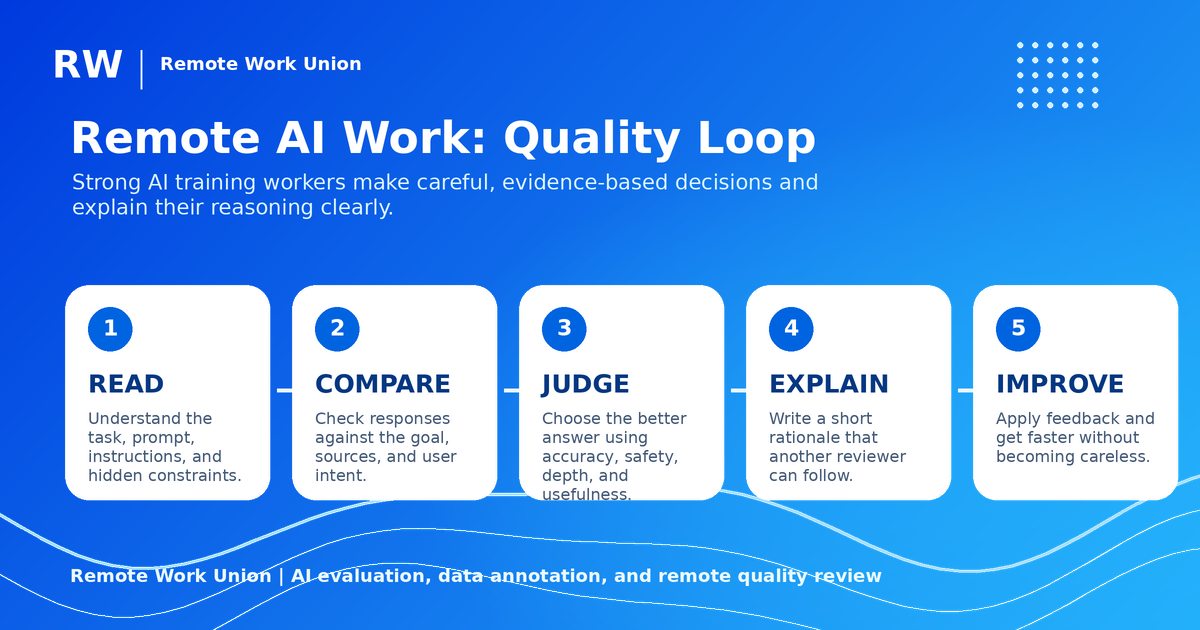
That mindset is valuable in remote roles because companies do not just need people who are online. They need people who can produce clean work, make reliable decisions, document reasoning, and improve after feedback. In AI training and evaluation, for example, the work often depends on comparing two AI responses, judging accuracy, checking whether an answer follows instructions, and explaining why one result is better than another. That is analytical work, even when the job title does not say analyst.
Analytical workers also tend to do well in asynchronous teams. They can read a task brief, work through a queue, ask specific questions, and deliver output without needing a meeting for every decision. That makes them useful across remote research, AI model evaluation, quality review, data cleanup, content QA, operations, and business intelligence roles.
1. Remote AI Evaluator or Model Response Reviewer
A remote AI evaluator reviews how an AI model responds to prompts. The work may involve comparing two answers, rating helpfulness, checking factual accuracy, identifying hallucinations, reviewing tone, or deciding whether an answer followed instructions. This is one of the strongest work from home job categories for analytical thinkers because it is built around judgment.
AI evaluation roles may appear under titles like AI trainer, AI data annotation specialist, AI response evaluator, AI model reviewer, prompt evaluator, LLM evaluator, search quality evaluator, or content quality reviewer. Some projects are generalist projects, while others need subject matter expertise in writing, law, finance, medicine, math, coding, marketing, history, education, or another field.
Large AI companies and AI products such as OpenAI, Anthropic, Google, Meta, and Grok have made AI quality, model behavior, and human feedback more visible keywords in the remote work market. Separate AI work platforms and contractor marketplaces — including names people commonly search for such as micro1, Mercor, Handshake AI, Outlier, and DataAnnotation-style platforms — often use similar language around AI training, AI evaluation, prompt review, and data annotation.
This role fits you if you like comparing options, explaining your reasoning, checking claims, and improving systems. It is usually less about being a coder and more about being precise.
Pay range: General AI evaluation roles typically pay $20+/hr. Expert-tier work requiring domain knowledge in law, finance, medicine, engineering, or advanced research can pay $50–$200/hr through platforms like Handshake AI, Mercor, and micro1.
- Best for: analytical generalists, strong writers, researchers, subject matter experts, people who like structured judgment
- Skills to show: reasoning, written explanations, fact-checking, instruction following, attention to detail, domain expertise
2. Remote Research Analyst
Remote research analysts gather, organize, and summarize information so a company can make better decisions. This can include market research, competitor research, customer research, product research, policy research, academic-style research, or source verification. For analytical thinkers, this is one of the most natural work from home jobs because the core task is turning messy information into something clear.
A strong research analyst is not just someone who can use Google. The better skill is knowing which sources are trustworthy, which claims need verification, which details are relevant, and how to explain findings without adding noise. In a remote environment, research work often becomes a written product: a brief, memo, table, spreadsheet, source list, or recommendation.
Research roles can be entry-level or expert-level. Entry-level roles may ask for source collection, data entry, list building, or basic summaries. Higher-value roles may require industry knowledge, financial reasoning, legal research, scientific literacy, or strong strategic judgment.
- Best for: curious people, strong readers, careful fact-checkers, writers who like evidence
- Skills to show: source evaluation, synthesis, clear summaries, spreadsheets, citation habits, domain knowledge
3. Data Analyst or Reporting Assistant
Data analyst roles are a classic match for analytical thinkers, but not every remote data role requires advanced coding. Some work from home data jobs focus on spreadsheets, dashboards, reporting, data cleanup, KPI tracking, customer lists, financial records, or operational metrics. These jobs often sit between data analysis and business support.
If you are comfortable with Excel, Google Sheets, formulas, filters, pivot tables, charts, and basic database logic, you may qualify for more roles than you think. The key is to show that you can turn raw information into decisions. Employers do not just want rows and columns; they want clean numbers, patterns, warnings, and next steps.
For more advanced roles, SQL, Python, Tableau, Power BI, Looker, or analytics engineering can help. But analytical beginners can still start with remote reporting assistant, data coordinator, operations analyst, sales operations support, or marketing analytics assistant roles.
- Best for: spreadsheet users, number-focused thinkers, organized problem-solvers
- Skills to show: Excel, Google Sheets, QA checks, reporting, dashboards, data cleanup, basic analytics
4. Business Analyst or Operations Analyst
Business analysts and operations analysts study how a process works and look for ways to improve it. That might mean mapping workflows, finding bottlenecks, writing requirements, tracking support issues, improving onboarding, organizing vendor data, or helping teams make decisions from internal information.
These jobs are excellent for analytical thinkers who are not purely technical. You need to understand systems, ask good questions, compare the current process to the desired outcome, and communicate clearly. Remote companies often need people who can document processes, create SOPs, maintain dashboards, and make recurring work less chaotic.
This can also be a good path for people coming from office manager, project coordinator, customer success, recruiting, finance, logistics, or administrative backgrounds. If you have ever been the person who understood how everything actually worked, operations analysis may fit.
- Best for: process thinkers, organized generalists, project-minded workers
- Skills to show: workflow mapping, documentation, problem solving, reporting, stakeholder communication
Ready to find remote roles that match your analytical skills? Find vetted opportunities on RemoteWorkUnion.com.
Find Roles Hiring Now →5. SEO Analyst or Content Quality Analyst
SEO analysts study search intent, keyword patterns, rankings, website structure, content gaps, and performance data. Content quality analysts review whether pages, articles, product descriptions, or help center content are accurate, useful, and aligned with user intent. Both roles can be done remotely and both reward analytical thinking.
For an analytical thinker, SEO is not just writing blog posts. It is understanding what people search, why they search it, what information they expect, and how a page should be structured to satisfy that need. Content quality work uses similar judgment: does this page answer the question, is it clear, is it trustworthy, does it repeat itself, does it match the audience, and does it need updating?
These roles overlap with AI content evaluation because companies increasingly need humans who can evaluate AI-generated content, improve outlines, catch factual problems, and make sure content serves a real user.
- Best for: analytical writers, marketers, editors, search-focused thinkers
- Skills to show: keyword research, content audits, search intent, editing, analytics, quality review
6. Quality Assurance Tester or QA Reviewer
Quality assurance work is built for people who notice what other people miss. Remote QA testers review websites, apps, workflows, forms, instructions, or internal systems and document what breaks. QA reviewers may also inspect content, data, transactions, AI outputs, or completed work against a rubric.
The best QA workers are not random nitpickers. They are systematic. They can reproduce an issue, explain what happened, identify the expected behavior, and describe the severity. That is why analytical thinkers often do well in QA even if they are not engineers.
Technical QA roles may require test cases, bug-tracking tools, browser testing, API familiarity, or automation. Non-technical QA roles may focus on content accuracy, task review, policy compliance, or operations quality.
- Best for: detail-oriented people, testers, editors, systems thinkers
- Skills to show: bug reports, test cases, checklists, documentation, pattern recognition, patience
7. Fraud, Risk, Trust, and Safety Analyst
Fraud and risk roles require careful pattern recognition. Remote analysts may review suspicious account activity, marketplace behavior, transactions, policy violations, identity signals, spam, abuse reports, or content moderation queues. These roles require judgment because the right answer is often not obvious from one data point.
This can be a strong work from home path for analytical thinkers who like rules, exceptions, and decision frameworks. You may need to review evidence, apply a policy, identify edge cases, and document why a decision was made.
Some trust and safety roles can be emotionally difficult depending on the content being reviewed, so applicants should read job descriptions carefully. But many risk roles focus on fraud patterns, user behavior, compliance queues, marketplace safety, or operational review rather than graphic content.
- Best for: people who like investigation, rules, policy, and pattern detection
- Skills to show: risk review, policy judgment, documentation, compliance awareness, careful escalation
8. Financial Analyst, Bookkeeping Analyst, or Remote Accounting Support
Analytical thinkers with finance, accounting, bookkeeping, or small business experience can look for remote roles that involve reconciliations, reporting, invoice review, cash flow tracking, expense categorization, payroll support, or financial analysis. These jobs often reward accuracy more than personality.
A remote financial analyst may build forecasts, compare budgets to actuals, create reports, or analyze performance. A bookkeeping analyst or accounting support specialist may clean records, categorize transactions, reconcile accounts, or flag inconsistencies. The common thread is precision.
These roles can be especially good for people who want remote work but do not want constant calls. Some jobs require client communication, but a lot of the value comes from clean, reliable work.
- Best for: finance-minded workers, bookkeepers, accountants, spreadsheet users
- Skills to show: reconciliations, reporting, Excel, accounting software, accuracy, confidentiality
9. UX Researcher or Customer Insights Analyst
UX research and customer insights roles help companies understand what users need, why they behave a certain way, and where products create friction. This can include survey analysis, interview notes, usability testing, customer feedback tagging, support ticket analysis, and research summaries.
Analytical thinkers can be strong in this category because the job is not just collecting opinions. It is finding patterns in human behavior and turning them into product decisions. You need empathy, but you also need structure. The best insights are specific, evidence-based, and tied to action.
Entry-level versions of this work may include research operations, survey coding, feedback analysis, or customer research assistant roles. More senior roles may require study design, interviewing, statistics, product strategy, or experience with UX research tools.
- Best for: people who like psychology, product thinking, customer behavior, and research
- Skills to show: synthesis, tagging, interview notes, survey analysis, product judgment, clear recommendations
10. Prompt Writer, Prompt Evaluator, or AI Workflow Specialist
Prompt-related work can be a good fit for analytical thinkers because good prompts are structured thinking in written form. Prompt writers design instructions that produce better AI outputs. Prompt evaluators test whether prompts work. AI workflow specialists use tools to turn repeated tasks into cleaner processes.
This category can overlap with AI training, content operations, marketing operations, research, and automation. You do not necessarily need to be a coder, but you do need to understand instructions, constraints, examples, edge cases, and output quality.
Strong candidates can show before-and-after examples: a messy input turned into a clean output, a prompt that reduces errors, a checklist that improves quality, or a workflow that saves time without sacrificing accuracy.
- Best for: structured writers, tool users, AI experimenters, process thinkers
- Skills to show: prompt writing, evaluation, workflow design, error reduction, documentation, AI tool fluency
How to Choose the Right Analytical Work From Home Job
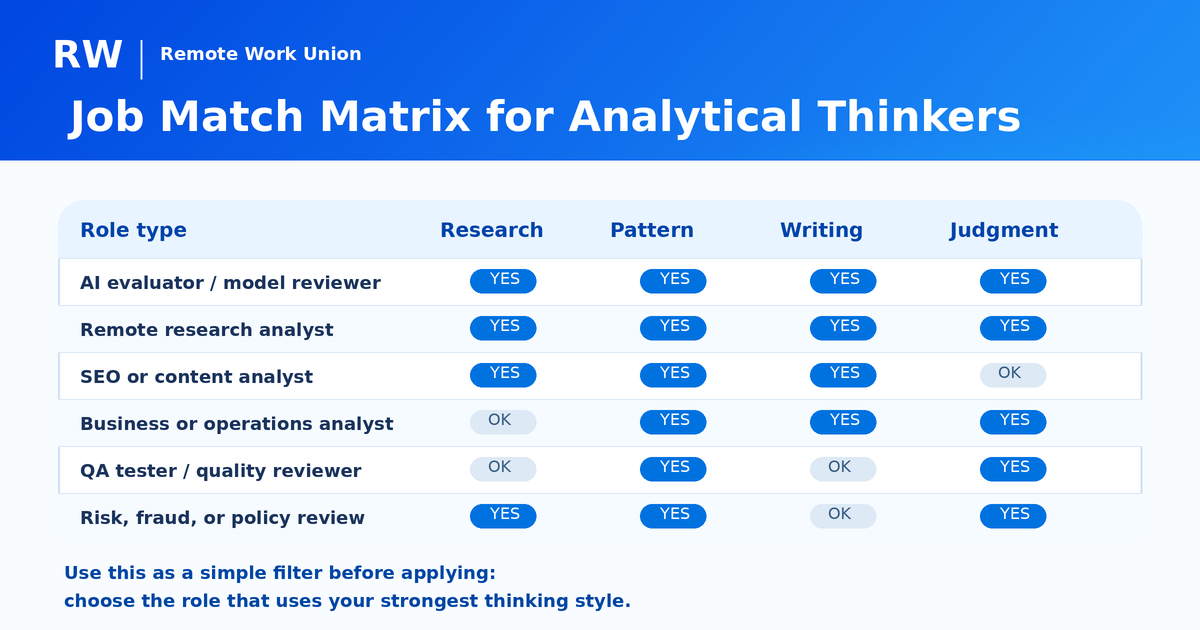
Do not choose only by job title. Choose by the type of thinking the role uses. If you like checking facts and comparing sources, start with research analyst, AI fact-checking, search quality, or content quality roles. If you like numbers and patterns, look at data analyst, reporting assistant, finance support, or business operations roles. If you like systems and rules, look at QA, policy review, risk review, fraud analysis, or operations analysis.
If you are a strong writer but not technical, AI evaluation and content quality roles may be the fastest bridge into remote work. If you are comfortable with spreadsheets, data and operations roles can become more stable over time. If you already have a professional background, subject matter expert AI training work can sometimes pay more because it uses expertise that general applicants do not have.
The best path is usually not one platform or one title. It is a small portfolio of remote work categories that use the same strengths: research, judgment, accuracy, writing, and process improvement.
Skills Analytical Thinkers Should Highlight on Remote Applications
Many applicants undersell themselves because they describe personality traits instead of evidence. Do not only say that you are analytical. Prove it with examples.
Strong application language might include: reviewed complex information for accuracy, compared competing sources, created spreadsheets to track patterns, wrote decision rationales, improved a checklist, caught inconsistencies before publication, evaluated content against a rubric, summarized research for decision-makers, or documented a repeatable process.
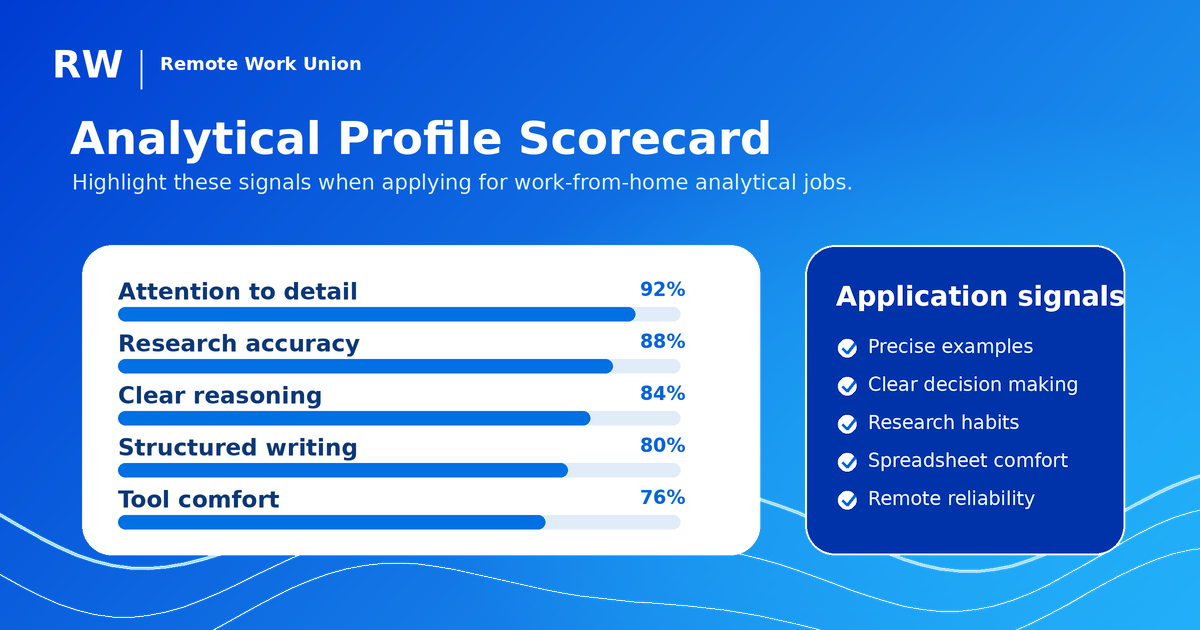
For remote AI jobs, highlight instruction following, written reasoning, fact-checking, prompt evaluation, domain knowledge, and comfort reviewing AI outputs. For data roles, highlight Excel, Google Sheets, reporting, cleanup, and quality checks. For operations roles, highlight documentation, workflows, SOPs, and recurring process improvement. For QA roles, highlight testing, bug reports, checklists, and attention to edge cases.
Beginner-Friendly Analytical Jobs to Start With
The most beginner-friendly analytical work from home jobs are usually roles where the company provides a rubric, template, or queue. These include AI response evaluation, data annotation, search quality review, content QA, research assistant work, spreadsheet cleanup, lead list verification, product data review, and basic QA testing.
These jobs are not always easy, but they are easier to enter than roles that require years of formal analyst experience. The tradeoff is that beginner-friendly roles can be inconsistent. That is why analytical workers should apply across multiple categories instead of waiting on one platform or one company.
A practical beginner strategy is to build a profile that can fit AI evaluation, research, content quality, and operations support at the same time. Those jobs use overlapping skills, so one strong application can be adapted into several opportunities.
Red Flags Analytical Thinkers Should Watch For
Analytical workers are often good at spotting scams, but remote job listings can still waste time. Be careful with any platform that charges you to apply, guarantees income without screening, asks you to buy training before seeing work, avoids clear payment terms, or pushes you into unpaid tasks with no explanation. Real remote work platforms may test you, but they should not require you to pay to start.
Also watch for vague job descriptions that use trendy AI keywords without explaining the work. A legitimate remote AI evaluation job should tell you something about the task type, skill area, application process, pay structure, availability of projects, or qualification steps. It may not reveal every client detail, but it should not feel like a mystery funnel.
For long-term stability, separate two questions: can I get accepted, and can I get consistent work after acceptance? Both matter. Some AI training platforms approve workers before they have enough projects. That does not mean the role is fake; it means you should avoid relying on a single source of remote income.
Quick test: If a platform asks you to pay before you can access work, that is a red flag. Legitimate platforms like Handshake AI, Mercor, micro1, and Outlier are free to apply to and will test your skills before assigning paid work.
A Simple 30-Day Plan for Analytical Thinkers
Week one: Build a remote profile around proof. List your strongest analytical examples, tools, domains, writing samples, research experience, spreadsheet work, QA work, and any subject matter expertise. Rewrite your resume so it shows evidence, not just traits.
Week two: Apply to a balanced mix of roles. Include remote AI evaluator roles, AI data annotation, research analyst, content quality analyst, QA reviewer, data assistant, and operations analyst positions. Track every application in a spreadsheet with platform, role, date, status, pay range, and next step.
Week three: Improve your tests and samples. Practice writing short rationales, comparing AI answers, summarizing research, cleaning messy data, and creating concise documentation. Analytical work often comes down to whether your reasoning is clear enough for someone else to trust.
Week four: Refine based on responses. If you get rejected from AI evaluation roles, strengthen writing samples and domain positioning. If data roles ignore you, add spreadsheet examples. If research roles stall, create a short sample research brief. The goal is not to chase every remote job. The goal is to make your analytical strengths obvious.
Frequently Asked Questions
Do I need a technical background to get work from home jobs as an analytical thinker?
No. Many of the best remote jobs for analytical thinkers — including AI response evaluation, research analysis, content QA, business analysis, and operations review — do not require coding or a technical degree. What they reward is careful judgment, structured reasoning, written clarity, and attention to detail. Domain expertise in any professional field is a significant advantage.
What do remote AI evaluator jobs actually involve?
Remote AI evaluator jobs involve reviewing how an AI model responds to prompts. Tasks include comparing two AI answers and choosing the better one, checking factual accuracy, rating helpfulness and tone, identifying hallucinations or errors, and writing clear explanations for your decisions. These roles reward the kind of careful, systematic thinking that analytical workers do naturally.
How much do remote analytical jobs pay?
Pay varies by role and expertise level. General AI evaluation and data annotation roles typically start at $20+/hr. Expert-tier roles that require domain knowledge in fields like law, finance, medicine, coding, or research can pay $50–$200/hr through platforms like Handshake AI, Mercor, and micro1. Operations analyst and UX research roles often pay in similar ranges depending on the company.
Which platforms should analytical thinkers apply to for remote AI work?
Handshake AI, Mercor, micro1, and Outlier are the main platforms to start with for remote AI evaluation and training work. Each has a different application and qualification process. Applying to multiple platforms at once is the most reliable strategy, since project availability varies by platform and timing.
What is the best first step for an analytical thinker trying to break into remote work?
Start by building a short profile that demonstrates your analytical strengths with specific evidence — a spreadsheet sample, a written comparison of two AI outputs, a research fact-check, or a documented process review. Then apply across several role types at once: remote AI evaluator, research analyst, content quality analyst, and operations support. Analytical skills apply across all of these, so one well-crafted application can be adapted into several opportunities.
Are remote analytical jobs consistent or do they vary in workload?
Many AI training and evaluation roles are project-based, which means workload can fluctuate. Some periods are busy and some are slow depending on platform demand and your qualification tier. This is why analytical workers benefit from applying across multiple platforms and role types rather than depending on a single source of remote income.
How do I avoid scams when searching for analytical remote jobs?
Legitimate remote work platforms never charge you to apply or start working. Be cautious of any listing that guarantees income without a screening process, requires upfront payment for training, or avoids clear payment terms. Real AI evaluation platforms like Handshake AI, Mercor, micro1, and Outlier are free to join and will test your skills before assigning paid work.
Can I do remote analytical work alongside a full-time job?
Yes. Many AI training, data annotation, research, and QA review roles are project-based and asynchronous. You complete tasks on your own schedule rather than during set hours, which makes them compatible with a full-time job. Some roles pay per task rather than hourly, giving you flexibility to work during evenings and weekends.
What does a strong remote application look like for analytical roles?
Strong applications show evidence, not just traits. Instead of saying you are analytical, include specific examples: reviewed AI outputs for factual accuracy, created a spreadsheet to track quality patterns, wrote decision rationales for a rubric-based review process, documented a workflow to reduce errors, or summarized research findings for decision-makers. Concrete language gets you matched faster than personality descriptions.
What is the difference between AI training jobs and data annotation jobs?
The terms often overlap. Data annotation typically refers to labeling, tagging, or categorizing information so that AI models can learn from it. AI training jobs is a broader term that includes annotation but also encompasses response evaluation, quality scoring, feedback writing, prompt testing, and instructional fine-tuning. Both categories reward the same underlying skills: accuracy, consistency, attention to detail, and clear written reasoning.