If you are the kind of person who instinctively organizes information into categories, spots inconsistencies before anyone else in the room, and gets frustrated when a process is sloppy, you have a genuine advantage in the remote work market. Data-minded professionals — people who think in patterns, spreadsheets, process flows, and structured logic — are increasingly valuable to AI companies, research firms, quality assurance teams, and operations-heavy businesses that need rigorous human judgment applied to large volumes of information.
The challenge is that the best remote jobs for this kind of thinker are not always labeled clearly. You will not always find a listing that says "spreadsheet thinker needed." You have to recognize where your instincts translate — and translate them into the right language when you apply.
This guide covers the strongest work from home categories for data-minded professionals, what the work actually looks like, what it pays, and how to position yourself to get matched with the right opportunities.
What This Article Covers
- Why Data-Minded Professionals Have a Remote Work Advantage
- AI Training and Data Annotation Jobs
- QA and Data Quality Reviewer Roles
- Research Analyst and Fact-Checking Jobs From Home
- Operations and Business Analyst Remote Roles
- Remote Data Cleanup and Database Operations
- How to Translate Data Skills Into Remote AI Job Keywords
- How to Build a Profile and Work Sample
- What to Avoid
- Frequently Asked Questions
Why Data-Minded Professionals Have a Remote Work Advantage
Remote work favors people who can work independently, follow structured instructions, and make accurate decisions without someone reviewing every step in real time. That is exactly how data-minded professionals already operate. Whether you built that skill through years of working in operations, finance, marketing analytics, research, logistics, customer data management, or even informal habits like maintaining your own tracking spreadsheets, the underlying skill is the same: structured, reliable judgment applied to messy information.
AI companies are building systems that require enormous amounts of labeled, reviewed, and corrected human input. The work is not glamorous. It often involves reading hundreds of similar examples, applying a consistent standard, catching small errors, flagging inconsistencies, and writing brief explanations for your decisions. That is not a burden for someone who thinks this way. It is a comfort zone.
The pay range is broader than most people expect. General data work and entry-level AI annotation roles typically pay $20+/hr. When the work requires specialized domain knowledge — finance, legal, medical, research, engineering, or operations expertise — rates can reach $50–$200/hr through platforms like Handshake AI, Mercor, and micro1.
AI Training and Data Annotation Jobs
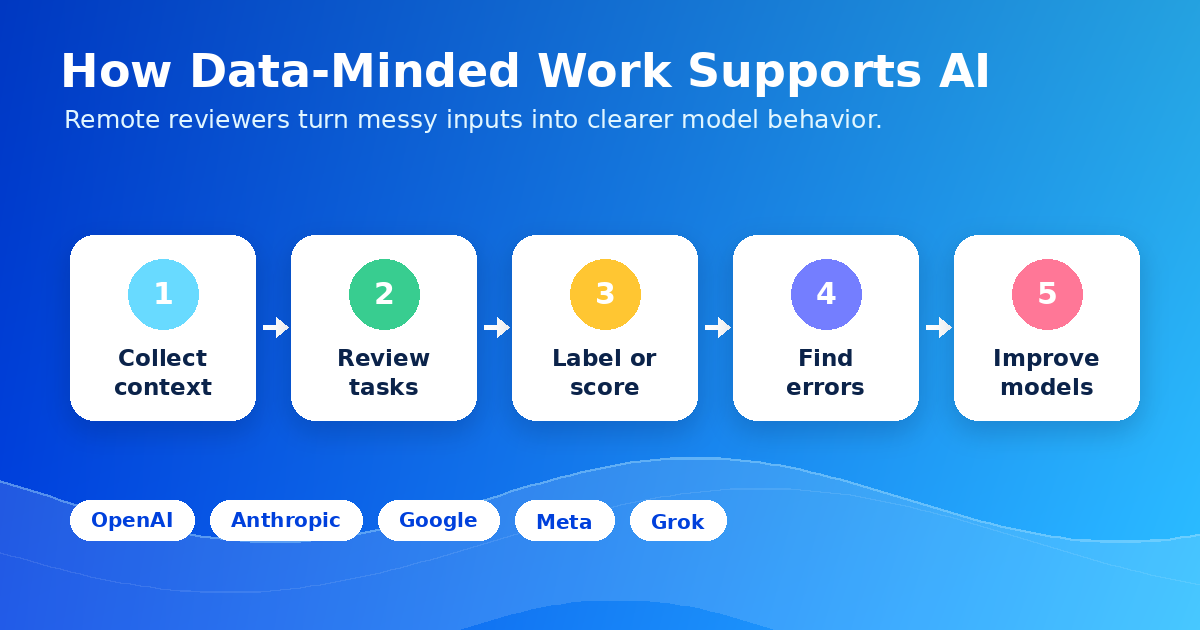
This is the single biggest opportunity for data-minded professionals in the remote market right now. AI training and data annotation work involves reviewing AI outputs, labeling examples, comparing responses, rating quality, checking factual claims, flagging errors, and applying rubric-based standards to large volumes of model-generated content. Companies building AI systems connected to names like OpenAI, Anthropic, Google, Meta, and Grok all depend on this kind of human feedback to improve their models.
The data-minded advantage here is real. These tasks require you to apply the same standard consistently across dozens or hundreds of similar examples. That means resisting the urge to improvise, staying anchored to the rubric even when edge cases feel ambiguous, and writing clear notes when something does not fit neatly. Inconsistency is the most common quality failure in AI annotation work. People who are naturally consistent — who track and apply patterns — perform better here than people who rely on intuition.
Common task types include: response comparison and ranking, factuality and accuracy review, instruction-following evaluation, formatting and tone scoring, safety and policy review, prompt and completion labeling, search result relevance rating, and domain-specific expert review.
Key insight: The best AI annotation workers are not the fastest ones. They are the ones who apply the rubric consistently, note edge cases clearly, and catch the mistakes that other reviewers miss on the third read-through.
Platforms that hire for this kind of work include Handshake AI, Mercor, micro1, and Outlier. Each platform has different qualification processes, but all of them benefit significantly from applicants who can demonstrate structured judgment and pattern-recognition skills — which is exactly what data-minded professionals bring.
QA and Data Quality Reviewer Roles
Quality assurance roles in the remote market are a natural fit for anyone who has spent time checking work for errors, verifying that processes were followed correctly, or catching inconsistencies in reports, records, or workflows. Remote QA work in the AI space specifically involves reviewing the outputs of annotation teams, checking whether tasks were completed according to the guidelines, catching labeling errors, flagging patterns of inconsistency, and sometimes rewriting or correcting submissions.
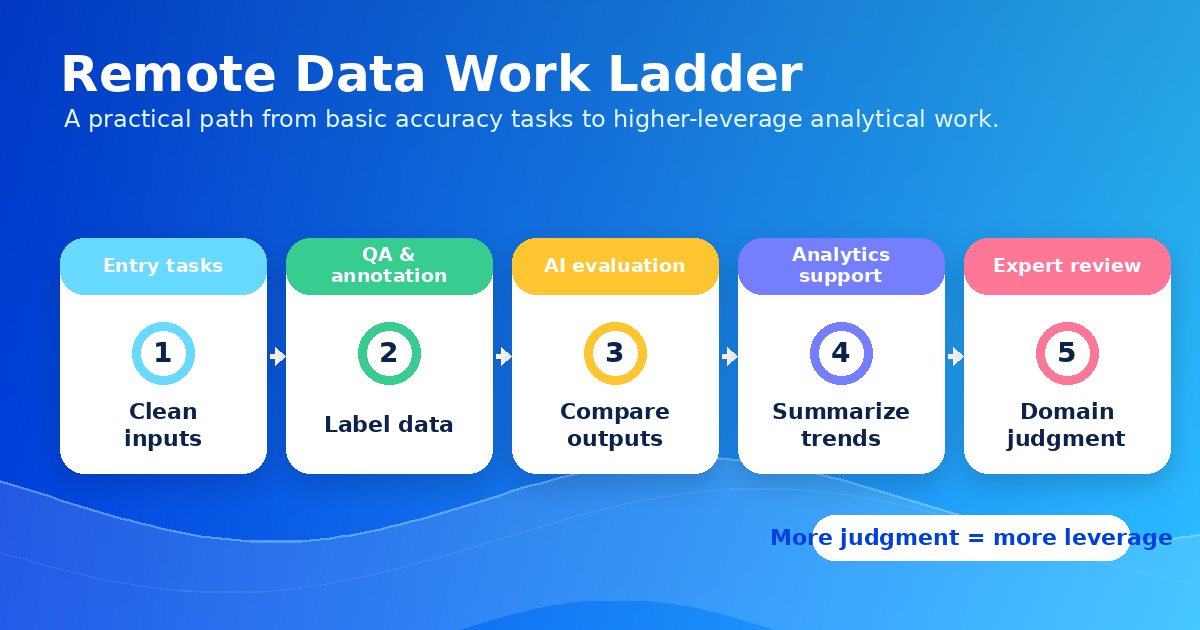
This is often a step above entry-level annotation work, which means better pay and more responsibility. A QA reviewer needs to understand the task standard well enough to catch subtle mistakes — which requires careful reading, pattern memory, and the ability to apply a rubric to someone else's work, not just your own.
Outside of AI specifically, remote QA roles also appear in content publishing, market research, data pipeline management, software testing, and customer data verification. If you have experience auditing records, reconciling data, or reviewing team output for compliance, those skills translate directly.
Research Analyst and Fact-Checking Jobs From Home
Remote research roles are strong fits for data-minded professionals because they reward the same core behavior: systematic information gathering, source evaluation, pattern spotting across multiple inputs, and structured documentation of findings. AI companies need research workers to verify factual claims in AI outputs, trace sources, assess the credibility of references, and flag unsupported assertions.
Independent research firms, market research companies, consulting firms, and media organizations also hire remote research analysts who can compile information from multiple sources, maintain organized documentation, and summarize findings clearly. These roles do not always require advanced degrees — they require rigor and clarity.
Fact-checking jobs from home often involve reviewing AI-generated content for accuracy, comparing AI summaries against primary sources, rating whether AI citations actually support the claim being made, and writing concise feedback explaining errors. For a detail-oriented professional who is comfortable with research and source evaluation, this is a realistic and well-paying remote opportunity.
Operations and Business Analyst Remote Roles
Operations and business analyst roles in the remote market have expanded significantly as more companies build distributed teams. Data-minded professionals with experience in process mapping, workflow optimization, reporting, KPI tracking, data visualization, or business analysis are in demand for remote contractor and part-time roles across industries.
In the AI training space specifically, operations experience translates into roles that oversee data workflows, review the consistency of annotation pipelines, write internal guidelines, or evaluate whether AI outputs meet operational standards for a specific business process. A marketing operations professional who understands campaign data, attribution models, and reporting frameworks can apply that knowledge to AI training tasks involving business and marketing content.
Remote business analyst work more broadly includes client-facing analysis roles at consulting firms, internal reporting positions at growing startups, fractional analyst work for small businesses that need data clarity but cannot afford a full-time hire, and project-based analysis for product and strategy teams. Pay varies significantly, but experienced analysts in specialized domains can command $50–$200/hr as contractors.
Ready to turn your data skills into remote income? Find roles hiring now on RemoteWorkUnion.com.
Find Roles Hiring Now →Remote Data Cleanup and Database Operations
Data cleanup and database operations work involves reviewing, standardizing, deduplicating, correcting, and improving the quality of datasets. It is not glamorous, but it pays well relative to its difficulty and is genuinely important work for companies that need clean data to make business decisions or train AI models.
Common tasks include identifying and merging duplicate records, standardizing formats across datasets, flagging missing or corrupted entries, reclassifying incorrectly labeled records, and writing brief documentation on decisions made during cleanup. These roles appear in AI data pipelines, CRM management, healthcare data management, e-commerce catalog management, and financial data reconciliation.
If you have experience with spreadsheet software like Excel or Google Sheets, basic SQL queries, database management tools, or even careful manual data entry and verification work, you are qualified for entry-level remote data cleanup roles. More experienced data professionals can take on higher-level roles involving data governance, schema design review, or data quality auditing.
How to Translate Data Skills Into Remote AI Job Keywords
The most common reason data-minded professionals do not get matched with good remote AI work is that they describe their skills in the wrong language. A platform algorithm or human screener looking for an "AI evaluator" may not recognize that your five years of spreadsheet-based reporting work is directly relevant.
Here is how to translate common data skills into the terms that AI training platforms and remote employers recognize:
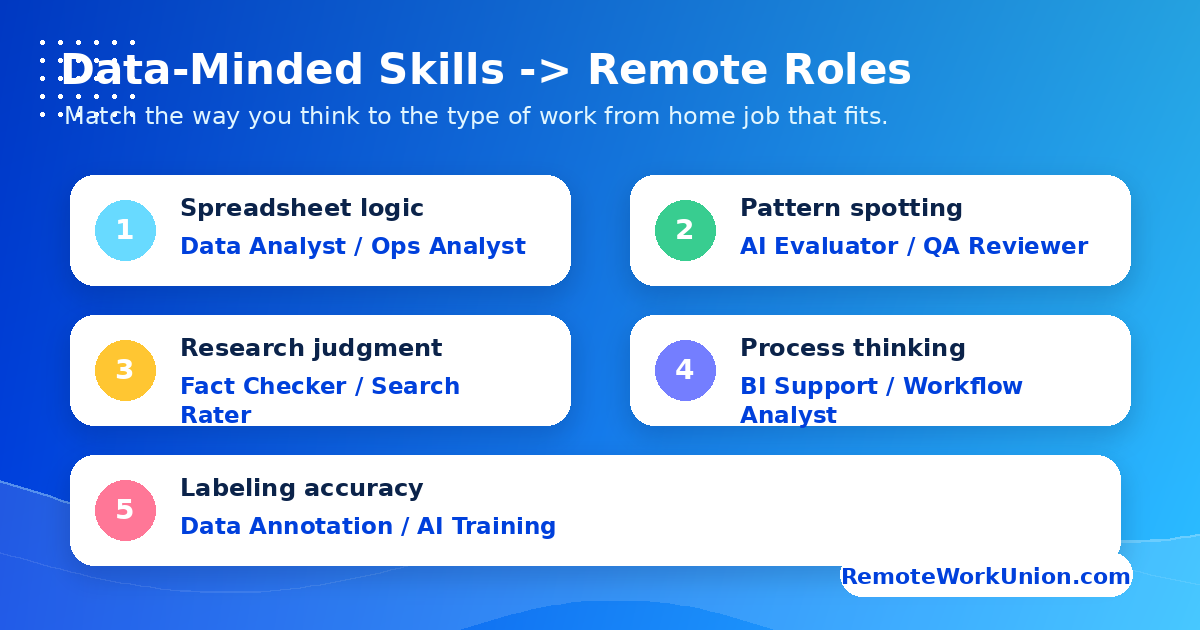
Spreadsheet analysis and Excel/Google Sheets work → pattern recognition, structured data review, tabular data annotation, category labeling, rubric-based scoring
Quality control and process compliance → QA review, data quality auditing, guideline adherence, consistency checking, error flagging
Research and reporting → factuality review, source verification, citation accuracy, research-based AI evaluation, knowledge-domain review
Operations and workflow management → AI output evaluation, task flow review, business process evaluation, operational content review
Business analysis and KPI tracking → performance metrics review, business AI evaluation, financial content review, market research evaluation
Use these terms in your profile descriptions, application essays, and resume bullet points. The goal is to make the connection obvious so that a matching algorithm or human reviewer immediately sees where you fit.
How to Build a Profile and Work Sample
A strong profile for remote data and AI work does not require a portfolio website or a polished PDF deck. What it requires is specific, believable evidence of structured thinking. Here are the most effective ways to build that evidence.
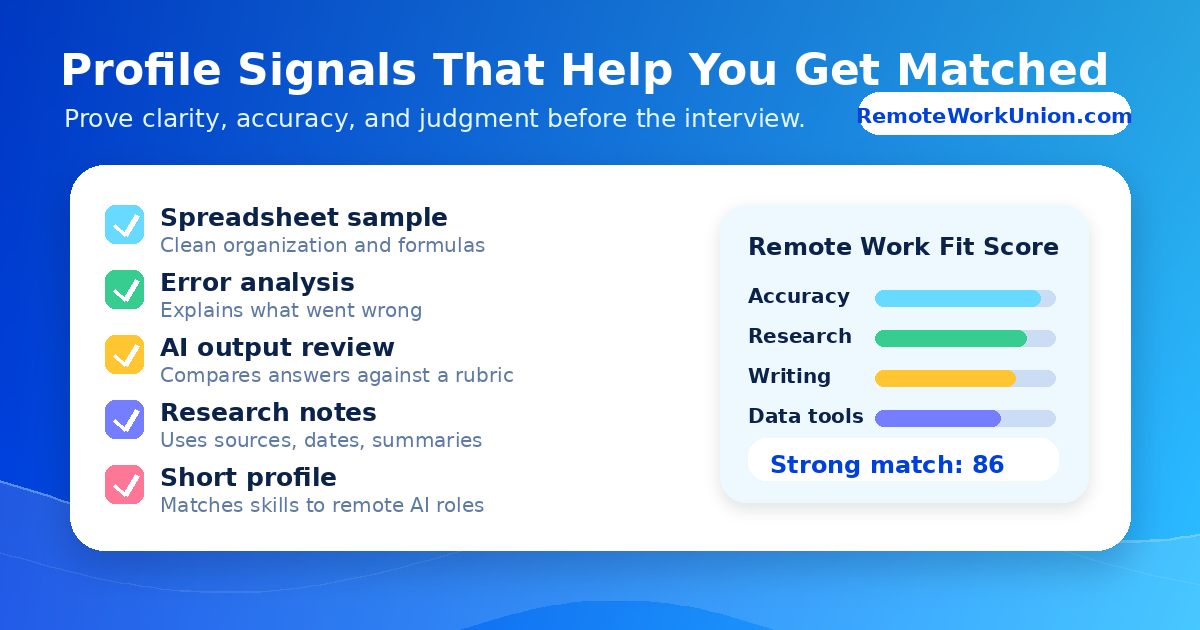
Spreadsheet sample: Take a small dataset of AI outputs or research claims — you can generate these yourself — and build a simple spreadsheet that labels each one for accuracy, quality, or category. Include a column for your reasoning. This demonstrates annotation thinking in a format every AI platform understands.
Written comparison: Write a short 200-word comparison of two AI-generated answers to the same question. State which one is better and explain exactly why, using criteria like accuracy, instruction following, completeness, and clarity. This is essentially a miniature version of what AI evaluator roles require.
Error analysis: Find an AI-generated article or summary online and write a brief note identifying any unsupported claims, factual errors, or places where the AI deviated from the prompt. Format this clearly with line references or quotes. It demonstrates the exact skill that AI QA and fact-checking roles reward.
Research notes: Document how you verified a specific fact or evaluated the reliability of a source. Even a single well-documented example shows that you can apply a research standard, not just read things and form opinions.
Profile rule: Be specific about your strongest category. A profile that says "I can review AI content in business, marketing, operations, and finance contexts" is far more useful than one that says "I can review many types of content." Specific expertise gets matched faster.
What to Avoid
There are several common mistakes that data-minded professionals make when entering the remote market. Being aware of them in advance saves time and protects your reputation on the platforms where you apply.
Overgeneralizing your profile. Data-minded does not mean everything. If you try to qualify for every task type simultaneously, you dilute your strongest signal. Focus on two or three categories where your judgment is genuinely strong and let those lead your profile.
Rushing qualifications. Qualification tests for AI evaluation and data annotation work are not designed to be beaten quickly. They are designed to verify that you apply a standard consistently. Going fast through edge cases is exactly what eliminates otherwise-qualified applicants. Read every instruction twice before you begin.
Using AI tools to complete AI evaluation tasks. Many platforms explicitly prohibit using AI assistance to complete evaluation work, because the entire purpose of the task is to measure human judgment. If you use an AI model to help you rate another AI model's outputs, you are defeating the purpose of the role and risking your account.
Applying to platforms that charge fees. Legitimate remote AI training and data annotation platforms never charge you to access work. If a platform asks for an upfront fee in exchange for guaranteed work, it is not a real opportunity. The platforms worth your time — Handshake AI, Mercor, micro1, Outlier — are free to apply to.
Ignoring inconsistency in your own work. In AI evaluation and data work, consistency is the primary quality signal. If you rate similar examples differently on Tuesday versus Thursday, that is a problem even if both individual ratings seemed reasonable at the time. Build a quick personal checklist for each task type and use it every session.
Frequently Asked Questions
Do I need a data science degree to get remote data-related work?
No. Many of the best remote roles for data-minded professionals require strong analytical thinking, pattern recognition, and careful judgment — not a formal data science credential. AI evaluator, QA reviewer, research analyst, and data annotation roles often prioritize demonstrated attention to detail and domain knowledge over degrees.
What is the pay range for remote data annotation and AI evaluation jobs?
General AI data annotation and entry-level evaluation roles typically pay $20+/hr. Expert-tier roles — those requiring specialized domain knowledge in law, finance, medicine, engineering, or research — can pay $50–$200/hr depending on the platform and the complexity of the work.
Which platforms are best for data-minded professionals looking for remote work?
Platforms like Handshake AI, Mercor, micro1, and Outlier are good starting points for AI training and evaluation work. These platforms regularly need workers who can compare AI outputs, flag errors, score quality, and review structured data tasks. Apply across multiple platforms to find the best match for your skill category.
What kind of work sample should I build to get hired for remote data roles?
A short portfolio that includes a spreadsheet with annotated examples, a written comparison of two AI outputs, a fact-check of a recent article, or a brief error analysis of a dataset can all demonstrate the kind of structured thinking these roles reward. You do not need a polished website — a Google Doc or simple PDF works fine.
Can I do remote data work around a full-time job?
Yes. Many AI training, data annotation, and QA review roles are project-based and asynchronous, which means you can complete tasks during evenings and weekends. Some platforms pay per task rather than hourly, giving you flexibility to work when you have time and attention available.