Consultants and business strategists are better positioned for remote work than many people realize. The core skills of consulting — research, diagnosis, comparison, written recommendations, stakeholder communication, market analysis, and decision support — translate cleanly into work from home jobs. A consultant does not always need a traditional client retainer to earn remotely. The same judgment used to evaluate a business plan, improve an operation, compare vendors, or explain a go-to-market strategy can also be useful in AI training, model evaluation, expert review, research projects, business analysis, and flexible strategy work.
This is especially true as companies rely more heavily on AI systems. AI companies and AI-enabled platforms need people who can tell whether an answer is useful, realistic, complete, and commercially sound. Coding ability helps for technical roles, but many remote AI jobs are built around judgment, not programming. Someone with consulting experience can often evaluate the quality of a model response better than someone who only knows how to follow a checklist. The work may involve ranking responses, reviewing business reasoning, testing prompts, checking market research outputs, or explaining why one recommendation is stronger than another.
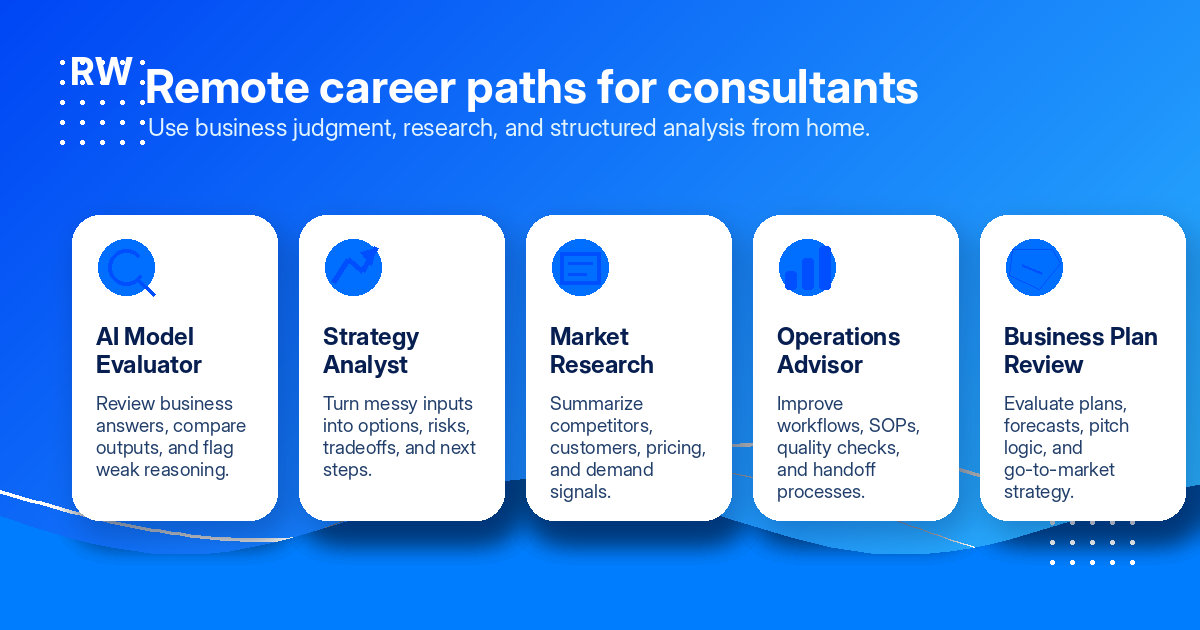
For consultants, business strategists, independent advisors, former operators, MBA-style generalists, startup consultants, analysts, and corporate strategy professionals, the best remote path is not one single job title. It is a cluster of roles. The goal is to understand where your expertise fits, create a profile that signals business judgment, and apply to platforms and companies that value expert evaluation, research quality, and clear written reasoning.
Why consultants are strong candidates for remote work
Consulting is already built around deliverables. You gather information, clarify the problem, identify constraints, compare options, make recommendations, and explain the reasoning. That process can be done from anywhere when the work is digital. A consultant working from home can review a pitch deck, audit a workflow, assess a market, improve a business process, or evaluate AI-generated recommendations without needing to sit in an office.
The biggest advantage is judgment. Many entry-level remote jobs are based on availability: answering support tickets, taking calls, logging data, or completing repetitive tasks. Consulting-adjacent remote work is different. It pays for the quality of your thinking. A business strategist who can read a messy scenario and produce a clear answer is useful in remote consulting, AI model evaluation, expert networks, research support, and business operations work.
Consultants also tend to have transferable language. Words like strategy, operations, due diligence, market sizing, customer research, competitive analysis, financial modeling, stakeholder management, workflow improvement, process design, risk assessment, and executive communication are valuable keywords. They help remote hiring systems understand that you are not only looking for generic work from home jobs. You are looking for roles where business experience matters.
1. Remote AI model evaluator for business topics
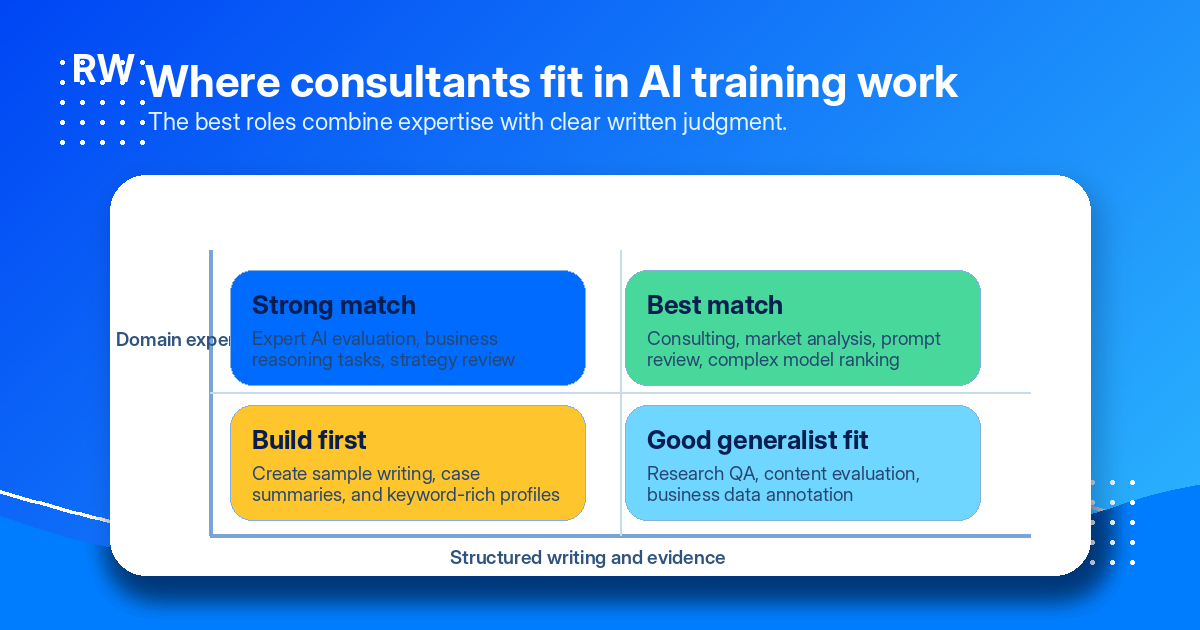
One of the strongest work from home options for consultants is AI model evaluation. In these roles, a worker reviews AI-generated answers and decides which response is better, more accurate, more useful, or better supported. For business topics, this can include strategy advice, market analysis, operations recommendations, sales planning, customer segmentation, financial reasoning, startup analysis, or management communication.
A consultant may be asked to compare two AI responses to the same prompt. One response might sound polished but ignore the real constraint. Another might be less flashy but more practical. A strong evaluator can explain the difference. That explanation is the value. AI companies, AI labs, and AI training platforms need reviewers who can identify shallow advice, vague strategy, weak assumptions, unsupported claims, and unrealistic recommendations.
This type of remote AI work can be a good fit for people searching for AI training jobs, model evaluation jobs, business AI reviewer jobs, remote AI evaluator work, and expert AI review. Major AI companies such as OpenAI, Anthropic, Google, Meta, and Grok are useful keywords in this market because applicants often search around those ecosystems. The practical route for most beginners is to apply through remote AI platforms, expert networks, and contractor marketplaces that match evaluators with projects. Platforms such as Mercor, micro1, Handshake AI, and Outlier are commonly discussed by people looking for flexible AI work, but applicants should always evaluate each opportunity on its own terms.
2. Remote business strategist or strategy analyst
Remote business strategy roles are a natural fit for consultants who can turn incomplete information into a clear plan. These jobs may involve market research, growth strategy, pricing analysis, customer analysis, product positioning, competitive research, or go-to-market planning. Some roles are full-time, but many are contract, fractional, or project-based.
A remote strategy analyst may review a company's market, summarize competitors, write a positioning memo, create a SWOT analysis, map customer segments, or propose a launch plan. A business strategist may help a founder decide which channel to test first, which customer profile to target, or which operational metric needs attention. The best candidates show that they can move from information to decision. They do not just collect facts. They explain what the facts mean.
When applying, use keywords that match the work: business strategy, market research, growth strategy, competitive analysis, go-to-market strategy, customer research, business analysis, strategic planning, and executive summary. If the role overlaps with AI, add AI evaluation, prompt testing, AI research, model response review, and business reasoning.
3. Market research and competitive analysis work from home
Market research is one of the most practical remote jobs for consultants because the work is already information-based. Companies need help understanding competitors, pricing, customer segments, trends, positioning, channel strategy, and demand signals. A consultant who can search carefully, compare sources, and summarize findings in plain language can be useful without needing to be a full-time employee.
The strongest market research deliverables are not giant reports. They are clear answers. A company may need to know which competitors matter, how the market is segmented, what customers complain about, what pricing models are common, or what claims competitors use in their messaging. Remote researchers can compile this information and turn it into useful analysis.
This type of role is also relevant to AI training because AI-generated market research often needs human review. A model may produce a confident answer that sounds right but misses nuance, invents details, or overgeneralizes from weak evidence. Consultants and strategists can help evaluate whether the output is actually useful for a business decision.
4. Operations consultant and process improvement roles
Operations consulting can also move remote. Many businesses need help documenting processes, improving handoffs, writing SOPs, analyzing bottlenecks, designing dashboards, or creating quality control checklists. These are work from home jobs when the underlying process is digital or can be documented through interviews, screenshots, data exports, and workflow tools.
For consultants with operations experience, keywords matter. Use process improvement, operations analysis, SOP development, workflow optimization, quality assurance, project management, vendor management, documentation, business operations, and systems improvement. If you have experience with tools like spreadsheets, Airtable, Notion, HubSpot, Salesforce, Asana, Monday, Slack, or Google Workspace, mention them where relevant.
Operations work is also valuable in AI review. AI systems are increasingly asked to write SOPs, improve workflows, summarize processes, and recommend operational changes. A human reviewer with operations experience can tell whether those recommendations are specific, realistic, and safe to use.
Consultants and business strategists are some of the strongest candidates for remote AI evaluation and strategy roles. Find opportunities that match your expertise.
Find Roles Hiring Now →5. Business plan, pitch deck, and startup review
Consultants and business strategists can also work remotely by reviewing business plans, pitch decks, startup ideas, grant proposals, and go-to-market documents. This work may come from startups, small businesses, accelerators, creators, consultants, or AI training platforms that need expert review of business reasoning.
A strong reviewer looks for gaps. Is the target customer clear? Does the pricing make sense? Are the assumptions realistic? Does the strategy match the budget? Is the market analysis specific enough? Does the pitch deck explain the problem, solution, traction, model, and next steps? These questions are familiar to consultants, but they are also useful in remote evaluation work.
This can overlap with writing, editing, finance, marketing, and research jobs. The best positioning is not simply "I give business advice." It is more specific: I evaluate business plans, identify weak assumptions, improve strategy documents, review market research, and write clear recommendations.
6. Fractional consulting and advisory work
Fractional work is another path for consultants who want remote flexibility. A fractional strategist, fractional chief of staff, fractional operations lead, fractional growth advisor, or fractional business analyst may work with several clients instead of one employer. This can be harder to start than platform-based AI work, but it can become more durable over time.
Fractional consulting usually depends on proof. A profile should show what problems you solve, which industries you understand, and what outcomes you can help produce. Case studies matter. They do not need to reveal private client information. A short anonymous case summary can still show the structure of your thinking: the problem, the constraint, the analysis, the recommendation, and the result.
For someone just starting, fractional work can be combined with AI training platforms, research projects, and remote analyst contracts. The point is not to rely on one source. Remote consultants should build a portfolio of opportunities.
7. Expert network calls and written expert projects
Expert networks connect companies, investors, and researchers with people who understand a specific market or business function. Some of this work is phone-based, but written expert projects and asynchronous research assignments can also appear. Consultants, former operators, analysts, and strategists may qualify if they have credible experience in a sector or function.
This work is not always steady, but it can pay well when the fit is strong. The key is specificity. "Business strategist" is broad. "B2B SaaS pricing strategist," "restaurant operations consultant," "healthcare revenue cycle analyst," "ecommerce retention consultant," or "AI workflow consultant for small businesses" is more searchable and more credible.
Remote AI platforms use a similar logic. The more clearly your profile explains your domain, the easier it is for a matching system to route you toward relevant projects.
8. Prompt and workflow consultant for small businesses
Many small businesses want to use AI but do not know where to begin. A consultant can help them turn repetitive work into AI-assisted workflows: customer email drafts, internal SOPs, content calendars, research summaries, lead qualification, sales scripts, hiring rubrics, meeting summaries, and reporting templates. This is not the same as being an AI engineer. It is business process consulting with AI tools included.
The best prompt consultants do not sell magic prompts. They identify a workflow, define the desired output, create a repeatable process, and add quality checks. For example, a consultant might help a recruiting firm summarize resumes, help a sales team create account research briefs, or help a local business draft customer response templates. The value is not the prompt alone. The value is the system around it.
This type of work pairs well with AI training experience. If you have evaluated model outputs, tested prompts, ranked responses, or corrected weak AI reasoning, say so. It shows that you understand both the usefulness and the limits of AI.
How to position yourself as a consultant for remote AI and strategy jobs
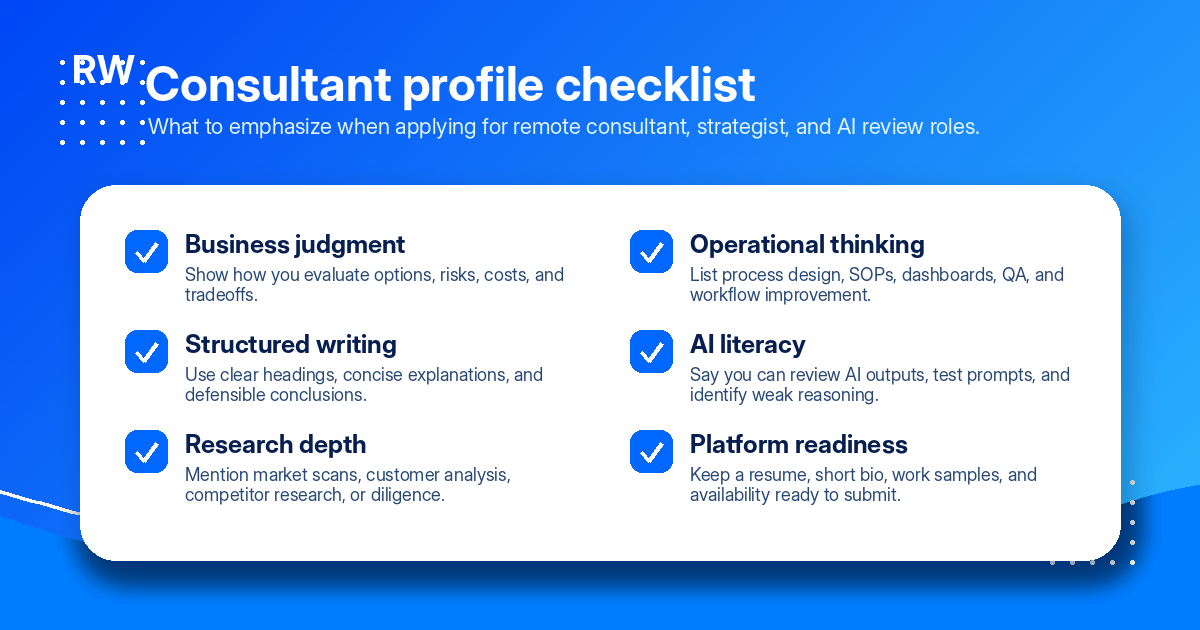
A consultant profile should not read like a generic resume. It should make your judgment easy to understand. Start with a simple headline: Business strategist and consultant with experience in market research, operations, and AI model evaluation. Then support that headline with specific skills: competitive analysis, business writing, process improvement, strategy memos, customer research, financial reasoning, project management, and model response review.
Your profile should also show how you communicate. Remote work rewards clear writing because managers and platforms cannot watch you think in real time. They judge your work through written outputs. Include short samples when possible: a market summary, a strategy memo, an operations checklist, a business plan review, or a before-and-after example of a process improvement. Keep samples clean and anonymized.
For AI training platforms, emphasize that you can follow instructions, compare outputs, explain preferences, identify hallucinations or weak reasoning, and write concise evaluations. Consultants sometimes make the mistake of sounding too abstract. Platforms need precision. Show that you can combine expert judgment with task discipline.
Best keywords to include in your resume or profile
Use keywords that match both consulting and remote AI work. Strong terms include strategy consultant, business strategist, business analyst, market research, competitive analysis, operations consultant, process improvement, SOP development, workflow optimization, go-to-market strategy, customer research, pricing analysis, executive communication, project management, AI model evaluation, AI training, model response review, prompt evaluation, research QA, expert reviewer, and subject matter expert.
You can also include platform and ecosystem keywords naturally where they apply: Mercor, micro1, Handshake AI, Outlier, OpenAI, Anthropic, Google, Meta, and Grok. Do not stuff names into a profile randomly. Use them in context. For example: Interested in remote AI training and model evaluation work involving business reasoning, strategy analysis, and expert review for AI systems used by companies such as OpenAI, Anthropic, Google, Meta, and Grok.
The goal is to be searchable without sounding spammy. A good profile reads like a clear professional summary, not a list of buzzwords.
How to avoid low-value remote consulting traps
Not every remote consulting job is worth your time. Be careful with roles that require unpaid strategy projects, vague commission-only promises, expensive training before you can apply, or unclear ownership of your work. Real remote work platforms should explain the application process, the task type, the pay structure, and the conditions for getting paid. If a company charges you just to access a job, that is a warning sign.
Consultants should also avoid overcustomizing every application. Create a strong base profile, then adjust the first few lines for each category of work. One version can target AI model evaluation. Another can target market research. Another can target operations consulting. This keeps quality high without turning every application into a new project.
The best remote strategy is diversified. Do not depend on one platform, one client, or one project type. Remote AI work can pause. Consulting clients can disappear. Expert network projects can be inconsistent. A smart consultant builds multiple channels at the same time.
A practical weekly plan for consultants starting remote work
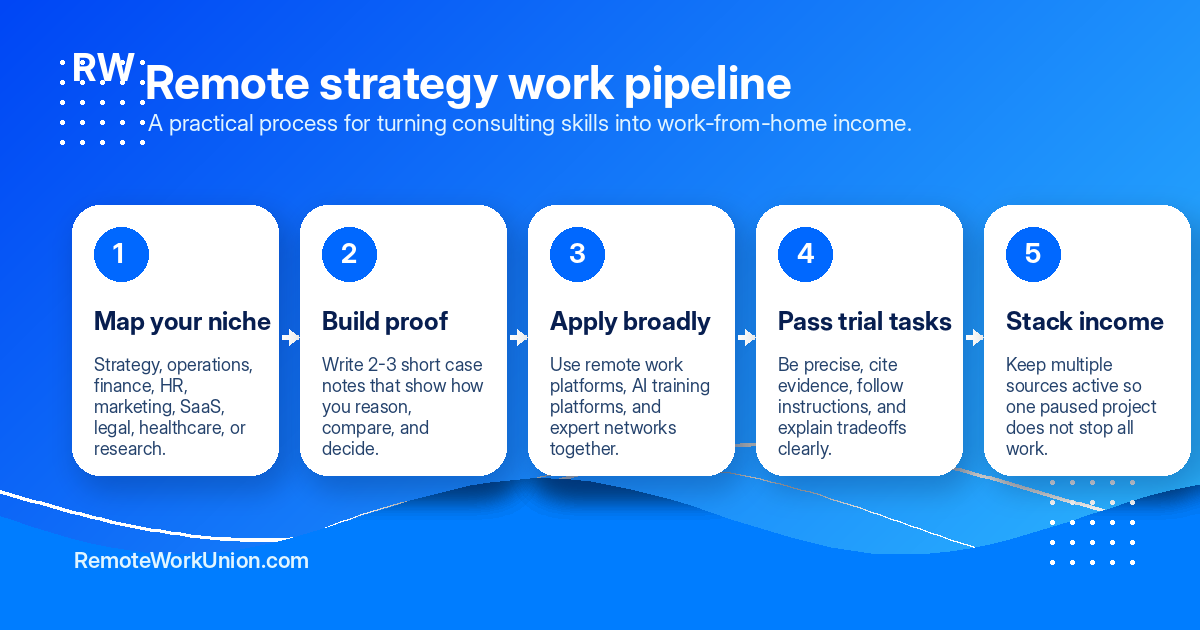
A simple weekly plan is enough to start. On day one, update your resume and create a remote work profile that emphasizes business judgment, structured writing, and AI evaluation. On day two, write two short work samples: one market research memo and one business recommendation memo. On day three, apply to AI training platforms, remote consulting marketplaces, and research jobs. On day four, build a list of fractional consulting prospects. On day five, follow up, complete trial tasks, and refine your profile based on which roles respond.
Keep the system simple. Track where you applied, what version of your profile you used, whether you completed a trial task, and whether work became available. Consultants are used to solving other people's systems. Treat your remote job search like a system too.
Conclusion
The best work from home jobs for consultants and business strategists are not limited to traditional consulting. Remote AI model evaluation, business strategy analysis, market research, operations improvement, pitch deck review, expert projects, and AI workflow consulting all use the same underlying skill: the ability to make sense of business information and explain what should happen next.
Consultants who can write clearly, reason carefully, and apply domain expertise have a real advantage in remote work. AI has increased the need for human judgment, not removed it. The opportunity is strongest for people who can review AI outputs, test business logic, compare recommendations, and communicate decisions in a way that is useful to companies.
Frequently Asked Questions
What remote work can a consultant do from home?
Consultants can do remote AI model evaluation, business strategy analysis, market research, operations consulting, pitch deck and business plan review, expert network projects, fractional advisory work, and AI workflow consulting. The core consulting skills of research, judgment, structured writing, and recommendations all translate to remote roles that can be done from anywhere.
How do consultants get into remote AI training jobs?
Consultants apply to AI training platforms and expert evaluation marketplaces that match reviewers with business-domain tasks. These roles often involve comparing AI-generated strategy advice, ranking responses to market research questions, identifying weak business reasoning, or reviewing financial and operational recommendations. Platforms like Mercor, micro1, Handshake AI, and Outlier are commonly discussed starting points.
Do you need a coding background for remote AI evaluation jobs?
No. Many remote AI evaluation jobs are built around business judgment, writing quality, and domain expertise rather than programming. Consultants who can evaluate strategy advice, spot weak assumptions, and explain what makes one business recommendation stronger than another are exactly the kind of reviewers AI companies need for business-focused model evaluation.
What keywords should a consultant use for remote work profiles?
Strong keywords include strategy consultant, business strategist, market research, competitive analysis, operations consultant, process improvement, go-to-market strategy, customer research, executive communication, AI model evaluation, AI training, model response review, expert reviewer, and subject matter expert. Platform ecosystem keywords like Mercor, micro1, Handshake AI, Outlier, OpenAI, Anthropic, Google, Meta, and Grok can also be relevant when used in natural context.
How much do remote AI evaluation jobs pay for consultants?
Pay varies by platform, task type, and domain expertise. Expert-tier AI evaluation roles involving business, strategy, legal, or financial reasoning can pay $50–$200 per hour. General model evaluation work typically pays above $20 per hour. Consultants with specialized domain knowledge in finance, operations, strategy, or market research tend to qualify for higher-paying evaluation categories.