Canada is one of the better markets for remote AI training work because many projects need strong English writing, careful research, reliable judgment, and North American cultural context. The work is not limited to software engineers. Many AI training jobs are built for writers, editors, students, researchers, bilingual applicants, business professionals, legal reviewers, finance specialists, healthcare writers, and people who can read carefully and explain why one answer is better than another.
The key is knowing what to search for. Many legitimate roles do not use one single title. You may see AI model evaluator, AI response rater, data annotation specialist, prompt evaluator, AI writing reviewer, RLHF contributor, search quality rater, AI content editor, research reviewer, or domain expert reviewer. These jobs can appear on dedicated AI platforms, general job boards, company career pages, and contractor marketplaces.
This guide explains how Canadian applicants can find real remote AI work, avoid obvious scams, and prepare a stronger profile before applying.
What AI Training Work Actually Means
AI training work is the human review layer behind modern AI systems. Large AI companies and AI labs build models that can write, reason, code, summarize, classify, search, and answer questions. Human reviewers help improve those systems by rating model outputs, writing better example answers, checking facts, labeling data, comparing two responses, and explaining which response is more helpful.
In practical terms, a remote AI contractor might read two chatbot answers and decide which one follows the instructions better. Another contractor might rewrite a weak answer into a stronger one. A data annotation worker might label whether a response is safe, accurate, relevant, or complete. A subject matter expert might review a legal, medical, financial, mathematical, or coding answer for quality.
This is why strong writing matters. The job is usually not just clicking boxes. Good reviewers can explain their decisions clearly, notice small errors, follow detailed guidelines, and stay consistent across many tasks.
Why Canadian Applicants Can Be Competitive
Canadian applicants often bring several advantages to remote AI work. Many projects need fluent English, professional writing, research ability, and familiarity with North American products, education, culture, regulations, job markets, and consumer language. For some projects, Canadian English and Canadian context matter specifically.
Canada also has a large pool of college-educated applicants, bilingual English and French speakers, remote workers, writers, editors, analysts, teachers, finance professionals, healthcare professionals, lawyers, paralegals, and technical workers. That mix is valuable because AI training is becoming more specialized. A general writing role may only require clear English, but higher-value projects may need finance, law, medicine, coding, science, math, business, or education experience.
Tip: Canada is a credible location for English-language and bilingual AI training searches, especially when applicants know how to present their skills. These roles can be competitive and project-based, but the market is real.
The Main Types of Remote AI Jobs to Search For in Canada
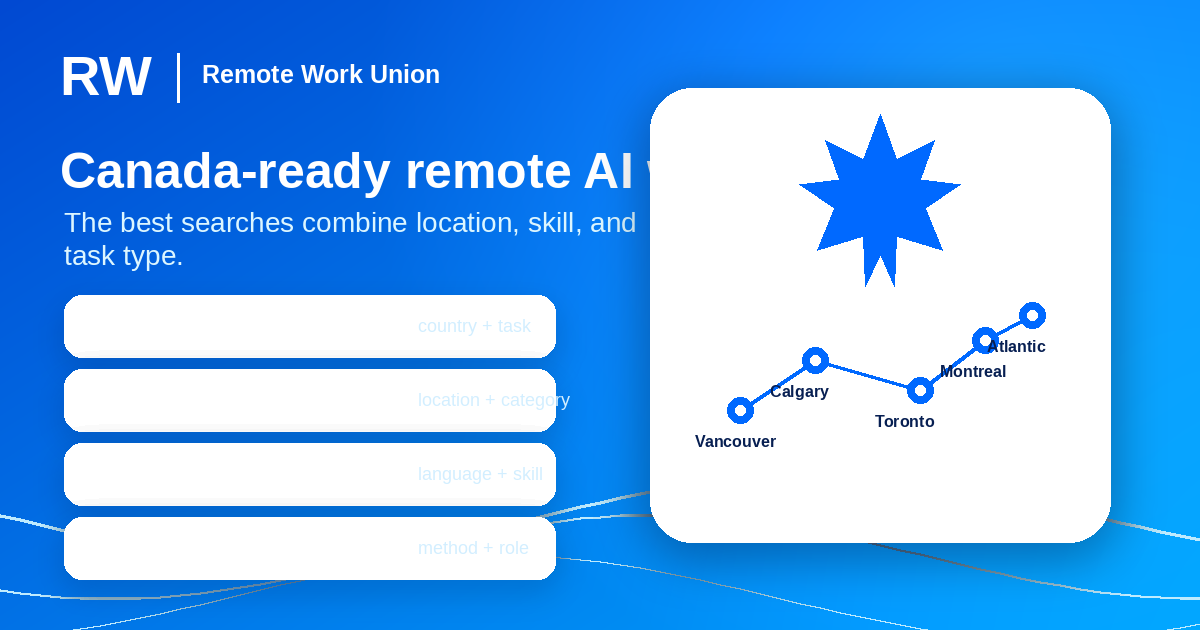
The best approach is to search by task type rather than only searching for one job title. AI platforms and job boards use different labels for similar work.
AI model evaluation is one of the broadest categories. These roles ask you to compare AI answers, rate helpfulness, identify mistakes, and write short explanations. Search terms include AI model evaluator Canada, AI response evaluator, AI answer reviewer, chatbot evaluator, model response rater, RLHF evaluator, and remote AI reviewer.
AI writing evaluation fits people who can edit, summarize, rewrite, and judge tone. Search terms include AI writing evaluator, AI content reviewer, AI editor, prompt response writer, AI content editor, and writing quality evaluator.
Data annotation work is usually more structured. It may involve labeling text, images, search results, categories, safety issues, intent, sentiment, or factual claims. Search terms include data annotation Canada, remote data labeling, AI data annotator, machine learning data labeling, and human feedback data jobs.
Research and fact-checking work is useful for applicants who are careful with sources. These roles may involve verifying claims, judging whether an AI answer is supported, or improving answer accuracy. Search terms include AI fact-checking jobs, AI research reviewer, search quality evaluator, AI answer fact checker, and remote research evaluator.
Bilingual AI evaluation can be strong for English-French applicants. Search terms include French AI evaluator, Canadian French AI trainer, bilingual AI data annotation, French language model evaluator, and English French AI reviewer.
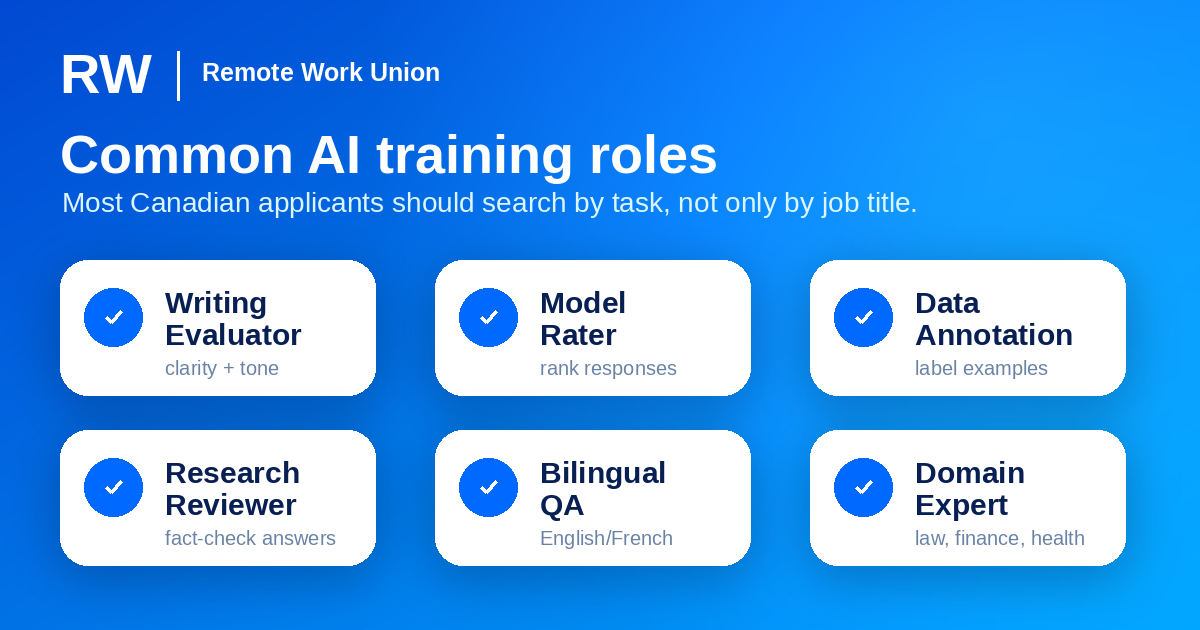
Domain expert review is where your work history can matter most. A marketer, salesperson, accountant, business operator, customer service lead, consultant, teacher, analyst, software engineer, lawyer, nurse, or graduate researcher may be matched with projects that need expert judgment in their field.
Where Canadians Should Look for Legitimate Opportunities
Start with dedicated AI training platforms and contractor marketplaces that frequently post model evaluation, data annotation, writing evaluation, and expert review work. Applicants often search platforms such as Mercor, Outlier AI, Handshake AI, micro1, Surge AI, Stellar AI, and similar AI work marketplaces. Availability changes by project, country, language, and client needs, so the same platform can be strong one month and quiet the next.
Use general job boards too. LinkedIn, Indeed, company career pages, remote job boards, and specialized contractor boards can surface roles under less obvious titles. Instead of searching only "AI training jobs," combine keywords: Canada, remote, contractor, AI evaluator, model evaluation, data annotation, prompt evaluator, writing evaluator, RLHF, chatbot evaluator, and search quality rater.
You can also search by major AI company keywords, but be precise. Searches like OpenAI jobs Canada, Anthropic remote AI evaluator, Google Gemini AI training jobs, Meta AI data annotation, Microsoft AI evaluator, Claude AI training, or Grok AI evaluator may help you discover related listings, contractors, vendors, or role descriptions. Many workers are not directly employed by the AI lab itself — they may work through vendors, platforms, or project-based contractor networks that support AI development.
Remote Work Union connects you to legitimate remote AI training and evaluation roles. Apply for free and find roles hiring now.
Find Roles Hiring Now →How to Tell Whether an AI Training Job Is Legitimate
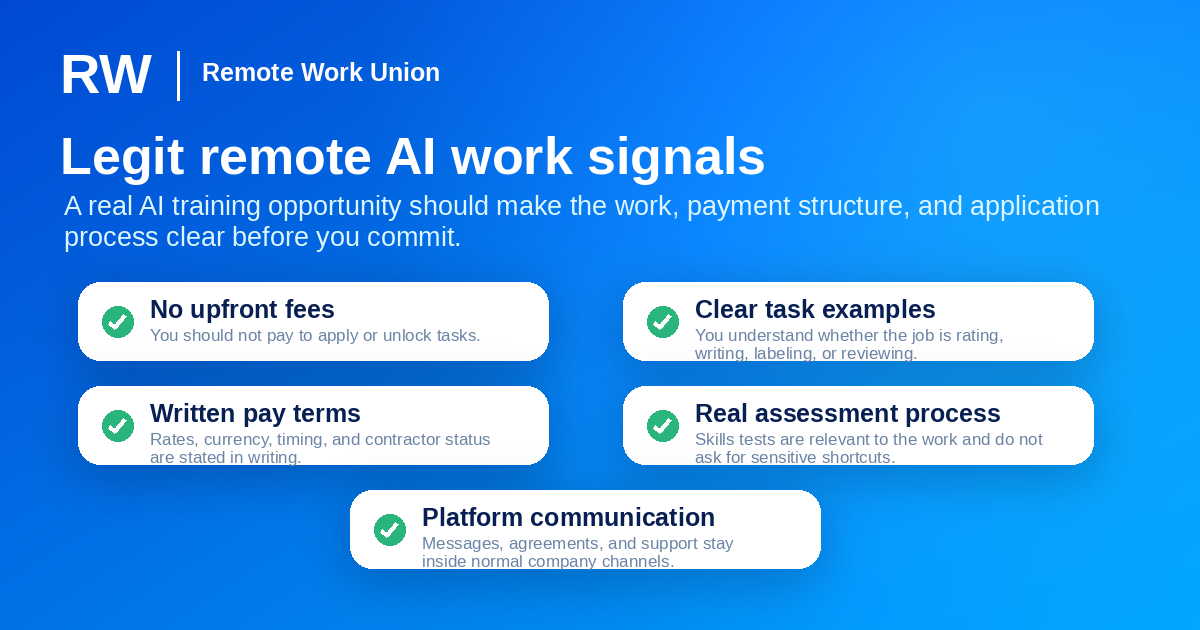
Legitimate remote AI work should feel like a real application process, not a mystery offer. You should see a clear role description, basic company or platform information, written payment terms, contractor expectations, task examples, assessment steps, and communication through normal company channels.
Be cautious if a job asks for an upfront fee, promises guaranteed income, requires you to buy a course before applying, refuses to explain the work, pushes you to move the conversation to a strange messaging app immediately, asks for sensitive personal information before basic screening, or advertises unrealistic pay with no assessment.
Real AI training platforms often require skills tests because the work depends on judgment. A writing role may test clarity. A research role may test fact-checking. A coding role may test programming. A bilingual role may test translation or native-level language quality. Assessments can be annoying, but they are common in legitimate AI evaluation work.
How to Build a Stronger Canadian Applicant Profile
Your profile should make your judgment skills obvious. Do not rely on vague phrases like hard worker, fast learner, or good with computers. AI training platforms need to know what you can review well.
A strong profile for a writing-focused role might mention editing, professional writing, academic writing, content review, grammar, tone, summarization, fact-checking, prompt writing, and clear feedback. A profile for research roles should mention source evaluation, claim verification, web research, citation checking, detail orientation, and analytical writing. A data annotation profile should mention guideline following, labeling accuracy, consistency, spreadsheets, quality control, and structured review.
If you have a degree, include it clearly. If you have professional experience in law, finance, medicine, education, software, science, marketing, operations, consulting, or analytics, include it. AI training platforms increasingly need subject matter experts who can judge whether a model answer is not just well written, but actually correct.
Canadian applicants should also mention relevant language context when true: Canadian English, Canadian French, bilingual English/French, Quebec French, North American business writing, Canadian education, Canadian finance, Canadian legal research, or Canadian healthcare writing.
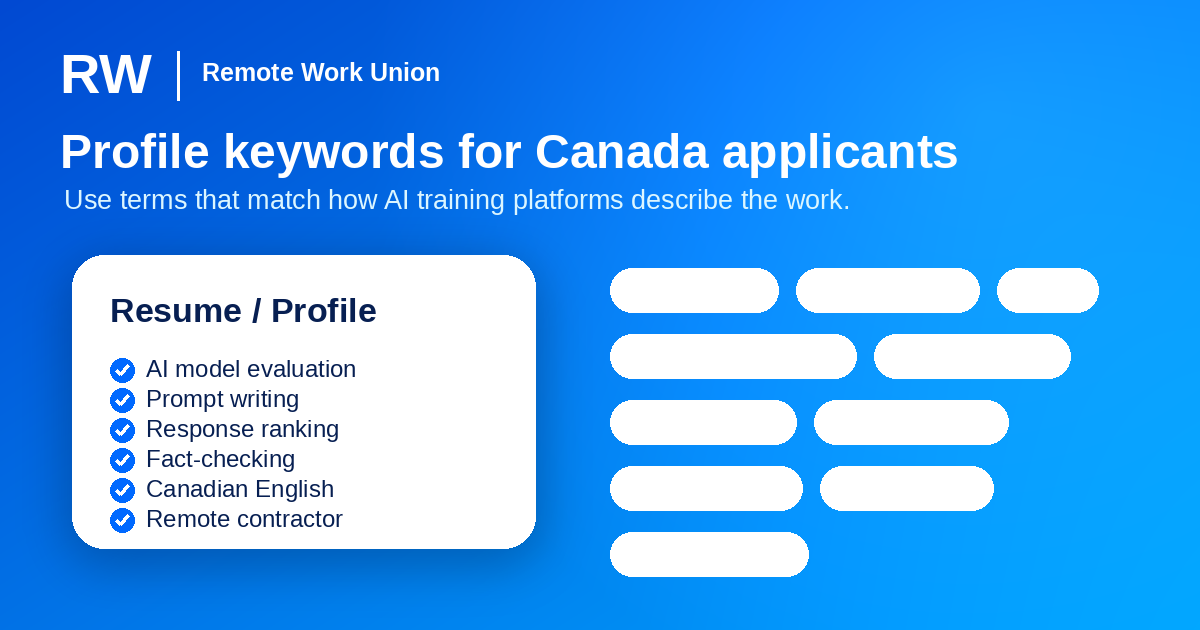
Resume and Keyword Examples
For remote AI training jobs, your resume does not need to look complicated. It needs to be easy for a recruiter, platform, or automated screening system to match to the project. Use a simple format, clear job titles, short bullets, and specific skills.
Useful keyword phrases include AI model evaluation, AI response rating, data annotation, data labeling, prompt writing, prompt evaluation, RLHF, human feedback, chatbot evaluation, AI content review, writing evaluation, editing, fact-checking, research review, source verification, search quality, classification, quality assurance, guideline adherence, and written feedback.
- Writing or research applicant: "Reviewed written responses for clarity, accuracy, tone, and instruction-following; provided concise feedback to improve answer quality."
- Data annotation applicant: "Labeled and categorized text data according to detailed guidelines while maintaining consistency and quality across repeated tasks."
- Domain expert: "Evaluated technical content within my subject area for accuracy, completeness, risk, and practical usefulness."
The goal is not to pretend you have AI experience if you do not. The goal is to translate your existing skills into the language these roles use.
What the Application Process Usually Looks Like
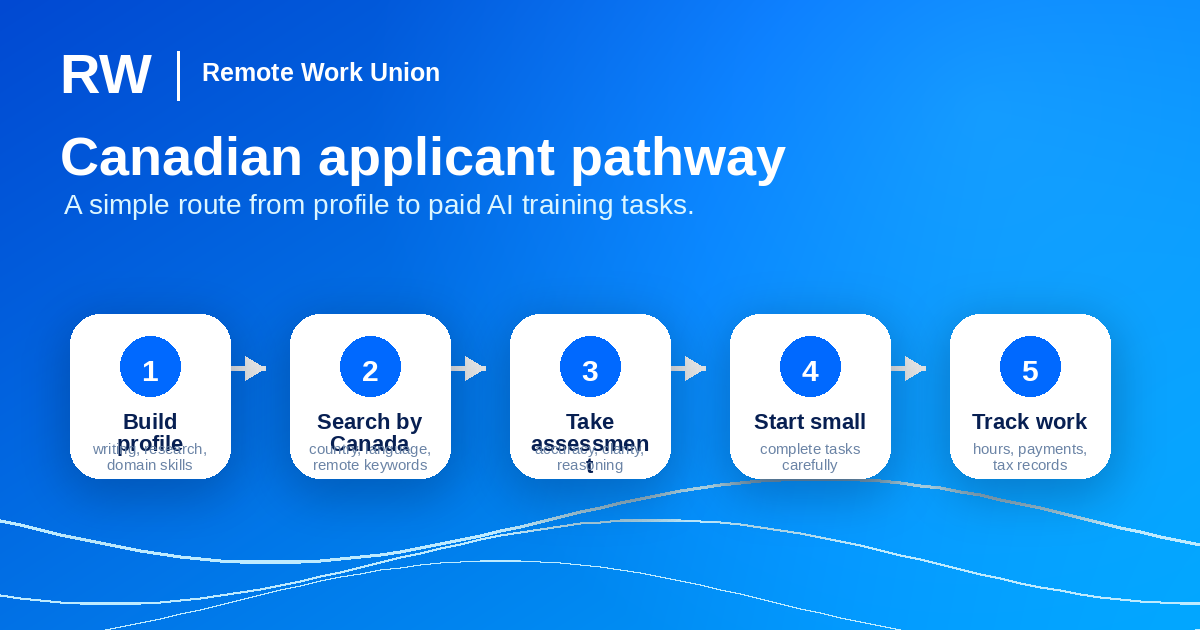
Most AI training applications follow a predictable path. First, you create a profile and upload a resume or work history. Second, you select skills, language abilities, education, country, and available hours. Third, you may complete an assessment. Fourth, the platform may match you to projects. Fifth, you complete onboarding, read guidelines, and begin tasks if work is available.
The assessment is often the filter. Read every instruction carefully. Many applicants fail because they rush, over-explain, ignore the prompt, miss a hidden requirement, or choose the answer that sounds nicer instead of the answer that actually follows the task. AI evaluation work rewards careful reading more than speed at the beginning.
Once accepted, do not assume task volume will be stable. Remote AI work can slow down when a project ends, the client pauses work, quality standards change, or a platform has more workers than tasks. Treat each platform as one possible income stream rather than a guaranteed full-time job.
Pay, Contractor Status, and Taxes for Canadians
Many remote AI training roles are contractor roles, not traditional employee jobs. That means applicants should pay attention to payment currency, payment method, invoicing, tax forms, task availability, and whether the role is part-time, project-based, or ongoing. Some platforms pay in USD, some may show local currency, and some vary by project.
Do not judge a role only by the highest advertised hourly rate. Ask whether the rate applies to all tasks, only expert tasks, only active work time, or only a limited project. A lower but steady project may be more useful than a high-rate project with almost no task volume.
Tax note: Canadian workers should keep records of hours, payments, expenses, platform names, dates, and currency conversion. Tax obligations vary based on your situation, province, business structure, and income level. Use a qualified tax professional or official Canadian tax guidance when needed. This article is not tax advice.
Common Mistakes Canadian Applicants Should Avoid
The first mistake is searching too broadly. "Remote jobs" is too general, and "AI jobs" often returns software engineering roles. Better searches include the task: AI evaluator, model response rater, AI writing evaluator, data annotation, RLHF, prompt evaluator, search quality rater, or AI fact-checker.
The second mistake is applying with a generic resume. If your resume only says customer service, student, marketer, analyst, or teacher, the platform may not understand how your background fits AI work. Translate your experience into review skills: writing, research, accuracy, quality control, feedback, guidelines, domain knowledge, and judgment.
The third mistake is ignoring location requirements. If a role says Canada, US-only, UK-only, North America, or specific language market, take that seriously. Country restrictions can be part of the client requirement.
The fourth mistake is assuming one rejection means the entire category is closed. AI training work is platform-based and project-based. If one application fails, improve your profile, practice the assessment style, and apply to other platforms and job boards.
A Simple Search Plan for Canadian Applicants
Use a weekly search routine. Start with a few dedicated AI platforms, then check LinkedIn and major job boards. Search by country and role type. Save the searches that return relevant listings. Track where you applied, which resume version you used, whether you completed an assessment, and whether the platform responded.
Search examples to use:
- Canada AI training jobs remote
- AI model evaluator Canada
- Remote AI evaluator Canada
- AI data annotation Canada
- RLHF evaluator remote Canada
- AI writing evaluator remote
- French AI evaluator Canada
- Canadian French AI data annotation
- AI fact-checking jobs remote
- Search quality rater Canada
After applying, keep improving your profile. Add stronger examples. Clarify your subject expertise. Make your resume easier to scan. If you are bilingual, make that prominent. If you are a strong writer, show that through clean application answers and careful assessments.
Final checklist: Does your resume clearly show writing, research, review, language, technical, or domain expertise? Are you searching for task-based titles? Did you include Canada, remote, contractor, and language keywords? Does the platform explain the task, pay structure, and assessment? Are you avoiding jobs that ask for upfront fees? Are you tracking applications, assessments, and task volume?
Frequently Asked Questions
Are remote AI training jobs available in Canada?
Yes. Canada is a strong market for remote AI training work because many projects need fluent English, professional writing, careful research, and North American cultural context. Canadian applicants can find roles in AI model evaluation, data annotation, writing evaluation, research review, and domain expert review through dedicated AI platforms, job boards, and contractor marketplaces.
What types of AI training jobs can Canadian applicants do?
Canadian applicants can pursue AI model evaluation, AI writing evaluation, data annotation, research and fact-checking, bilingual AI review for English and French speakers, and domain expert review in fields like law, finance, medicine, education, and software. These roles may appear under titles like AI evaluator, AI response rater, data annotator, prompt evaluator, RLHF contributor, or search quality rater.
Do I need a tech background for Canada AI training jobs?
No. Many remote AI training jobs in Canada are designed for people with strong writing, research, or domain expertise rather than engineering backgrounds. Writers, lawyers, teachers, nurses, finance professionals, and business analysts can all qualify. The key is presenting your skills clearly in AI evaluation language and passing the platform's assessment.
How do I know if a remote AI training job posting is legitimate?
Legitimate remote AI work shows a clear role description, basic company or platform information, written payment terms, task examples, and assessment steps. Be cautious of any job that asks for an upfront fee, promises guaranteed income, requires buying a course before applying, or pushes you to communicate through unusual channels before basic screening.
Can bilingual English-French Canadians find specialized AI training work?
Yes. Bilingual English and French speakers — including Quebec French speakers — can search specifically for French AI evaluator, Canadian French AI data annotation, bilingual AI reviewer, and French language model evaluator roles. Some platforms actively seek Canadian French expertise for projects that require French language quality and cultural context.
What keywords should I use on my resume for Canadian AI training jobs?
Useful keywords include AI model evaluation, data annotation, data labeling, prompt writing, prompt evaluation, RLHF, human feedback, chatbot evaluation, AI content review, writing evaluation, editing, fact-checking, research review, source verification, search quality, classification, quality assurance, guideline adherence, and written feedback. Also include Canada, Canadian English, or Canadian French where relevant to your background.