Outlier AI has become one of the most searched platforms for remote AI training jobs because it sits at the intersection of three huge trends: work from home jobs, AI model improvement, and flexible online freelance work. People are not only looking for another survey site or low-paid data entry task. They are looking for legitimate online jobs from home that use real skills: writing, editing, coding, math, finance, law, science, education, research, and multilingual knowledge.
The important thing to understand is that Outlier is not a traditional employer with a guaranteed salary, fixed schedule, manager, and benefits. It is a freelance contributor platform operated by Scale AI that connects qualified experts with AI-related projects. The work can be useful, flexible, and well matched for people with strong judgment. It can also be inconsistent, competitive, and dependent on project availability. That distinction matters before you apply.
This guide explains how Outlier AI works, what remote AI training jobs usually involve, how pay is structured, what the application process looks like, and how to improve your chances of getting matched with better projects.
What Is Outlier AI?
Outlier AI is a contributor platform for people who want to work on AI training and model improvement projects from home. In simple terms, companies building large language models need humans to help create better training data, check model behavior, write challenging prompts, compare answers, and improve the quality of AI outputs. Outlier connects qualified freelancers with that type of work.
According to Outlier's own description, the platform is operated by Scale AI and connects experts with leading AI companies to provide human feedback that improves language learning models. That means the work is not just typing random labels into a form. Depending on the project, contributors may need to use subject-matter knowledge, careful writing, technical reasoning, or professional judgment.
This is why Outlier AI jobs appeal to people searching for remote jobs that are not customer support, appointment setting, cold calling, surveys, or gig apps. The best-fit applicant is usually someone who already has useful expertise and wants to convert that expertise into remote AI training work.
How Outlier AI Works
Outlier works more like a freelance project marketplace than a normal job. You create a profile, provide information about your experience, verify your identity and location, complete skill screenings, and then wait to be matched with available projects. If a project is available and you qualify, you may complete project-specific onboarding before doing paid tasks.
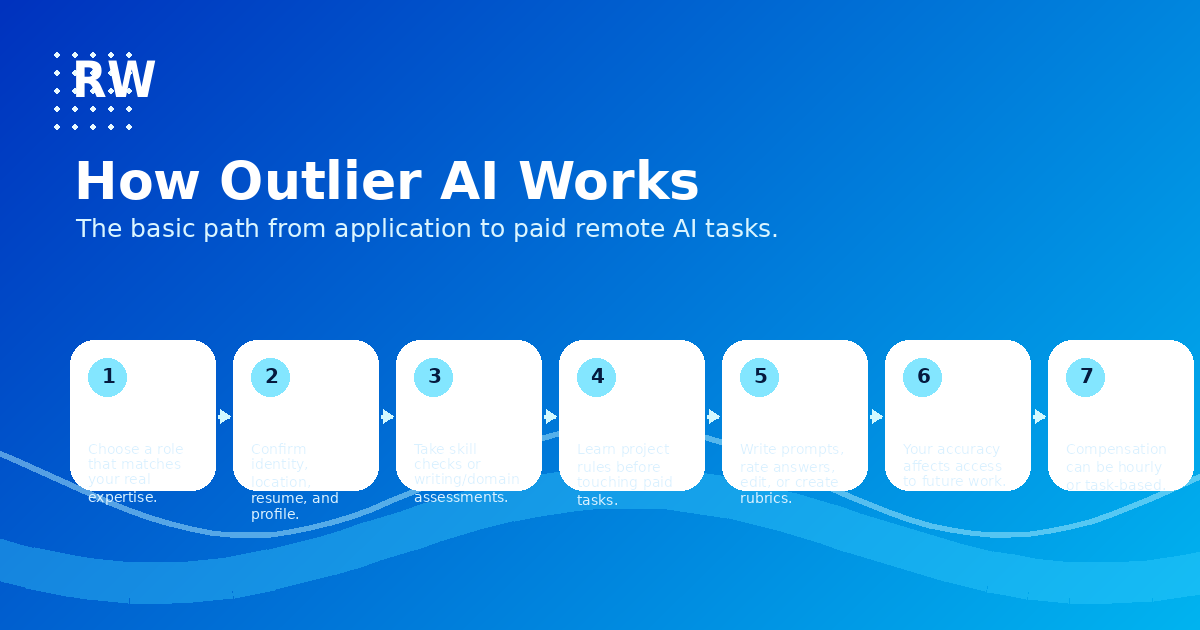
The general flow is straightforward:
- Create a profile with your education, work experience, skills, and areas of expertise.
- Apply to opportunities that match your background, such as writing, coding, math, languages, law, finance, or other professional domains.
- Verify your identity and location, since projects may have country, state, region, or tax-related limitations.
- Complete skill screenings or assessments that test whether you can follow instructions and produce high-quality work.
- Complete project-specific onboarding if you are matched with a live project.
- Work on assigned tasks, which may include prompt writing, answer comparison, response editing, rubric creation, factual checking, or domain-specific analysis.
- Maintain quality, because accuracy, instruction-following, and consistency affect whether you continue receiving work.
Key point: Getting accepted to the platform does not always mean there will be work available immediately. Project demand changes. A strong profile can improve your odds, but the platform still depends on client needs, domain demand, location eligibility, and task volume.
What Remote AI Training Jobs on Outlier Actually Involve
Remote AI training work is broader than most people think. It is not simply chatting with a bot. It is usually structured work designed to make AI systems more accurate, helpful, safe, and reliable.
Common task types can include:
- Writing difficult prompts that test whether an AI model can reason through a problem.
- Creating a correct answer or reference response for a model to learn from.
- Ranking two or more AI-generated answers based on accuracy, clarity, usefulness, safety, and instruction-following.
- Editing or rewriting model responses so they become stronger examples.
- Building rubrics that define what a good answer should include.
- Checking factual accuracy in a specialized subject area.
- Reviewing code, math, legal reasoning, finance explanations, science answers, or multilingual outputs when your background matches the project.
This is why AI training jobs are a better fit for people with real-world expertise than for people who only want passive online income. The platform may look simple on the surface, but the work rewards careful thinking, patience, clarity, and the ability to follow instructions exactly.
Is Outlier AI a Full-Time Remote Job?
No. It is better to think of Outlier as flexible freelance remote work, not a guaranteed full-time remote job. Outlier's FAQ describes contributors as independent contractors or freelancers, not employees. That means no traditional employee benefits, no guaranteed hours, and no guaranteed long-term project assignment.
For some workers, that flexibility is the entire appeal. You can work from home, choose when to contribute, and fit tasks around a job, school, parenting, consulting, music, freelancing, or another business. For others, the lack of predictable work can be frustrating.
How Outlier AI Pay Works
Outlier pay can be based on time spent or tasks completed, depending on the project. Outlier says payment details are shared before you start a project and that payments are processed weekly through common methods such as PayPal, AirTM, or bank transfer. The exact amount can vary based on specialization, project type, task complexity, location, and current demand.
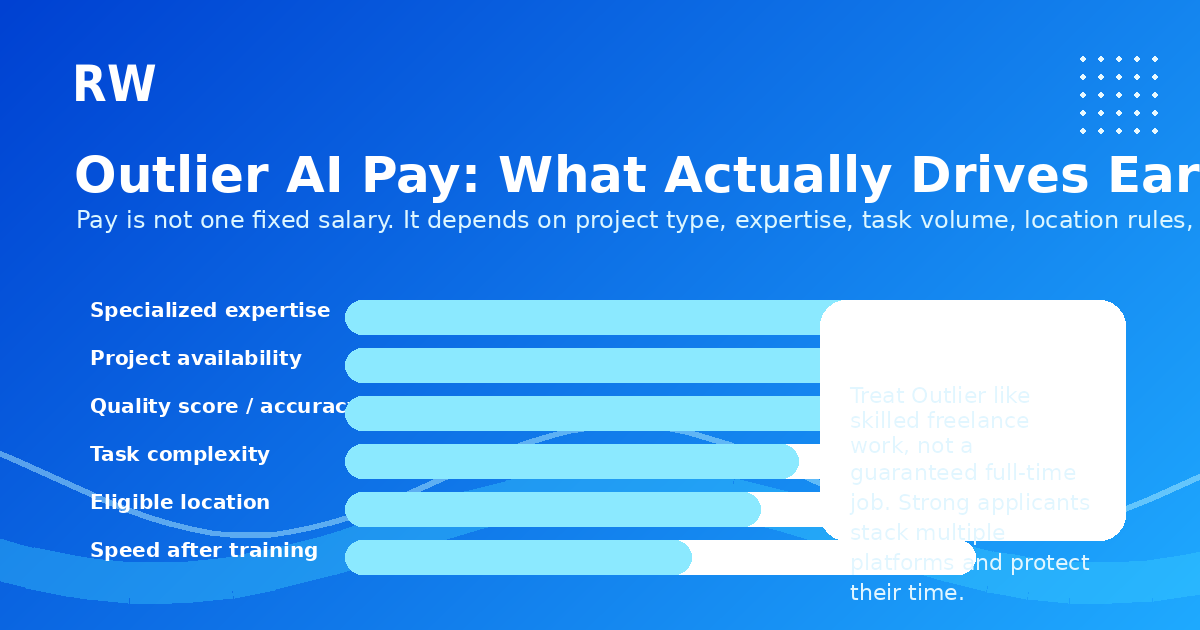
A coding expert, math specialist, legal professional, finance expert, advanced writer, or multilingual evaluator may see different opportunities from a generalist. That does not mean everyone gets premium work. It means the platform values expertise when there is a project that needs that expertise.
The biggest mistake is applying because you saw a high hourly number somewhere and assuming that number applies to every worker, every project, and every week. Remote AI training jobs can pay well compared with surveys, basic data entry, or gig apps, but project access is not automatic. Your real earnings depend on three things: getting accepted, getting matched, and maintaining quality once you are inside.
Before starting any project, pay attention to:
- Whether compensation is hourly, per task, or tied to a specific project structure.
- Whether onboarding, training, or assessments are paid or unpaid.
- How quality issues, rejected tasks, or compliance reviews affect payment.
- Whether there is enough task volume to justify your time.
- How quickly you can complete tasks without sacrificing accuracy.
Who Is Outlier Best For?
Outlier is strongest for people who can turn existing expertise into AI training value. You do not always need a technical background, but you do need a skill the platform can use. If your background is vague, your profile may not stand out. If your expertise is specific, your odds improve.
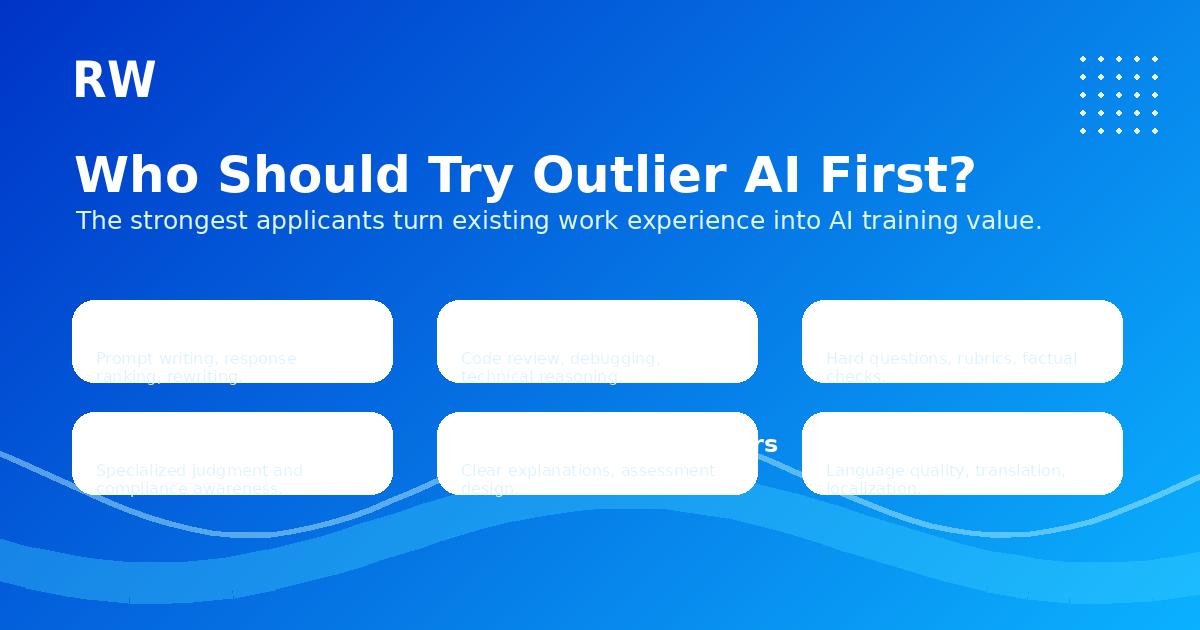
The best-fit profiles often include:
- Writers, editors, journalists, copywriters, and content strategists who can evaluate language quality and improve model answers.
- Software engineers, full-stack developers, data scientists, and technical professionals who can review code or reason through technical tasks.
- Math, science, engineering, and research backgrounds that can create difficult prompts and verify correct answers.
- Lawyers, paralegals, compliance professionals, accountants, finance analysts, and business professionals with specialized judgment.
- Teachers, tutors, professors, curriculum designers, and test-prep professionals who understand explanations, rubrics, and assessment quality.
- Bilingual or multilingual professionals who can evaluate language, localization, translation, and cultural nuance.
Outlier is weaker for applicants who have no clear expertise, no strong writing ability, no patience for detailed instructions, or no tolerance for inconsistent project volume. It is also a poor fit for anyone trying to game the system with copied answers, purchased accounts, VPN tricks, automation, or exaggerated credentials.
Looking for remote AI training roles? Apply through Remote Work Union.
Browse Roles Now →How to Apply for Outlier AI Jobs
The application process is usually simple, but simple does not mean easy. Outlier's onboarding process generally includes creating an account, selecting areas of expertise, completing skill screenings, and verifying identity. Some projects require additional project-specific onboarding before paid tasks begin.
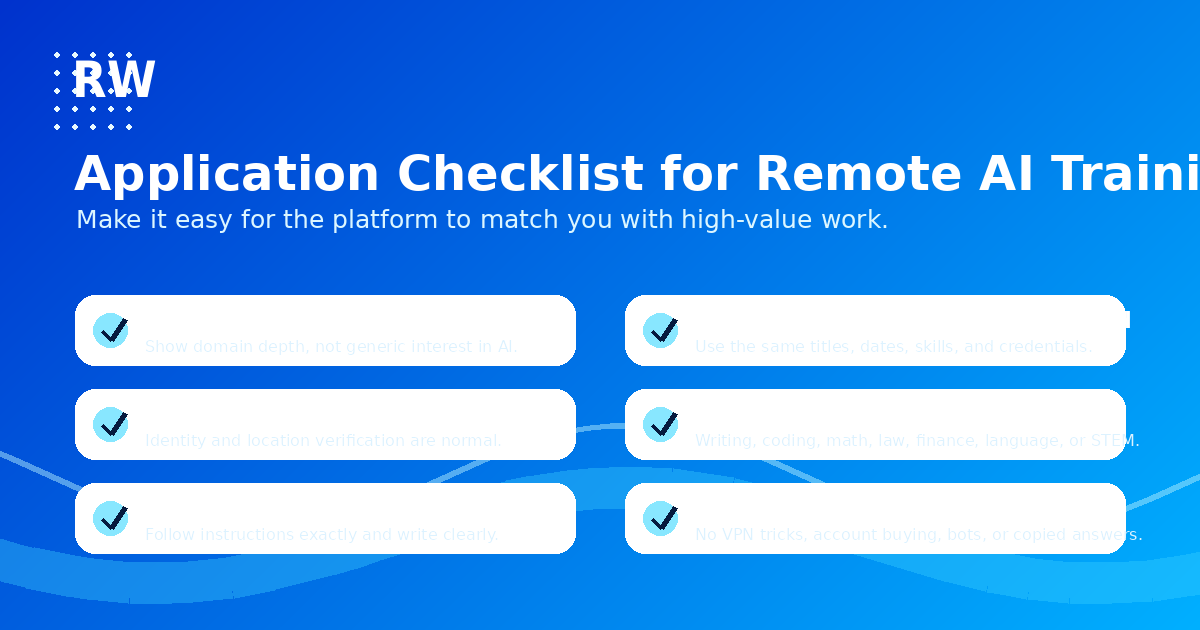
Prepare these before you apply:
- A current resume that clearly explains your expertise, not just a list of generic responsibilities.
- A LinkedIn profile that matches your resume and shows your education, credentials, and work history.
- A valid government ID and mobile phone for verification.
- A clear understanding of the domain you are applying for: writing, coding, STEM, finance, law, language, business, education, or another specialty.
- Examples of your strongest relevant work, especially if your field involves writing, analysis, research, code, or communication.
Do not apply as a generalist if you have a stronger angle. A marketer should not only say "marketing" — they should say content strategy, SEO, copywriting, paid media, email marketing, analytics, brand positioning, or social media strategy. A finance professional should say financial analysis, accounting, valuation, Excel modeling, tax, bookkeeping, or audit. A writer should specify editing, technical writing, journalism, creative writing, legal writing, or research-based content. Specificity helps matching.
Application Tips That Improve Your Chances
Most people apply too casually. They see remote work, click through fast, and assume the platform will figure out where to place them. That is the wrong approach. Treat your Outlier profile like a mini resume for AI training work.
1. Lead with your strongest domain
AI platforms need experts, not just people who like AI. Your profile should quickly answer one question: what can this person judge better than the average internet user? If the answer is unclear, your application is weaker.
2. Use keywords that match real AI training work
Include phrases such as AI trainer, AI evaluator, model response evaluation, prompt writing, rubric creation, factual accuracy, technical review, writing assessment, research, data annotation, LLM evaluation, and domain expertise where they honestly apply. Do not keyword-stuff. Use the language naturally in your resume and profile.
3. Be honest about your experience level
Do not pretend to be a machine learning engineer if your background is content, sales, finance, teaching, or law. Many remote AI jobs do not require building AI models. They require human judgment, clear communication, and subject-matter expertise. Present your real background in the most useful way.
4. Take screening tasks seriously
AI training platforms are obsessed with instruction-following because the work itself depends on precision. Read the directions slowly. Answer exactly what is asked. Avoid rambling. Show that you can reason, write clearly, and follow constraints.
5. Avoid shortcuts that can get your account removed
Outlier's community guidelines prohibit account sharing, false information, purchased accounts, unauthorized automation, and misleading location practices. That matters because account trust is central to AI training work. Do not risk your account for a shortcut.
6. Apply to multiple remote AI platforms
Even if Outlier is your first target, do not build your entire remote work plan around one platform. Remote AI training work is project-based. A smarter strategy is to apply to several legitimate platforms, track which ones match your skills, and focus your time on the ones that actually provide quality projects.
Common Mistakes Applicants Make
The biggest mistake is treating Outlier like a passive income app. It is not passive. You are being paid to think, write, evaluate, and follow detailed project rules.
Other common mistakes include:
- Applying with a generic resume that hides your strongest expertise.
- Choosing the wrong domain because it sounds higher paying, even though you are not qualified for it.
- Rushing assessments instead of showing careful reasoning.
- Ignoring location rules or trying to work from a location that is not allowed.
- Expecting full-time consistency from a project-based freelance platform.
- Focusing only on hourly rate instead of actual task availability and approval quality.
- Using AI-generated answers in assessments without checking whether that violates project instructions or produces low-quality work.
Best approach: Treat AI training like skilled contract work. Document your experience clearly, apply to the right domain, follow instructions, and manage expectations around project volume.
Is Outlier AI Legit?
Outlier is a real platform, and it is operated by Scale AI. That does not mean every applicant will earn money, every project will be consistent, or every experience will be smooth. "Legit" and "guaranteed income" are not the same thing.
A practical answer is this: Outlier is legitimate enough to be worth applying to if you have relevant expertise, understand the freelance structure, and are comfortable with variable project availability. It is not ideal if you need a guaranteed paycheck, employee benefits, fixed hours, or a predictable full-time remote job immediately.
For Remote Work Union readers, the smart move is to treat Outlier as one part of a broader remote work strategy. Apply, optimize your profile, test the platform, and compare it with other remote AI training jobs, expert review platforms, AI research opportunities, and work from home jobs that match your background.
How Outlier Compares to Basic Online Jobs
Compared with surveys, basic data entry, receipt apps, or microtask sites, Outlier has more upside because it can use real expertise. A strong writer, coder, lawyer, finance professional, engineer, teacher, or researcher can bring judgment that simple gig apps do not need.
Compared with a normal remote job, Outlier has less stability. There may be no manager, no benefits, no guaranteed hours, and no long-term role. The upside is flexibility. The downside is uncertainty.
That makes Outlier best for people who want flexible remote income, portfolio-style freelance work, or a bridge into AI-related online jobs. It is less ideal for someone who needs a stable salary next week.
Bottom Line
Outlier AI can be a strong option for remote workers who want to get paid to help train and improve AI models from home. The best opportunities are usually not random. They go to people who can prove useful expertise, write clearly, follow instructions, pass screenings, and maintain quality over time.
Apply if you have a real skill to bring to AI training: writing, coding, research, math, law, finance, science, education, marketing, language, or another domain where human judgment matters. Just do not confuse flexible freelance work with guaranteed full-time employment. The winning strategy is to apply, prepare seriously, track your results, and keep building multiple remote income options.