People searching for "Claude AI training jobs" are usually not looking for one narrow job title. They are looking for remote work connected to the kind of AI evaluation that makes assistants like Claude more useful, accurate, harmless, and trustworthy. Some roles may be at major AI companies, but many are contractor or partner-platform roles that use broader job titles like AI model evaluator, LLM response rater, AI trainer, prompt response reviewer, AI safety evaluator, research evaluator, fact-checking reviewer, or RLHF contractor.
This article explains what those jobs typically involve, what skills matter, how to search more intelligently, and how to avoid confusing marketing language with real hiring opportunities.
What people mean by "Claude AI training jobs"
Claude is associated with Anthropic, a major AI company known for building AI assistants and emphasizing safety-focused AI behavior. When job seekers search for Claude AI training jobs, they often mean one of three things:
- Direct Anthropic jobs connected to Claude, AI research, safety, product, operations, or model behavior.
- Contractor roles where people evaluate AI answers in a style similar to Claude's priorities: helpfulness, honesty, accuracy, harmlessness, and clear reasoning.
- Broader AI training jobs at platforms or companies working on large language model evaluation, response ranking, expert review, data annotation, or safety testing.
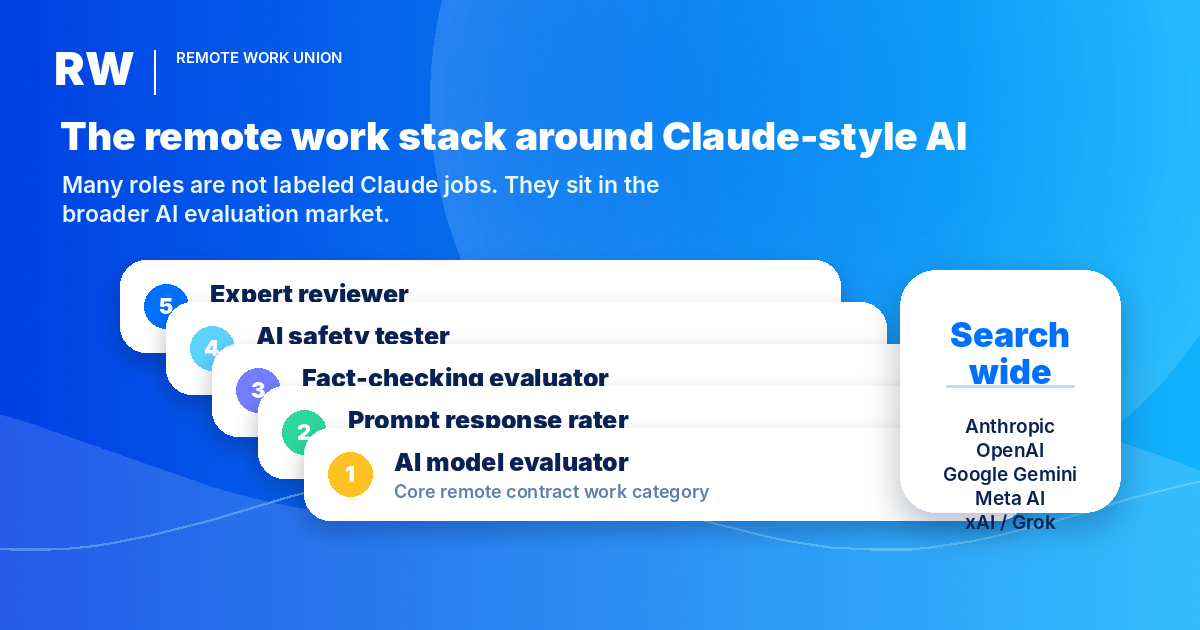
The important distinction is this: not every "Claude AI job" is a direct Anthropic job. Many legitimate opportunities are part of the broader AI evaluation market. That market includes companies working with models from Anthropic, OpenAI, Google Gemini, Meta AI, xAI/Grok, Microsoft, and other AI labs or enterprise AI teams.
A smarter search is not just "Claude jobs." A smarter search includes the words employers actually use: AI evaluator, LLM evaluator, model evaluation, response ranking, AI trainer, RLHF, RLAIF, AI safety reviewer, prompt evaluator, content quality reviewer, and expert AI reviewer.
What Anthropic-style AI evaluation work looks like
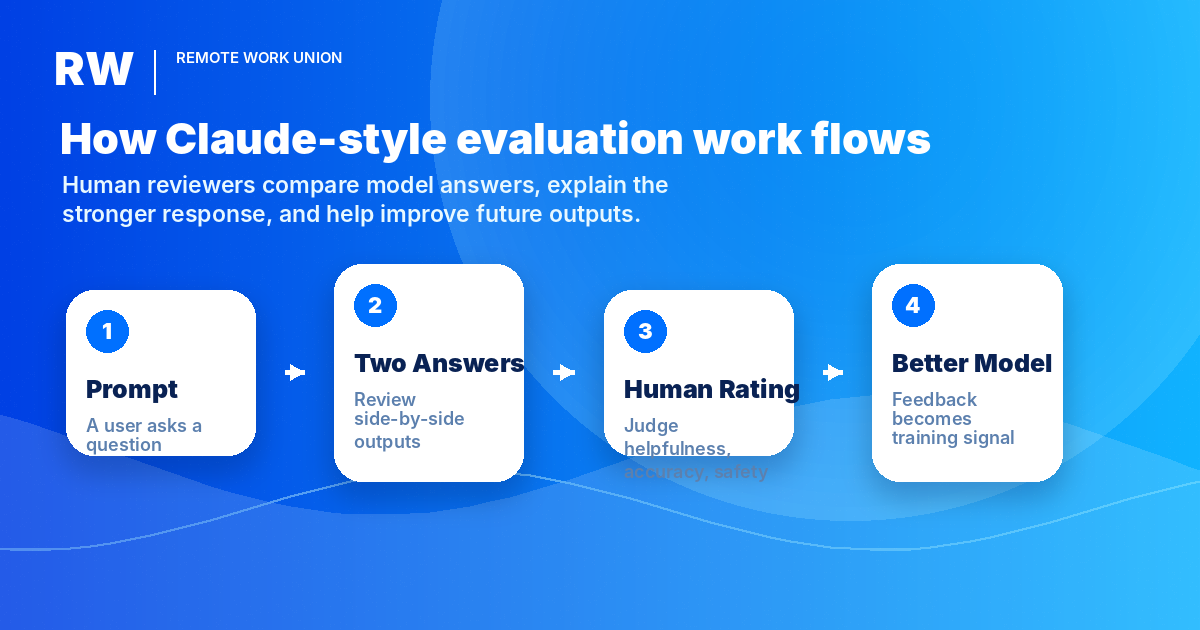
Anthropic-style AI evaluation is not just typing prompts into a chatbot. The work usually involves structured judgment. You may be asked to compare two AI responses, decide which answer is better, explain why, and follow a detailed rubric.
A typical task might ask:
- Which response answered the user's question more directly?
- Which response made fewer unsupported claims?
- Which response was safer or more appropriate?
- Which response followed instructions better?
- Which response was more useful to a real person?
- Which response handled uncertainty more honestly?
- Which response avoided overconfident or misleading language?
This is why strong writers, editors, researchers, teachers, business professionals, lawyers, healthcare professionals, scientists, and coders can all be good fits. The work is not only technical. It is often about judgment, clarity, and the ability to explain your reasoning in plain English.
Common remote roles related to Claude-style work
You may not see a job posting titled "Claude AI Trainer." Instead, search for related roles. Common titles include:
- AI model evaluator
- LLM response evaluator
- AI trainer
- Prompt response reviewer
- AI safety evaluator
- AI red team contractor
- AI fact-checking reviewer
- Search quality evaluator
- Data annotation specialist
- RLHF contractor
- RLAIF evaluator
- Expert AI reviewer
- Writing evaluator
- Coding evaluator
- Legal AI evaluator
- Healthcare AI evaluator
- Finance AI evaluator
These jobs can be part-time, project-based, contract, freelance, or full-time. Many are remote, but not all are work-from-anywhere. Some require a specific country, native-level English, a degree, domain expertise, or availability during certain hours. Read the requirements carefully instead of assuming that every remote AI role is open globally.
The skills that matter most
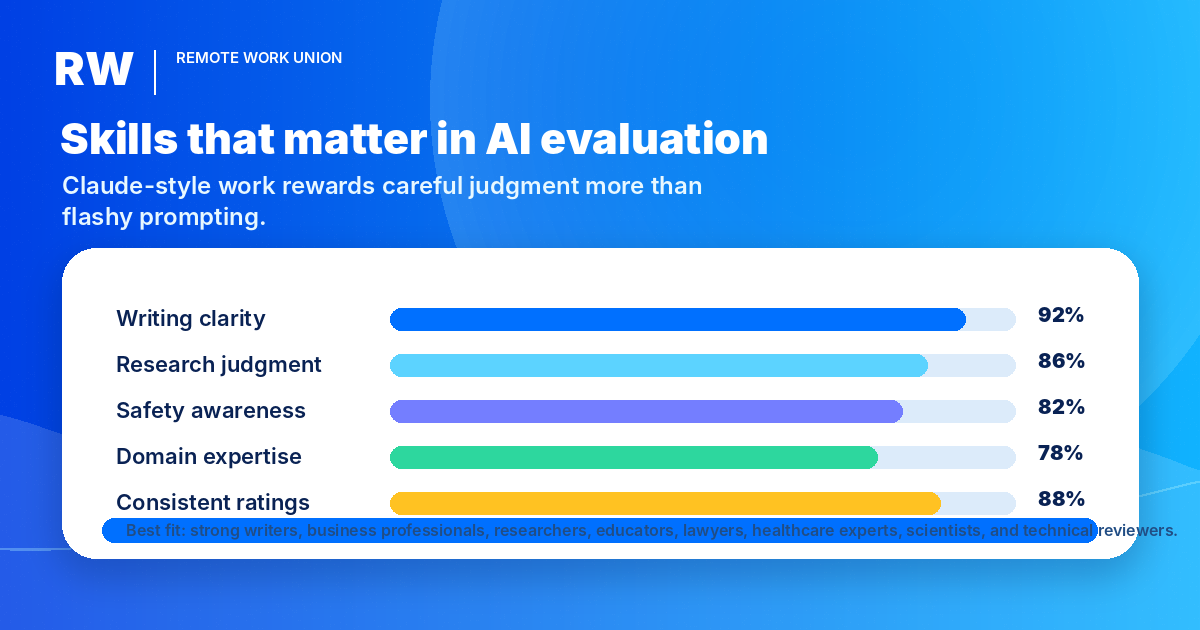
Claude-style AI evaluation rewards people who can be precise. You do not need to sound like a machine learning engineer to be useful. You need to be able to read carefully, compare outputs, and explain quality differences.
1. Clear writing
Most evaluation tasks require written explanations. A strong reviewer can say why one answer is better without rambling. They can point to the exact reason: stronger evidence, better structure, safer guidance, clearer caveats, or better instruction-following.
Instead of writing, "Answer A is better," a good evaluator writes, "Answer A is better because it gives the user a direct answer, includes a practical next step, and avoids making a medical claim without context. Answer B is more confident but less supported."
2. Research ability
Some AI evaluation jobs require fact-checking. You may need to verify claims, check dates, compare sources, or identify hallucinations. This is especially important for topics like law, medicine, finance, science, policy, travel, and product recommendations. Research skill does not mean reading endlessly — it means knowing when a claim needs verification and how to find a reliable source quickly.
3. Safety judgment
AI assistants are often evaluated on whether they give unsafe, harmful, manipulative, or deceptive guidance. Claude-style evaluation pays close attention to safety. Reviewers may need to identify when a response should refuse, redirect, add a warning, or give safer high-level information.
Good safety evaluation is balanced. The best answer is often the one that helps the user safely without providing instructions that could cause harm.
4. Domain expertise
General writing ability helps, but expertise can raise your earning potential. AI companies and contractor platforms often need reviewers with backgrounds in business, law, medicine, education, finance, science, coding, engineering, accounting, marketing, and academic research. For example:
- A lawyer may review legal reasoning or contract analysis outputs.
- A nurse may evaluate health information for clarity and caution.
- A finance professional may review spreadsheet, investing, or accounting answers.
- A teacher may evaluate explanations for students.
- A software engineer may review code, debugging advice, or technical documentation.
- A business analyst may review strategy, operations, or market research outputs.
5. Consistency
AI training platforms care about consistency. If you rate one answer as unsafe in one task and rate a similar answer as acceptable in another, your work may be flagged. The best evaluators follow the rubric, not their mood.
Why Claude-style work can fit non-coders
A common mistake is assuming that AI jobs are only for software engineers. Some AI evaluation roles do involve coding, but many do not. Large language models need feedback on writing quality, reasoning, tone, safety, instruction-following, factuality, and domain expertise.
That creates opportunities for many backgrounds:
- Business professionals can review strategy, operations, sales, marketing, and customer support answers.
- Writers and editors can evaluate clarity, structure, style, and instruction-following.
- Creatives can review brainstorming, brand voice, scripts, and content quality.
- Lawyers and legal researchers can evaluate legal reasoning and caution.
- Teachers, professors, and tutors can review educational explanations.
- Doctors, nurses, and medical writers can evaluate health-related responses.
- Scientists and researchers can evaluate technical accuracy.
- Coders can review code, debugging, and software documentation.
How to search for Claude AI training jobs
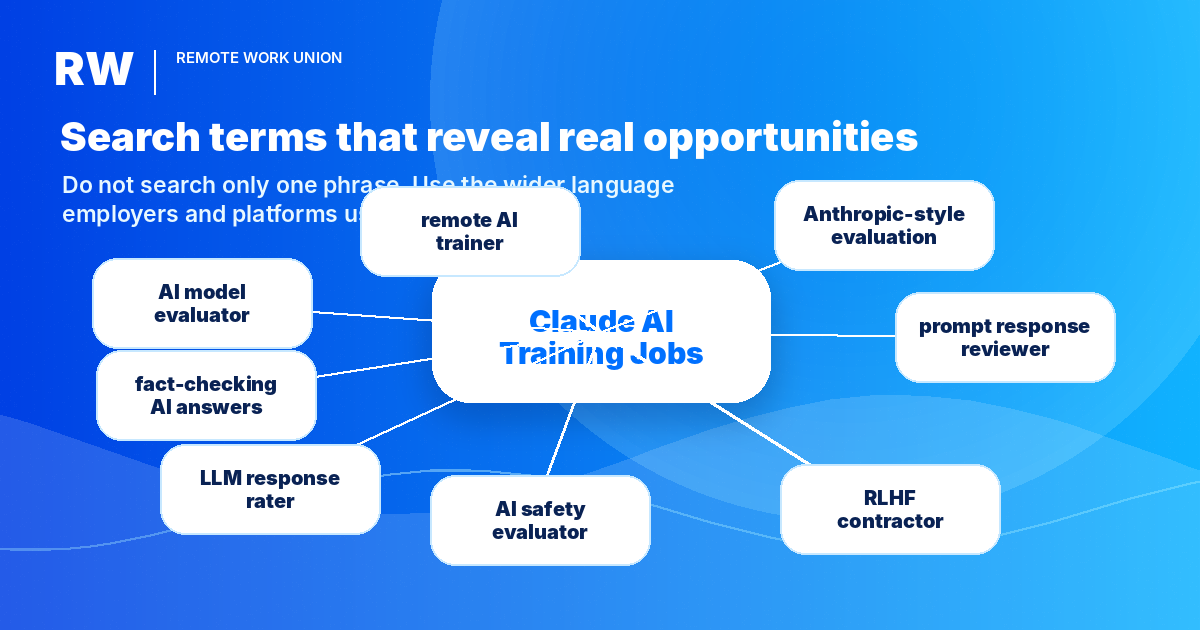
Use a wide search strategy. Search engines and job boards do not use one consistent title for this work.
Start with these searches:
- Claude AI training jobs
- Claude AI jobs remote
- Anthropic jobs remote
- Anthropic contractor jobs
- AI model evaluator remote
- LLM evaluator jobs
- AI trainer jobs remote
- prompt response evaluator
- RLHF jobs remote
- AI safety evaluator jobs
- AI red team jobs remote
- AI fact-checking jobs
- expert AI reviewer jobs
- chatbot evaluator jobs
- data annotation AI jobs
- remote AI research contractor
Then search by your expertise:
- legal AI evaluator jobs
- healthcare AI training jobs
- finance AI evaluator jobs
- coding AI evaluation jobs
- writing evaluator AI jobs
- teacher AI evaluator jobs
- business AI training jobs
- science AI reviewer jobs
Do not limit yourself to one company. People search for OpenAI jobs, Claude jobs, Gemini jobs, Meta AI jobs, Grok jobs, and Microsoft AI jobs because those brands are familiar. But many paid evaluation projects are posted through partner platforms, staffing companies, data vendors, research contractors, and remote work marketplaces. See the platform comparison guide for a broader look at where to apply.
Remote Work Union tracks legitimate remote AI training roles across top platforms. Find opportunities that match your background without sorting through scam listings.
Find Roles Hiring Now →Where these jobs usually appear
1. Official company career pages
Major AI companies may post roles in research, safety, trust and safety, policy, product operations, data, engineering, and model evaluation. These are often more competitive and may require specific experience. Search official career pages for terms like model behavior, safety evaluation, policy specialist, trust and safety, human feedback, data quality, research operations, AI evaluation, AI alignment, and red teaming.
2. AI training platforms
Contractor platforms often post project-based work where applicants complete assessments and then receive tasks. These may include response ranking, prompt writing, expert review, safety evaluation, data labeling, coding evaluation, or domain-specific AI review. Look at platforms like Mercor, Outlier AI, Handshake AI, micro1, and Surge AI.
3. Remote job boards
Remote job boards sometimes list AI evaluator roles, but the wording varies. Some postings look like writing jobs, research jobs, data jobs, or content quality roles. Use filters carefully — a job can say "remote" but still require the United States, Canada, the UK, Australia, or another specific location.
4. LinkedIn and general job boards
LinkedIn, Indeed, ZipRecruiter, Greenhouse, Lever, Wellfound, and company career pages can all surface AI evaluation work. The best searches combine brand names with role terms — for example: Anthropic AI evaluator, Claude safety evaluation, LLM evaluator remote, AI model response reviewer, RLHF contractor, or language model evaluator.
How to make your profile stronger
A generic remote work profile is not enough. Hiring teams and platforms need to know what kind of evaluation work you can do.
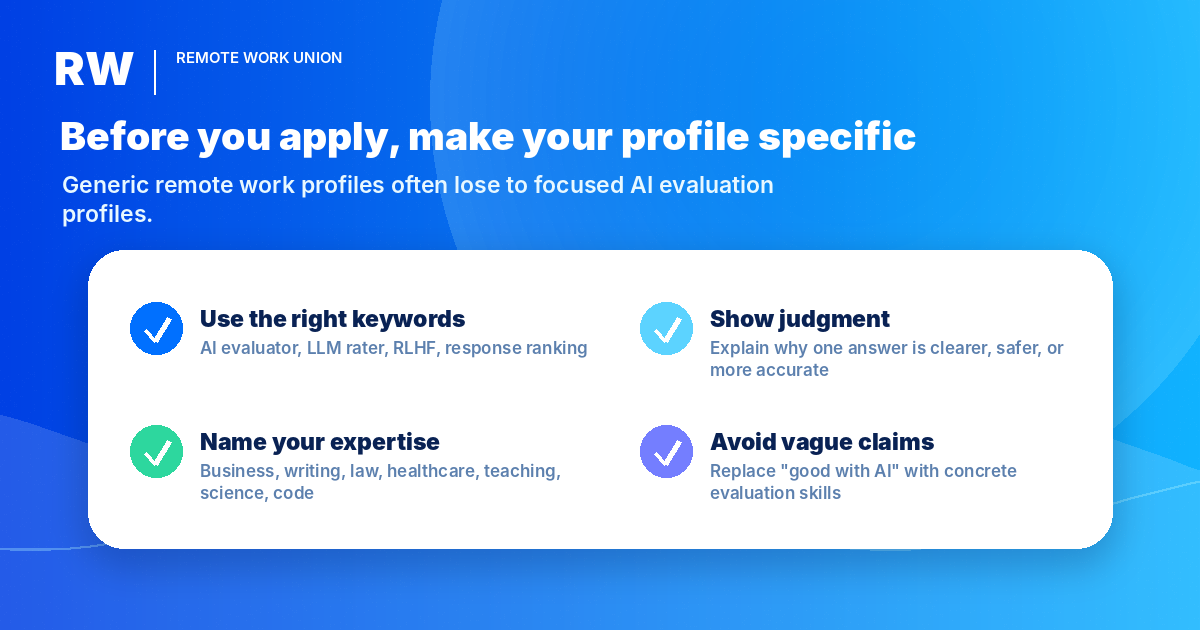
Replace vague phrases with specific skills
Weak profile language sounds like this: "I am interested in AI," "I use ChatGPT sometimes," "I am a fast learner," or "I want remote work." Stronger language is specific: "I can compare AI responses for accuracy, helpfulness, safety, and instruction-following." "I have experience writing clear feedback and explaining why one response is stronger than another." "I can fact-check AI outputs using reliable sources." "I can evaluate business, marketing, finance, legal, healthcare, education, or technical answers based on my background."
Add relevant keywords naturally
Your resume or profile should include relevant terms if they are true for you: AI model evaluation, LLM evaluation, response ranking, prompt evaluation, RLHF, RLAIF, data annotation, AI safety, fact-checking, research, editing, domain expertise, quality assurance, and rubric-based evaluation. Use these terms in context — a profile that reads naturally performs better than a list of buzzwords. See the remote work resume guide for more specific advice.
Show examples of judgment
If a platform asks for a writing sample or assessment, explain decisions clearly. Many applicants fail because they give opinions without evidence. A good evaluator states the better answer, explains the main reason, mentions any accuracy or safety issue, keeps the explanation concise, and uses the rubric's language when appropriate.
What to avoid
The AI training job market is real, but it also attracts scams and low-quality listings. Be careful with any opportunity that:
- Charges you to apply.
- Promises guaranteed income.
- Sends a fake check for equipment.
- Asks you to move conversations off-platform immediately.
- Uses a major AI company name but has no connection to that company.
- Has a suspicious email domain.
- Offers very high pay with no assessment, interview, or screening.
- Refuses to explain what the work involves.
Also be careful with job listings that imply you are working directly for Anthropic, OpenAI, Google, Meta, Microsoft, or xAI when the actual role is through a third-party contractor. Third-party work can still be legitimate, but the relationship should be clear.
Tip: Legitimate AI work can still be competitive, slow, or inconsistent. A scam is different: it tries to extract money, personal information, or unpaid labor through false promises.
How much can Claude-style AI evaluation jobs pay?
Pay varies widely. General AI evaluator jobs may pay modest hourly rates. Expert roles in law, medicine, finance, coding, science, or advanced writing can pay more. Some projects are hourly, some are task-based, and some are inconsistent month to month.
The most realistic mindset is to treat AI evaluation as a flexible remote work category, not guaranteed full-time income. Some people use it as a side hustle. Others stack multiple platforms. A smaller group turns it into a major income source by combining expertise, availability, and strong assessment performance.
A simple application checklist
Before applying, make sure you can answer these questions:
- What type of AI evaluation work am I qualified to do?
- Which domain expertise can I prove?
- Can I write clear explanations of why one answer is better than another?
- Can I fact-check quickly and responsibly?
- Do I understand the difference between helpfulness, accuracy, instruction-following, and safety?
- Have I searched beyond one phrase like "Claude jobs"?
- Does the role clearly explain pay, location requirements, and contractor status?
- Does the company or platform look legitimate?
- Is my resume specific to AI evaluation rather than generic remote work?
- Am I applying to enough platforms to handle inconsistent task volume?
Frequently Asked Questions
What do people mean by Claude AI training jobs?
People searching for Claude AI training jobs usually mean one of three things: direct Anthropic roles connected to Claude, AI research, safety, or model behavior; contractor roles where people evaluate AI answers in a style similar to Claude's priorities (helpfulness, honesty, accuracy, and harmlessness); or broader AI training jobs at platforms working on LLM evaluation, response ranking, expert review, data annotation, or safety testing. Not every Claude AI job is a direct Anthropic job.
Do you need to work directly for Anthropic to do Claude-style AI evaluation?
No. Many legitimate opportunities in Claude-style AI evaluation are part of the broader AI evaluation market, which includes companies working with models from Anthropic, OpenAI, Google Gemini, Meta AI, xAI/Grok, Microsoft, and other AI labs. Contractor platforms often post project-based work that involves the same types of tasks — response ranking, expert review, safety evaluation, and data annotation — without a direct Anthropic relationship.
What skills matter most for Claude-style AI evaluation jobs?
The most valued skills are clear writing (the ability to explain why one AI answer is better than another), research ability (fact-checking claims quickly and responsibly), safety judgment (knowing when an AI response should refuse, redirect, or add a warning), domain expertise (professional background in law, medicine, finance, education, coding, science, or business), and consistency (following rubrics reliably across repetitive tasks). Coding is not required for most roles.
How should you search for Claude AI training jobs?
Use a wide search strategy. Start with terms like Claude AI training jobs, Claude AI jobs remote, Anthropic contractor jobs, AI model evaluator remote, LLM evaluator jobs, RLHF jobs remote, and AI safety evaluator jobs. Then search by your specific expertise — legal AI evaluator, healthcare AI training, finance AI reviewer, coding AI evaluation. Check official company career pages, AI training platforms, remote job boards, and LinkedIn using combinations of brand names and role terms.
How much do Claude-style AI evaluation jobs pay?
Pay varies widely. General AI evaluator roles may pay modest hourly rates. Expert roles in law, medicine, finance, coding, science, or advanced writing pay more. Some projects are hourly, some are task-based, and work volume can be inconsistent month to month. A realistic mindset is to treat AI evaluation as flexible remote income, not guaranteed full-time income — until you have a consistent track record with a specific platform or client.