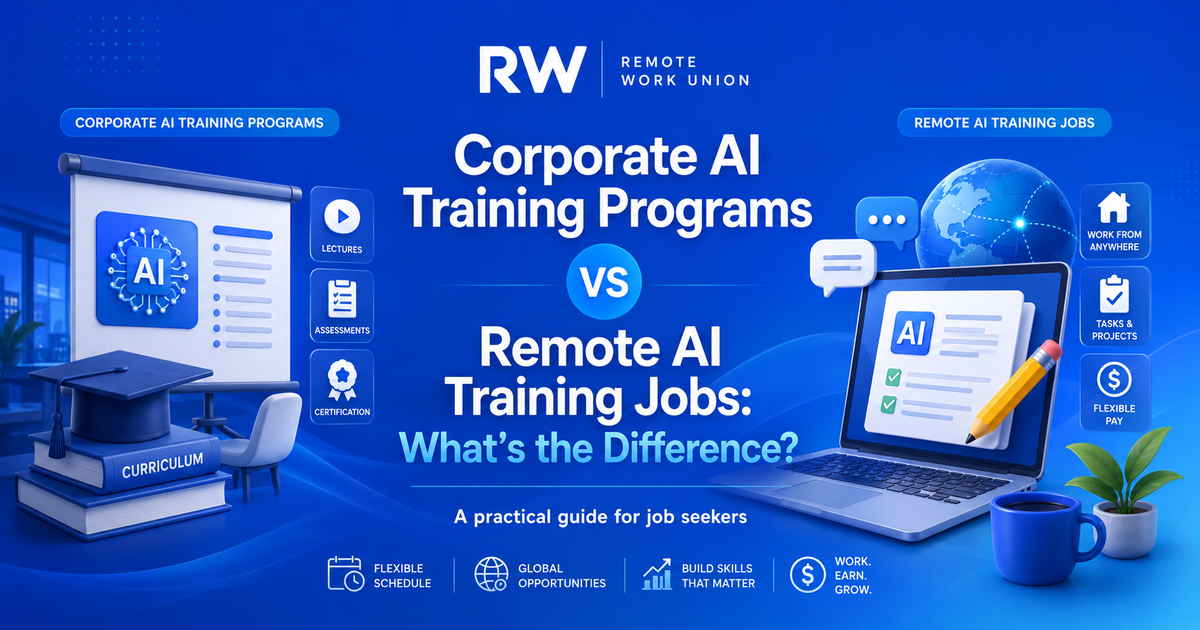
A lot of job seekers search for phrases like "AI training," "AI training jobs," "corporate AI training," and "remote AI training jobs" and assume they are all pointing to the same opportunity. They are related, but they mean very different things.
A corporate AI training program is usually a learning program. It teaches employees, teams, or managers how to use AI tools more effectively inside a company. A remote AI training job is usually paid work. The worker helps improve AI systems by reviewing outputs, comparing model responses, labeling data, writing prompts, fact-checking answers, testing instructions, or using domain expertise to evaluate whether an AI response is useful and accurate.
That difference matters. One path helps you learn AI skills. The other can pay you to use your judgment, writing, research, language ability, subject expertise, or coding knowledge to improve AI models.
Quick Answer: The One-Sentence Difference
Corporate AI training programs teach people how to use AI. Remote AI training jobs pay people to help improve AI.
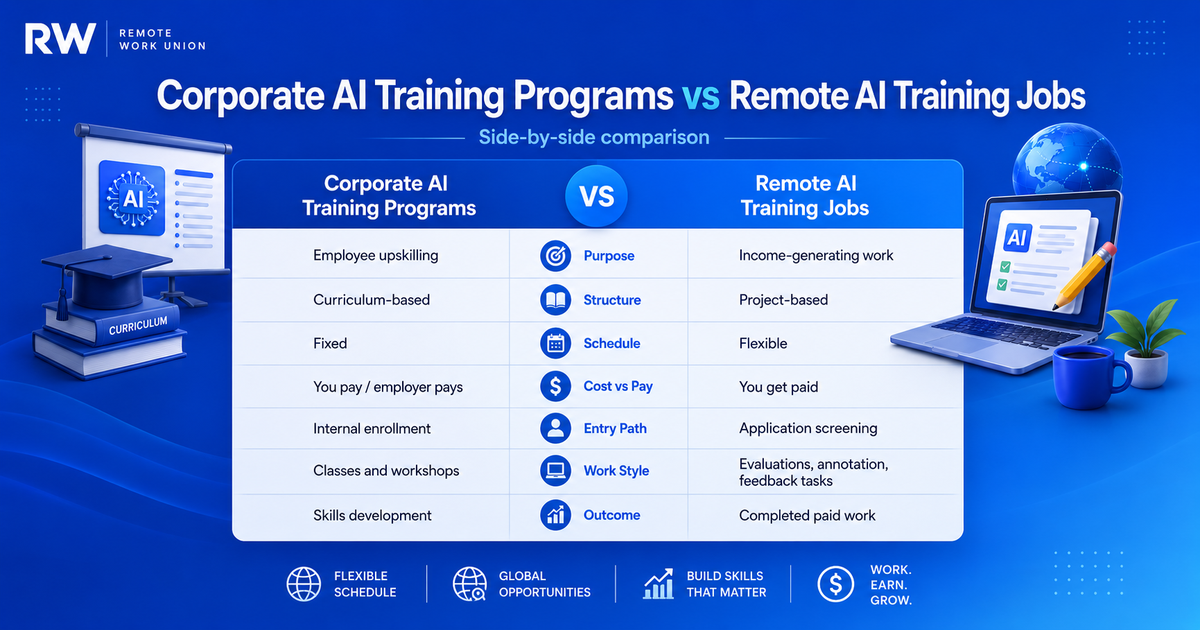
| Category | Corporate AI Training Programs | Remote AI Training Jobs |
|---|---|---|
| Main purpose | Teach employees how to use AI | Pay workers to help improve AI |
| Format | Courses, workshops, certifications | Projects, tasks, evaluations, annotations |
| Who participates | Employees, managers, departments | Contractors, freelancers, specialists |
| Money flow | Company or learner pays for training | Worker gets paid for completed work |
| Schedule | Often fixed or structured | Often flexible or project-based |
| Best for | Learning AI tools | Earning from AI-related remote work |
What Are Corporate AI Training Programs?
Corporate AI training programs are structured learning experiences built for companies, teams, or professionals. They are designed to help people understand and use AI tools in the workplace. A corporate AI training program might teach employees how to use ChatGPT, Claude, Gemini, Microsoft Copilot, or internal AI systems. It might also teach managers how to create AI policies, sales teams how to draft better follow-up emails, or legal and compliance teams how to understand AI risk.
Common topics in corporate AI training programs include AI literacy and basic terminology, prompt writing and prompt improvement, how to use AI tools safely at work, internal productivity workflows, data privacy, confidentiality, and compliance, and role-specific use cases for marketing, sales, finance, operations, HR, engineering, education, healthcare, legal, and customer support teams.
The key point: the participant is usually learning how to use AI. They are not being hired to train AI models.
What Are Remote AI Training Jobs?
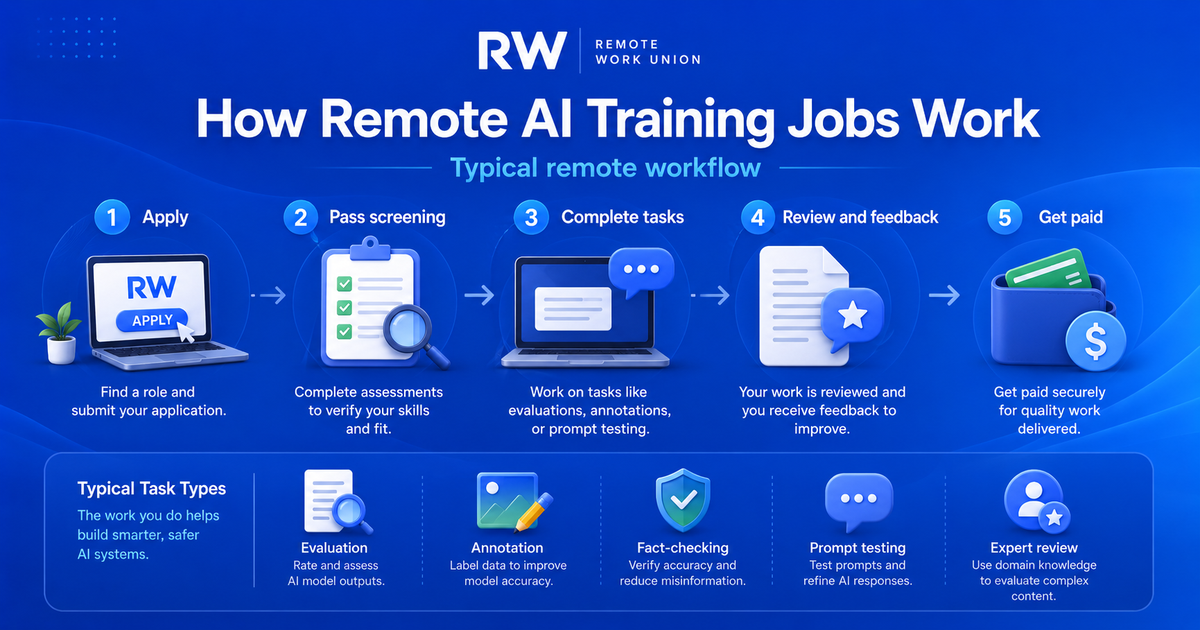
Remote AI training jobs are different. These are roles or projects where workers help improve AI systems through human feedback. Modern AI systems need human review because models can be useful, but they can also be incomplete, inconsistent, biased, confusing, or factually wrong. Human reviewers help identify better answers, flag mistakes, label content, test prompts, compare model responses, and provide structured feedback that can improve future model behavior.
Remote AI training work can appear under many job titles, including AI evaluator, AI trainer, AI rater, AI model evaluator, AI response reviewer, data annotation specialist, prompt evaluator, human feedback specialist, RLHF contributor, search quality rater, expert reviewer, and AI fact-checker.
Remote Work Union connects you to legitimate paid AI training and evaluation roles. Browse roles now.
Find Roles Hiring Now →Who Each Path Is For
Corporate AI training programs are most useful for employees who need to adopt AI tools in their current role, managers who need to set AI policy for their teams, professionals who want to understand AI risk and compliance, and organizations that want to standardize how AI is used internally.
Remote AI training jobs are most useful for job seekers who want to earn money from their existing expertise and judgment, remote workers who want flexible, contract-based projects, specialists in writing, law, finance, medicine, education, coding, or other domains who can apply that knowledge to AI evaluation, and people looking for legitimate work-from-home income connected to the AI economy.
Common Remote AI Training Job Types
AI evaluator and AI rater roles ask you to compare two AI responses and choose the better one, rate a single response against a rubric, or explain why an output is helpful or unhelpful. Data annotation roles ask you to label data, categorize examples, or structure information that helps AI systems learn patterns. Prompt evaluation roles ask you to write or test prompts and explain whether the AI's response fulfilled the request.
Expert review roles require specialized professional knowledge. Lawyers can review legal reasoning. Doctors and medical writers can review health content. Finance professionals can review market and accounting explanations. Teachers can review educational content. Coders can review programming solutions. The more specialized your expertise, the higher-value projects you may qualify for.
Skills That Matter for Remote AI Training Work
Writing clarity matters in most remote AI training jobs because reviewers need to explain their judgments in concise, specific language. Research skills matter because AI systems can produce confident-sounding answers that contain errors. Instruction-following matters because platforms measure whether reviewers apply rubrics consistently. Domain expertise matters for specialist projects because the reviewer needs to judge the subject content, not just the writing quality.
Key distinction: Corporate AI training measures what you learned. Remote AI training work measures what you produce. Strong candidates for paid work show what they can evaluate, not just what they have studied.
Decision Guide: Which Path Should You Prioritize?
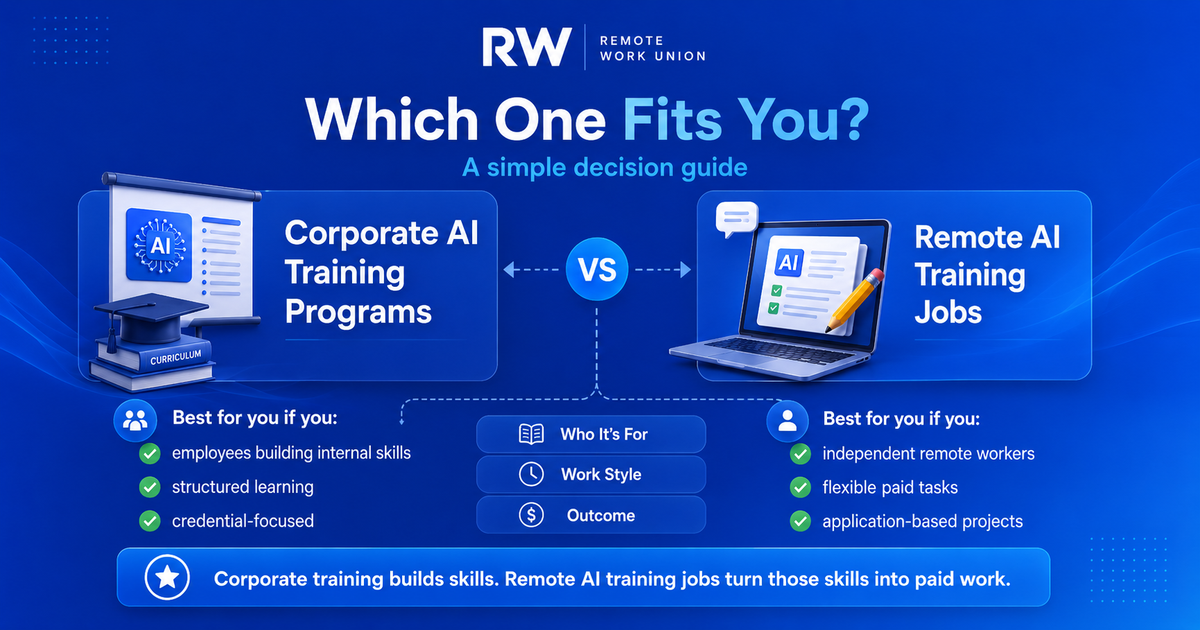
If your goal is to use AI more effectively in your current job, a corporate AI training program is the right investment. It will help you understand the tools, reduce confusion, and apply AI responsibly in a workplace context.
If your goal is to earn income from your existing knowledge and judgment by working from home on AI-related projects, remote AI training jobs are the right target. Build a clear skill lane, prepare for screening tasks, and apply to platforms where your background matches what the project needs.
If you want both — stronger AI skills at your day job and supplemental income from remote AI evaluation — the two paths can coexist. Corporate training can sharpen your understanding of how AI tools work, and remote evaluation work can build your reputation as a reliable, high-quality reviewer.
Frequently Asked Questions
What is the difference between corporate AI training programs and remote AI training jobs?
Corporate AI training programs teach employees how to use AI tools in the workplace. Remote AI training jobs pay contractors and freelancers to help improve AI systems through evaluation, annotation, feedback, and expert review work. One is education; the other is employment.
Can I do both corporate AI training and remote AI training jobs?
Yes. Corporate AI training can teach you how to use tools effectively at your day job, while remote AI training work can provide additional income from home. The skills developed in corporate AI programs can also make you a stronger candidate for remote AI evaluation roles.
Which is better for making money: corporate AI training or remote AI training jobs?
Remote AI training jobs are the path to earning. Corporate AI training programs typically cost money or are provided by employers as a benefit. Remote AI training work pays you for your time, judgment, and expertise. If your goal is to generate income from AI skills, remote AI training roles are the better target.