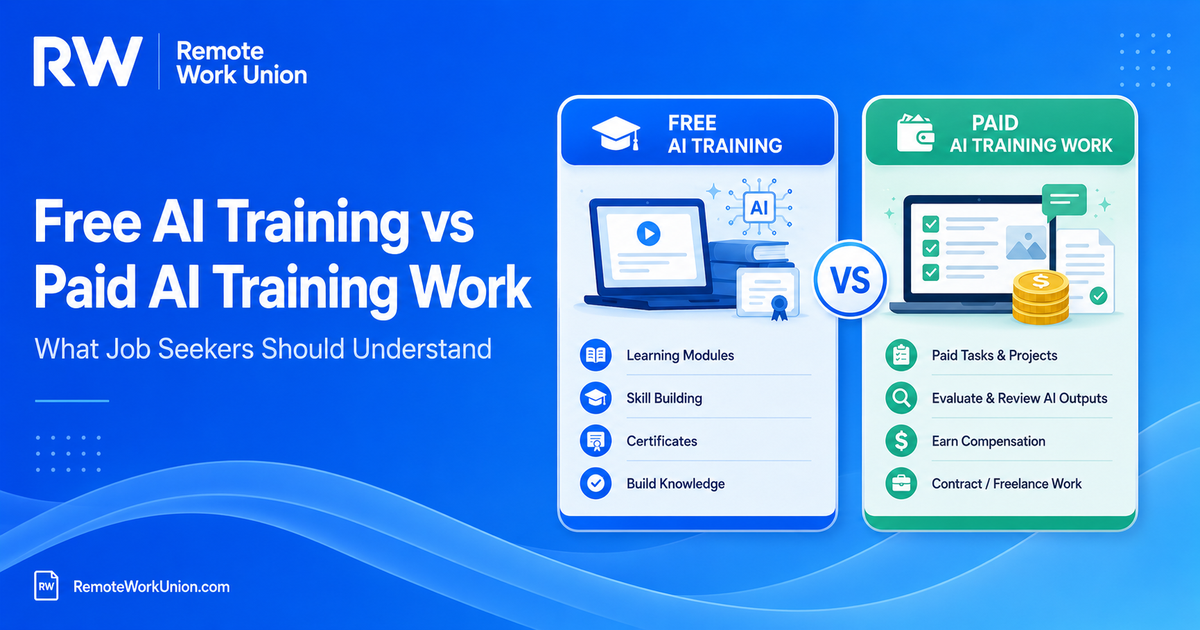
Free AI training and paid AI training work sound similar, but they are not the same thing. Free AI training usually means education: courses, tutorials, practice exercises, certificates, and self-study that help a job seeker understand artificial intelligence tools and workflows. Paid AI training work means doing real production tasks that help improve AI systems, search products, chatbots, assistants, datasets, and model outputs.
The simplest difference is this: free AI training teaches you. Paid AI training work pays you to evaluate, edit, label, compare, fact-check, or improve AI outputs. Both can be useful, but they serve different purposes. Job seekers should use free training to build skill and confidence, then look for paid roles where their judgment, writing, research, domain knowledge, or technical ability can be turned into remote work.
Why the Search Term Is Confusing
The phrase "AI training" has two meanings. In education, it can mean learning how AI works or learning how to use tools like ChatGPT, Claude, Gemini, Grok, or other AI assistants. In the labor market, it can mean training AI models through human feedback, data annotation, model evaluation, answer rating, prompt testing, response rewriting, safety review, and expert review.
That overlap creates confusion. A person searching for free AI training may be looking for a course. A person searching for AI training jobs may be looking for paid remote work. For job seekers, the key is to separate learning material from earning opportunities before spending time on applications.
What Free AI Training Usually Means
Free AI training usually refers to educational material that helps someone understand AI concepts, AI tools, prompt writing, workflow automation, machine learning basics, data labeling, or AI use cases. It may come from universities, software companies, online course platforms, creator tutorials, documentation pages, webinars, or public learning hubs.
This type of training can be valuable because it gives beginners vocabulary. It helps people understand terms like prompt engineering, model evaluation, data annotation, RLHF, human feedback, AI rater work, large language models, multimodal AI, generative AI, and AI quality review. It can also help workers from writing, teaching, coding, law, finance, healthcare, research, operations, customer support, and administration translate their existing skills into AI-adjacent work.
Free AI training is not automatically a job credential. A certificate can help show initiative, but most paid AI training projects care more about performance on screening tests, writing samples, reasoning tests, domain expertise, attention to detail, and consistency. A course may help you prepare. It usually does not guarantee work.
What Paid AI Training Work Usually Means
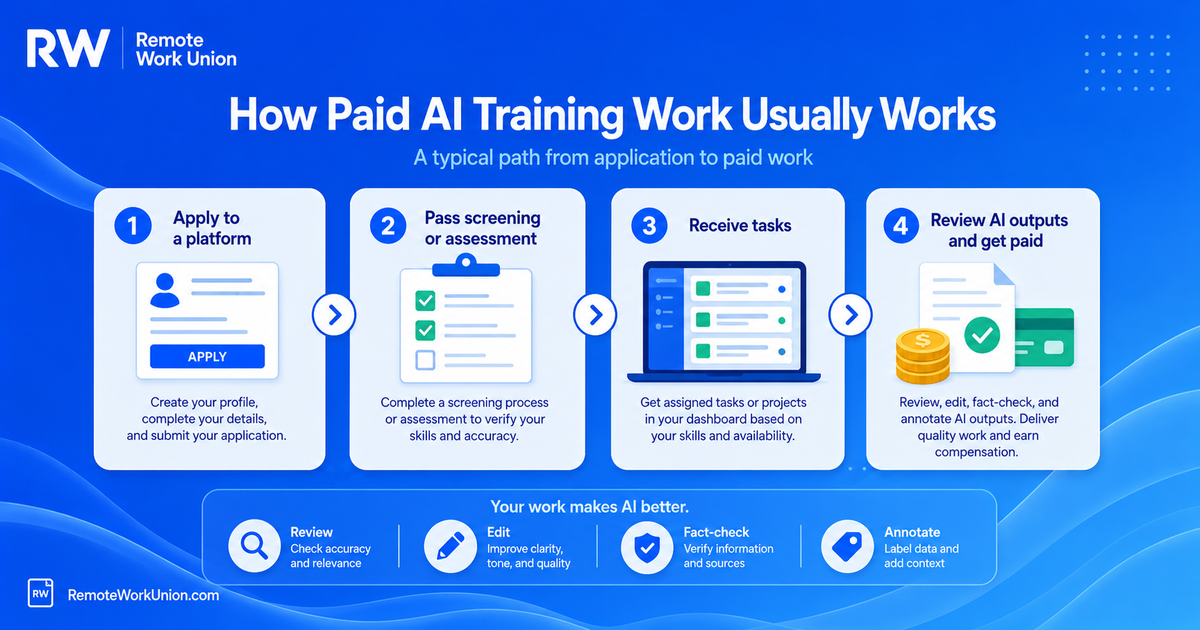
Paid AI training work is practical work done for a company, platform, lab, vendor, or contractor network. Instead of only learning about AI, the worker completes tasks that help improve AI products. These tasks often involve reading prompts, reviewing model answers, comparing two responses, labeling data, checking facts, rewriting weak outputs, testing instruction following, evaluating tone, or identifying hallucinations.
Paid AI training jobs can appear under many names. Common titles include AI evaluator, AI model evaluator, AI rater, AI trainer, AI response reviewer, prompt evaluator, data annotator, search evaluator, language evaluator, coding evaluator, subject matter expert reviewer, RLHF contributor, human feedback specialist, and AI content quality analyst.
These roles may be remote, part-time, project-based, hourly, freelance, contract, or task-based. Some projects are generalist and focus on writing clarity, reasoning, and research. Others require specialist knowledge, such as coding, math, law, finance, healthcare writing, education, science, safety policy, or bilingual language review.
The Main Difference: Learning vs Delivering
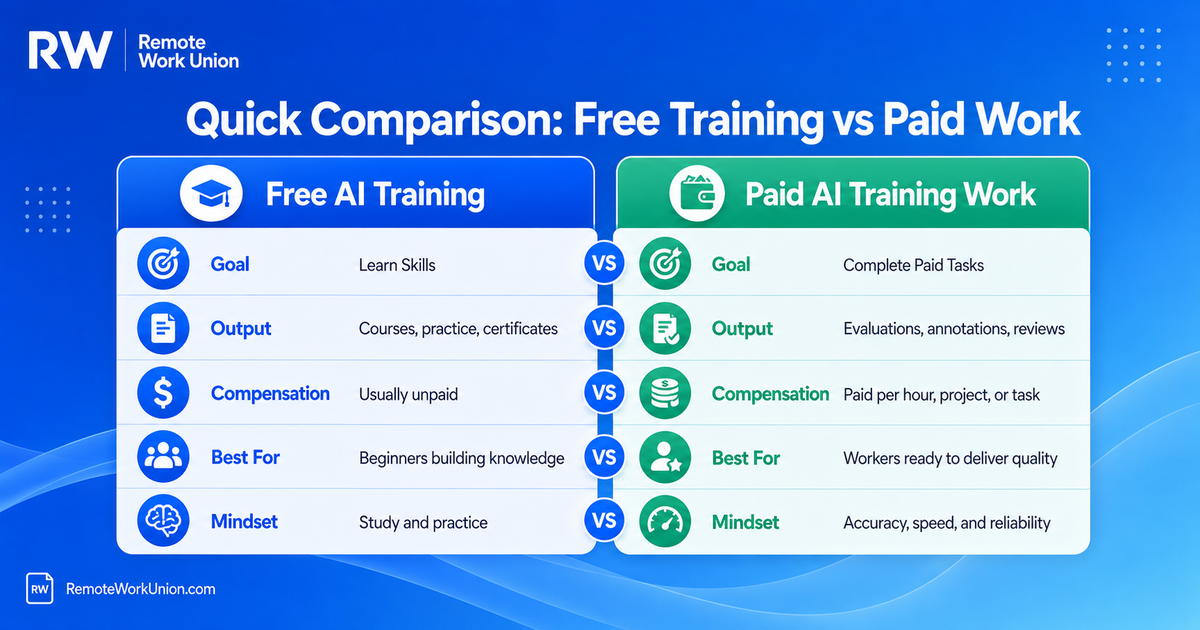
The easiest way to understand the difference is to ask what the output is. In free AI training, the output is your knowledge. You may finish a lesson, complete a quiz, earn a certificate, or practice a workflow. In paid AI training work, the output is a deliverable for the company: a reviewed answer, a labeled dataset, a rewritten response, a comparison score, a quality judgment, a fact-check, or a completed annotation task.
Free training is useful when it helps you get better at paid work. Paid work is different because it requires quality, reliability, and judgment. The company is not paying because you watched a course. It is paying because your review, annotation, or feedback improves a system.
Ready to turn your skills into paid AI training work? Find roles at RemoteWorkUnion.com.
Find Roles Hiring Now →Common Paid AI Training Tasks
Paid AI training work can vary by platform and project, but many tasks fall into predictable categories. A remote AI evaluator may compare two chatbot responses and choose which one better follows instructions. A prompt evaluation worker may test whether an AI assistant answered the actual question. A data annotation worker may label examples so a model can learn patterns. An AI response reviewer may flag hallucinations, unsupported claims, vague writing, poor structure, unsafe content, or missing context.
A fact-checking project may require verifying names, dates, claims, calculations, citations, or source quality. A writing evaluation project may require improving clarity, tone, concision, and usefulness. A coding project may require testing code, explaining bugs, or judging whether an answer solves the prompt. A subject matter project may ask professionals to review specialized outputs in law, finance, medicine, education, science, engineering, or business.
When Free AI Training Is Worth It
Free AI training is worth it when it reduces confusion, teaches relevant vocabulary, improves your writing or evaluation process, or helps you perform better on platform assessments. It is especially useful for beginners who do not yet understand the difference between data annotation, model evaluation, AI rater work, prompt testing, and human feedback.
It is also worth using free training when you are entering a new area. A teacher may need to learn how AI evaluation rubrics work. A writer may need to practice concise answer comparisons. A researcher may need to learn how to structure source-based verification. A coder may need to learn how AI coding evaluation differs from regular software development.
When Free AI Training Becomes a Distraction
Free AI training becomes a distraction when a job seeker keeps collecting courses instead of applying to real work. Many remote workers do not need endless certificates. They need a clean profile, a strong writing sample, a focused application strategy, and enough practice to pass assessments. At some point, preparation must turn into execution.
Skills That Transfer Into Paid AI Training Work
The strongest paid AI training applicants usually have transferable skills. Writing skill matters because many tasks require explaining why one answer is better than another. Research skill matters because AI models can sound confident while being wrong. Reading comprehension matters because many prompts contain hidden constraints. Judgment matters because scoring a response is rarely just about grammar. Consistency matters because platforms need workers who can follow the same standards across many tasks.
Domain expertise can also matter. Lawyers, paralegals, finance analysts, accountants, teachers, tutors, nurses, medical writers, software engineers, data analysts, marketers, translators, editors, and researchers may find projects that match their backgrounds. A professional does not need to become a machine learning engineer to contribute. In many AI training workflows, human expertise is useful because the model needs judgment, context, and review.
How to Move From Free Training to Paid Work
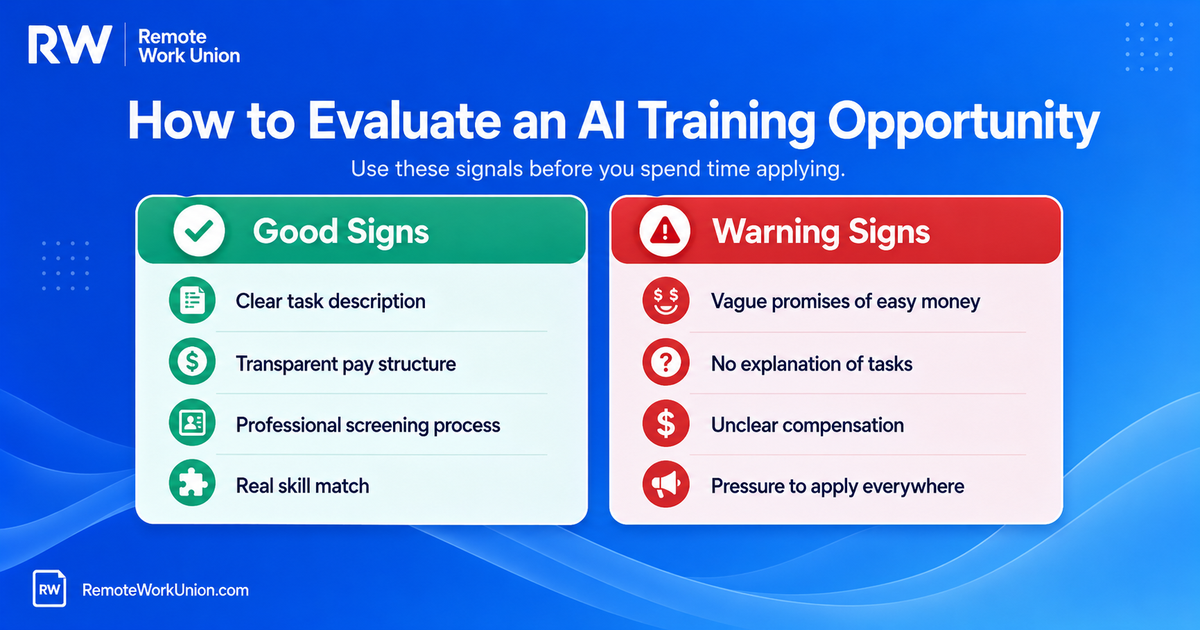
The transition from free learning to paid work requires three things: a clear skill lane, a focused application, and a willingness to complete a screening task seriously. First, identify the type of work you are genuinely qualified to do — writing evaluation, research and fact-checking, domain expert review, or coding evaluation. Second, build an application that shows that specific fit, not a general claim of interest in AI. Third, when you receive a screening task, treat it like paid work — read instructions fully, follow the rubric, and explain your judgments clearly.
Simple test: Ask yourself whether you can explain your judgment on an AI response in two to three specific sentences. If yes, you are ready to apply. If no, practice with any AI tool you use regularly before applying.
Frequently Asked Questions
What is the difference between free AI training and paid AI training work?
Free AI training is education — courses, tutorials, and certificates that teach you about AI tools and concepts. Paid AI training work is employment — getting paid to evaluate, annotate, compare, or improve AI outputs for companies and platforms that are building AI systems.
Do I need free AI training courses before applying for paid AI training jobs?
Not necessarily. Most paid AI training platforms care more about your performance on screening tests and writing samples than on certificates. Free training can help you prepare, but it is not a substitute for the judgment skills and consistency that platforms actually measure.
How do I move from free AI training to paid AI training work?
Identify the task types used in paid AI training projects — comparison, annotation, rubric review, fact-checking — and practice those specifically. Build a focused application with a clear skill lane, then apply to platforms where your background matches the project requirements.