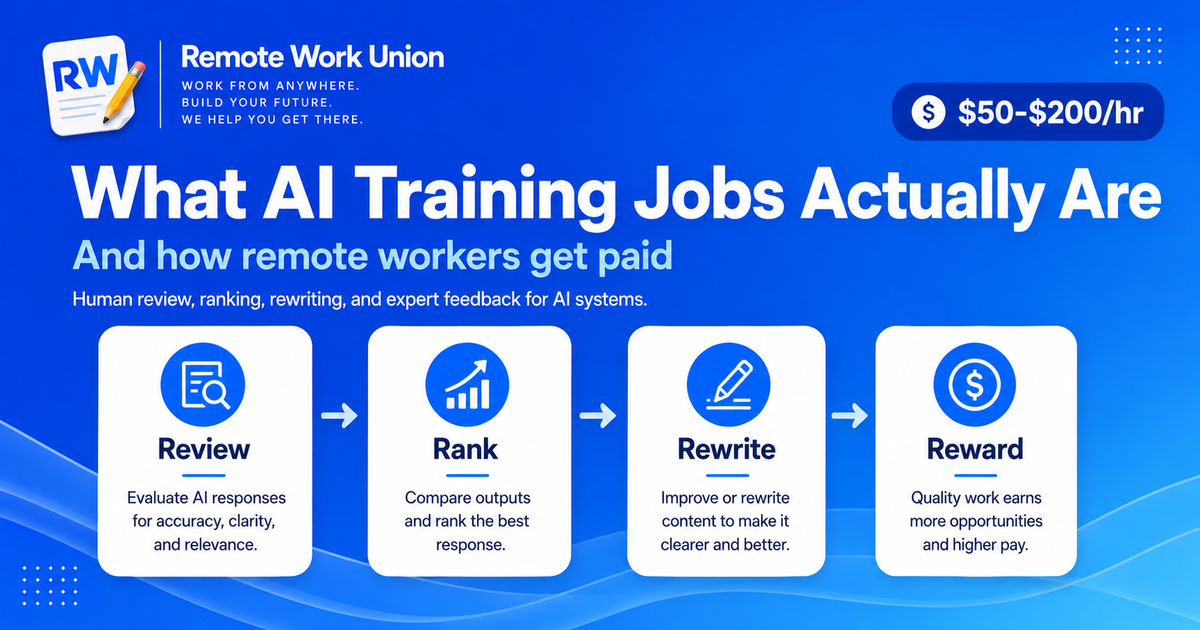
AI training jobs are one of the most misunderstood categories inside remote work. A lot of people see phrases like AI trainer, AI evaluator, AI research contributor, model reviewer, or expert rater and assume the job must be deeply technical. In most cases, that is not what the work is. The core of remote AI training work is usually human judgment. Companies building AI products need people who can read, compare, correct, improve, rank, rewrite, or evaluate model outputs. They need clear thinkers more than they need machine learning engineers.
That is why this category has grown into a serious lane for online jobs from home. Instead of fighting over the same customer support openings or generic low-pay listings, remote workers can use subject knowledge to qualify for higher-value project work. Writers can improve tone and clarity. Marketers can judge copy and audience fit. Lawyers can review legal reasoning. Finance professionals can spot weak analysis. Engineers can assess code or technical accuracy. In other words, AI training jobs turn real-world expertise into structured remote work.
What an AI Training Job Really Is
An AI training job usually sits somewhere between editing, quality assurance, research support, and evaluation. The work is often project-based rather than a traditional long-term salary role. A platform, vendor, research team, or company hires contributors to help improve model performance. Those contributors interact with tasks, not raw machine learning systems.
A task might ask you to compare two responses and explain which is better. Another might ask you to rewrite an answer so it becomes more accurate, safer, clearer, or more useful. Some projects ask for rankings. Some ask for fact-checking. Some ask for domain-specific feedback. Others ask you to generate strong example answers so the model can learn from better outputs.
This is the reason the term AI training can sound more technical than the actual work feels. You are usually not training a model by writing code. You are training it by providing signal. Your judgment becomes part of the feedback loop that helps the system improve.
Typical Tasks Remote Workers See
Although platforms package the work differently, most remote AI jobs fall into a few core task types. Writing projects involve drafting, rewriting, or improving model answers. Review projects focus on accuracy, clarity, tone, and usefulness. Research tasks involve fact-checking claims, comparing sources, or evaluating whether an answer leaves out something important. Ranking tasks ask you to compare multiple outputs and justify the strongest one. There are also specialized projects such as code review, financial reasoning review, legal analysis review, or education-focused evaluation.
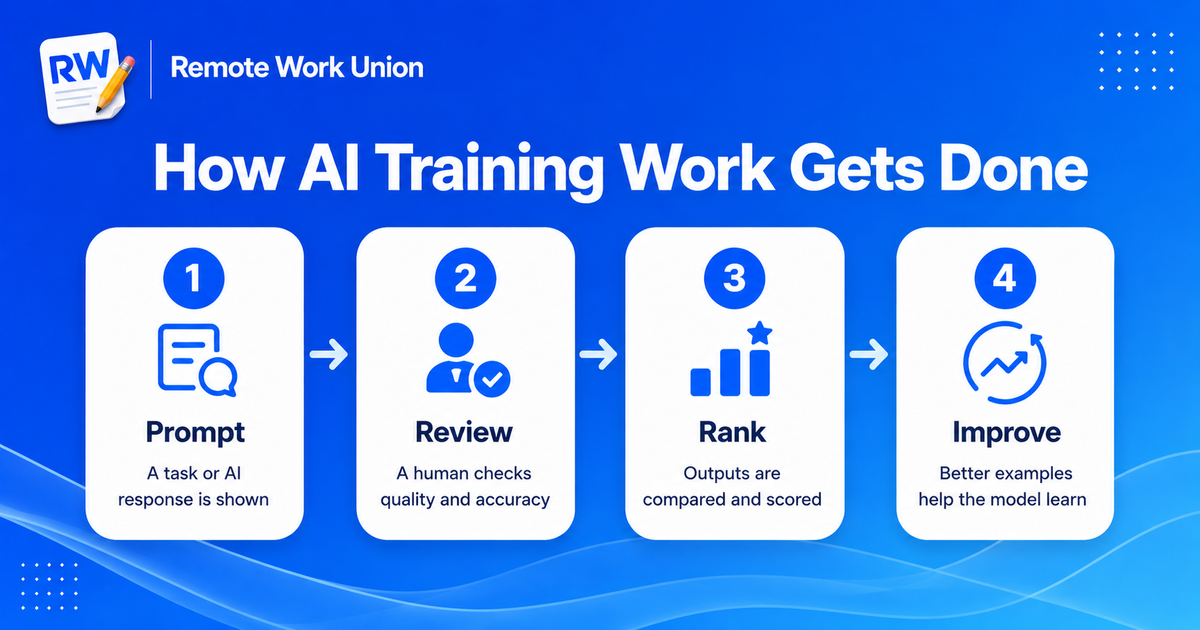
The common thread across all of these is structured decision-making. A task is shown. You assess it against instructions or standards. You give a clear answer, and often explain why. That combination of judgment plus explanation is what makes AI evaluation work valuable.
How Remote Workers Get Paid
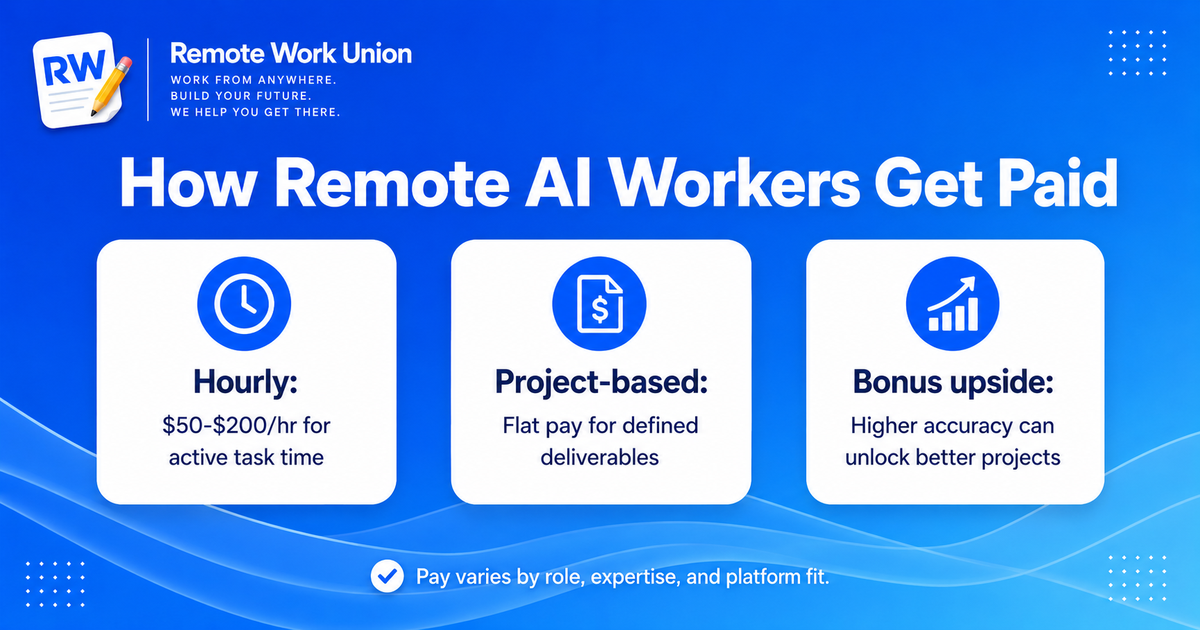
Remote workers get paid for AI training work in a few different ways. Some platforms show an hourly rate. Others pay by completed task, completed batch, or accepted project milestone. Some use a project rate that roughly converts into an hourly expectation if you work efficiently. In higher-skill roles, pay often reflects both expertise and assessment performance.
This is why the category is so attractive compared with many online jobs from home. A generic remote role may pay one flat rate because almost anyone can apply. A specialized remote AI job can justify a higher rate when the work requires stronger reasoning, proven writing skill, domain expertise, or test performance. That is where the "up to $50-$200/hr" language comes from. Not every task pays at the top end, but the ceiling can be materially higher than surveys, microtasks, and low-leverage gig work.
What Affects Pay Rates
Pay in AI training jobs is not random. A few factors usually shape the rate. First is difficulty. A general review task tends to pay less than a specialized finance, legal, engineering, or advanced writing task. Second is scarcity. If a platform has trouble finding reliable experts in a field, rates tend to rise. Third is proof of skill. Applicants who pass screening tests, submit strong samples, or show clear professional experience are often matched into better projects. Fourth is project urgency and quality standards. High-stakes work with tighter standards can command more.
It also matters whether the work is general or domain-specific. Someone evaluating basic prompt quality may be in one rate band. Someone reviewing spreadsheet reasoning, contract interpretation, medical-style explanations, or code quality may be in another. Remote work pay usually follows replaceability. The harder you are to replace, the better the rate can be.
What Companies Look For
The strongest applicants are not always the most technical. They are usually the most reliable and the clearest thinkers. Companies and platforms want contributors who follow instructions, communicate well, produce consistent work, and can explain their reasoning. Clear writing matters even when the project is not a writing project. If your judgment is good but your explanations are messy, your value drops.
Subject-matter expertise matters too. A marketing background can help with ad review, positioning, and brand-language tasks. A legal background can help with policy review or legal reasoning tasks. Finance professionals can contribute to spreadsheet logic and analytical evaluation. Engineers can review technical outputs. Teachers can assess explanations and curriculum-style content. Many remote AI jobs reward people who can bring a real discipline into the workflow.
Key insight: Do not present yourself as a generic remote worker. Present yourself as someone with expertise in a specific area that maps directly to AI evaluation tasks. The more specific your positioning, the easier it is to be matched into better-paying projects.
Where This Work Fits in a Remote Career
AI training jobs can work as a side income lane, a bridge between projects, or a core remote work category. Some people use them to earn flexible online income while freelancing or job hunting. Others use them as a main work-from-home focus because the work is asynchronous and skill-based. For people leaving low-paying gig work, AI training can be a strong upgrade because it rewards thought rather than just availability.
It is also useful as a broader career signal. If you repeatedly do strong evaluation, research, writing, or structured reasoning work, you build proof that you can operate in remote, process-driven environments. That can help with future remote jobs in operations, research, content, trust and safety, quality control, and knowledge work more broadly.
Conclusion
AI training jobs are not magic, and they are not all the same. But they are a real category of remote AI work where human expertise still matters. If you understand the task structure, know what affects pay, and can present your experience clearly, you give yourself a much better shot at finding stronger work from home opportunities.